Table of Contents >> Show >> Hide
If a chandelier, a synth toy, and a Raspberry Pi had a wonderfully weird art-school child, it would probably look a lot like The LED Roundsystem. At first glance, the project feels playful and almost disarmingly simple: glowing spherical forms suspended in space, shifting color in response to sound like they are eavesdropping on the room and gossiping in light. But spend a minute with it and the piece opens up into something much richer. It is sculpture, instrument, engineering experiment, and environmental remix all at once.
That combination is exactly why The LED Roundsystem still feels fresh. It does not rely on giant screens, overblown spectacle, or the usual “look, I added LEDs to a thing” energy. Instead, it turns humble materials into responsive objects with personality. The result is a work that makes people smile first and think second, which is often the smartest order for interactive art.
In a world full of shiny gadgets trying very hard to be futuristic, this project takes a more charming route. It says, in effect, “What if sound could bloom into color inside a floating handmade planet?” And honestly, that is a much better question than most consumer tech asks before breakfast.
What Is The LED Roundsystem?
The LED Roundsystem is an interactive light-and-sound artwork associated with artist and maker Gavin Morris. The project centers on globe-like hanging forms that illuminate, react to sound, and create a kind of visual music. Rather than presenting LEDs as hard-edged electronics, the installation softens them into sculptural objects. That matters. The technology is not hidden, exactly, but it is translated into something more human and more atmospheric.
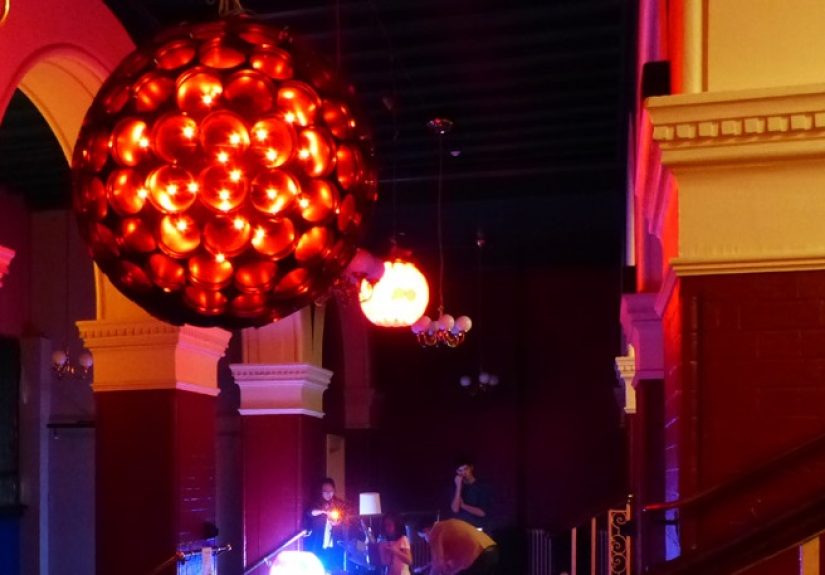
The piece works because it sits at the intersection of several appealing ideas: sound-reactive lighting, handmade object design, immersive installation, and upcycled construction. Those spheres are not factory-perfect luxury fixtures. They carry the delight of experimentation. They look like they were imagined by someone who enjoys both code and chaos, which is usually a promising sign.
At its core, the installation turns music and ambient audio into a shared experience. Instead of hearing a room and doing nothing about it, the sculpture answers back. It glows differently depending on pitch and intensity, transforming invisible vibrations into shifting visual language. For viewers, that means sound becomes spatial. It surrounds you. It hovers overhead. It behaves less like decoration and more like a participant.
Why The Project Feels So Memorable
There are plenty of reactive LED projects in the maker world, but not all of them linger in the imagination. Many are technically impressive yet emotionally flat. The LED Roundsystem does something harder: it creates mood. The shapes are soft, the light is diffused, and the behavior feels organic rather than mechanical. That combination makes the work approachable even for people who do not know a WS2812 from a waffle iron.
Another reason it sticks is that it embraces contrast. The materials are modest, but the effect is magical. The electronics are digital, but the result feels strangely natural. The logic is programmable, yet the experience seems improvised, almost alive. Good interactive design often lives in that tension between control and unpredictability.
And then there is the color. LED art can go wrong fast. Too much saturation and everything starts looking like a gaming keyboard trapped in a nightclub. Here, color is not just loud; it is expressive. When handled well, reactive lighting becomes emotional shorthand. High notes can sparkle. Bass can throb. Transitional tones can feel dreamy, eerie, playful, or theatrical. The installation uses color less as decoration and more as interpretation.
How The LED Roundsystem Works
1. The Light Engine: Addressable LEDs
One of the most important ingredients behind the project is the use of individually addressable RGB LEDs. That phrase sounds intimidating, but the idea is simple: each pixel can be controlled independently. Instead of switching an entire string of lights to one color, the system can tell each LED what to do. That allows the globes to display nuanced patterns, tonal shifts, and multi-color responses rather than acting like basic on-off fixtures.
This is what gives the installation its expressive power. Fine-grained light control makes the difference between “pretty lamp” and “responsive visual instrument.” With addressable LEDs, the sculpture can map different sounds to different colors, animate transitions, and behave more like a dynamic system than a static object.
2. The Sculpture: Diffusion Makes The Magic
Raw LEDs are bright, sharp, and a little rude. Left exposed, they shout. Diffusion teaches them manners. In The LED Roundsystem, the spherical forms soften and scatter the light, creating a richer glow that feels less like exposed circuitry and more like luminous sculpture. This matters aesthetically, but it also matters psychologically. Diffused light invites people in. It feels warmer, more tactile, and more atmospheric.
That design choice is one of the project’s smartest moves. A lot of makers focus on processors and code, then treat the physical shell as an afterthought. This work flips that habit. The housing is not packaging. It is part of the medium. The sphere becomes both diffuser and identity. It turns electronics into object theater.
3. The Brain: Sound Analysis And Control
For a project like this to feel musical, it has to do more than detect that sound exists. It has to analyze it in a meaningful way. Reactive light systems often separate audio into features such as volume, pitch range, or dominant frequency bands. That way, the visuals can respond differently to a soft vocal line, a snare hit, or a heavy bass pulse.
That is where the real fun begins. Instead of merely flashing on every beat like an overexcited appliance, a well-designed system can translate frequency into visual behavior. Higher sounds may produce one color family, lower tones another. Sudden peaks can trigger bursts or shifts. Sustained sounds can create hovering, slower transitions. It is less “light show as wallpaper” and more “light show as interpretation.”
4. The Hidden Engineering Reality
Of course, any beautiful LED installation is also a quiet argument with power distribution, wiring discipline, signal integrity, heat, and reliability. Large LED projects are not difficult because code is dramatic. They are difficult because electrons are picky little divas. A successful piece needs clean power, stable signaling, sensible physical layout, and a design that can survive real-world use.
That practical side is easy to overlook when watching the finished work, but it is one reason projects like this earn respect among makers. The audience sees glowing globes. The builder sees power rails, data lines, timing, protective components, and many opportunities for one tiny bad connection to ruin an otherwise magical evening.
Why Upcycled Materials Matter Here
One of the most compelling aspects of The LED Roundsystem is that it transforms ordinary materials into immersive art. That choice gives the work a distinct personality. Instead of polished industrial perfection, the project embraces reuse, experimentation, and handcrafted texture. The result feels inventive rather than expensive, and that distinction is important.
Upcycling does more than save material. It changes the visual language of technology. When reused cups and humble craft materials become glowing, responsive globes, the installation quietly challenges the assumption that advanced experiences need premium components or corporate budgets. It suggests that imagination, composition, and behavior matter at least as much as material cost.
There is also something deeply democratic about this approach. It tells artists, students, tinkerers, and DIY obsessives that they do not need a museum-sized grant to create compelling interactive work. They need a concept, a process, and a willingness to experiment until the weird thing becomes the good thing.
What The LED Roundsystem Says About Interactive Art
At its best, interactive art does not ask viewers to “use the interface.” It invites them to feel that the space itself is responsive. The LED Roundsystem achieves that by keeping the interaction intuitive. People understand sound. People understand glow. They do not need a tutorial to grasp that one is affecting the other.
This simplicity is a strength, not a limitation. Some interactive installations collapse under the weight of their own cleverness. They are technically advanced but experientially clumsy. The best works often use minimal cues to create immediate delight. That is exactly what happens here. Viewers recognize the cause-and-effect relationship quickly, then spend the rest of the time enjoying the poetic variations.
The installation also reflects a broader truth in media art: technology works best when it disappears into behavior. Nobody walks away saying, “Wow, what a nice data protocol.” They remember that the room seemed to listen. They remember that color felt musical. They remember that the objects overhead seemed to breathe with sound. That is the victory.
Lessons For Designers, Makers, And Artists
If you are a creator studying this piece, there are several lessons worth stealing politely.
First, form matters as much as function. The sculptural shell is not secondary. It is essential to the emotional effect.
Second, diffusion is not a technical footnote. It is often the difference between harsh output and beautiful light.
Third, interactivity should feel obvious, not overexplained. People should sense the system before they understand the system.
Fourth, limitations can improve the work. Using accessible materials can push a project toward originality instead of generic polish.
Fifth, reliability is part of aesthetics. If an installation glitches every few minutes, viewers stop seeing poetry and start seeing troubleshooting.
In other words, the brilliance of The LED Roundsystem is not just that it uses LEDs creatively. It is that it combines concept, behavior, material choice, and technical execution into a coherent experience. That is what makes it art instead of just illuminated hardware.
The Experience Of Standing Under The LED Roundsystem
To really understand The LED Roundsystem, you have to imagine encountering it in person rather than as a list of components. You walk into a room and notice a soft constellation overhead, a cluster of luminous globes suspended in space. They do not behave like standard lighting. They feel watchful in the gentlest possible way, as if the room has developed a nervous system made of color.
At first, the experience is visual. You notice the shape of the spheres, the softness of the glow, and the way the light seems to sit inside the objects instead of merely blasting outward. The installation has presence before it has action. It already changes the room. Corners feel less empty. Silence feels more expectant. Even stillness seems staged.
Then sound enters the equation, and the piece becomes something else entirely. A voice rises, and one part of the sculpture shifts. Music swells, and the colors reorganize themselves with a strange confidence. A beat lands, and the installation answers, not like a machine following orders, but like a partner improvising in the same language. That is the real hook. The work does not just display light; it performs listening.
The emotional effect can be surprisingly layered. There is delight, obviously. Watching sound become color scratches a very old human itch. It feels a little like seeing the invisible caught in the act. But there is also curiosity. Viewers start asking themselves small, instinctive questions. Did that red bloom come from the bass? Did the high vocal line trigger that cooler tone? Is the system reacting to rhythm, pitch, or both? Suddenly the audience is participating not just with their senses, but with their attention.
There is also a social dimension to the experience. Installations like this change the way people occupy a room together. They encourage noise, experimentation, and shared discovery. Someone claps. Someone laughs. Someone tries a louder sound just to see what happens. The work gives permission for playful behavior without needing to instruct anyone. It becomes a conversation starter, an atmosphere generator, and a low-key collaboration between strangers.
What makes the experience linger, though, is not novelty alone. It is the mood. The soft surfaces and responsive color create something more intimate than a typical tech demo. Instead of feeling like a product presentation, it feels like stepping briefly into a handmade universe where light has ears. You leave remembering the sensation of being inside an artwork that seemed to notice you. And that, for any installation, is a pretty remarkable trick.
Conclusion
The LED Roundsystem is a strong example of what happens when interactive technology is guided by artistic restraint instead of technical showing off. It uses responsive lighting, sound analysis, and clever material choices to create an experience that is immersive without being overwhelming and playful without becoming trivial.
More importantly, it shows that excellent digital art does not begin with expensive hardware. It begins with a clear idea: turn sound into living color, and do it in a form people want to stand beneath. Everything else follows from that decision. The LEDs matter. The processors matter. The wiring absolutely matters. But they matter because they serve the atmosphere, not because they demand applause for existing.
That is why the project still feels relevant. In an era packed with louder, bigger, and more disposable visual effects, The LED Roundsystem offers something better: a responsive environment with character. It proves that light can be sculptural, electronics can be warm, and recycled materials can help create genuine wonder. Not bad for a bunch of cups, some code, and a beautifully stubborn idea.