Table of Contents >> Show >> Hide
- Why This Idea Turned Heads So Fast
- How Liquid-Filled Filament Actually Works
- Why This Is More Than Just “Another Flexible Material”
- What This Could Change for Makers and Small Teams
- The Caveats Are Not Small, and That Is Fine
- The Bigger Trend: 3D Printing Is Escaping the Plastic Box
- What Hobbyists Should Watch Next
- Conclusion
- Experience Notes: What This Kind of Breakthrough Feels Like in the Real World
If you told a room full of makers five years ago that a desktop 3D printer might one day “print filament” that is secretly carrying liquid inside it, you would have gotten at least three raised eyebrows, two nervous laughs, and one guy in the back muttering, “That sounds like a terrible idea.” And yet here we are. In one of the more delightfully strange developments in desktop fabrication, liquid-filled filament has entered the chat and kicked the old boundaries of FDM-style printing right in the nozzle.
That matters because 3D printing has always been a little bit of a material compromise. Standard desktop machines are great at pushing melted thermoplastics into useful shapes, but the minute you want something truly soft, rubbery, heat-resistant, or chemically resilient, things get messy. TPU can flex, sure, but it is still not the same thing as real silicone. Resin can mimic softness, but the workflow, cost, and handling requirements are a different beast. So when a liquid-core filament system showed up promising real silicone printing on a desktop platform, it did not feel like a small tweak. It felt like someone had quietly opened a side door into a new category.
Why This Idea Turned Heads So Fast
The reason this concept grabbed attention is simple: it breaks the mental model most people have for filament printing. Traditional filament is solid. You heat it, soften it, and lay it down. End of story. Liquid-filled filament flips that story on its head. The outer “filament” acts more like a delivery shell, while the actual printable material lives inside. Instead of merely melting plastic, the system feeds liquid components to a mixing nozzle, where the real material is deposited and cured.
That sounds less like classic FDM and more like a hybrid between material extrusion, chemical dispensing, and controlled wizardry. The charm of the idea is that it appears to borrow the familiar motion system, slicing logic, and toolpath behavior of desktop printers, while sneaking in a completely different material process under the hood. It is a bit like finding out your toaster has been moonlighting as a chemistry lab.
How Liquid-Filled Filament Actually Works
The Outer Shell Is Not the Star of the Show
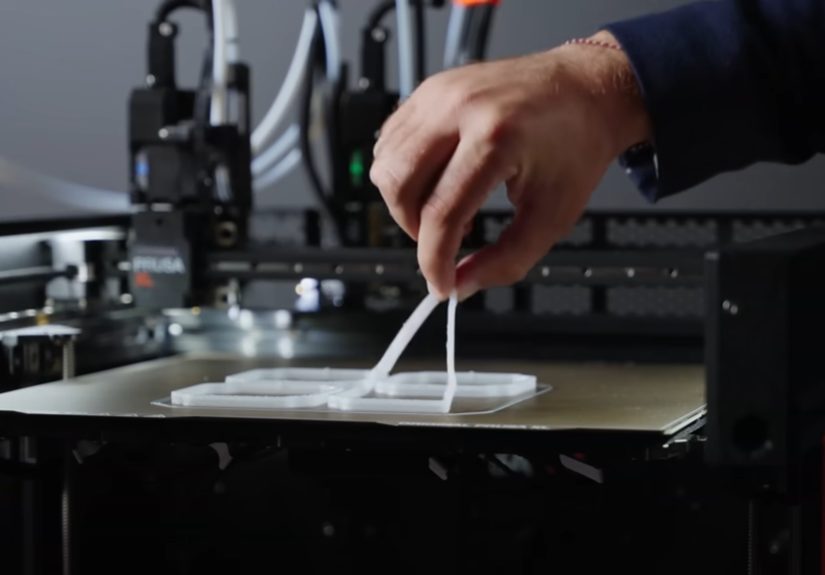
In the system that sparked so much conversation, the printable substance is not a standard thermoplastic at all. The outer sheath carries liquid material through the machine, and once it reaches the extrusion system, that shell is stripped away so the liquid can be mixed and pushed through the nozzle. In the case of silicone printing, this is especially important because the material behaves nothing like PLA, PETG, or ABS. It is not there to be melted and cooled. It is there to be combined, dispensed, and cured into a final form.
That distinction is huge. Conventional filament printing depends on temperature doing most of the work. Liquid-filled filament depends on controlled delivery and material chemistry. Suddenly, the printer is not just managing heat and motion. It is managing timing, ratios, extrusion consistency, and curing behavior. The machine is still drawing a part layer by layer, but the logic behind each layer is much closer to process engineering than hobbyist plastic squeezing.
Why Silicone Is the Perfect “Wait, What?” Material
Silicone is one of those materials that product designers love and desktop printers traditionally side-eye. It is soft, durable, elastic, heat resistant, and useful for everything from gaskets and grips to medical-adjacent prototypes and wearables. It also refuses to behave like a normal filament. That is why so many makers have historically taken the scenic route: print a mold, cast silicone into it, wait, demold, and pretend the extra steps were all part of the fun.
A liquid-core delivery system changes that equation. Instead of using the printer to make the mold for silicone, the printer gets much closer to producing the silicone part itself. That is a major shift in workflow. It reduces setup time, shortens iteration cycles, and creates design freedom for parts that are awkward to mold or expensive to prototype through traditional means.
Why This Is More Than Just “Another Flexible Material”
Whenever a strange new printing material appears, the first question is usually, “Couldn’t I just use TPU?” That is a fair question, but it misses the point. TPU is excellent for many flexible applications. It offers elasticity, impact resistance, and useful durability, which is why it has become the go-to flexible filament on many desktop machines. But silicone plays in a different league. It can be softer, more temperature-resistant, and better suited to applications where rubber-like feel, chemical resilience, or long-term flexibility matter more than simple bendability.
In practical terms, TPU is what you use when you want a flexible phone grip, bumper, or protective sleeve. Silicone is what you start craving when you need a compliant seal, a soft-touch interface, a heat-resistant contact surface, or a part that needs to feel less like plastic pretending to be flexible and more like the real thing. For engineers, inventors, and small product teams, that difference is not cosmetic. It can determine whether a prototype merely looks right or actually behaves right.
What This Could Change for Makers and Small Teams
The most exciting part of liquid-filled filament is not the novelty. It is the possibility that desktop machines may finally begin handling materials that used to live behind industrial paywalls. That could be a big deal for startups, design shops, lab teams, educators, and obsessive garage tinkerers who always seem to be one weird material away from building something brilliant.
Imagine printing a rigid housing and then adding a silicone gasket directly onto it. Imagine producing custom soft grips without mold-making. Imagine iterating on seals, bumpers, cushions, flexible feet, protective pads, or soft robotic interfaces without turning every revision into a mini manufacturing project. Multi-tool systems become especially interesting here, because they suggest a future where one machine can place structural plastic and compliant silicone in the same build strategy.
That is where this story starts feeling bigger than a quirky headline. It points toward desktop fabrication becoming genuinely multi-material in a more useful sense. Not just “this print has blue and orange plastic,” but “this product has rigid zones, soft zones, bonded interfaces, and real functional variation.” That is a much more meaningful version of progress.
The Caveats Are Not Small, and That Is Fine
No, This Does Not Magically Solve Everything
As exciting as the concept is, it comes with practical questions. What happens to the stripped outer sheath after the liquid core is extracted? How much waste does the delivery format create? How consistent is the mixing ratio over long prints? How reliable is curing across detailed geometry? What cleaning and maintenance does the system require after a failed print, which is a sentence every 3D printing enthusiast reads with a tiny shiver?
Then there is speed. A material that needs time to cure introduces different constraints than one that simply cools. Bed adhesion, support strategy, part geometry, environmental conditions, and post-print handling all become more nuanced. The machine may still look like a desktop printer, but the process begins to resemble a specialized manufacturing workflow. That is not a flaw. It is just the price of entering a richer material world.
The Economics Still Need Watching
New printing methods often arrive wearing the shiny shoes of possibility and the heavy backpack of cost. Toolheads, consumables, maintenance, waste handling, and learning curve all affect adoption. A clever system can still stumble if the consumables are too expensive, the setup is too fussy, or the workflow only makes sense for edge cases. Makers are adventurous, but they also know when an innovation feels more like a science-fair marvel than a daily driver.
That said, even early-stage economics do not have to be perfect for the technology to matter. Desktop 3D printing itself began as a glorious mess of compromises, hacks, and “good enough” results. What changed the industry was not immediate perfection. It was the realization that the category had room to grow. Liquid-filled filament feels like one of those moments.
The Bigger Trend: 3D Printing Is Escaping the Plastic Box
This development also fits a larger pattern in additive manufacturing: the steady migration away from simple solid thermoplastics toward process-specific materials and hybrid workflows. Researchers and companies have been pushing liquid and semi-liquid printing approaches for hydrogels, conductive materials, elastomers, and other specialty substances for years. What makes the current moment exciting is not that liquid-material printing exists. It is that the desktop ecosystem seems increasingly interested in making those ideas usable outside of research labs and industrial showrooms.
In other words, the real story is not “Look at this weird filament.” The real story is that desktop printers are evolving from plastic deposition tools into general-purpose material platforms. That is a very different future. Once users accept that the motion system can drive more than hot plastic, the door opens to adhesives, sealants, soft compounds, conductive fills, food-safe experimental materials, and other niche formulations that were previously awkward or impossible to handle on familiar hardware.
No, your printer is probably not becoming a universal materials genie tomorrow. But the direction is clear. The machine on the bench is slowly becoming less of a filament appliance and more of a programmable deposition robot. That is a much bigger idea than it first appears.
What Hobbyists Should Watch Next
If liquid-filled filament keeps gaining traction, the next chapter will not be about shock value. It will be about refinement. Users will want cleaner handling, less waste, better slicer integration, broader material libraries, and easier switching between rigid and soft toolpaths. They will want predictable curing, reliable bonding, and part quality that holds up beyond demo-day excitement.
The winners in this space will probably be the companies that treat the whole workflow seriously. The material alone is not enough. The printer, toolhead, software, calibration logic, maintenance path, and user documentation all have to work together. This is one of those areas where clever engineering must be matched by boring reliability, and that sentence is meant as the highest compliment.
Still, even at this early stage, liquid-filled filament deserves attention because it expands the imagination of what desktop fabrication can be. And frankly, imagination has always been one of the best fuels in the maker world. Sometimes a weird idea is not just weird. Sometimes it is the first sign that the old category labels are about to stop making sense.
Conclusion
Liquid-filled filament may sound like a joke someone made after inhaling too much ABS nostalgia, but it points to a serious and exciting shift in 3D printing. By turning the filament path into a delivery mechanism for reactive or nontraditional materials, developers are opening desktop machines to functions that plain thermoplastics could never fully cover. Silicone is the headliner because it highlights the gap so clearly: makers have wanted this material for years, but until now the workflow rarely felt desktop-friendly.
There are still real questions around waste, consistency, cost, maintenance, and long-term usability. That is normal. The important thing is that the concept exists, works, and suggests a path toward more capable multi-material machines. If the past decade of desktop 3D printing was about making plastic printing faster, cleaner, and easier, the next decade may be about making printers less loyal to plastic in the first place. And honestly, that was not on our bingo card either.
Experience Notes: What This Kind of Breakthrough Feels Like in the Real World
For anyone who has spent time around desktop 3D printing, the emotional arc of a new material breakthrough is almost comically familiar. First comes disbelief. Then curiosity. Then the dangerous sentence: “I bet I could make that work.” Liquid-filled filament taps directly into that cycle. It feels strange at first because it challenges years of muscle memory. Most hobbyists understand the rhythm of loading a spool, heating a nozzle, purging plastic, and dialing in flow. This approach asks users to keep the familiar choreography while accepting that the material logic has completely changed.
That creates a very specific kind of excitement. It is the excitement of seeing a machine you thought you understood suddenly reveal a new trick. People who have spent years wrestling with TPU, trying to fake soft-touch parts with lattice infill, or printing molds just to cast a few silicone prototypes will immediately see the appeal. The experience is not just “cool new thing.” It is relief. Relief that a frustrating workaround might finally have a direct path.
There is also a psychological shift that comes with it. Once you realize the printer can handle something other than heat-softened plastic, your brain starts sprinting ahead. You stop asking, “Can it print this model?” and start asking, “What materials could ride through this motion system next?” That is when the technology begins to feel bigger than the demo. The machine starts to look less like a consumer gadget and more like a platform with weird, wonderful expansion slots.
Of course, the lived experience will still include all the classic maker rituals: cautious optimism, overconfidence, test squares, failed first layers, dramatic declarations that the machine is cursed, and eventual success that somehow erases the memory of the last four hours. That part never changes. But the difference here is that the payoff could be more meaningful. You are not just chasing a cleaner Benchy. You are chasing materials that can unlock entirely different product ideas.
For small businesses and independent designers, that experience could be even more powerful. A direct-to-silicone workflow means faster iteration on parts that need softness, grip, compliance, or sealing performance. It means fewer trips through the mold-making loop for early prototypes. It means being able to hold a part in your hand and evaluate not just its geometry, but its behavior. That kind of feedback is gold during development, because products are not judged only by shape. They are judged by feel, flex, friction, compression, and trust.
And maybe that is the most exciting experience of all: the sense that desktop printing is growing up without losing its weirdness. Liquid-filled filament is undeniably odd, slightly hilarious, and exactly the kind of idea that makes the maker community lean in. But beneath the novelty is something practical and important. It hints at a future where experimentation gets easier, not harder, and where the distance between prototype and functional part keeps shrinking. In the workshop, those are the moments you remember. Not because they are tidy, but because they change what you believe your tools can do.