Table of Contents >> Show >> Hide
- How We Picked the Best Solar Chargers for Phones
- The Quick List
- The 6 Best Solar Chargers in 2024
- 1) BigBlue SolarPowa 28 Best Overall Solar Charger for Your Phone
- 2) Goal Zero Nomad 5 Best Ultralight Solar Charger
- 3) BioLite SolarPanel 10+ Best Solar Charger with a Built-In Battery
- 4) Jackery SolarSaga 40W Mini Best for Faster Direct Phone Charging
- 5) Anker SOLIX PS30 Best Value USB-C Solar Panel
- 6) BLAVOR 10,000mAh Solar Power Bank Best Emergency Solar Backup
- What to Look for in a Solar Charger for Your Phone
- Real-World Experience: What Using Solar Chargers Actually Feels Like
- Final Verdict
If your phone dies in the wild, civilization suddenly feels very far away. One minute you are checking a trail map or texting “be there in 20,” and the next minute your screen goes black and you become a dramatic Victorian character abandoned by modern technology. That is exactly why a good solar charger matters.
The trick is that not every solar charger is good at the same job. Some are lightweight panels made for direct charging in full sun. Some work best when paired with a power bank. Others are really battery packs with a tiny solar panel attached, which is useful in emergencies but not exactly the same as carrying your own miniature power plant. In other words, shopping for the best solar charger for your phone can get weird fast.
This guide cuts through the marketing glow. Based on product testing trends, official specs, and real-world usability, these are the six solar chargers that stood out in 2024 for keeping your phone alive when outlets are nowhere to be found. Some are better for backpacking, some are better for car camping, and one is best described as “the glove-box hero you hope you never need.”
How We Picked the Best Solar Chargers for Phones
For this list, I focused on what matters most for phone charging rather than giant off-grid setups. That means usable wattage, realistic portability, USB output options, durability, and whether the charger makes sense for the way people actually use phones outdoors. A huge panel that can power half a campsite is impressive, but if it is heavy, awkward, and overkill for topping off an iPhone or Galaxy, it does not belong at the top of a phone-focused guide.
I also weighed an important real-world lesson: solar chargers work best in direct sun, and a panel’s advertised wattage reflects ideal conditions, not “partly cloudy afternoon while you wonder why your battery percentage is moving slower than a sloth in flip-flops.” That is why the winners below balance power, portability, and common sense.
The Quick List
- Best Overall: BigBlue SolarPowa 28
- Best Ultralight Pick: Goal Zero Nomad 5
- Best with Built-In Battery: BioLite SolarPanel 10+
- Best for Faster Direct Charging: Jackery SolarSaga 40W Mini
- Best Value USB-C Panel: Anker SOLIX PS30
- Best Emergency Solar Power Bank: BLAVOR 10,000mAh Solar Power Bank
The 6 Best Solar Chargers in 2024
1) BigBlue SolarPowa 28 Best Overall Solar Charger for Your Phone
If you want the easiest recommendation on this page, this is it. The BigBlue SolarPowa 28 hits the sweet spot between size, output, and portability. It folds down small enough for a backpack, opens into a larger panel surface, and gives you enough power to charge a phone more confidently than the ultra-compact options.
That balance is exactly why it rose to the top in multiple review roundups. It earned “best overall” recognition in prominent 2024-style buying guides for good reason: it is strong enough to be genuinely useful without turning your daypack into a physics experiment. One set of testing even found it could bring a drained iPhone XR to 27 percent in 30 minutes of full sun, which is the kind of real-world stat that gets people’s attention fast.
The hardware story is solid too. This model is rated at 28 watts, folds into a compact four-panel design, and offers multiple charging ports for more than one device. That means you can top off a phone, camera, or small power bank without starting a family argument over whose battery emergency counts most.
Why it stands out: It is the most balanced pick for most people. Enough power, enough portability, and very little nonsense.
Best for: Hikers, campers, festival-goers, road-trippers, and anyone who wants one dependable charger instead of a complicated system.
Watch out for: It does not store power on its own, so you will still want a separate power bank for nighttime charging.
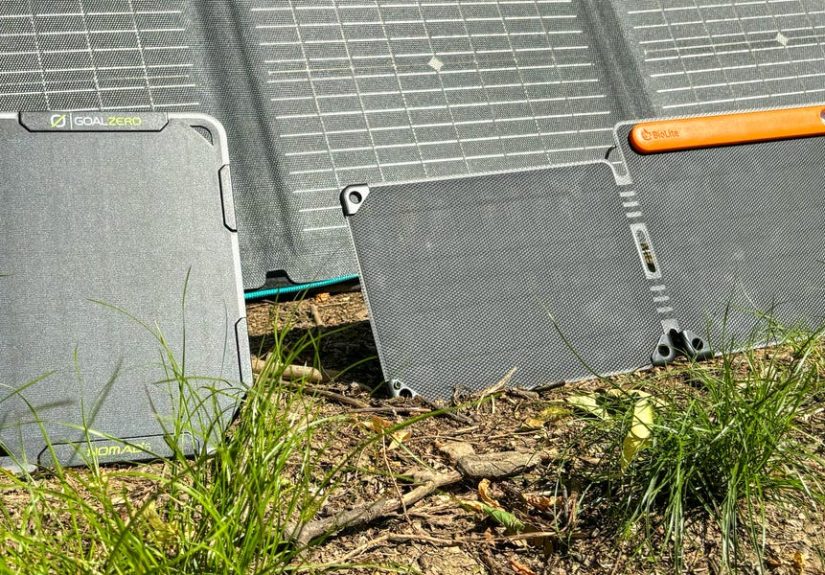
2) Goal Zero Nomad 5 Best Ultralight Solar Charger
The Goal Zero Nomad 5 is tiny, simple, and refreshingly honest about what it is. It is not trying to be a full campsite energy center. It is a small 5-watt solar charger designed for lightweight adventures and backup charging in good conditions.
That modesty is part of the charm. At just 12.7 ounces, the Nomad 5 is the kind of panel you can toss into a pack without feeling like you packed a folding cafeteria tray. It also has a built-in kickstand and a rugged design, which makes setup easier than the usual “lean it against a rock and hope the wind behaves” method.
For minimalist trips, this is a smart pick. It is especially good for topping up a small power bank or slowly feeding smaller USB devices. Goal Zero itself makes a strong case for pairing it with a battery pack rather than relying on direct phone charging alone, and that is good advice. A 5-watt panel can absolutely help, but it is more of a steady sip than a caffeinated chug.
Why it stands out: Super packable, durable, and easy to position.
Best for: Ultralight hikers, emergency kits, day hikes, and minimalist travelers.
Watch out for: Five watts is five watts. Great for portability, less great if you expect speed.
3) BioLite SolarPanel 10+ Best Solar Charger with a Built-In Battery
The BioLite SolarPanel 10+ solves one of the biggest annoyances of solar charging: the sun keeps office hours, but your phone does not. This panel includes a built-in 3,200mAh battery, so it can store some of the day’s harvest for later. That makes it more flexible than panel-only options when the light changes or you want power after sunset.
BioLite also leans into usability. The company’s “Optimal Sun System” includes an integrated sundial and kickstand that help you angle the panel correctly. That sounds a little nerdy until you remember that poor alignment can cost a meaningful chunk of performance. Suddenly the sundial stops sounding gimmicky and starts sounding like the solar version of “read the map before you hike off a cliff.”
At 10 watts and about 1.2 pounds, it is still fairly portable, but it gives you more flexibility than the tiniest panels. For someone who wants a cleaner all-in-one option for phone charging, this is one of the most appealing designs on the market.
Why it stands out: The integrated battery gives it practical day-to-night usefulness.
Best for: Weekend camping, travel, and users who want a simpler setup with less cable drama.
Watch out for: The battery is helpful, but it is not huge. Think “useful reserve,” not “weekend power empire.”
4) Jackery SolarSaga 40W Mini Best for Faster Direct Phone Charging
If you want something more powerful without jumping to a giant power-station panel, the Jackery SolarSaga 40W Mini is a very compelling middle ground. It is still portable enough for outdoor use, but it offers more headroom for direct charging than the smaller minimalist panels.
Jackery positions it as a compact outdoor-friendly panel with dual USB-A and USB-C support, and that combination matters. USB-C makes life easier for modern phones, while the extra power rating gives this panel a better shot at charging devices at a useful pace in real sun. Jackery also highlights a 23 percent solar conversion efficiency claim and a relatively lightweight design for its class.
This is the pick for people who want a phone-focused solar charger that feels less like emergency gear and more like a serious travel companion. It is especially well suited to car camping, basecamp setups, or any trip where you want more speed than a 5W or 10W panel can usually offer.
Why it stands out: Solid mix of output, modern ports, and portability.
Best for: Campers, van travelers, and anyone who wants faster direct charging from the sun.
Watch out for: It is more capable, but also bulkier than ultra-light options.
5) Anker SOLIX PS30 Best Value USB-C Solar Panel
Anker knows charging gear, and the SOLIX PS30 feels like a brand that understands what people actually carry in their pockets now. This 30W panel includes both USB-C and USB-A outputs, folds down neatly, and is built specifically for low-power devices like phones and tablets.
That USB-C detail is a bigger deal than it sounds. Plenty of older solar chargers still lean too hard on USB-A, which is fine until you remember your entire bag has quietly become a USB-C democracy. The PS30 embraces the present, and it does it in a weather-resistant package with IP65 protection.
At 2.4 pounds, it is not featherweight, but it is still portable enough for camping and travel. For shoppers who want a modern, no-fuss panel from a major charging brand, this one makes a strong case as a value-oriented pick that still feels current.
Why it stands out: Modern ports, practical size, and a reassuringly straightforward design.
Best for: Travelers who want USB-C convenience and a familiar brand ecosystem.
Watch out for: It is best for phones and tablets, not for bigger off-grid ambitions.
6) BLAVOR 10,000mAh Solar Power Bank Best Emergency Solar Backup
Let’s be very clear about what this product is and is not. The BLAVOR 10,000mAh Solar Power Bank is not the best choice if your plan is to fully rely on the sun every day to recharge your phone from empty. Tiny solar surfaces on power banks simply are not magic. In fact, small built-in solar panels often need a lot of direct sunlight and can take a very long time to refill the battery.
What BLAVOR does offer is something different: a normal-sized portable power bank with bonus solar capability. That makes it useful as an emergency layer, not a primary solar workstation. You get a 10,000mAh battery, USB connectivity, wireless charging, and extra survival-ish touches like a flashlight. It is the kind of thing you toss into a day bag, glove box, or emergency kit and feel smarter for doing so.
For that reason, it earns a spot on this list. It is not the strongest “solar charger” in pure panel terms, but it is one of the more practical solar-flavored power products for everyday people who mostly want backup power with a sunlight option attached.
Why it stands out: Compact, practical, and more realistic for emergency backup than for full-time solar dependence.
Best for: Emergency kits, commuting, travel bags, and casual outdoor use.
Watch out for: Use the solar panel as a backup trickle source, not your main recharge plan.
What to Look for in a Solar Charger for Your Phone
Wattage Matters More Than Marketing
A higher watt rating generally means faster charging potential, at least in ideal sunlight. For a single phone, around 7 watts is the bare minimum worth considering, while 15 watts or more usually feels more practical. Once you move into the 25W to 40W range, charging becomes much more comfortable for phones and small battery packs.
Panel-Only vs. Integrated Battery
Panel-only chargers can be excellent, but they work best when paired with a separate power bank. That setup lets you collect energy during the day and use it later. Integrated-battery models are more convenient, though usually with smaller storage. Tiny solar power banks with mini panels are best seen as emergency tools, not miracle workers.
Ports and Compatibility
USB-C is no longer a luxury feature; it is a sanity feature. If you have a newer phone, tablet, earbuds, or power bank, USB-C support will make your life easier. USB-A still matters, but it should not be your only option unless you are buying a very small or very inexpensive charger.
Weight and Packability
If you are backpacking, every ounce matters. If you are car camping, it matters less. This sounds obvious, yet many people buy a solar charger as if they are preparing for Everest and then only use it at a picnic table three feet from a cooler. Match the charger to the trip.
Weather Resistance
IP ratings are not just alphabet soup for gear nerds. They matter if your panel may be exposed to drizzle, splashes, dust, or rough handling. Outdoor electronics should not behave like tissue paper in a surprise weather shift.
Real-World Experience: What Using Solar Chargers Actually Feels Like
Here is the honest part nobody puts in giant bold letters on the box: using a solar charger for your phone is less like plugging into a wall outlet and more like negotiating with nature. When it works well, it feels amazing. You set a panel in the sun, angle it correctly, watch your phone begin to charge, and suddenly you feel like the cleverest person in camp. You did not need a gas generator, you did not need to ration your battery like a squirrel hoarding acorns, and you definitely did not need to hover near the one sketchy campground outlet next to the bathroom sink.
But solar charging also teaches patience. Clouds matter. Tree cover matters. Dust on the panel matters. The exact angle matters more than most people expect. A charger that feels fantastic at noon in a bright open field can feel oddly dramatic at 4 p.m. near a shady trail. That is why experienced users learn to treat solar as part of a system. A quality panel collects energy when conditions are good, while a power bank stores that energy for when conditions are not. That combination is where solar charging starts to feel truly useful instead of just environmentally adorable.
In real trips, the best strategy is simple: start fully charged, carry a power bank, and use solar to extend your runtime rather than rescue you from total battery chaos. That is one reason panels like the BigBlue, Jackery, and Anker make so much sense. They give you enough output to make the most of good sunlight. And that is why small integrated-battery models or solar power banks also have value. They smooth out the experience when the weather changes or you are charging later in the day.
Another thing you notice quickly is that different trips change what “best” means. On a backpacking trip, a tiny Goal Zero panel can feel brilliant because it disappears into your kit. On a car-camping weekend, that same panel may feel a little underpowered, while a 30W to 40W option suddenly feels like the smart choice. At a music festival, a solar power bank with a flashlight might be more practical than the technically superior fold-out panel you forgot to position properly because you were busy hunting tacos.
And yes, there is also a weird emotional bonus to solar chargers. They make you more aware of energy. You start noticing where the sun moves, where the shade falls, and how much power your phone really needs. You stop wasting battery on things you do not care about. You dim the screen, close fifteen background apps, and suddenly understand that your phone’s real enemy is not low battery but your own chaotic behavior.
That is probably the biggest takeaway from spending time with solar chargers in 2024: the best one is not necessarily the biggest, the most expensive, or the one with the most dramatic ad copy. It is the one that fits how you travel, how much you carry, and how patient you are willing to be when the sun decides to play hard to get.
Final Verdict
If you want the best all-around solar charger for your phone in 2024, go with the BigBlue SolarPowa 28. It delivers the best mix of usable power, portability, and real-world flexibility for most people.
If you want a tiny backup panel, choose the Goal Zero Nomad 5. If you want built-in battery storage, the BioLite SolarPanel 10+ is the smartest pick. If you want more direct charging speed, the Jackery SolarSaga 40W Mini is the stronger move. If modern USB-C convenience is your top priority, the Anker SOLIX PS30 deserves a long look. And if you mostly want an emergency-ready battery bank with bonus solar functionality, the BLAVOR 10,000mAh Solar Power Bank is the one to keep in your bag.
In short, the best solar charger is the one that matches your trip. Buy for the way you actually travel, not the fantasy version of yourself who apparently spends every weekend surviving elegantly in the desert with a titanium mug and perfect signal strength.
Note: Specs, model availability, and retail pricing can change over time, so it is smart to verify details before publishing or buying.