Table of Contents >> Show >> Hide
- Why Cleaning and Disinfecting a Toilet Are Not the Same Thing
- What You Need Before You Start
- How to Clean and Disinfect Your Toilet Step by Step
- How Often Should You Clean and Disinfect Your Toilet?
- How to Remove Common Toilet Problems
- Common Mistakes to Avoid
- Expert Tips for Keeping a Toilet Cleaner Between Deep Cleans
- The Bottom Line
- Real-Life Experiences and Lessons From Cleaning Toilets the Right Way
Let’s be honest: toilet cleaning is nobody’s idea of a glamorous Saturday. No one has ever posted, “Just deep-cleaned the toilet, feeling radiant,” and gotten a standing ovation. Still, if you want a bathroom that looks better, smells fresher, and feels less like a tiny germ convention, knowing how to clean and disinfect your toilet the right way matters.
The good news is that the job is a lot less awful when you stop winging it. According to cleaning experts and public health guidance, the trick is simple: clean first, then disinfect. In other words, remove the grime before you try to kill germs. That one-two punch is what turns a quick wipe into a truly sanitary result.
This guide breaks down exactly how to clean and disinfect your toilet, what supplies work best, how often to do it, and which mistakes make the process slower, stinkier, or strangely dramatic. There is no need for a chemistry degree, a hazmat suit, or a pep talk from your ancestors. Just a few solid tools, a little patience, and maybe an open window.
Why Cleaning and Disinfecting a Toilet Are Not the Same Thing
One of the biggest cleaning myths is that “clean” and “disinfected” mean the same thing. They do not. A toilet can look spotless and still have germs hanging around like they pay rent.
Cleaning removes dirt, residue, and a lot of germs
When you clean a toilet, you are physically removing visible mess, mineral deposits, body oils, and organic residue. Toilet bowl cleaner, soap-based cleaners, and scrubbing tools do much of this heavy lifting. Cleaning improves appearance and removes much of what allows germs to stick around in the first place.
Disinfecting kills germs on the surface
Disinfecting comes after cleaning. A disinfectant is designed to kill or inactivate germs on hard, nonporous surfaces, but only when used correctly. That means using the right product, applying enough of it, and letting it sit for the full contact time listed on the label. Translation: spray-and-immediately-wipe is often just expensive optimism.
For most homes, regular cleaning is enough most of the time. But disinfecting becomes especially important when someone in the household is sick, when a bathroom is heavily used, or when you are dealing with high-touch areas such as the toilet handle, seat, lid, and nearby faucet.
What You Need Before You Start
You do not need a cleaning cart worthy of a luxury hotel. A few practical supplies will do the job well.
Basic toilet-cleaning supplies
- Rubber or reusable cleaning gloves
- Toilet bowl cleaner or disinfecting toilet cleaner
- EPA-registered disinfectant spray or wipes for exterior surfaces
- Toilet brush
- Microfiber cloths or disposable paper towels
- An old toothbrush or detail brush for hinges and tight spots
- Optional: white vinegar for mineral buildup
- Optional: a pumice stone made for toilet stains on porcelain bowls only
Safety matters more than your cleaning playlist
Before you start, turn on the bathroom fan or open a window. Wear gloves, especially if you are using bleach or a disinfectant. And never mix bleach with ammonia, vinegar, acids, or other cleaners. That is not “extra strength.” That is “please call Poison Control” energy.
How to Clean and Disinfect Your Toilet Step by Step
This is the easiest sequence because it gives the bowl cleaner time to work while you clean the outside of the toilet.
Step 1: Prep the bathroom
Remove rugs, trash cans, magazines, and anything else sitting too close to the toilet. You are about to clean; you do not need your bath mat catching overspray like an innocent bystander. Ventilate the room, put on gloves, and keep your products nearby.
Step 2: Start with the toilet bowl
Lift the seat and apply toilet bowl cleaner around the inside rim so it runs down the sides of the bowl. Make sure to target the area under the rim, where grime and bacteria love to gather. Let the cleaner sit according to the label instructions. Many products need several minutes to loosen soil and disinfect effectively.
If the bowl has hard water rings, rust-colored marks, or stubborn stains, let the cleaner sit a little longer if the label allows. For mineral buildup, white vinegar can help soften deposits before scrubbing. For really stubborn stains, a wet pumice stone can work on porcelain bowls, but use a light hand and keep the stone wet to avoid scratching.
Step 3: Clean the exterior from top to bottom
While the bowl cleaner is sitting, spray the outside of the toilet with your bathroom cleaner or disinfectant. Start with the tank, then move to the flush handle, lid, seat, hinges, rim, outer bowl, base, and the floor area around the toilet. Working from top to bottom helps you avoid re-contaminating areas you already cleaned.
Pay special attention to high-touch spots. The flush lever or button, seat edges, underside of the seat, and lid are frequently handled but often cleaned too quickly. This is also the time to hit the bolts, hinge caps, and the awkward area where the toilet meets the floor. Those spots collect dust, hair, and mysterious bathroom grime that nobody invited.
Step 4: Disinfect properly, not symbolically
After cleaning visible dirt away, apply your disinfectant to the exterior surfaces again if needed and follow the label directions exactly. The surface usually needs to stay visibly wet for a specific contact time in order for the product to disinfect. That may be one minute, five minutes, or even longer depending on the product.
This is where many people accidentally quit too early. If you spray and wipe immediately, you may clean the surface but not fully disinfect it. Let the product do its thing. Germs are not known for honoring shortcuts.
Step 5: Scrub the bowl thoroughly
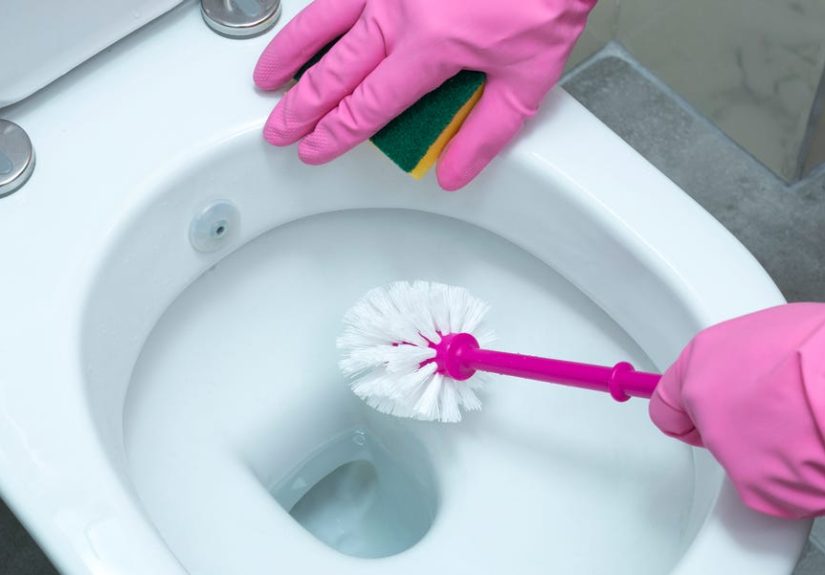
Use a toilet brush to scrub the entire inside of the bowl, including under the rim, the waterline, and the drain opening at the bottom. If the waterline ring is stubborn, give it extra attention. Then flush with the lid down if possible. Closing the lid is a sensible hygiene habit that may help reduce the spread of droplets, though it is not a magic shield.
Step 6: Wipe, dry, and finish the surrounding area
Wipe down the exterior surfaces with a clean cloth or paper towel if the label directs you to. Then clean the nearby floor, wall, toilet paper holder, and any nearby touch points. A toilet might be sparkling, but if the handle and floor area are still grimy, the room will not feel truly clean.
Step 7: Clean your tools
Do not forget the toilet brush. After scrubbing, you can trap the brush handle under the seat and let the brush drip into the bowl for a few minutes. Some people spray the brush with disinfectant before storing it. Let it dry fully in its holder. A wet brush trapped in a closed container is basically a swamp with a handle.
How Often Should You Clean and Disinfect Your Toilet?
A good rule for most households is to clean the toilet at least once a week. In busy homes, homes with children, or bathrooms used by guests, more frequent touch-ups may make sense. If someone in the home is sick, the toilet and surrounding high-touch bathroom surfaces should be cleaned and disinfected more often, and in some situations even after each use by the ill person if practical.
If weekly cleaning sounds ambitious, think of it this way: regular light cleaning is far easier than waiting until the bowl develops a science fair ring and the base starts looking like it belongs in a detective show.
How to Remove Common Toilet Problems
Hard water stains
Hard water stains often show up as gray, brown, orange, or yellow rings. They are caused by mineral deposits, not laziness, so do not take it personally. Vinegar can help loosen mineral buildup. Specialized toilet bowl cleaners can also help. For heavy deposits, a wet pumice stone may be used carefully on porcelain.
Odors
If your toilet still smells after cleaning, the issue may be hidden grime around the base, under the seat hinges, or inside the brush holder. It can also come from the tank, wax ring problems, or nearby drains. In other words, if the smell survives a proper cleaning, the toilet may be trying to tell you something.
Stains under the rim
These are easy to miss and annoyingly common. Use a toilet brush with angled bristles or a small detail brush to scrub under the rim. Let cleaner sit long enough to break down buildup before scrubbing.
A dingy toilet tank
You do not need to deep-clean the tank every week, but it should not be ignored forever. Cleaning experts often recommend cleaning the tank a couple of times a year to remove mineral deposits and grime. Use a bleach-free disinfectant or vinegar-based soak if your toilet components are sensitive.
Common Mistakes to Avoid
Using too many products at once
More is not always better. Mixing cleaners can create dangerous fumes or reduce effectiveness. Stick with one product at a time and follow label directions.
Skipping contact time
This is probably the most common disinfecting mistake. The disinfectant has to remain wet for the full listed time. If it dries too fast, apply more if the label allows.
Forgetting the handle and seat hinges
People remember the bowl because it looks dramatic. Germs, meanwhile, are often happier on the handle, lid, seat edge, and nearby faucet. Clean the obvious parts, but do not ignore the sneaky ones.
Using one rag for everything
If you use the same cloth for the base, the seat, and the sink, congratulations, you have invented a very bad cross-contamination system. Use disposable towels or switch cloths as needed.
Cleaning only when it looks bad
By the time a toilet looks obviously dirty, the scrubbing job is usually harder, slower, and less pleasant. Weekly maintenance wins every time.
Expert Tips for Keeping a Toilet Cleaner Between Deep Cleans
- Wipe the seat and handle every few days in high-use bathrooms.
- Flush with the lid down when possible.
- Use the exhaust fan to reduce moisture and odors.
- Keep a dedicated bathroom cloth or disinfecting wipes nearby for quick touch-ups.
- Address mineral stains early before they become permanent-looking roommates.
- Replace worn toilet brushes and clean the holder regularly.
The Bottom Line
If you want to clean and disinfect your toilet like a pro, the formula is surprisingly simple: remove dirt first, disinfect second, and give the product enough time to work. Focus on the bowl, handle, seat, lid, base, and nearby floor. Clean weekly, disinfect more often when someone is sick, and avoid mixing products unless you enjoy terrible ideas.
A clean toilet does more than improve bathroom hygiene. It makes the entire room feel fresher, more cared for, and a lot less suspicious. And while the work may never be glamorous, there is something deeply satisfying about walking into a bathroom that smells clean instead of like a cover-up.
Real-Life Experiences and Lessons From Cleaning Toilets the Right Way
One of the biggest lessons people learn after finally cleaning a toilet properly is that the job gets easier when it becomes routine. The first deep clean is usually the rough one. It is the cleaning equivalent of opening a junk drawer and finding three dead batteries, a mystery key, and a coupon from another century. The bowl ring is thicker, the base is dustier, and the seat hinges are somehow hiding a full biography of your household habits. But once everything is actually clean, maintenance becomes far less dramatic.
In many homes, the “I cleaned the toilet, so why does the bathroom still feel dirty?” moment usually comes down to missed details. The handle was skipped. The base was ignored. The floor beside the toilet was never wiped. A lot of people discover that the smell they blamed on the bowl was really coming from the brush holder, the tiny gap around the seat bolts, or splashes that dried around the base. That experience changes how they clean forever. Suddenly, it is not just about scrubbing inside the bowl. It is about cleaning the whole toilet as a unit.
Another common experience is realizing that speed is the enemy of real disinfecting. Many people spray, wipe immediately, and assume the surface is sanitized. Then they read the label and discover the disinfectant needed several minutes of contact time. It is a strangely humbling moment. You think you have been disinfecting for years, but in reality, you may have just been giving your toilet a lightly scented pep talk.
Households with kids often learn a different lesson: high-touch areas get dirty faster than expected. The flush handle, lid, and seat edges can get grimy long before the bowl looks bad. Parents, especially, tend to notice that quick, frequent wipe-downs are more realistic than waiting for one giant weekend scrub session. A two-minute wipe of the seat and handle can do wonders in between deeper weekly cleans.
People dealing with hard water also have their own toilet-cleaning journey. At first, they may think the brown or yellow ring means the toilet is permanently stained or somehow beyond saving. Then they learn it is often just mineral buildup and that the right cleaner, a little soaking time, and some persistence can make a huge difference. That moment when the ring finally disappears is surprisingly emotional. No award is given, but internally, it feels deserved.
And then there is the universal lesson almost everyone learns once: never get creative with chemical combinations. Many people try to “boost” their cleaner with bleach, vinegar, or another product and later discover that this is both unnecessary and unsafe. After that, most become much more label-loyal, much more ventilation-friendly, and much less interested in turning the bathroom into a home science experiment.
Over time, the best experience-based advice is simple: keep the process boring. Use the right cleaner, follow the directions, clean from top to bottom, let products sit long enough, and do it regularly. Boring toilet maintenance may not be exciting, but it beats emergency scrubbing before guests arrive. Every single time.