Table of Contents >> Show >> Hide
Looking for a job used to sound simple: find an opening, polish your resume, apply, interview, and hope nobody asks whether you can “wear many hats.” Now? Some job ads read like a fever dream written by a committee of exhausted managers, one overenthusiastic recruiter, and a spreadsheet that has developed unrealistic standards.
That frustration is not just internet melodrama. Across today’s hiring market, job seekers keep running into bloated job descriptions, vague pay, endless interview stages, stale or fake listings, and “entry-level” roles that somehow expect enough experience to qualify you for a midlife crisis. Meanwhile, employers say they are overwhelmed by applications and struggling to spot the right candidates. So everyone is stressed, but somehow the applicant is still the one being told to complete a six-hour assignment before speaking to an actual human.
The result is a modern job search that can feel less like career development and more like an escape room with no clues, bad lighting, and a hiring portal that times out every 12 minutes. Here is a closer look at why the problem has gotten so ridiculous, followed by 40 of the most absurd requirements people say they keep seeing when trying to get hired.
Why Job Requirements Keep Getting More Unrealistic
Part of the problem is simple inflation, just not the kind you complain about in the grocery aisle. Employers often inflate job requirements in an attempt to attract a “perfect” candidate. A role that once needed trainable skills now asks for a degree, three certifications, two software platforms, polished presentation skills, industry knowledge, and the emotional resilience of a hostage negotiator.
Another issue is the “entry-level” paradox. Companies say they want fresh talent, but many listings define “fresh” as “someone with three to five years of directly relevant experience who can hit the ground running on day one.” That shuts out the very people entry-level jobs are supposed to welcome: recent grads, career changers, and workers who learned valuable skills outside a traditional path.
Then there is the technology problem. Applicant tracking systems and AI screening tools can encourage employers to load postings with every possible keyword, qualification, and nice-to-have under the sun. The job description becomes less of a realistic hiring document and more of a wish list written by someone shopping in a talent warehouse where everything is somehow in stock.
And of course, job seekers are also dealing with a trust problem. Many candidates complain about vague salaries, bait-and-switch remote work claims, ghosting after multiple rounds, and postings that do not seem very real in the first place. So when a company says it wants a “rockstar self-starter who thrives in ambiguity,” applicants are increasingly likely to hear, “Please do three jobs for the price of one and smile about it.”
40 Of The Most Ridiculous Job Requirements People Keep Running Into
- “Entry-level” but requires 3–5 years of experience. That is not entry-level. That is “we want someone experienced enough to need the job, but inexperienced enough to accept the pay.”
- A bachelor’s degree for work that used to be trained on the job. If the duties are answering emails, updating spreadsheets, and scheduling meetings, this probably does not require $40,000 in student debt as a prerequisite.
- A master’s degree “preferred” for an assistant role. Nothing says “healthy labor market” like needing graduate school to coordinate calendars and order toner.
- Five software platforms for a beginner position. Employers love asking for mastery of tools people usually learn after getting hired, as if every applicant has spent their free time collecting enterprise software badges for fun.
- Three certifications before day one. Some postings expect candidates to arrive fully licensed, fully certified, and basically pre-assembled like premium office furniture.
- “Must hit the ground running” with zero training. Translation: the company wants a new hire, not a learning curve, not onboarding, and definitely not patience.
- Unpaid take-home projects that take half a weekend. A short sample task is one thing. A full marketing plan, slide deck, design draft, and launch calendar is just free consulting wearing a fake mustache.
- A one-way video interview before anyone speaks to you. Nothing makes candidates feel valued like answering canned questions alone in their bedroom while trying to look natural under ring-light interrogation.
- Six or seven interview rounds for a regular salary job. Unless the role involves launching satellites or picking a pope, seven interviews may be excessive.
- “Competitive salary” with no actual number. Competitive with what, exactly? A coupon? A sandwich? The confidence of the hiring manager?
- Salary range posted, but the actual offer lands far below it. Few things build trust quite like discovering the “range” was apparently decorative.
- Part-time pay with full-time availability. Employers sometimes want workers available nights, weekends, holidays, and random Tuesday mornings, all for 20 hours a week and no benefits.
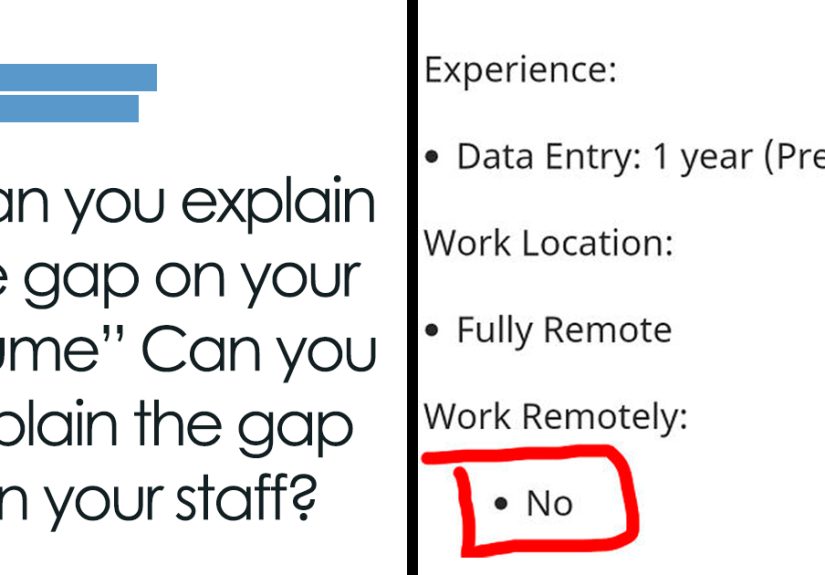
- Remote job that suddenly becomes hybrid. Some candidates apply because the role is listed as remote, only to discover “remote” means “remote until we get you emotionally invested.”
- Hybrid role that still expects you near the office at all times. If you have to live within commuting distance, attend frequent in-person meetings, and be on call for last-minute appearances, that is not flexibility. That is geographic clinginess.
- Relocation required for a short-term contract. Move your life, sign a lease, uproot your routine, and do it all for a role that might vanish before your boxes are unpacked.
- Bring your own car, laptop, phone, and equipment for a low-paying job. At some point, the employee is no longer joining a company. They are subsidizing one.
- “Must be passionate” about a job with weak pay and vague growth. Passion is great. It is also much easier to sustain when rent is covered.
- Open availability for a role advertised as flexible. Some listings use “flexible” the way gym memberships use “easy cancellation.” The reality is often less charming.
- Junior role, senior-level responsibilities. Employers love titles like coordinator or associate when what they really want is a mini-director with lower compensation expectations.
- Marketing jobs that combine six professions into one. Copywriter, editor, strategist, SEO specialist, social media manager, graphic designer, video editor, and analytics lead? Congratulations, that is a department.
- Customer service roles asking for advanced analytics or coding experience. At this point, companies are either confused or hoping they accidentally hire a wizard.
- Sales roles requiring an existing client book before you are hired. Nothing says “great opportunity” like being expected to show up with your own revenue already in your briefcase.
- Administrative jobs demanding executive presence, bookkeeping, event planning, and HR support. Some job descriptions treat “other duties as assigned” like an all-you-can-carry buffet.
- Internships asking for years of experience. The whole point of an internship is learning. Requiring seasoned experience for one is like demanding swimming skills before letting someone near a kiddie pool.
- Recent grads expected to have brand-name portfolios. Some postings seem to assume college seniors somehow spent the last four years interning at five global companies while also attending class and eating occasionally.
- Career changers penalized for not having a perfectly linear resume. If a person has transferable skills, adaptability, and results, a nontraditional path should not be treated like a suspicious back alley.
- Employment gaps treated like a character flaw. People take time off for caregiving, health, layoffs, education, military service, and plain old life. A gap is not a crime scene.
- Immediate availability, but you are still expected to behave professionally. Employers want people who can start tomorrow, unless those people are courteous enough to give their current employer notice. Then suddenly timing is a problem.
- Multiple personality, aptitude, and behavior tests for basic roles. Some application processes make it feel like you are being evaluated for astronaut school when you are applying to answer customer emails.
- References required before a serious interview has even happened. Job seekers are increasingly asked to hand over their professional goodwill before the company has shown it deserves it.
- Long presentations during the interview process. Asking candidates to build a strategy deck, pitch it to leadership, and defend every detail is a lot when the company still has not clarified salary.
- Perfect culture fit and “fresh perspective” at the same time. Employers want someone who blends in instantly, challenges the status quo, never causes friction, and somehow does all that before lunch.
- “Must thrive in ambiguity.” Sometimes that means adaptability. Sometimes it means the company has not figured out the role and wants you to absorb the chaos gracefully.
- “Rockstar,” “ninja,” or “unicorn” language. These are usually warning signs that the company wants impossible output, constant hustle, and perhaps a little unpaid magic.
- Strict in-office policies for roles that clearly could be remote. If the job happens entirely on a laptop, requiring five days in-office can feel less like business need and more like a trust exercise nobody volunteered for.
- Social media presence as a requirement for non-public-facing jobs. Not everyone wants to turn their personal online life into an unpaid extension of the employer brand.
- Background checks, drug tests, essays, assessments, and interviews before basic questions are answered. Job seekers are sometimes expected to complete a full compliance obstacle course before learning what the job actually pays.
- “Opportunities for advancement” with no visible path. If growth depends on vague future possibilities, that is not a career ladder. It is a motivational poster.
- Contract-to-hire roles with no real intention to hire. Some postings dangle permanent employment like a carrot that was never actually attached to the stick.
- “Other duties as assigned” that secretly means doing the work of three missing employees. This is the grand finale of unrealistic requirements: a vague phrase powerful enough to swallow your entire job description whole.
What These Ridiculous Requirements Say About the Job Market
If all of this sounds dramatic, it is because the modern hiring process often is. These requirements reveal a deeper mismatch between what employers say they want and what they are actually willing to build. Many companies want loyalty without stability, expertise without training, flexibility without trust, and top-tier performance without top-tier compensation. That is not a talent strategy. That is wishful thinking with a login portal.
It also explains why so many workers feel cynical. When candidates see bloated listings, mystery pay, and hoops for the sake of hoops, they do not read that as high standards. They read it as disorganization, indecision, or a company trying to get champagne skills on a vending-machine budget.
The smarter employers are moving the other direction. They are narrowing job requirements to what is truly necessary, being clearer about pay and flexibility, and focusing on skills rather than prestige markers. That shift matters because great candidates often do not look perfect on paper. They look trainable, capable, and ready to contribute once somebody finally stops demanding the impossible.
Experiences Job Seekers Keep Talking About
One of the most common stories comes from recent graduates who do exactly what they were told to do for years: finish school, get internship experience, build a resume, network, and apply broadly. Then they hit the market and discover that “entry-level” now means “bring several years of experience, polished work samples, and preferably proof that another employer already took a chance on you.” It is a strange little loop. You need a job to get experience, but you need experience to get the job. That contradiction is funny for about 12 seconds, and then it starts to feel expensive.
Career changers describe a different flavor of frustration. They may have years of experience leading teams, solving problems, working with clients, or managing projects, but if they do not match the exact industry wording on a posting, they are often filtered out before anyone reads the full story. A teacher moving into corporate training, a retail manager transitioning into operations, or a military veteran pursuing project management can all bring strong, relevant skills. Yet many say the system treats them like beginners because their resume does not follow the “correct” shape. It is less like being evaluated and more like being rejected by a very literal robot.
Parents returning to the workforce often talk about another problem: the disappearing employer. They update their resumes, carefully explain their experience, complete assessments, and even make it through multiple interviews, only to hear nothing. No update, no rejection, no closure, just silence so complete it deserves its own office. That silence can make highly qualified people question themselves when the bigger issue may be a disorganized hiring process, a stale posting, or a company that never intended to move quickly in the first place.
Then there are the candidates who get baited by the promise of remote work. They apply because the listing says remote. They interview because the recruiter confirms remote. They continue because the role sounds like it fits their life. Then, sometime around the final stage, the truth arrives wearing business casual: the company actually wants someone in-office three days a week, located within commuting distance, and “fully committed to in-person collaboration.” At that point, the candidate is not just disappointed. They are annoyed that basic facts were treated like a plot twist.
Another experience people keep sharing is the free-work trap. A writing candidate gets asked to draft a sample article, then a second sample, then “just a quick revision.” A marketing candidate is told to produce a campaign proposal. A designer is asked for custom mockups. A product candidate is told to build a presentation. None of those tasks are always unreasonable on their own, but together they create a pattern: companies extracting real labor before extending real trust. Applicants start wondering whether they are interviewing or unknowingly staffing a temporary idea factory.
Still, most job seekers do not expect perfection. They can handle competition, clear expectations, and even rejection. What they struggle with is nonsense. They want honest salaries, realistic qualifications, timely communication, and roles that match what is actually being advertised. That is not asking for luxury treatment. That is asking to be treated like a professional adult rather than a contestant on a bureaucratic game show. And honestly, if employers can manage that much, they might discover a shocking result: qualified people are a lot easier to find when the requirements stop sounding like science fiction.
Conclusion
Job seekers are not imagining the absurdity. Unrealistic hiring requirements have become one of the defining headaches of the modern job search, and the complaints are not just whining from people who do not want to work. More often, they are coming from qualified adults who are perfectly willing to do the job, just not audition for it like they are trying to join an elite acrobatics troupe.
The best way to read today’s job market is with a mix of strategy and skepticism. If a posting sounds inflated, ask questions. If the salary is hidden, proceed carefully. If the interview process starts demanding free labor and endless hoops, take that as information, not just inconvenience. The right role should challenge you, not insult your intelligence. And if a company wants a junior employee with senior credentials, full-time availability, seven niche skills, and the patience of a saint for entry-level pay, it may not be your dream job. It may just be a very creative red flag.