Table of Contents >> Show >> Hide
- Why Gardenista Keeps Returning to Japan
- Lesson 1: Edit Ruthlessly and Respect Empty Space
- Lesson 2: Let Green Do the Heavy Lifting
- Lesson 3: Use Stone, Gravel, and Water With Intention
- Lesson 4: Borrow the View and Frame What Matters
- Lesson 5: Slow the Journey
- Lesson 6: Prune for Shape, Mood, and Clarity
- Lesson 7: Respect Age, Weathering, and Imperfection
- How to Apply These Lessons in an American Garden
- What to Avoid
- Conclusion
- The Experience of Living With These Lessons
Garden trends come and go. One year it is maximalist borders bursting with every flower that has ever owned a petal. The next, it is edible landscaping with the intensity of a small farm. But the Japan-inspired ideas that keep surfacing on Gardenista have real staying power, and for good reason: they are not just pretty. They are practical, calming, space-savvy, and surprisingly modern.
What makes these gardens so magnetic is not the presence of a lantern, a maple, or a carefully raked patch of gravel. It is the thinking behind them. Japanese garden design tends to value restraint over clutter, mood over spectacle, and sequence over instant gratification. In other words, it understands something many backyards have forgotten: a garden is not just a collection of plants. It is an experience.
That is the heart of the “Lessons from Japan” trend on Gardenista. The most useful takeaway is not that every American garden should try to impersonate Kyoto. It is that gardeners can borrow a philosophy: simplify, edit, frame the view, celebrate the seasons, and let the landscape breathe. No passport required. Just a little humility, a few stones, and the courage to stop buying random ornaments at the garden center.
Why Gardenista Keeps Returning to Japan
Gardenista’s fascination with Japanese-inspired gardens makes sense in an era of visual overload. So many outdoor spaces are designed to perform on social media first and function second. Japan-inspired gardens flip that script. They are quieter, but not boring. Structured, but not stiff. Minimal, but never empty. That combination feels fresh because it solves several modern problems at once.
Small spaces benefit from the illusion of depth. Busy households benefit from calm. Drought-prone regions benefit from gravel, stone, and carefully chosen plants instead of thirsty lawns. And gardeners everywhere benefit from learning that one beautiful thing placed well can do more work than twelve things fighting for attention.
In short, the trend is not really about importing foreign decoration. It is about rediscovering discipline. That may sound stern, but in the garden it feels luxurious. A well-composed path, a view framed by foliage, and a single tree with sculptural branching can make an ordinary backyard feel like it finally exhaled.
Lesson 1: Edit Ruthlessly and Respect Empty Space
Less in the garden can feel like more in the mind
One of the clearest lessons from Japan is that empty space is not a design failure. It is part of the composition. Gardenista’s coverage of Japanese-inspired design repeatedly comes back to this idea: what you leave out matters just as much as what you put in.
For American gardeners, this can be a mildly shocking concept. We are a people who love filling gaps. If there is an open corner, we plant it. If there is a bare wall, we hang something on it. If there is room for one hydrangea, surely there is room for six. But Japanese-inspired design treats open space as a pause. It allows the eye to rest and gives the important elements room to matter.
That means a gravel court can be powerful. A plain patch of moss can be elegant. A single boulder can carry more visual weight than a whole chorus line of decorative pots. When a garden is edited well, it becomes more legible. You notice form, shadow, season, and sound. The whole place stops yelling.
Lesson 2: Let Green Do the Heavy Lifting
Color is welcome, but it should not run the meeting
If you want a Japan-inspired garden, resist the urge to build it around nonstop bloom. That does not mean flowers are unwelcome. It means they are not the main event. Much of the beauty comes from foliage, branching structure, bark, moss, and subtle variation in green tones.
This is one reason these gardens feel calm. Instead of a color riot, they often rely on a controlled palette with brief, dramatic seasonal highlights. A flowering cherry, a flush of azaleas, or a moment of iris bloom feels more memorable when everything around it is not also demanding applause.
That is smart design for real life. Green carries a garden longer than flowers do. It holds the structure together in spring, summer, and fall, and even in winter the bones remain visible. Japanese maples, pines, clipped shrubs, bamboo-like textures, moss, and ground-hugging plants all contribute to that layered, restful look.
The lesson here is simple: do not chase constant excitement. Build a garden that looks composed even on an ordinary Tuesday. A space that is beautiful without peak bloom is a space that actually works.
Lesson 3: Use Stone, Gravel, and Water With Intention
Hardscape is not filler; it is narrative
In Japanese garden design, stone is never just a rock somebody forgot to move. Gravel is not merely what happens when mulch gives up. These materials are expressive. They suggest mountains, islands, rivers, shorelines, distance, and stillness. Even a dry garden can imply motion through raked patterns and carefully placed stones.
This is one of the most practical lessons for American gardeners because it works in spaces large and small. A tiny courtyard can use gravel to create a sense of calm and order. A side yard can become a simple dry landscape with a few well-placed stones and a restrained planting palette. A water basin or modest fountain can add sound without turning the backyard into a theme park for stressed-out frogs.
Water, when used, is especially powerful. It cools the atmosphere, creates reflection, and adds sound that softens traffic noise and neighborhood commotion. But even when water is absent, Japanese-inspired gardens often preserve its emotional effect through stone and gravel. That is design doing a clever little magic trick.
The real takeaway is that every material should feel chosen, not dumped. Stones should have presence. Gravel should create unity. Water should contribute mood. If the hardscape looks random, the spell breaks.
Lesson 4: Borrow the View and Frame What Matters
A garden does not have to end where the property line does
One of the most elegant concepts in Japanese garden design is borrowed scenery, or using a distant tree, hillside, rooftop, or open sky as part of the composition. This technique makes a garden feel larger and more connected to the surrounding world.
In practical terms, this means you should pay close attention to what lies beyond your own beds and borders. Maybe your neighbor has a magnificent oak. Maybe there is a church steeple in the distance, or a stand of trees beyond the fence, or even a slice of open sky at the end of a path. Good garden design can incorporate those external elements instead of ignoring them.
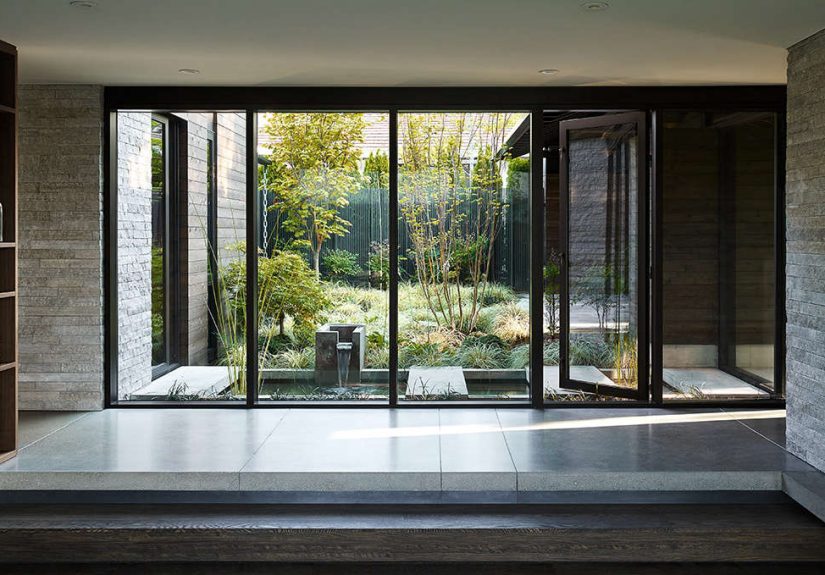
At the same time, Japanese-inspired spaces are masters of framing. A window, doorway, gate, hedge opening, or stand of branches can turn a view into a scene. Suddenly the garden feels painterly, as if every glance has been lightly edited.
This is especially valuable in suburban yards where the surrounding scenery is, let us say, mixed. You may not be able to borrow Mount Fuji, but you can absolutely hide the recycling bins and frame the one decent tree. Design is about optimism with standards.
Lesson 5: Slow the Journey
Paths are supposed to shape behavior, not just prevent muddy shoes
Japanese-inspired gardens are often designed as sequences. You do not take them in all at once. You move through them. A path curves. A gate suggests transition. A stepping-stone slows your stride. A view appears, disappears, and appears again from a different angle.
That sense of choreography is one of the most overlooked lessons from Japan. In too many gardens, paths are treated as utility lines from point A to point B. But a well-designed path changes how you feel. Irregular stepping-stones make you pay attention. Winding routes create anticipation. Narrow passages open into wider moments of relief.
This technique works beautifully in modest gardens. In fact, it may work best there. A few small shifts in level, texture, or direction can make a compact space feel layered and memorable. Add a gate or threshold, and the space feels divided into rooms without actually becoming cramped.
When movement becomes part of the design, the garden stops being a backdrop and becomes an event. Not a dramatic Broadway event, granted. More of a beautifully paced indie film with excellent lighting. But still, an event.
Lesson 6: Prune for Shape, Mood, and Clarity
Maintenance can be part of the art
Japanese pruning is often misunderstood as aggressive shaping for novelty. In reality, the best pruning is subtle. It clarifies the character of a plant, reveals branch structure, and creates flowing forms that work with nearby stones, paths, and open space.
That does not mean every shrub must become a cloud. In fact, one of the smartest lessons from Gardenista’s expert coverage is that overly stylized cloud pruning can look forced when used carelessly. Better results often come from mounded, layered masses and carefully thinned trees that feel airy rather than stuffed.
Think of pruning as sculpting mood. A tree with breathing room feels graceful. A clipped shrub that rolls gently around a rock feels integrated. A dense thicket hacked into geometric panic, on the other hand, feels like the garden is being micromanaged by a very tense accountant.
Good pruning also improves longevity, airflow, and visual clarity. It keeps the garden readable. You are not just making plants smaller. You are teaching them how to participate in the composition.
Lesson 7: Respect Age, Weathering, and Imperfection
Not everything needs to look brand new to look good
American garden culture can be obsessed with freshness. Fresh mulch. Fresh paint. Freshly scrubbed stone. But Japan-inspired garden design often treasures the opposite: weathering, patina, moss, lichen, softened edges, and the visible passage of time.
This attitude changes everything. Suddenly the old stone basin is not shabby; it is soulful. The slightly silvered fence is not tired; it is settled. Moss on stone is not neglect; it is atmosphere. Of course, safety and function still matter. Rotting steps are romantic only until someone twists an ankle.
Still, the broader lesson is liberating. A garden should not look plastic and frozen. It should look lived in. The best landscapes do not deny time; they collaborate with it. That makes them emotionally richer and, frankly, more believable.
How to Apply These Lessons in an American Garden
You do not need a tea house, a huge budget, or botanical-level expertise to bring these ideas home. What you need is restraint and a willingness to work with your climate rather than against it.
- Choose one focal tree with sculptural presence, such as a Japanese maple where climate allows, or a local equivalent with elegant branching.
- Reduce the plant palette and repeat forms instead of collecting one of everything.
- Use gravel, decomposed granite, or stone to create clarity and reduce visual noise.
- Frame a view from a window, porch, or seating area so the garden reads like a composition.
- Install stepping-stones or a subtle path that slows movement and creates sequence.
- Use climate-appropriate plants to capture the spirit of the style instead of copying a plant list blindly.
That last point matters. One of the wisest modern interpretations of Japan-inspired gardening is to borrow the feeling, not just the parts. If your region does not suit certain classic Japanese plants, use local or well-adapted species that offer similar texture, habit, or restraint. The goal is authenticity of experience, not costume drama in shrub form.
What to Avoid
The fastest way to lose the spirit of a Japan-inspired garden is to turn it into a collection of stereotypes. Too many ornaments, too many symbolic objects, too many disconnected “Zen” elements, and the whole design starts looking like a souvenir shop exploded in the yard.
Avoid forcing meaning into every corner. Avoid mixing every idea at once. Avoid treating lanterns, bridges, statues, and bamboo as shortcuts to depth. The real beauty is created by composition, pacing, material choice, and sensitivity to season. Those things are less flashy, but far more convincing.
In other words, if the garden feels like it is trying too hard, it probably is.
Conclusion
The reason Japan keeps trending on Gardenista is not mysterious. These gardens offer what many modern landscapes lack: calm, clarity, structure, and emotional depth. They prove that beauty does not depend on excess. A garden can be powerful because it is restrained, memorable because it unfolds slowly, and moving because it honors time, weather, and the changing seasons.
For American gardeners, that is the most useful lesson of all. You do not need to replicate a historic temple garden to learn from Japan. You can borrow the edit, the pacing, the reverence for stone and foliage, the respect for open space, and the idea that a garden should help people notice where they are.
That may be why these ideas never really go out of style. Trends usually shout. The best lessons from Japan do something much smarter: they lower their voice until you lean in.
The Experience of Living With These Lessons
What do these ideas feel like in everyday life? That may be the most important question, because the success of a garden is not measured only in photographs. It is measured in how the place changes your behavior. A Japan-inspired garden tends to slow you down without announcing that it is doing so. You step more carefully on irregular stones. You pause at a gate even if no one told you to. You look up when a framed view suddenly makes a distant tree feel intentional. The garden does not bark instructions. It quietly edits your pace.
Morning is often when the effect is strongest. A simple gravel area looks crisp before the day gets busy. Dew on moss makes the green feel deeper. A clipped shrub casts a neat shadow that seems almost painted onto the ground. Even a very small yard can feel composed at that hour. The experience is not dramatic; it is clarifying. You notice the curve of a branch, the way a stone anchors a bed, the contrast between rough bark and smooth gravel. The details are small, but the mental effect is large.
Rain improves these gardens in a way that feels almost unfair. Wet stone darkens beautifully. Leaves shine. Moss becomes luminous. Water sounds louder, softer, and more convincing all at once. A garden built around restraint has a way of revealing more under gray skies, not less. That is a useful reminder for anyone designing a yard only for peak sunshine. Some of the most memorable garden moments happen when the weather is moody and the textures get to show off.
There is also a deeply practical pleasure in tending a space like this. Raking gravel can be repetitive, but in a good way. Light pruning becomes an act of refinement rather than warfare. Sweeping paths, wiping a basin, or clearing fallen leaves from stepping-stones can feel less like chores and more like resetting the room. The work teaches attentiveness. You start noticing when a shrub is throwing off the balance, or when a tree needs thinning so the view opens again. Maintenance becomes part of the relationship.
Over time, the seasonal experience grows richer. Spring brings blossom and fresh growth, but not chaos. Summer emphasizes cool green structure. Fall turns a single maple into theater. Winter reveals bones, bark, stone, and spacing. Because the design is not dependent on nonstop flowers, the garden keeps speaking in every season. That may be the most lasting lesson from Japan: a garden should not only look good at its peak. It should remain worth visiting, worth walking, and worth noticing all year long.