Table of Contents >> Show >> Hide
- Why Repotting Matters (Yes, Even If It Looks Fine)
- When to Repot a Venus Flytrap
- What You’ll Need
- Pick the Right Pot (Size, Depth, and Material)
- The Only Soil Mixes You Should Consider
- Step-by-Step: How to Repot a Venus Flytrap
- Aftercare: The First 2–3 Weeks
- Water Quality: The Quiet Hero of Flytrap Success
- Common Repotting Mistakes (and How to Avoid Them)
- FAQ: Quick Answers That Save Plants
- Experience-Based Notes from Real Grower Patterns (Extra 500+ Words)
- Conclusion
Repotting a Venus flytrap sounds like it should involve a tiny surgeon’s mask and a signed waiver. In reality, it’s more like giving your plant a fresh mattress in the exact kind of “swamp bed” it loves: acidic, nutrient-poor, and constantly moist.
In this guide, you’ll learn when to repot, what soil mix actually works (spoiler: not “all-purpose potting soil”), and how to do it without turning your flytrap into a dramatic, black-leafed soap opera.
Why Repotting Matters (Yes, Even If It Looks Fine)
Venus flytraps (Dionaea muscipula) are picky for a reason: in nature they live in wet, acidic boggy soils with very low nutrients. In a pot, their growing medium slowly becomes less “bog” and more “mystery casserole” as minerals, salts, and impurities build upespecially if the plant has ever been watered with less-than-pure water.
Repotting gives your flytrap fresh, airy, acidic media and resets the root zone so it can grow vigorously instead of quietly plotting its resignation.
When to Repot a Venus Flytrap
The safest timing is early spring (as dormancy ends and before the main growth push) because the plant is about to wake up and can recover quickly. Some growers also repot in late fall when the plant is slowing down.
Best times (most beginner-friendly)
- Early spring: right before or as new growth starts
- Late winter to early spring: if you grow with a winter dormancy
Times to avoid (if you can)
- While flowering: flowering costs energy; repotting adds stress
- Peak heat waves: hot, dry air makes transplant shock worse
How often should you repot?
A good rule is every 1–2 years, or sooner if the soil looks compacted, the pot is crowded with divisions, algae/moss is taking over, or you suspect mineral buildup from questionable water. If you just bought a flytrap from a store, repotting sooner is often smart because you don’t know what water or soil it’s been living with.
What You’ll Need
- A clean pot with drainage holes (plastic is easiest; glazed ceramic can work)
- Fertilizer-free growing medium (recipes below)
- Distilled, reverse osmosis, or clean rainwater
- Optional: gloves (peat is messy), tweezers/chopstick, scissors for dead leaves
- Optional but helpful: a TDS meter if you want to check water quality
Pick the Right Pot (Size, Depth, and Material)
Your flytrap doesn’t need a mansion, but it does appreciate a deeper pot than many houseplants. Depth helps keep roots insulated and lets you use the tray method (watering from below) without the plant sitting in a swampy anaerobic mess.
Pot depth and width
- Depth: aim for about 4 inches minimum; deeper is often easier to manage with standing water
- Width: slightly bigger than the current root/rhizome mass; don’t oversize dramatically
Best materials
- Plastic: lightweight, easy to drill, and doesn’t leach minerals
- Glazed ceramic: can work because the glaze reduces mineral exchange and evaporation
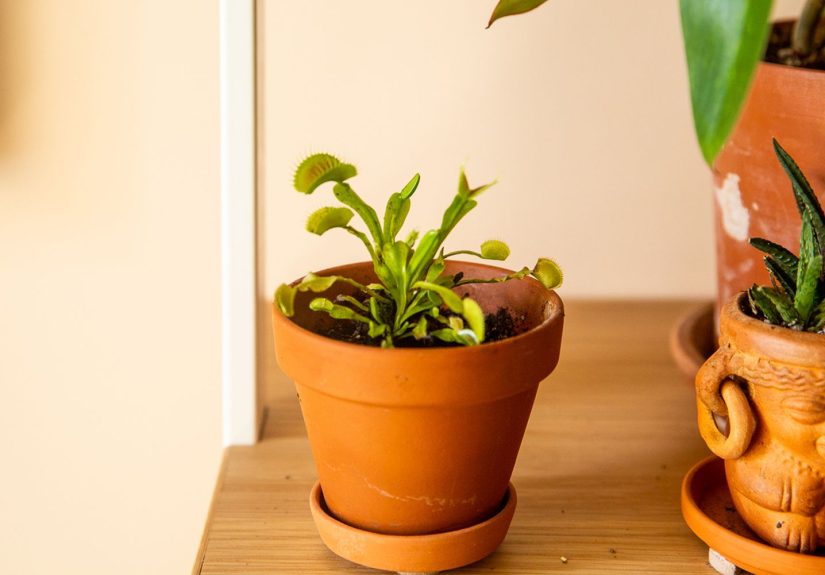
If you’re tempted by terracotta: it’s pretty, but it can leach minerals over time. Your flytrap’s favorite flavor is “nutrient-free,” not “clay latte.”
The Only Soil Mixes You Should Consider
The #1 mistake is using standard potting soil. It’s typically loaded with nutrients, compost, wetting agents, or lime. Venus flytraps want the opposite: acidic, low-nutrient, fertilizer-free media that stays moist but still has oxygen around the roots.
Reliable mix options (choose one)
Option A: Peat moss + perlite (classic and widely used)
- 1:1 peat moss to perlite (easy, beginner-friendly)
- Or 4:1 peat to perlite (holds moisture longer; great in hot climates)
Option B: Peat moss + coarse silica sand
- 1:1 peat to coarse sand (a “standard carnivorous plant mix” style)
- Or 3:1 peat to sand (slightly more moisture-retentive)
Option C: Long-fiber sphagnum (LFS) alone or mixed
Long-fiber sphagnum can work beautifully, but it’s pricier and behaves differently than peat. If you’re new, peat-based mixes are simpler to learn.
Two must-do details before you mix
- Make sure every ingredient is fertilizer-free. Avoid “moisture control,” “feeds for 6 months,” or anything that sounds like a vitamin subscription.
- Pre-moisten the mix with pure water. Dry peat can repel water at first. Mix until it’s evenly dampmoist to the touch, not dripping like a soaked sponge.
Step-by-Step: How to Repot a Venus Flytrap
Take your time. A careful repot is faster than the “I rushed and now I’m googling ‘why is my flytrap melting’ at 2 a.m.” scenario.
Step 1: Prepare the new pot
- Rinse the pot (no soap residue).
- Fill it with your pre-moistened carnivorous plant mix.
- Make a planting hole in the center deep enough for the roots and the white base of the plant.
Step 2: Remove the plant gently
- Water the plant first (moist soil slides out easier).
- Tip the pot and ease the plant out by supporting the baseavoid yanking traps.
- Loosen the old medium carefully. It’s okay if some sticks to roots; you’re not aiming for “squeaky clean,” just not compacted.
Step 3: Inspect the rhizome and roots
The rhizome is the thick base where leaves emerge. Healthy tissue is typically firm. Trim only clearly dead material (brown/black mush), and leave healthy roots alone.
Step 4: Optionaldivide if the plant has multiple crowns
Many flytraps form clumps. If you see distinct crowns (multiple growth points), you can separate them gently during repotting and pot them individually. This is also a great way to “accidentally” multiply your collection.
Step 5: Plant at the right depth
- Set the plant so the roots and lower rhizome sit in the moist mix.
- Keep the growing point above the soil linedon’t bury the whole plant like it’s a carrot.
- Firm the mix around the roots gently to remove large air pockets (no tamping like concrete work).
Step 6: Water thoroughly (with the right water)
Use distilled, reverse osmosis, or clean rainwater. Water until it drains from the bottom. Then place the pot in a shallow tray of the same pure water.
Aftercare: The First 2–3 Weeks
Repotting is stressful, even when done perfectly. Expect a short “sulk period.” A little slowdown is normal; panic is optional.
What’s normal
- Slow growth for 1–2 weeks
- A few traps darkening or dying back
- Leaves looking less perky while roots settle
What to do right after repotting
- Light: keep strong light consistent, but avoid suddenly blasting a weak indoor plant with full midday sun without acclimating
- Water: keep the tray filled with a shallow level of pure water; don’t let the pot dry out
- Feeding: skip feeding for a bit; let it recover first
Water Quality: The Quiet Hero of Flytrap Success
If Venus flytraps had a dating profile, it would say: “No minerals, no drama, no exceptions.” Many failures come down to water quality, not repotting technique.
Best water choices
- Distilled water
- Reverse osmosis (RO) water
- Clean rainwater (collected safely)
Water to avoid
- Most tap water (minerals accumulate over time)
- “Filtered” water from common pitcher filters (often not low-mineral enough)
- Mineral water or “drinking water” with added minerals
If you’re the analytical type, a TDS meter can help you decide if your water is safe. If you’re the practical type, use distilled/RO and move on with your life like a champion.
Common Repotting Mistakes (and How to Avoid Them)
Mistake 1: Using regular potting soil
Regular soil is too rich and can burn sensitive roots. Stick to peat-based or sphagnum-based, fertilizer-free mixes.
Mistake 2: Oversizing the pot
A huge pot can stay too wet and stagnant, especially indoors. Go just a bit bigger than needed unless you’re building a true outdoor mini-bog setup.
Mistake 3: Letting the mix dry out while “settling in”
Flytraps aren’t drought-tolerant. Keep moisture consistent. The tray method makes this easier than guessing from the top.
Mistake 4: Fertilizing the soil
Flytraps get nutrients from prey and light, not rich soil. Skip soil fertilizer entirely.
FAQ: Quick Answers That Save Plants
Can I repot my Venus flytrap during dormancy?
Yes, many growers do. Early spring (as dormancy ends) is often the sweet spot because the plant is about to grow and can recover quickly. If you repot deep in winter dormancy, keep conditions stable and don’t let the medium dry out.
Do I need a terrarium?
Not usually. Flytraps crave light and airflow more than a sealed humid box. Outdoors in bright sun (with proper water) is ideal in many climates; indoors can work with strong supplemental light.
My traps keep closing while I repot. Did I break it?
No. Traps are touchyliterally. Try to hold the plant by the base and avoid poking the trigger hairs. A few triggered traps won’t ruin the plant; it’s just spending energy being dramatic.
Experience-Based Notes from Real Grower Patterns (Extra 500+ Words)
Here’s the part nobody tells you until you’ve worn half a bag of peat like a face mask: repotting a Venus flytrap is less about perfection and more about avoiding the handful of things flytraps truly hate. The biggest “aha” moment many growers report is that the plant’s roots are often smaller than expectedespecially if you’re used to chunky houseplant root balls. A flytrap isn’t trying to anchor a 7-foot fiddle-leaf fig; it’s trying to survive in a bog where nutrients are scarce and water is plentiful. So when you slide it out of the pot and don’t find a wild jungle of roots, that’s not automatically a problem. The important part is the rhizome (the firm base) and the new growth point.
Another common repotting “experience lesson” is how peat behaves like a grumpy sponge. Dry peat can repel water at first, so growers who skip pre-moistening end up with a pot that looks wet on top but hides dry pockets underneath. The fix is simple: pre-moisten your mix in a bucket or bowl with distilled/RO/rainwater until it’s evenly damp. If you squeeze a handful, it should feel wet but not gush water like a squeezed-out mop. This one step alone prevents a lot of post-repot stress.
You’ll also notice that flytraps have a talent for looking worse right after you help them. It’s a special gift. Many growers see a week or two of slower growth, a few traps turning black, or older leaves collapsing and assume they “did it wrong.” Usually, that’s just transplant adjustmentespecially if the rhizome is firm and the newest center growth looks alive. The plant is basically reallocating energy to roots and new traps. If you’ve ever moved apartments and eaten cereal for dinner the first week, you get it.
Pot choice creates its own set of real-world observations. People who try shallow pots often find the plant dries faster than expected or swings between too wet and too dry. Deeper pots tend to buffer temperature and moisture, especially when you’re using the tray method. On the flip side, growers sometimes oversize the pot dramatically (“room to grow!”) and then discover the medium stays overly soggy indoors, inviting algae, fungus gnats, or a sour smell. The practical middle ground many experienced growers land on is: go deeper, not wildly wider. A stable pot with enough depth is more helpful than a giant tub of constantly wet peat.
Water quality is the biggest “experience gap” between success and heartbreak. A lot of flytraps die slowly, not suddenlynew traps get smaller, leaves blacken, growth stallsand growers chase lighting, humidity, feeding, and moon phases, when the real culprit is mineral buildup from tap or “filtered” water. Repotting helps reset the soil, but if the same water continues, the problem returns. That’s why experienced growers become weirdly passionate about distilled/RO/rainwater. They’re not being dramatic; they’re being accurate.
Finally, an experience-based tip that saves sanity: don’t treat repotting like a one-day performance review. It’s a small reset. Get the fundamentals right (pure water, correct medium, strong light), and your flytrap usually rebounds. If it looks unimpressed for a couple of weeks, that’s normal. Give it consistency, not constant tinkering. Venus flytraps love two things: catching bugs and proving you cannot rush them.
Conclusion
If you remember only three things about how to repot a Venus flytrap, make them these: use a fertilizer-free bog-style mix, use pure water, and repot in early spring when recovery is easiest. Keep the medium consistently moist, give it bright light, and let the plant settle without overfeeding or over-handling.
Repotting isn’t just maintenanceit’s how you keep a flytrap healthy for years. And honestly, watching fresh traps pop up after a clean repot feels like getting a thumbs-up from the world’s tiniest carnivorous diva.