Table of Contents >> Show >> Hide
- What Version of The Game of Life Are You Playing?
- How to Set Up The Game of Life
- How to Start the Game
- How a Turn Works
- What the Spaces Mean
- Marriage, Family, Houses, and Other Big Milestones
- Loans, Insurance, Investments, and Other Money Drama
- How to Win The Game of Life
- Best Tips for Playing The Game of Life
- What the Experience of Playing The Game of Life Is Really Like
- Final Thoughts
If you have ever opened The Game of Life box and thought, “Why does this family game look like it also wants me to file taxes?” you are not alone. Between cars, pegs, cards, money, houses, loans, and the possibility of making terrible life choices with a cheerful plastic spinner, this classic board game can look a little busier than a Monday morning parking lot.
The good news is that the rules are easier than the board makes them seem. At its heart, The Game of Life is simple: players move from the start of adulthood to retirement, make big decisions along the way, collect money and life milestones, and try to finish with the highest total value. It is part strategy, part luck, and part “well, apparently my cousin just became a millionaire after buying a suspiciously profitable mansion.”
This guide covers the classic flow most people mean when they search for Game of Life rules, while also pointing out where newer editions may change a few details. So if you want a clear, practical, and fun Game of Life setup and play guide, buckle up your tiny plastic driver and let’s hit the road.
What Version of The Game of Life Are You Playing?
Before you begin, check your box. That sounds obvious, but it matters. Some classic and anniversary editions support more players and include classic pieces like LIFE tiles, paper money, loans, houses, buildings, and a more elaborate board setup. Many newer editions are streamlined for quicker play, often with fewer players, updated careers, and slightly different card systems.
That means one family’s copy might say 2 to 6 players, while another says 2 to 4. One edition may have a banker handing out cash, while another version uses updated cards, tiles, or electronic banking. The smartest move is this: use your box contents as the final tie-breaker, but follow the structure in this article because the core Game of Life gameplay is still largely the same.
How to Set Up The Game of Life
1. Assemble the board and spinner
Set the gameboard in the middle of the table. If your edition includes buildings, bridges, mountains, or other plastic parts, attach them first. Then put together the spinner and make sure it actually spins instead of behaving like it has already given up on adulthood.
2. Sort the game pieces
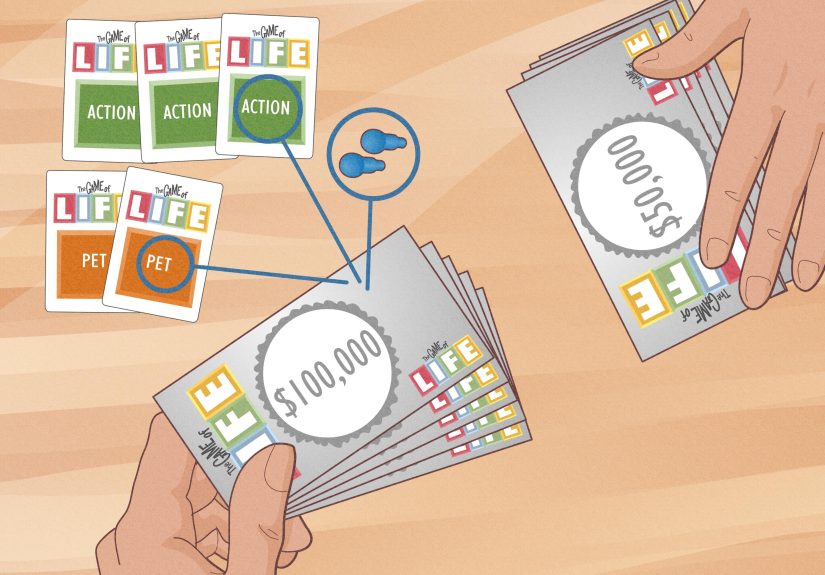
Separate the cards into their proper decks. Depending on the edition, these may include Career cards, Salary cards, House Deeds, Starter Homes, Investments, Share the Wealth cards, or similar decks. Put each pile face down near the board.
If your version includes LIFE tiles, shuffle them and place them near the board as a draw pile. In classic versions, a few LIFE tiles may be placed at Millionaire Estates during setup. If you have house cards, loans, insurance policies, or investment cards, place those near the banker where everyone can reach them without causing a full economic summit.
3. Choose a banker
One player becomes the banker. That player handles the money, loans, and bank payments. In classic editions, the banker gives each player a starting amount of cash. In newer versions, starting funds or card-based balances may differ, so match the amount to your edition.
4. Pick cars and pegs
Each player chooses a car and places one person peg in the driver’s seat. Extra pegs stay nearby for future life events, like marriage, children, or the game’s ongoing commitment to turning your vehicle into a rolling family reunion.
5. Decide who goes first
All players spin the spinner once. The highest spin goes first, and play continues clockwise. That is it. Setup complete. You are now officially ready to make questionable financial decisions in a safe and colorful environment.
How to Start the Game
At the start of play, most versions ask each player to choose one of two paths:
Start a career or go to college.
This is one of the biggest early decisions in how to play The Game of Life. If you start a career right away, you usually earn money sooner. If you choose college, you often take on debt first, but you may unlock better career options later. In other words, the game introduces life’s most cheerful trap: future opportunity with immediate financial pain.
In classic rules, career players draw a career card and a salary card, then begin moving. College players usually borrow money for tuition, start on the college path, and later get access to stronger career choices at the Job Search space. In newer editions, the college path still tends to trade short-term pain for long-term possibility.
How a Turn Works
Most turns in The Game of Life follow the same rhythm:
- Spin the spinner.
- Move your car forward the number of spaces shown.
- Follow the instructions on the space where you land.
- End your turn unless the space tells you to spin or move again.
You always move forward in the direction of the arrows. No reversing. No “I changed my mind.” No emotionally driven U-turns. If you land on an occupied space, many classic rules tell you to move to the next open space. That keeps the game moving and prevents a traffic jam in plastic suburbia.
Some spaces will pay you. Some will cost you. Some will hand you a LIFE tile. Some will force you into a major milestone whether you were emotionally prepared for it or not. That is not a flaw in the design. That is the design.
What the Spaces Mean
Regular spaces
Most standard spaces tell you to collect money, pay money, draw something, or follow a specific event. Read the text and do exactly what it says. The game is very committed to consequences, even if those consequences are “Pay for a ski accident” or “Congratulations, buy a house immediately.”
PAY DAY spaces
Whenever you land on or pass a PAY DAY space in many editions, collect your salary from the bank. This is one of the happiest moments in the game, right up until another space immediately makes you pay for something ridiculous.
LIFE spaces
On a LIFE space, take a LIFE tile if your version uses them. These tiles usually stay face down or hidden until the end. They represent milestones, good deeds, family moments, and other life events that add value to your final score. The surprise value of LIFE tiles is part of what gives the game its last-minute drama.
Career or tax spaces
Some spaces interact with specific careers. In classic rules, if someone owns the matching career, you pay that player. If nobody owns it, you pay the bank. There are also tax-related spaces where you pay according to your salary or career card. This is where the game gently reminds everyone that accountants are powerful.
Red stop spaces
Red spaces are major events. In classic versions, these often include Job Search, Get Married, and Buy a House. When you reach one, you must stop there even if you still have moves left. Follow the instructions, then usually spin and move again.
These spaces matter because they shape your game path. They are not optional. You cannot say, “I am focusing on self-growth this year” and drive past your wedding.
Marriage, Family, Houses, and Other Big Milestones
A lot of the fun in The Game of Life comes from the way it turns ordinary milestones into mini-events.
Getting married often adds a peg to your car and may trigger gifts, bonuses, or a spin-based reward depending on the edition.
Having children usually means adding more pegs to your car. Some editions award money or bonuses later based on how many kids you have. Your tiny vehicle may eventually look less like a sedan and more like a clown car with a mortgage.
Buying a house is another key event. Draw or choose a house card, pay the listed price, and keep that deed until the end or until the rules let you upgrade. Houses often matter at retirement because they can be sold back for value.
These milestone moments are what make the game memorable. You are not just moving around a track. You are building a silly, luck-filled life story one spin at a time.
Loans, Insurance, Investments, and Other Money Drama
If there is one universal truth in this board game, it is this: cash moves fast.
Many versions let players take bank loans when they do not have enough money. That helps you stay in the game, but loans usually must be repaid with interest later. College often begins with debt, and surprise costs can pile on from there.
Some classic editions also allow auto insurance, homeowner’s insurance, or stock/investment cards. These can protect you from certain penalties or help you earn money when specific numbers are spun. In updated editions, the names may change, but the principle stays familiar: spend now for a chance at later protection or profit.
This is where a little strategy comes in. Players who burn through cash too quickly may end up borrowing constantly. Players who hoard every dollar may miss good opportunities. The sweet spot is balancing risk, timing, and a healthy respect for the possibility that the spinner absolutely hates you.
How to Win The Game of Life
The game ends when all players reach retirement.
At that point, players usually do some or all of the following, depending on the edition:
- Repay outstanding loans, often with interest.
- Sell houses or cash in property value.
- Reveal LIFE tiles and total their value.
- Count remaining cash and bonuses.
- Add everything together.
The player with the highest total value wins.
That final count is one of the best parts of the game because it creates chaos in the most polite possible way. The player who looked dominant for forty-five minutes may suddenly lose to someone who quietly collected great LIFE tiles, paid off debt, and retired without needing financial CPR.
Best Tips for Playing The Game of Life
Check your edition before teaching the rules
This is the biggest favor you can do for game night. Do not mix three different versions into one explanation unless you enjoy confusion and loud family debates.
Do not ignore debt
Loans feel harmless early on because they keep you moving. At the end of the game, they become that one problem you thought future-you would solve. Future-you would like a word.
College is not always the automatic best move
Yes, college can unlock stronger careers. It can also slow your early game and load you with debt. Sometimes the straight-to-career path is the better play, especially if the spinner gives you momentum.
Remember that hidden value matters
LIFE tiles can swing the ending. A player with steady tile collection and decent cash management can beat a flashier player who looked rich the whole game.
Keep the pace up
The Game of Life is more fun when turns move quickly. Read the space, resolve it, laugh at the nonsense, and pass the spinner. This is not the time for a ten-minute committee meeting about whether buying the mountain cabin aligns with your long-term fictional priorities.
What the Experience of Playing The Game of Life Is Really Like
One of the reasons this board game has stuck around for generations is that it does something sneaky: it turns simple rules into stories people remember. Nobody walks away from a round of The Game of Life saying, “I moved seven spaces and collected money.” They say, “I skipped college, became weirdly successful, bought an overpriced house, had four kids, and still lost to my aunt because she kept pulling huge LIFE tiles.” That is the magic.
For first-time players, the early experience usually feels light and funny. Everyone is still optimistic. The board is neat. The cars are mostly empty. Cash is flowing. Then the game starts doing what it does best: creating dramatic swings out of nowhere. Suddenly one player is celebrating a great salary, another is taking out a loan, and somebody else is staring at a house purchase like they accidentally signed real paperwork.
The middle of the game is often where personalities show up. Risk-takers usually lean into expensive choices, aggressive paths, and every opportunity to chase bigger rewards. Cautious players hang onto cash, avoid unnecessary debt, and quietly build a more stable finish. Then there is always one person who plays entirely by vibes. That player will somehow make baffling choices for an hour and still be terrifyingly close to winning.
Family game night also changes the feel of the rules. With kids, the game becomes a fun introduction to money, decisions, turn-taking, and the idea that choices have trade-offs. With adults, it becomes a comedy machine. People start narrating their fake careers like biographies, roasting each other over bad spins, and acting personally betrayed by taxes. The board game may be simple, but the table talk becomes elite.
Another memorable part of the experience is the visual comedy. Those little plastic cars start off clean and tidy, then gradually fill with pegs until they look like a small parade. By the end, the board feels like a strange suburb where everyone is somehow married, overcommitted, and trying to retire with dignity.
The ending is usually the biggest surprise. Players often think they know who is winning, but the final scoring can flip everything. Hidden LIFE tile values, house sales, debt repayment, and endgame bonuses create just enough uncertainty to keep everyone invested. That last reveal is why the game still works. It keeps hope alive for the underdog and keeps the leader just uncomfortable enough to stay honest.
If you are teaching the game, the best experience comes from not over-explaining. Start with setup, explain how a turn works, describe the major spaces, and let the game teach the rest. Most people understand it after one round. After that, the fun comes from reacting to the silly chain of events, not from memorizing every rule like it is a law school exam.
In the end, The Game of Life is less about perfect strategy and more about shared chaos. It is a board game where luck matters, choices matter a little, and storytelling matters most. That is why people keep pulling it off the shelf. It is familiar, funny, and just unpredictable enough to make every session feel like its own tiny suburban soap opera.
Final Thoughts
If you want a board game that is easy to teach, full of surprises, and weirdly great at creating family stories, The Game of Life still holds up. Once you understand the setup, the turn structure, and the major space types, the rest falls into place quickly. Choose your path, manage your money, enjoy the ridiculous twists, and do your best not to retire broke in a plastic car packed with kids.
That, technically speaking, is the dream.