Table of Contents >> Show >> Hide
- Why Tea Towels Became the Perfect Royal Wedding Souvenir
- What Makes Royal Wedding Commemorative Tea Towels So Charming
- Use It, Frame It, or Hide It From Spaghetti?
- How to Shop for One Without Getting Swept Into Souvenir Madness
- How to Care for Vintage and Sentimental Tea Towels
- Why Royal Wedding Tea Towels Still Work in Modern Kitchens
- The Experience of Living With a Royal Wedding Commemorative Tea Towel
- Final Thoughts
Some collectibles live behind glass. Others sit in velvet-lined boxes, looking expensive and vaguely intimidating. Royal wedding commemorative tea towels, on the other hand, take a more democratic route. They hang by the stove, brighten an oven handle, mop up a splash near the sink, and somehow still manage to whisper, “Yes, I am technically history.”
That is the magic of the royal wedding tea towel. It is half kitchen linen, half souvenir, and half cultural fever dreamwhich is admittedly too many halves, but that is the point. These towels are wonderfully extra. They turn a major public event into an everyday household object. One minute a wedding is happening at a cathedral with crowns, carriages, and polished trumpets; the next minute it is printed on cotton and living beside your cookie sheet. If that sounds a little absurd, congratulations: you understand the appeal perfectly.
In the world of kitchen textiles, royal wedding commemorative tea towels occupy a strange and lovable niche. They are decorative without being precious, nostalgic without needing a family tree, and collectible without requiring a climate-controlled vault. Some are beautifully designed. Some are gloriously over-the-top. A few are so cheerfully tacky they become art by sheer force of confidence. And all of them tell us something about how people bring history homeliterally, into the kitchen.
Why Tea Towels Became the Perfect Royal Wedding Souvenir
To understand why royal wedding tea towels caught on, you have to start with the tea towel itself. Traditionally associated with Britain, the tea towel began as a lint-free cloth used around tea service and delicate china. That origin matters. A tea towel was never just a rag with ambitions. It was tied to rituals of serving, hosting, polishing, and presenting things beautifully. In other words, it already belonged to a world of ceremony.
Once you realize that, the leap to royal wedding memorabilia makes perfect sense. A royal wedding is ceremony turned up to eleven: the outfits, the invitations, the symbols, the flowers, the pageantry, the national mood swing. A tea towel is small, practical, easy to print, easy to ship, and easy to display. It gives buyers a useful keepsake that also feels domestic and intimate. Not everyone can buy the palace, but plenty of people can buy the towel.
Over time, the format became a familiar part of royal souvenir culture. Big wedding momentsthink Charles and Diana, William and Catherine, Harry and Meghan, and later official wedding-related collections tied to younger royalskept the tradition alive. Alongside commemorative mugs, plates, tins, and coins, tea towels remained one of the most recognizable kitchen-friendly souvenirs. They were affordable, visible, and just whimsical enough to feel fun instead of formal.
The Kitchen Is Part of the Fantasy
There is also a subtler reason these towels work so well: the kitchen is where nostalgia gets to put on an apron. Royal weddings may be global media spectacles, but the way many people enjoy them is surprisingly cozy. Tea, pastries, breakfast television, friends on the couch, someone shouting opinions about hats. A commemorative tea towel fits that atmosphere perfectly. It takes a massive public event and shrinks it into something warm, familiar, and slightly ridiculous in the best possible way.
What Makes Royal Wedding Commemorative Tea Towels So Charming
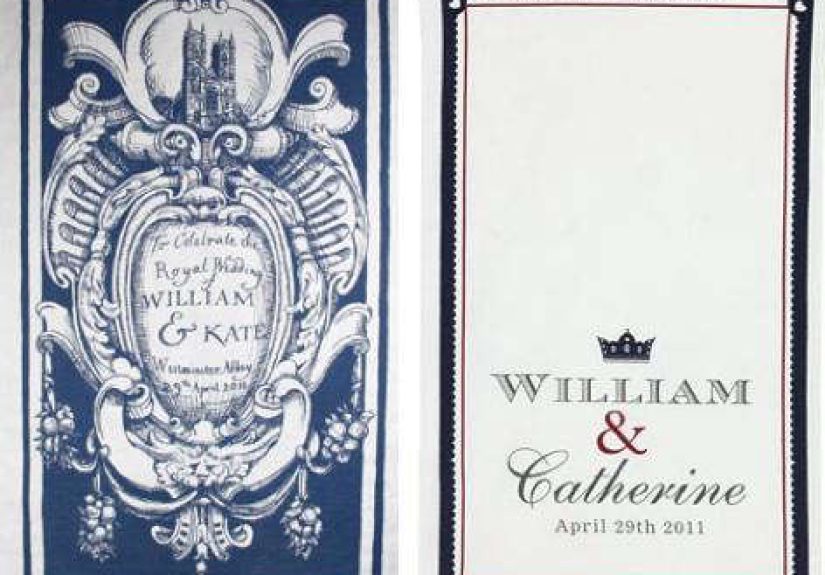
The charm starts with the visuals. A good royal wedding tea towel usually throws everything into the design blender: portraits, dates, crowns, crests, cathedral silhouettes, floral borders, ribbons, monograms, and enough decorative scrollwork to make a stationery designer tear up with joy. Some feature formal portraiture. Others go cartoonish, playful, or knowingly campy. The best ones walk a fine line between sincere celebration and “I cannot believe this exists, and I need it immediately.”
That tension is what makes them memorable. A commemorative tea towel is not trying to be subtle. It is trying to mark an occasion. It wants to be seen. It wants to announce, from a hook or drawer or frame, that this specific wedding mattered enough to become a household object. Even when the design is corny, it still works because the item is doing exactly what souvenir culture is supposed to do: preserving a mood.
There is also a texture story here. Unlike posters or postcards, tea towels have softness and movement. They wrinkle, fold, drape, and age. That gives them personality. A printed portrait on cotton feels different from a portrait on glossy paper. It feels more lived with. More domestic. More human. The royal family may operate in a highly choreographed public world, but a tea towel pulls that image into everyday life, where it can coexist with coffee rings, pie crust, and very real opinions about whether anyone needed a carriage that large.
Not All Towels Are Created Equal
Some royal wedding tea towels are made to be used. Others are made to be admired from a safe distance, preferably by people who understand that marinara sauce is an enemy of history. Generally, lighter flat-weave cotton or linen-cotton towels feel more traditional and decorative, while heavier kitchen towels lean more functional. For collectors, graphic appeal matters almost as much as the event being commemorated. A mediocre towel tied to a major wedding can still feel underwhelming. A brilliantly designed one can become a favorite even if you are only mildly interested in royal news.
Use It, Frame It, or Hide It From Spaghetti?
This is the eternal tea towel dilemma. Is the towel a working kitchen tool, or is it decorative royalty that should never come within six feet of tomato sauce? The honest answer is: both options are valid.
If you want to use your royal wedding commemorative tea towel, there is no rule saying you cannot. Tea towels were made to dry dishes, cushion serving bowls, protect hands around warm dishes, and even wrap gifts or line baskets. In a real kitchen, a beautiful towel can still earn its keep. Used thoughtfully, it becomes even more charming because it gathers a story instead of just sitting there like a textile aristocrat.
If, however, you found a vintage Charles-and-Diana piece in excellent condition or a particularly graphic William-and-Catherine design you adore, displaying it as art makes a lot of sense. Framing tea towels has become a popular decorating trick for a reason. A striking print, centered motif, or bold border can look surprisingly polished on the wall. What reads as “dish towel” in a drawer can read as “textile print” in a frame. The kitchen equivalent of a glow-up.
You can also split the difference. Rotate it seasonally. Hang it over the oven handle for a few weeks, then fold it away. Drape it on a tray during a tea party. Use it as a conversation-starting accent when serving scones. Let it work lightly rather than heroically. No towel needs to prove itself by surviving a lasagna emergency.
How to Shop for One Without Getting Swept Into Souvenir Madness
Shopping for royal wedding tea towels is where taste, sentiment, and restraint all enter the chat. Start with the obvious: buy the design you actually like. That sounds simple, but souvenir collecting often tempts people into buying for category rather than joy. If the portraits are stiff, the colors muddy, or the typography looks like it lost a fight with a clip-art archive, keep moving.
Next, check the fabric and condition. If you are buying vintage, look for staining, fading, weakened fibers, frayed edges, and storage odors. A towel with light age can feel charming; a towel that seems one strong sneeze away from retirement is another matter. Printed details should still be legible, especially dates, names, and symbols. Those are part of the piece’s identity.
It also helps to think about what kind of collector you are. Some people want official event merchandise. Others love unofficial versions because they are often funnier, stranger, and more revealing of public taste. The “official” route can feel polished and ceremonious. The unofficial route can feel more alive. Both tell a story. One says, “history.” The other says, “history, but with stronger opinions and maybe a corgi illustration.”
What Usually Makes a Towel Feel Special
In practical terms, collectors tend to gravitate toward a few qualities: a major wedding date, strong visual design, excellent condition, and some emotional or aesthetic pull. Maybe it reminds you of watching coverage with family. Maybe it matches your English-country kitchen. Maybe you just enjoy the wonderfully odd fact that someone, somewhere, decided a royal marriage should be commemorated on fabric meant for drying crystal.
How to Care for Vintage and Sentimental Tea Towels
If you own an older or sentimental tea towel, treat it like a textile first and a kitchen towel second. Vintage linens are not fond of rough handling, hot water, or the kind of aggressive laundry optimism that ends with someone saying, “Huh, it shrank.”
The safest approach is gentle washing in cool-to-tepid water with mild detergent. Hot water can be hard on fragile vintage fibers. If there are stains, do not go straight to harsh bleach and a dramatic speech. Start conservatively. Soaking, gentle swishing, and patient rinsing are usually smarter than brute force. Air-drying is ideal, especially for delicate older cloths. If ironing is needed, press carefully after confirming the fabric can handle it.
For especially old, embroidered, or structurally weak pieces, preservation may matter more than perfect brightness. A little age is not a flaw; it is part of the artifact. The goal is not to make a 1981 towel look factory-new. The goal is to keep it stable, clean enough, and beautiful enough to survive another generation of admiration and overexcited brunch conversation.
Why Royal Wedding Tea Towels Still Work in Modern Kitchens
Modern kitchens can be sleek to the point of emotional frostbite. Stainless steel, hard lines, hidden appliances, everything looking edited within an inch of its life. Into that environment walks the royal wedding commemorative tea towel, waving from the sidelines like a cheerful aunt in a fabulous hat. Suddenly the room has humor. Texture. Story.
That is why these towels still resonate. They soften a space. They give a kitchen personality without demanding a renovation budget. They connect functional decor with memory and conversation. And they fit beautifully into current design habits that value collected objects, framed textiles, flea-market finds, and vintage-inspired layers over showroom perfection.
Even people who are not dedicated royal watchers can appreciate the format. You do not have to care deeply about monarchy to enjoy good print design, cultural nostalgia, or the delightfully unserious idea of a wedding becoming dish-drying decor. In fact, the slight absurdity may be part of the appeal. A royal wedding tea towel knows exactly what it is. It is useful, decorative, historical, and a tiny bit theatrical. Honestly, goals.
The Experience of Living With a Royal Wedding Commemorative Tea Towel
Living with one of these towels is a very specific kind of pleasure. It is not loud in the way a giant framed poster is loud, and it is not formal in the way a china cabinet can be formal. Instead, it has a companionable presence. You notice it while making toast. You notice it while wiping your hands after washing berries. You notice it when guests wander into the kitchen, pause, squint at the print, and say, “Waitis that a royal wedding tea towel?” That moment alone is worth a lot. The towel is instantly a conversation piece, and conversation pieces that also function as textiles are pulling more than their fair share of the workload.
There is also a quiet emotional rhythm to it. A royal wedding commemorative tea towel often feels less like merchandise and more like a time capsule with hemmed edges. It can bring back the day of the event, the media frenzy, the breakfast watch party, the photos everybody debated, the dress predictions, the headlines, the memes, the elaborate hats, the energy of a public occasion that somehow entered private homes. Even if you bought the towel years later at an antique mall or online vintage shop, it still carries that atmosphere. You are not just buying fabric; you are buying the mood that came attached to it.
In practical daily life, the experience is full of tiny decisions. Do you actually use it? Do you save it for pretty moments only? Do you drape it over a bread basket when friends come by for tea, then whisk it away before anyone reaches for barbecue sauce? Many owners end up creating a middle path. The towel is used gently, displayed often, and protected selectively. That compromise feels right. It allows the item to remain alive in the kitchen without becoming a casualty of spaghetti night.
The tactile part matters, too. A vintage or commemorative tea towel has a softness that printed souvenirs on ceramic or metal do not have. It folds into drawers, catches light in a different way, and looks charmingly imperfect when hung by hand. Over time, it becomes part of the room’s visual language. The kettle, the cutting board, the cookbook stand, the bowl of lemons, and theresomewhere in the mixa royal crest and wedding date casually holding court near the sink. It is funny, but it is also oddly grounding. Grand public spectacle has been domesticated. Ceremony has been invited to stay for breakfast.
Perhaps that is the biggest experience of all: these towels make history feel livable. Not distant, not academic, not sealed away. Livable. They allow a person to enjoy beauty, memory, and a little camp in the most ordinary part of the home. And that may be the true genius of the royal wedding tea towel. It does not ask you to stand back and admire from afar. It asks you to hang it up, pour the tea, and let the kitchen become part museum, part stage set, and part real life. Which, when you think about it, is exactly where the best collectibles belong.
Final Thoughts
Royal wedding commemorative tea towels are not just novelty linens. They are a surprisingly rich blend of kitchen history, decorative art, souvenir culture, and domestic nostalgia. Their appeal lies in the contradiction: they are ordinary objects tied to extraordinary events. They can be practical, playful, sentimental, or stylishsometimes all before lunch.
If you love kitchens with personality, these towels make sense. If you love vintage textiles, they make even more sense. And if you simply enjoy objects that are a little witty, a little historic, and a little gloriously overcommitted to the moment, then a royal wedding tea towel may be one of the most charming things you can hang in your kitchen.
Because when history shows up wearing a crown and printed on cotton, the least you can do is give it a nice hook by the stove.