Table of Contents >> Show >> Hide
- When Tiny Art Develops a Big Attitude
- What Makes a Miniature “Badass”?
- Real Artists Who Prove Tiny Can Be Mighty
- Why We Love Tiny Worlds So Much
- How Badass Miniatures Are Made
- Miniatures as Social Commentary
- Why Badass Miniatures Work So Well Online
- How to Appreciate Miniature Art Like a Pro
- Experience Section: What Tiny Trouble Teaches Us
- Conclusion: Small Art, Giant Personality
Editorial note: This article is an original, web-ready synthesis based on real miniature art practices, museum collections, artist portfolios, contemporary diorama photography, and small-scale installation culture. No copied passages, no source-link clutter, and absolutely no tiny plastic people were harmed in the making of this article.
When Tiny Art Develops a Big Attitude
There is something wonderfully suspicious about miniature art. A tiny person standing beside a giant strawberry is cute. A tiny person using that strawberry as a suspiciously dramatic boulder in a dessert-themed disaster movie? Now we are talking. Badass miniatures live in that glorious middle ground between craftsmanship, comedy, and “who left this little rebel on my kitchen counter?”
The best miniature art does not simply shrink the world. It flips the world over, shakes the crumbs out of its pockets, and says, “Look again.” A cracked sidewalk becomes a canyon. A cereal flake becomes a surfboard. A coffee stain becomes a lake with questionable zoning laws. In the hands of clever artists, small-scale scenes can feel cinematic, political, emotional, or just plain ridiculous in the best possible way.
Miniatures have been around for centuries, from portrait miniatures and dollhouses to architectural models, tabletop scenes, museum dioramas, train layouts, gaming figures, and fine-scale craft. But the modern internet era has given miniature art a fresh personality. Today’s tiny worlds are not only displayed behind glass; they pop up on sidewalks, in photographs, in social feeds, inside tiny free galleries, and on everyday objects that suddenly become landscapes. The result is a genre that feels both old-school handmade and extremely online.
What Makes a Miniature “Badass”?
A miniature becomes badass when it does more than impress you with detail. Detail is nice, of course. A one-inch armchair with believable upholstery deserves applause, possibly from a very small audience. But badass miniature art adds tension, humor, surprise, or rebellion. It makes you lean in, then rewards you with a second joke, a hidden story, or a tiny disaster unfolding with suspicious confidence.
1. Scale Is the Superpower
Scale is the main trick, but it is not a cheap trick. When an artist places a tiny figure next to a real-world object, the ordinary object changes roles. A banana peel becomes a yellow ski slope. A toothbrush becomes an industrial cleaning machine. A keyboard becomes a city grid. Suddenly, your desk is no longer a desk. It is a metropolis where the citizens are very busy and probably underpaid.
This is why miniature photography works so well. The camera can choose the tiny figure’s point of view, making a pile of sugar look like a mountain range or a bottle cap look like a swimming pool. The viewer knows the truth, but the imagination happily signs a short-term lease in the fake world anyway.
2. The Trouble Is Playful, Not Destructive
“Causing a little trouble” does not mean damaging property, making a mess in public, or becoming the villain of a hardware store security camera. In miniature art, trouble means visual mischief. It means placing tiny characters in scenes that gently interrupt normal life. The art says, “Hey, this boring corner has a secret.”
That kind of trouble can be surprisingly powerful. A miniature scene on a city street asks people to slow down. A tiny gallery on a neighborhood fence invites passersby to look closer. A diorama of an abandoned library or flooded subway can make viewers think about climate, memory, urban life, or the fragile things we take for granted. The attitude may be small, but the meaning can be huge.
Real Artists Who Prove Tiny Can Be Mighty
One reason miniature art has such staying power is that artists keep reinventing it. Some use street corners. Some use studio-built dioramas. Others use food, office supplies, handmade furniture, old toys, or museum-level craftsmanship. The tools change, but the core magic stays the same: a tiny scene becomes a doorway.
Slinkachu and the Tiny Street Rebellion
The British artist known as Slinkachu helped popularize a modern form of miniature street art through carefully staged scenes using tiny model figures. His work often places miniature people in urban environments where cigarette butts, puddles, gutters, and cracks become dramatic landscapes. The scenes are funny at first glance, but they also say something about city life, loneliness, scale, and how easy it is to miss small stories in a fast-moving world.
What makes this approach so strong is the double reveal. First, you see the close-up photograph and believe in the tiny world. Then you see the wider shot and realize the “epic scene” was hiding in plain sight on a normal sidewalk. That shift is the whole joke, and also the whole philosophy: the city is full of strange little dramas if you are willing to look down.
Tatsuya Tanaka and Everyday Objects Gone Rogue
Japanese art director Tatsuya Tanaka is famous for his ongoing “Miniature Calendar” project, where everyday objects are reimagined as miniature landscapes. Broccoli can become a forest. A slice of bread can become a mattress. Staples can become architectural structures. His work is clever because it does not depend on expensive materials; it depends on noticing.
Tanaka’s miniature scenes are often cheerful, bright, and instantly understandable. They show how visual metaphors can turn the most ordinary object into a stage. A person who sees one of these scenes may never look at office supplies the same way again. That is not just cute. That is artistic sabotage, but the polite kind.
Lori Nix and Kathleen Gerber: Tiny Disaster, Big Mood
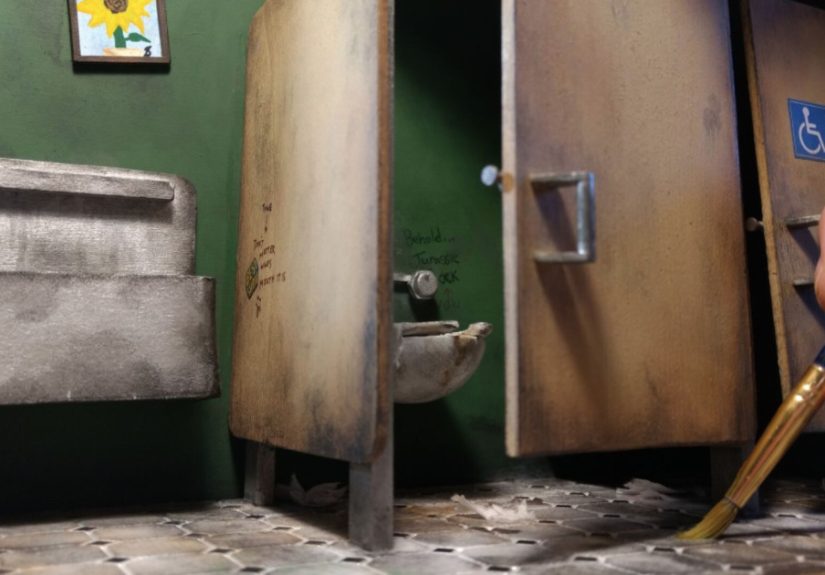
On the darker side of miniature art, the artist duo Lori Nix and Kathleen Gerber create detailed dioramas of post-human interiors and ruined environments. Their scenes may show abandoned classrooms, broken laundromats, damaged theaters, or nature slowly taking over human-made spaces. These are not quick craft-table projects. They are carefully built worlds designed for the camera.
Their work shows how miniatures can hold serious emotional weight. A tiny ruined room can feel more haunting than a full-size set because the viewer becomes both giant and witness. You are looking down at a world that feels fragile, finished, and strangely beautiful. It is disaster in a shoebox, but with museum-level patience.
Thomas Doyle and the Domestic Scene Under Pressure
American artist Thomas Doyle creates miniature scenes that often involve homes, neighborhoods, and suburban landscapes under surreal stress. A house may appear peaceful at first, then reveal collapse, rupture, or impossible physics. His diorama-like works use scale to make domestic life feel both familiar and unstable.
That tension is exactly what gives miniature art its bite. A tiny house is supposed to feel safe. But when it is cracked open, floating, sinking, or trapped in a glass vessel, it becomes a psychological landscape. The viewer is not just admiring detail; they are reading a tiny drama about control, memory, and the weird little earthquakes inside ordinary life.
Museums, Dollhouses, and Fine-Scale Craft
Miniature art is not only a social-media phenomenon. Institutions such as miniature museums, craft museums, and design collections have long treated tiny objects as serious works of skill and imagination. Fine-scale miniatures can include furniture, ceramics, tools, textiles, books, food, interiors, and historical rooms built with astonishing accuracy.
This is where the “badass” label takes on another meaning. Sometimes the attitude is not loud. Sometimes it is the quiet flex of making a tiny drawer that actually opens, a plate the size of a fingernail, or a room so realistic that the viewer forgets it could fit inside a lunchbox. Precision is its own form of swagger.
Why We Love Tiny Worlds So Much
Miniatures attract people because they offer control in a chaotic world. Real life is messy, expensive, loud, and full of emails that begin with “just circling back.” A miniature world, by contrast, can be arranged. It can be lit perfectly. Its weather can be made from cotton. Its citizens do not complain unless you write tiny complaint letters for them, which honestly sounds therapeutic.
Miniatures Make Us Feel Like Giants
Looking at miniatures gives viewers a strange, delightful sense of power. We can see the whole room, the whole street, the whole disaster, the whole joke. That bird’s-eye control is satisfying. At the same time, a good miniature scene pulls us emotionally downward, into the tiny character’s world. We are both giant and guest.
This push and pull is why small-scale art works so well in photography, museums, and storytelling. It creates intimacy without needing a long explanation. One tiny figure waiting beside a massive pencil can suggest work, pressure, ambition, or a very confusing office commute.
They Reward Close Attention
Modern life trains people to scroll quickly. Miniatures politely object. They demand a slower gaze. The first look gives you the scene. The second look gives you the joke. The third look reveals the tiny coffee cup, the handmade sign, the little ladder, the shadow, the texture, or the absurd detail that proves the artist has spent far too much time being brilliant.
That reward system is powerful for readers, viewers, and collectors. Miniatures turn attention into discovery. They make looking feel like a treasure hunt.
They Turn Everyday Objects Into Stories
One of the strongest trends in modern miniature art is the transformation of ordinary objects. Food, tools, paper clips, plants, sponges, coins, keys, and electronics become landscapes. This is not just visual comedy; it is creative reframing. The artist teaches the viewer to ask, “What else could this be?”
That question is the engine of imagination. A paintbrush can be a bridge. A matchbox can be a theater. A cracked eggshell can be a construction site. A stack of books can be a cliffside village where the residents are extremely literary and probably own tiny scarves.
How Badass Miniatures Are Made
Miniature art may look spontaneous, but most of it depends on careful planning. Even the funniest tiny scene needs composition, lighting, scale, and storytelling. Behind the whimsy is a lot of glue, tweezers, patience, and possibly one artist whispering, “Where did the tiny hat go?” at 1:17 a.m.
Materials: The Small Army of Stuff
Common miniature materials include polymer clay, wood, foam board, paper, resin, wire, cardboard, fabric, acrylic paint, model figures, train-set accessories, found objects, and recycled packaging. Some artists build everything from scratch. Others modify existing figures or combine handmade pieces with everyday objects.
The most important material, however, is not clay or paint. It is context. A tiny ladder means nothing by itself. Place it against a stack of pancakes, and suddenly breakfast has OSHA concerns.
Lighting: The Difference Between Toy and Movie Scene
Lighting can make or break miniature photography. Harsh light can expose the fake edges. Soft light can make a tiny world feel believable. Low angles can make small figures feel heroic. Backlighting can add mystery. Shadows can turn a harmless dust bunny into a cinematic fog bank.
Many miniature artists photograph their scenes from the figure’s perspective. This is crucial because it lets the viewer enter the tiny world instead of merely looking at it from above. A paperclip is not impressive from human height. From a tiny construction worker’s viewpoint, it is a steel beam with career opportunities.
Composition: The Tiny Scene Needs a Punchline
A good miniature scene usually has a clear idea. It might be a visual pun, a dramatic contrast, a social observation, or a small narrative. The viewer should understand the basic setup quickly, then enjoy the details afterward.
For example, a tiny person mowing a kiwi fruit works because the green texture resembles grass. A tiny climber scaling a cheese grater works because the object already looks dangerous and mountainous. A tiny office worker lost among keyboard keys works because most people have, at some point, felt personally attacked by a computer.
Miniatures as Social Commentary
Badass miniatures are not always jokes. Many artists use small scenes to talk about large systems: urban alienation, environmental damage, consumer culture, work stress, memory, class, history, and the strange emotional life of domestic spaces. The miniature format can make serious themes easier to approach because it lowers the viewer’s defenses.
A full-size ruined city may feel overwhelming. A tiny ruined room invites curiosity first, then reflection. A miniature protest scene may appear playful, but it can still point toward real questions about public space and civic life. A tiny museum or free neighborhood gallery can challenge the idea that art belongs only in large institutions.
This is where the trouble becomes meaningful. Miniatures interrupt expectations. They sneak ideas into places where people do not expect to find them. They are little visual ambushes, armed with glue and timing.
Why Badass Miniatures Work So Well Online
Miniature art is practically built for the internet. It has instant visual impact, strong shareability, and a built-in “wait, what am I looking at?” factor. A viewer can understand the concept in seconds, but still spend minutes zooming in on the details.
That makes miniature art perfect for blogs, social media, galleries, short videos, and visual storytelling. The format is compact, but the emotional range is huge. It can be cute, eerie, funny, elegant, nostalgic, or philosophical. It also crosses language barriers easily because scale-based humor is universal. Everyone understands that a tiny person using a mushroom as an umbrella is having a more interesting day than we are.
How to Appreciate Miniature Art Like a Pro
You do not need an art history degree to enjoy miniatures. You just need curiosity and a willingness to bend down emotionally, if not physically. The next time you see a miniature scene, ask a few simple questions.
What Changed Scale?
Look at what object has been transformed. Is a snack now a mountain? Is a puddle now an ocean? Is a piece of office equipment now a city? The scale shift is usually the main joke or message.
Where Is the Story?
Miniatures often imply action. Someone is climbing, escaping, waiting, cleaning, hiding, building, relaxing, or causing tiny administrative problems. The best scenes make you imagine what happened before and what might happen next.
What Details Reward a Second Look?
Search for tiny signs, tools, footprints, furniture, shadows, textures, or expressions. Miniature artists often hide their best jokes in the margins. The main idea gets your attention; the details make you stay.
Experience Section: What Tiny Trouble Teaches Us
Spending time with miniature art changes how you see the regular world. After looking at enough tiny scenes, you start noticing potential sets everywhere. The crumb beside your toaster is no longer a crumb. It is a boulder. The charging cable on your desk is no longer a cable. It is a highway, a serpent, a roller coaster, or a suspiciously modern sculpture. Your coffee mug is not a mug; it is a cylindrical apartment complex with caffeine-based weather.
That shift is the real experience behind Badass Miniatures: Causing A Little Trouble. The “trouble” is not chaos. It is imagination refusing to behave. Miniatures encourage us to treat ordinary things as unfinished stories. A used envelope can become a desert. A sponge can become a luxury mattress for exhausted tiny swimmers. A pencil shaving can become a curled wooden slide. The world does not get bigger; your attention gets sharper.
For anyone trying to create their own miniature scene, the first lesson is to start simple. You do not need a professional studio or a heroic budget. Choose one tiny figure, one everyday object, and one clear idea. A miniature person standing beside a cookie is fine. A miniature person mining chocolate chips from a cookie is better. A miniature person running a full cookie-based excavation company with a tiny warning sign is excellent and should probably have a union.
The second lesson is that imperfection helps. Many beginners worry that their handmade props are not clean enough, smooth enough, or realistic enough. But miniature art often thrives on personality. A slightly crooked sign can feel funnier than a perfect one. A rough cardboard wall can look charming with the right lighting. A tiny handmade table that leans a little may look like it has survived a dramatic family history.
The third lesson is to think like a photographer, not only like a maker. A miniature scene may look plain from above but magical from ground level. Put the camera low. Move the light. Change the background. Hide the messy edges. Miniature art is partly sculpture and partly stagecraft. The final image does not have to reveal the entire setup. It only has to sell the tiny world long enough for the viewer’s imagination to move in.
The fourth lesson is to keep the mischief kind. Public miniature art can be delightful when it is respectful, removable, and harmless. A tiny scene tucked into a safe, appropriate place can surprise people without creating problems. The goal is wonder, not cleanup duty. The best tiny trouble makes someone smile, pause, think, or take a closer look at a place they normally ignore.
Finally, miniature art teaches patience in a world obsessed with speed. It asks the maker to slow down and the viewer to slow down too. Cutting a tiny window, painting a tiny chair, arranging a tiny ladder, or waiting for glue to dry may not sound dramatic, but it builds a special kind of attention. That attention is rare. It is also contagious. Once you have seen a good miniature scene, the ordinary world becomes suspiciously full of possibilities.
Conclusion: Small Art, Giant Personality
Badass miniatures prove that size has very little to do with impact. A tiny scene can be funny, eerie, rebellious, beautiful, or unexpectedly deep. It can turn a sidewalk crack into a canyon, a sandwich into a construction site, or a forgotten corner into a miniature stage. The best small-scale art does not ask for attention by being loud. It earns attention by being clever.
In a culture where everything keeps getting bigger, faster, and noisier, miniatures offer a different kind of thrill. They whisper, “Come closer.” Then they reward you with a tiny world that feels alive. Sometimes that world is charming. Sometimes it is unsettling. Sometimes it looks like a group of miniature troublemakers just took over your breakfast. Either way, the message is clear: little art can have a massive attitude.