Table of Contents >> Show >> Hide
- What Is the Royal System Desk Shelf?
- The Big Idea Behind the 1948 Royal System
- Poul Cadovius: The Designer Who Freed the Floor
- Why the Royal System Became a Mid-Century Design Icon
- Materials, Finishes, and Construction
- How to Use the Royal System Desk Shelf in a Modern Home
- Styling Tips for the Royal System Desk Shelf
- Royal System Desk Shelf vs. a Traditional Desk
- Why It Still Feels Relevant Today
- Buying Considerations Before Choosing a Royal System Desk Shelf
- Experience Section: Living With the Royal System Desk Shelf
- Conclusion
Some furniture politely sits in a room. The Royal System – Desk Shelf, 1948 does something far more interesting: it lifts itself onto the wall, clears the floor, and quietly makes the entire space feel smarter. Designed by Danish innovator Poul Cadovius, the Royal System belongs to that rare club of mid-century modern furniture that still looks fresh enough to make today’s “minimalist home office” trends feel like they arrived late to the party.
At first glance, the Royal System Desk Shelf may seem simple: a beautiful wooden surface supported by elegant hangers and mounted on vertical rails. But that simplicity is exactly the magic trick. Behind the clean lines is a deeply practical idea: furniture should adapt to life, not bully it. In 1948, when many homes were still crowded with heavy cabinets, bulky desks, and floor-hogging storage pieces, Cadovius imagined a lighter future. His concept was almost mischievous in its clarity: why should furniture occupy the floor when the wall is sitting there doing absolutely nothing?
The result was one of the most influential wall-mounted shelving systems of the twentieth century. The desk shelf became one of its most useful elements, transforming a section of wall into a compact writing desk, display surface, work zone, or elegant landing pad for books, letters, and the occasional coffee cup that believes it is part of the décor.
What Is the Royal System Desk Shelf?
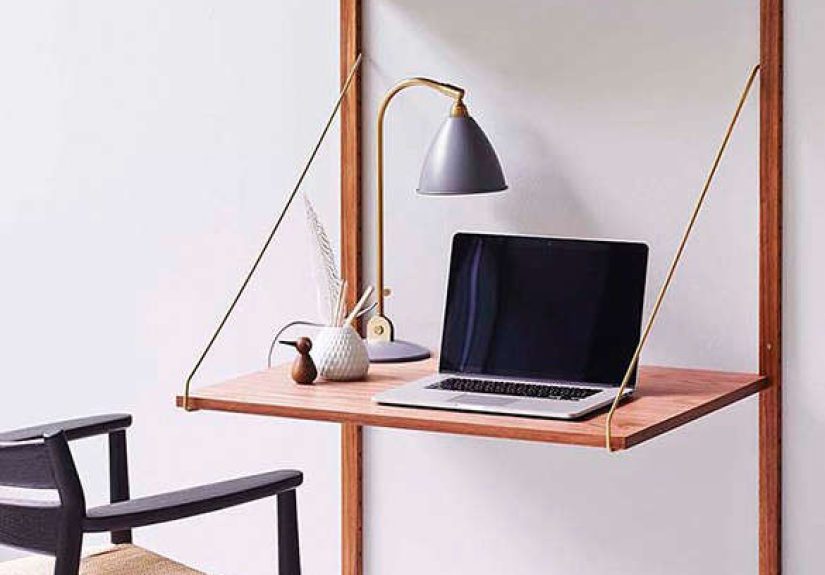
The Royal System Desk Shelf is a component of the larger Royal System shelving collection, originally designed in 1948 by Poul Cadovius and later relaunched by Danish manufacturer dk3. The full system includes wall-mounted rails, shelves, cabinets, drawers, magazine shelves, and work surfaces that can be combined in many configurations. The desk shelf is the deeper shelf designed to function as a writing surface or compact worktop.
Modern versions of the desk shelf are commonly offered in wood finishes such as oak, smoked oak, black lacquered oak, and walnut, with metal hangers available in brass or stainless steel. The proportions are famously efficient: wide enough to be useful, shallow enough to preserve room space, and refined enough to look intentional rather than improvised. It is not a “tiny desk because you ran out of options.” It is a proper design object that happens to be very good at saving space.
The Big Idea Behind the 1948 Royal System
Poul Cadovius had a simple but radical observation: people lived mostly on the bottom of a cube. In other words, the floor carried the furniture, while the walls remained underused. His Royal System challenged that habit by moving storage and work surfaces upward. This was not merely a visual preference; it was a practical strategy for making interiors feel lighter, cleaner, and more flexible.
In postwar Europe, and later in modern apartments around the world, flexibility mattered. Homes were changing. Rooms needed to perform multiple jobs. A living room might also be a study, a library, a record-listening corner, or a place to pay bills before online banking made us all invent worse passwords. The Royal System answered this shift with modularity. You could start with a few shelves and add a desk, cabinet, drawer unit, or additional bay as your needs changed.
A Wall-Mounted Desk Before Wall-Mounted Desks Were Cool
Today, wall desks are popular among apartment dwellers, remote workers, students, and anyone trying to make a spare corner behave like a productive office. But Cadovius anticipated this need decades ago. The Royal System Desk Shelf works because it does not pretend to be a massive executive desk. Instead, it offers a focused surface for writing, reading, laptop work, sketching, or organizing daily essentials.
That makes it especially relevant in modern homes where square footage must earn its keep. A traditional desk announces itself as a piece of furniture. The Royal System Desk Shelf feels more architectural. It becomes part of the wall, part of the room’s rhythm, and part of a larger storage composition.
Poul Cadovius: The Designer Who Freed the Floor
Poul Cadovius was one of the most inventive figures in Danish furniture design. Originally trained as an upholsterer, he became a designer, manufacturer, and entrepreneur with a remarkable instinct for systems. His career was not limited to a single chair or table. He thought in modules, mechanisms, production methods, and everyday behavior. That may sound less romantic than sketching a chair in a sunlit studio, but it is exactly why his work remains useful.
The Royal System became one of his greatest successes because it combined Danish craftsmanship with industrial logic. It looked warm and refined, yet it could be produced, shipped, installed, rearranged, and expanded. It was beautiful, but not precious. It was practical, but not boring. That balance is the sweet spot where Danish modern design tends to shine.
Why the Royal System Became a Mid-Century Design Icon
The Royal System did not become famous simply because it was attractive, although it certainly had the cheekbones for it. It became important because it solved several problems at once.
1. It Saved Floor Space
By mounting the desk shelf and storage components on the wall, the Royal System made rooms feel larger. In small apartments, this is not a luxury; it is survival. A floating desk keeps the floor visually open, which helps a room feel less crowded. Even in larger interiors, the system creates a sense of lightness that bulky furniture often cannot match.
2. It Was Modular and Adaptable
The Royal System was designed as a family of parts. Rails, shelves, hangers, cabinets, and desk surfaces could be combined in different ways. This meant the system could serve as a home office, library wall, media unit, dining room storage area, or bedroom workspace. One design could live many lives, which is a very polite way of saying it had commitment issues in the best possible sense.
3. It Balanced Craft and Efficiency
Danish modern furniture is often admired for its use of natural materials, clean forms, and human-centered proportions. The Royal System fits beautifully into that tradition. The wood brings warmth. The metal hangers add precision. The structure is rational without feeling cold. It is the kind of furniture that can hold a stack of design books and still look as if it has read them.
4. It Made Storage Look Elegant
Storage furniture often falls into two categories: useful but clunky, or stylish but suspiciously unable to hold anything heavier than a postcard. The Royal System avoids both traps. Its shelves and cabinets are meant for real use, while the floating composition keeps the look refined. The desk shelf adds a working surface without destroying the visual calm of the wall.
Materials, Finishes, and Construction
The Royal System Desk Shelf is typically made with veneered wood surfaces and solid wood rails, depending on the current component and finish. Popular options include oak and walnut, both classic choices in mid-century modern furniture. Oak feels lighter, more Scandinavian, and relaxed. Walnut feels deeper, warmer, and slightly more dramatic, like it owns a record collection and knows which jazz album to play first.
The hangers are a key visual detail. Brass hangers add warmth and a subtle vintage glow, especially against walnut or smoked oak. Stainless steel hangers create a cleaner, more contemporary expression. Neither choice is wrong; the decision depends on the room. Brass leans warmer and more traditional-modern. Stainless steel feels crisp, architectural, and understated.
Because the system is wall-mounted, installation matters. The rails must be properly fixed to a suitable wall structure, and the shelf should be loaded within recommended limits. This is furniture, not a circus act. Treat the installation seriously, and the system rewards you with years of stable, flexible use.
How to Use the Royal System Desk Shelf in a Modern Home
The best thing about the Royal System wall-mounted desk is that it does not demand a dedicated office. It can slip into places where a traditional desk would feel too heavy or awkward. That makes it particularly useful for contemporary interiors, where open-plan living and remote work have turned every room into a potential workspace.
Small Apartment Home Office
In a small apartment, the desk shelf can turn a living room wall into a compact office. Add a shelf above for books, a small cabinet for supplies, and a comfortable chair that can be moved away when work is finished. The room remains open, and the desk does not become a permanent obstacle course.
Bedroom Writing Corner
The Royal System Desk Shelf also works beautifully in a bedroom. It can serve as a writing desk, vanity, or quiet reading surface. Because it floats, it feels lighter than a standard desk, which helps preserve the calm atmosphere bedrooms desperately need after a long day of being filled with laundry you promised to fold yesterday.
Living Room Display and Work Zone
In a living room, the desk shelf can be part of a larger shelving arrangement. Use upper shelves for books, ceramics, framed art, or plants. Use the desk shelf for a laptop, notebook, or record player setup. Add closed storage if you want to hide cables, papers, and other evidence that real life exists.
Entryway Command Center
For a more unexpected use, install the desk shelf in an entryway. It can become a landing zone for keys, mail, sunglasses, and small daily items. Pair it with a drawer or cabinet, and suddenly the entry becomes organized instead of becoming the household museum of misplaced objects.
Styling Tips for the Royal System Desk Shelf
The Royal System looks best when it has room to breathe. Because the design relies on slim lines and open space, overcrowding the shelves can make the system lose its elegance. Think curated, not crammed. A few books stacked horizontally, a small lamp, a ceramic bowl, and one sculptural object can do more than twenty tiny accessories shouting for attention.
For a classic mid-century modern look, pair walnut with brass, warm neutral walls, a leather or woven chair, and a simple task lamp. For a brighter Scandinavian feel, choose oak with stainless steel, white walls, pale textiles, and natural greenery. For a contemporary gallery-like approach, use black lacquered oak with minimal accessories and strong artwork nearby.
Cable management is important if the desk shelf is used for laptop work. A beautiful wall system can be quickly humbled by a tangle of cords dangling below it like electronic spaghetti. Use cable clips, wall channels, or a nearby outlet strategy to keep the look clean.
Royal System Desk Shelf vs. a Traditional Desk
A traditional desk offers storage, surface area, and a strong furniture presence. That can be wonderful in a dedicated office. But in a shared room, guest room, or apartment, it can also feel heavy. The Royal System Desk Shelf offers a different kind of value. It is best for people who want a useful work surface without adding bulk.
It is not the ideal choice for someone who needs multiple monitors, heavy equipment, or deep drawers within arm’s reach. But for writing, laptop work, reading, planning, sketching, and light daily tasks, it is excellent. It gives you enough desk to work, enough shelf to organize, and enough visual elegance to make you clean up before guests arrive.
Why It Still Feels Relevant Today
The Royal System Desk Shelf remains relevant because it solves a problem that never went away: people need more function from less space. Modern homes are filled with hybrid activities. We work from home, stream entertainment, collect books, display objects, manage paperwork, and pretend we will eventually sort the drawer full of mystery cables. A modular wall system helps bring order to that reality.
Its longevity also comes from its restraint. The Royal System does not rely on trend-heavy shapes or decorative gimmicks. It uses proportion, material, and flexibility. That is why it can sit comfortably in a mid-century modern home, a Scandinavian apartment, a contemporary loft, or a restored historic interior. It has enough character to be noticed and enough discipline not to dominate.
Buying Considerations Before Choosing a Royal System Desk Shelf
Before purchasing a Royal System Desk Shelf, measure carefully. Consider the width of the wall, the height of the rails, the chair clearance, and how much space you need between shelves. Think about whether you want the desk shelf alone or as part of a larger system. A single desk shelf can be elegant, but the Royal System truly shines when its modular logic is allowed to work.
Also consider finish compatibility. Walnut and brass create a warm, heritage-rich look. Oak and stainless steel feel lighter and more modern. Black lacquered oak can look striking in a minimalist or high-contrast room. If you already own mid-century furniture, choose a finish that complements rather than competes with existing wood tones.
Finally, plan the installation. Wall-mounted furniture depends on proper support. The Royal System may look effortless once installed, but that effortlessness comes from careful alignment, secure fastening, and respect for weight limits. In design, as in life, floating gracefully usually requires good behind-the-scenes engineering.
Experience Section: Living With the Royal System Desk Shelf
Using the Royal System Desk Shelf feels different from using an ordinary desk. The first thing you notice is the floor. More specifically, you notice that you can see it. This may not sound thrilling, but in a compact room, visible floor space is practically a luxury amenity. A standard desk can create a visual block, while the Royal System keeps the lower part of the wall open. The room feels calmer before you have even opened your laptop.
There is also a pleasant ritual to working at a wall-mounted desk. Because the surface is defined and relatively compact, it encourages discipline. You do not spread papers across six square feet and call it “creative energy.” You choose what belongs there: laptop, notebook, pen, lamp, maybe a small plant that has been given strict instructions not to die. The limited surface becomes an advantage. It nudges you toward clarity.
The desk shelf is especially satisfying in morning light. Oak finishes can brighten a room, while walnut gives the wall a rich, grounded feeling. Brass hangers catch a little glow without becoming flashy. Stainless steel hangers, on the other hand, almost disappear into the structure, creating a more technical and modern impression. Either way, the design rewards small details. A well-chosen chair, a ceramic cup, or a framed print nearby can make the whole setup feel personal.
For remote work, the desk shelf is best suited to focused tasks rather than equipment-heavy setups. It is excellent for writing, answering emails, reviewing documents, taking calls, and reading. It may not be ideal for someone who needs three monitors, a printer, a microphone arm, and enough gadgets to launch a small satellite. But for many people, that is the point. The Royal System Desk Shelf creates a boundary between work and home. When the laptop closes, the surface returns to being part of the room rather than a permanent office invasion.
One of the most enjoyable experiences is reconfiguring the system over time. A shelf above the desk may begin as a place for books, then become a display area for ceramics, then later hold storage boxes or speakers. A cabinet can be added when paperwork multiplies, as paperwork tends to do when left unsupervised. This flexibility makes the Royal System feel less like a fixed purchase and more like a long-term design companion.
The system also changes how guests perceive a room. People often notice it not because it is loud, but because it is quietly clever. It has the charm of vintage design without feeling like a museum piece. It suggests taste, practicality, and a person who has made at least one excellent decision about wall storage. That is a powerful combination.
Living with the Royal System Desk Shelf ultimately proves why good design lasts. It does not merely decorate a room. It improves daily habits. It saves space, organizes essentials, frames beautiful objects, and creates a work surface exactly where one is needed. More than seventy years after its 1948 debut, it still feels like a solution for modern life. The floor is free, the wall is useful, and the desk is ready. Poul Cadovius would probably approveand perhaps remind us, with a wink, that the wall was available all along.
Conclusion
The Royal System – Desk Shelf, 1948 is more than a handsome piece of Danish modern furniture. It is a design idea that continues to solve real problems: limited space, visual clutter, changing routines, and the need for flexible home work areas. Poul Cadovius created a system that moved furniture off the floor and onto the wall, but the larger achievement was emotional as much as practical. The Royal System makes a room feel lighter, smarter, and more intentional.
For anyone interested in mid-century modern shelving, Danish wall-mounted desks, or compact home office ideas, the Royal System Desk Shelf remains a benchmark. It proves that functional furniture can be elegant, modular design can be warm, and a desk does not need four legs to stand the test of time.
Note: Original article written in standard American English, synthesized from reputable design, furniture, and product references, with no copied passages or publishing artifacts.