Table of Contents >> Show >> Hide
Underwater couples photography lives in that delicious little space between romance and chaos. It is dreamy, elegant, cinematic, andlet’s be honestoccasionally one nose-full of pool water away from becoming slapstick. That tension is exactly why the best images feel so unforgettable. They do not look staged in the usual sense. They look suspended, borrowed from a world where gravity took the day off and love learned how to float.
That is the magic of photographing couples underwater. The water softens movement, stretches fabric into poetry, turns sunlight into ribbons, and forces every pose to become simpler, slower, and more intentional. On land, a photographer can talk nonstop, fix a hand, rotate a chin, and micro-manage every eyelash. Underwater, control is suddenly on vacation. You get a few seconds, one breath, one drift, one flash of connectionand then the moment is gone. Honestly, it is a little rude. Also beautiful.
Over the years, underwater portraiture has moved from niche fine-art work into a style that now shows up in fashion, maternity, editorial projects, destination wedding galleries, and post-wedding “trash the dress” sessions. There is a reason it keeps resurfacing: couples underwater photos do not just document what two people look like. They reveal how two people move together when the world gets weird.
Why underwater couples photography feels so different
Water changes almost everything a photographer relies on. Light behaves differently. Color disappears faster than you want it to, especially the warm tones that make skin look alive. Tiny particles floating in the water become surprise guests in the frame. Even the best swimmers discover that “looking natural” while holding a pose, keeping their eyes soft, and not puffing their cheeks like nervous chipmunks is a genuine skill.
And yet, these challenges are exactly what make the genre so compelling. Because photographers often need to work close with wide lenses, the images feel intimate. Because strong lighting and careful angles matter so much, the final photos have a sculpted, almost painterly quality. Because breath is limited, couples tend to rely on instinct rather than overthinking. The result is often more honest than an over-directed portrait session on land.
That is also why my favorite underwater shots are never just about technical perfection. Sure, sharp focus helps. A reliable housing helps even more, especially if you enjoy not drowning your camera. But the photos that stay with people are the ones where emotion survives the medium. The water can add drama, but the connection has to do the heavy lifting.
What my favorite underwater shots usually have in common
1. The almost-surface kiss
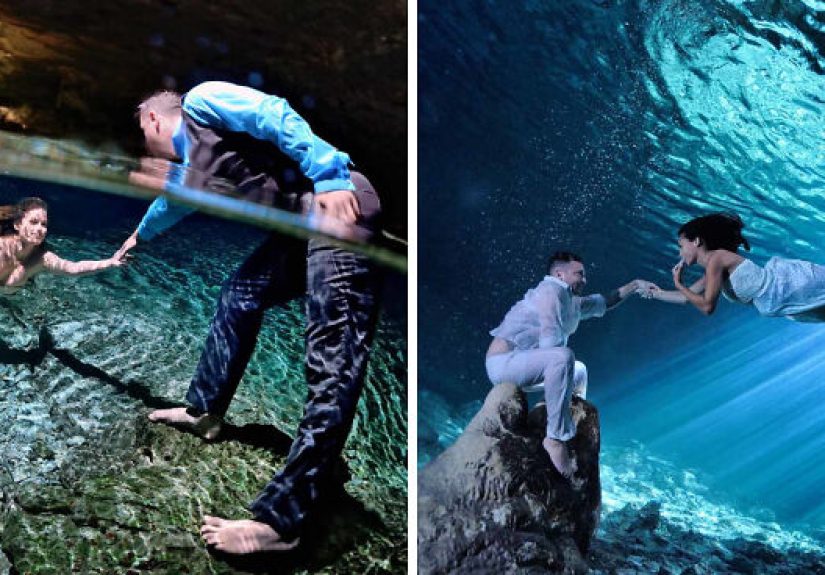
This is one of the classic underwater couples photos for a reason. When two people hover just below the surface, the frame gets everything at once: soft reflections, a hint of rippling light, and the strange illusion that the couple is floating between two worlds. It feels romantic without trying too hard. It also flatters movement, because the surface gives the scene structure even when everything else is drifting.
The trick is that this shot only looks effortless. In reality, it depends on timing, breath control, and couples who trust each other enough not to panic when their hair goes rogue. The best versions are usually simple: relaxed hands, slightly angled bodies, and no frantic kicking. If the couple looks calm, the photo feels expensive. If they look like they are auditioning for a lifeguard rescue video, not so much.
2. The floating dress shot
Fabric underwater is basically a co-author. A dress, veil, or sheer wrap can turn an ordinary pose into something theatrical in half a second. This is why underwater wedding and post-wedding portraits remain so popular. A white gown against blue or teal water creates instant contrast, and fabric expands into shapes that would be impossible on land without three assistants and a fan strong enough to power a small airport.
Some of the strongest examples in wedding media lean into this on purpose. Underwater newlywed portraits and “trash the dress” sessions keep showing up because the dress becomes part of the choreography. It trails, frames, curls, and catches light. It can make one still moment look like a moving scene from a dream.
3. The face-to-face drift
Not every underwater image needs a kiss. Sometimes the best shot is just a couple drifting toward each other, foreheads close, eyes open, hands barely meeting. Underwater romance photography works best when it leaves a little breathing roomfiguratively, because literally there is less of that available.
This type of image lets body language carry the frame. It is especially effective because the water strips away the usual distractions. There is no busy venue, no awkward furniture, no random uncle wandering into the background. There is just space, light, and two people trying not to laugh bubbles into each other’s faces.
4. The hand-hold descent
This is the shot that feels like a story. One partner leads, the other follows, and together they sink into the blue with just enough motion to suggest adventure. It works beautifully in pools, cenotes, and calm open water because it gives the viewer direction. Instead of a static portrait, you get narrative. They are not just posing. They are going somewhere.
Technically, this is also where wide-angle lenses earn their paycheck. Getting closer reduces the amount of water between the camera and the couple, which helps with clarity and cuts some of the visual murk. It also makes the image feel immersive instead of distant.
5. The backlit silhouette
Some of my favorite underwater shots are the simplest: two figures, strong shape, bright water above, darkness below. A backlit silhouette turns the couple into graphic design with emotions. It is bold, clean, and dramatic in a way that never feels cheesy.
This style works because underwater light is already theatrical. Sunlight breaking through ripples creates natural beams, gradients, and halos that would cost a fortune to imitate in a studio. Photographers often spend plenty of time fighting water’s quirks, but every so often the water decides to be generous and hands you a scene that looks custom-built for romance.
6. The genuine laugh underwater
Now we arrive at my personal favorite kind of success: the shot that was not supposed to be the hero image, then absolutely steals the show. Maybe someone surfaces too early. Maybe a partner opens their eyes and realizes the other person’s hair has transformed into a sentient sea creature. Maybe they try one more dip and come up laughing. Those frames are gold.
Underwater sessions can feel highly stylized, so a burst of real humor keeps the work from becoming too polished to breathe. Some of the best couples photography underwater succeeds precisely because it balances grace with playfulness. Romance is lovely. Romance with personality is better.
7. The open-water wild card
Pool sessions offer control, but open water offers wonder. When conditions cooperate, photographing couples in the ocean or a clear freshwater location can create images with scale, texture, and unpredictability that no pool can fully match. Wildlife in the distance, shafts of natural light, suspended particles glowing like dust in a cathedralit all adds atmosphere.
Of course, open water also demands respect. Currents, cold, visibility, depth, and safety all matter more than the shot. The smartest photographers know that underwater portraiture is not about overpowering the environment. It is about collaborating with it. On a good day, the ocean gives you poetry. On a bad day, it gives you a lesson in humility and a fresh appreciation for safety planning.
8. The post-wedding plunge
There is something delightfully rebellious about taking formal wedding energy and tossing it straight into the water. Post-wedding underwater portraits have become such a memorable offshoot of wedding photography because they let couples loosen up after the timeline pressure is gone. No guests waiting. No cake melting. No coordinator whispering about sunset. Just two people, a dress, a suit, and a photographer hoping nobody loses a shoe to the deep.
It also helps that the visual payoff is huge. Underwater wedding imagery feels romantic, unconventional, and slightly cinematic in the best possible way. It is the kind of work people do not scroll past quickly because it immediately asks a question: how did they even make that?
The technical side that quietly makes the magic possible
The prettiest underwater couples portraits are usually built on unglamorous decisions. A sturdy housing matters. So does water quality. Clear water is not a luxury; it is the difference between dreamy and disappointing. Photographers who work underwater learn fast that a pool can look crystal clear to the human eye and still photograph like a bowl of expensive soup.
Lighting is another make-or-break element. Underwater, good light does more than brighten a subjectit restores color, shapes faces, and helps separate the couple from the haze. Angled light is often more flattering than blasting straight ahead, because direct light can illuminate every floating particle between the lens and the subject. That is how backscatter sneaks in and turns your romantic masterpiece into a star field nobody asked for.
Color correction matters later too. Underwater images often come out blue or green because warm tones disappear first. That is why shooting in RAW is such a gift. It gives the editor room to rebuild skin tones, recover lost warmth, add clarity, reduce haze, and clean up particles without mangling the file. Great underwater photography is born in the water, but it often becomes fully itself during careful post-production.
And then there is the human side: comfort, breath, communication, and safety. The strongest sessions are rarely with the most athletic couples. They are with the most relaxed couples. People who stay calm in water move more beautifully. Models with underwater experience are a dream, but even beginners can create lovely images if they understand the pace, trust the photographer, and know they can surface anytime. A graceful frame is never worth sacrificing comfort or safety. Never.
What 21 years around underwater romance teaches you
The longer you look at underwater couples photography, the more obvious one truth becomes: the water is not the subject. The couple is. Water is the translator. It exaggerates tenderness, exposes tension, and rewards patience. It turns a small touch into a visual event. It makes stillness look dramatic and movement look lyrical. But it cannot invent connection that is not there.
That is why my favorite shots are never the ones with the most props, the biggest dress, or the fanciest location. They are the ones where two people look like they forgot the camera existed for half a second. Underwater, half a second is basically a lifetime.
500 extra words on the experience behind these images
If there is one thing years of underwater portrait work teach you, it is that every session begins long before anyone goes under. It begins in the conversation. You learn what kind of couple you have. Are they playful? Quiet? Competitive? Glamorous? Nervous? The answers matter because underwater photography magnifies personality. A bold couple can handle a dramatic descent or a sweeping fabric shot. A shy couple may create better work with simple hand-holding near the surface, where they can rise easily and reset. Good photographers do not force every pair into the same visual template. They read the roomor in this case, the pool.
You also learn that communication underwater is less about words and more about preparation. Hand signals become a language. One signal means “turn your face toward the light.” Another means “slow down.” Another means “surface now.” If that sounds unromantic, welcome to reality. The funny thing is that structure is what allows the romance to happen. When couples know what to expect, they relax. When they relax, their bodies soften. When their bodies soften, the images stop looking like a survival challenge and start looking like art.
Experience also teaches you to become obsessed with tiny details that viewers never consciously notice. Hair is one of them. Underwater, hair can look glorious or unhinged, sometimes in the same second. Fabric is another. Heavy materials sink like guilt; lighter fabrics drift like a dream. Makeup needs to hold. Eyes need a moment to adjust. Even the way a couple enters the water can affect the mood of the entire session. A calm entry creates calm energy. A frantic splash-fest usually creates photos with startled expressions and a photographer silently bargaining with the universe.
Then there is endurance. Underwater portrait sessions look graceful in the final gallery, but the process is full of repetition. Surface. Breathe. Reset. Go again. Try a softer hand. Fix the veil. Wait for the ripples to settle. Check the housing. Wipe the dome. Repeat until magic happens. This is why patience is not just helpful in underwater photography; it is practically part of the equipment list. Couples who understand this usually end up with the best galleries because they stop chasing a perfect single frame and start trusting the process.
And maybe that is the biggest lesson of all. Underwater couples photography is not memorable because it is difficult. It is memorable because difficulty strips away performance. When people have limited time, limited breath, and no control over gravity, they stop over-posing. They lean on instinct. They reach for each other. They laugh when something goes sideways. They become present. That presence is what makes the final images feel alive. The favorite shots are never just underwater. They are honest, suspended for one impossible moment, and somehow still full of air.
Conclusion
Underwater couples photography endures because it transforms romance into atmosphere. It blends technique with trust, beauty with unpredictability, and elegance with the occasional gloriously awkward reset. The favorite shots are not simply pretty. They feel weightless, intimate, and emotionally charged because the water strips the portrait down to its essentials: light, movement, and connection.
That is why these images keep captivating audiences year after year. Whether it is a newlywed plunge, a drifting embrace, a veil blooming around a bride, or a laugh breaking through a carefully planned pose, underwater portraiture offers something rare in modern photography: surprise. And when surprise meets tenderness, you do not just get a good picture. You get a frame people remember.