Table of Contents >> Show >> Hide
History loves a straight line. Real people, meanwhile, tend to be gloriously messy. That mismatch is one reason queer history often gets flattened, erased, or filed away under the world’s most suspicious label: “close friendship.” In many eras, people didn’t use modern words like gay, lesbian, bisexual, or queer the way we do now, so looking back requires care. Still, letters, poems, diaries, gossip, portraits, police records, and the occasional panicked editor have a funny way of leaving breadcrumbs.
So no, this is not a dramatic attempt to slap 21st-century labels onto everybody who ever wrote a dramatic letter. It is an invitation to notice that the historical record is often more rainbow-tinted than school textbooks suggest. Some of the figures below were almost certainly queer by modern standards. Others remain debated cases, with evidence that is suggestive rather than courtroom-level definitive. Either way, they were all a little less buttoned-up than the standard classroom version.
Let’s open the archive closet door and see who’s been standing in there all along.
1. Abraham Lincoln
Lincoln is one of the most debated names in conversations about queer history, and for good reason. During his early adulthood in Springfield, he shared a bed for years with close friend Joshua Speed. On its own, that fact proves very little; bed-sharing among men in the 19th century was far more common and less automatically sexualized than it would be today. Still, the emotional intensity of Lincoln’s letters to Speed has kept historians talking.
What makes this case interesting is not a single smoking gun, but the combination of deep attachment, affectionate language, and Lincoln’s visible anguish during periods of separation. Some scholars argue this was simply an intense male friendship in a different cultural context. Others think it may point to a romantic or erotic dimension we can’t fully recover. The most honest takeaway is that Lincoln’s inner life was probably more complicated than the marble statue version suggests.
In other words, Honest Abe may also deserve a little historical side-eye and a footnote that reads: “It’s complicated.”
2. James Buchanan
If Lincoln is the debated entry that launches a thousand arguments, James Buchanan is the one that launches a thousand raised eyebrows. America’s only lifelong bachelor president had an intensely close relationship with William Rufus King, a fellow politician who lived with him for years in Washington. Their bond was so notable that contemporaries joked about it, which is about as subtle as history gets before it starts waving a fan dramatically.
Now, caution still matters. Historians disagree about whether Buchanan should be labeled America’s first gay president. But the speculation did not come out of nowhere. His unusual lifelong bachelorhood, his emotional closeness with King, and the gossip of their own era all make him a compelling case. Even if we never get a diary entry saying, “Dear journal, it is exactly what it looks like,” Buchanan’s story is one of the strongest reminders that queer possibility has always existed in political history.
3. Eleanor Roosevelt
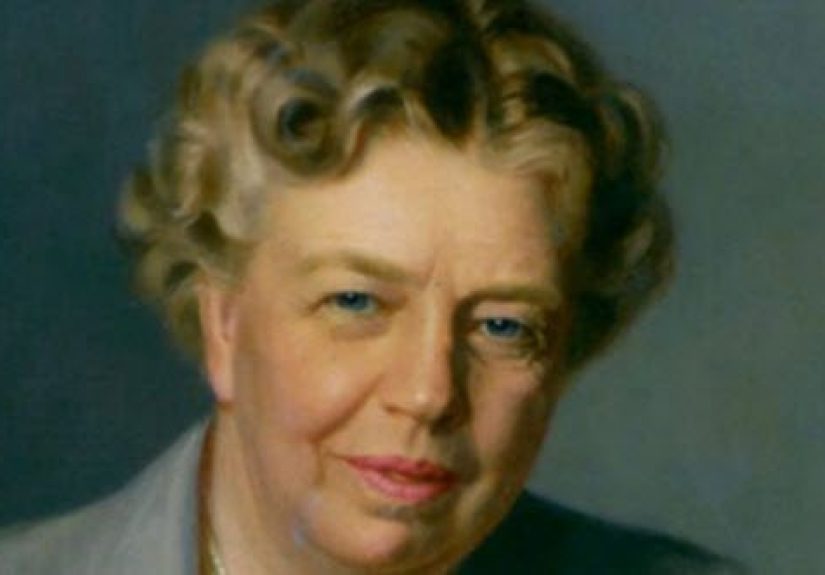
Eleanor Roosevelt’s relationship with journalist Lorena Hickok has inspired decades of discussion, and unlike some of the foggier cases on this list, this one comes with receipts. The two women exchanged a huge body of deeply intimate correspondence, and historians have long noted the emotional and romantic intensity in those letters. Some of the most explicit material was reportedly destroyed, which is both very on-brand for the era and very rude to future researchers.
What survives is still enough to suggest that Hickok was not just a dear pal who happened to get the deluxe emotional package. Their relationship appears to have been central to Eleanor’s life, especially during years when her marriage to Franklin Roosevelt was politically functional but personally complicated. That does not reduce Eleanor Roosevelt to one relationship; if anything, it makes her feel more fully human. The global human-rights icon was also a woman with longing, attachment, and a private life that did not fit neatly into First Lady stereotypes.
4. Walt Whitman
Walt Whitman practically writes himself onto a list like this. The poet of body, soul, comradeship, and cosmic sideburn energy had a significant relationship with Peter Doyle, a streetcar conductor he met after the Civil War. Whitman’s letters and recollections about Doyle are tender, affectionate, and difficult to shrug off as merely casual. Their bond lasted for years, and many scholars view Doyle as Whitman’s most important intimate companion.
Of course, Whitman also made an art form out of emotional excess. The man could make buying fruit sound spiritually charged. But his poetry and personal correspondence alike show a sustained erotic and emotional investment in men. Whether one uses the label gay, bisexual, or queer, Whitman belongs in any serious conversation about same-sex desire in American literary history. Basically, if anyone in the 19th century was out here writing homoerotic vibes into the national poetic bloodstream, it was Walt.
5. Leonardo da Vinci
Leonardo da Vinci is often introduced as painter, inventor, scientist, genius, notebook enthusiast, and patron saint of doing twelve projects at once. Less commonly noted in casual conversation: historians have long debated his sexuality, and many believe he was gay. As a young man in Florence, Leonardo was accused of sodomy in 1476. The charges were dismissed, but the incident remains part of the historical record.
He never married, never had children, and spent much of his life in the company of male assistants and companions. None of that alone settles the matter, but when paired with historical context and long-standing scholarly interpretation, it paints a suggestive picture. Leonardo also lived in a world where same-sex desire had to navigate danger, reputation, and law. So while modern certainty is impossible, the idea that he may have loved men is hardly fringe speculation. It is part of mainstream historical discussion now, and frankly, the Renaissance was not exactly a desert of coded longing.
6. Michelangelo
Michelangelo may be the clearest artistic example of “the evidence is literally in the poems.” He wrote passionately about Tommaso de’ Cavalieri, a young Roman nobleman he adored, and he created gift drawings for him that have been interpreted as intensely homoerotic. Later editors even changed masculine pronouns in Michelangelo’s poems to feminine ones, which is a classic move in the long-running historical game called “let’s pretend this says something else.”
Modern scholars are much less willing to play along. While it is difficult to pin down the exact physical nature of Michelangelo’s relationships, the emotional and erotic charge directed toward men is hard to miss. His case is a reminder that queer history is not always hidden because it was absent; sometimes it was hidden because later generations took out a linguistic mop and started scrubbing. Michelangelo was a titan of Western art, yes, but he also appears to have been a man whose heart leaned unmistakably toward men.
7. James Baldwin
Many readers know James Baldwin as a towering essayist on race, religion, exile, and American hypocrisy. Fewer people realize how centrally sexuality shaped both his life and his writing. Baldwin was a gay Black writer who spoke and wrote with extraordinary candor about desire, identity, vulnerability, and the brutal limits society tried to impose on him. His fiction did not tiptoe around taboo subjects; it walked straight into them and rearranged the furniture.
The reason Baldwin fits this list is not because his sexuality is mysterious. It is because public memory often trims him down into a more “acceptable” civil-rights sage, as though his queer identity were a side note instead of one of the engines of his insight. Baldwin understood what it meant to be watched, judged, and misread, and that experience sharpened his moral voice. If you only know him as a brilliant commentator on race, you are missing a major part of what made his brilliance so piercing in the first place.
8. Bayard Rustin
Bayard Rustin helped organize the 1963 March on Washington, advised civil-rights leaders, championed nonviolence, and spent decades pushing America toward a more honest democracy. He was also openly gay at a time when that fact was weaponized against him by allies and enemies alike. That tension is a huge part of why he remains less widely known than many figures he helped elevate.
Rustin’s sexuality wasn’t a rumor tucked into a dusty archive; it shaped his public life in direct, painful ways. He was often pushed behind the scenes because movement leaders feared homophobic backlash. Yet he kept working, kept organizing, and kept insisting that justice was indivisible. His story belongs here because so many people still meet Rustin first as “an organizer” and only later learn that he was one of the most important openly gay figures in 20th-century American political history. Hidden in plain sight, meet historical irony.
9. Lorraine Hansberry
Lorraine Hansberry is usually introduced as the groundbreaking playwright behind A Raisin in the Sun, which is true and important. But that summary often leaves out another truth: Hansberry privately identified with lesbian life and explored that identity in her writing and social world. Before the broader public caught up, she was already wrestling with the complexities of being Black, female, intellectually fierce, and queer in mid-century America.
That context adds tremendous depth to her work. Hansberry’s sensitivity to confinement, identity, and the fight to live truthfully did not come from nowhere. Her life shows how queer history often survives in fragments: letters, essays, circles of friends, pseudonymous writing, and the testimony of people who knew what official culture refused to say out loud. She wasn’t simply ahead of her time. She was living several truths at once while a more timid society tried to pretend those truths did not belong in the same room.
10. Gladys Bentley
If some people on this list come with careful scholarly hedging, Gladys Bentley arrives wearing a tuxedo and kicking the door open. The Harlem Renaissance performer was famous for her swagger, her piano playing, her gender-bending stage persona, and her open relationships with women. In an era that tried to police everything from hemlines to human feeling, Bentley made queerness visible, loud, and musically gifted.
She performed in men’s clothing, played with gender expectations in public, and built a persona that thrilled audiences while scandalizing respectable culture. Later in life, she faced pressure to conform to more conservative norms, which complicates her story rather than simplifying it. But that complexity is exactly the point. Queer history is not a straight march from repression to freedom. Sometimes it zigzags through performance, reinvention, backlash, and survival. Gladys Bentley did not merely hint at queer possibility. She put it onstage and made it swing.
Why This History Still Feels Personal
One reason topics like this resonate so strongly is that reading queer history can feel weirdly intimate. You start with a famous portrait, a textbook paragraph, or a name carved into marble. Then you find a letter, a poem, or a relationship that changes the emotional temperature of the whole story. Suddenly that figure is not just a monument. They are a person negotiating affection, secrecy, loneliness, risk, desire, reputation, and the exhausting choreography of public versus private life.
That experience matters because many readers, especially queer readers, know what it is like to read between lines. You learn to notice what is implied but not spoken. You recognize coded language, strategic silences, the too-close “friendship,” the letters that were burned, the pronouns an editor quietly swapped, the biographer who calls something “devotion” with the nervous energy of someone carrying a fragile vase across an icy driveway. Historical research can feel like decoding a long family text thread where everyone refuses to say the obvious thing.
There is also something comforting about discovering that queer life did not suddenly appear in the modern era like a software update. It was always here. In palaces, boarding houses, artist studios, protest movements, Harlem nightclubs, newspaper offices, and cramped Washington rooms with one too few beds, people kept finding ways to love, attach, perform, grieve, and imagine themselves. Not always safely. Not always happily. But persistently.
At the same time, this history teaches humility. Not every intense friendship was secretly romantic. Not every unmarried person was queer. Sometimes the most respectful thing we can say is that the archive leaves room for possibility rather than certainty. That restraint is not a weakness. It is part of taking the past seriously. The goal is not to “claim” people like collectibles. The goal is to notice where older narratives were too narrow, too sanitized, or too eager to erase complexity.
And maybe that is the real payoff of reading history this way. It trains us to be suspicious of tidy stories. It reminds us that human identity rarely fits clean boxes, especially when law, religion, custom, and danger are pressing down on it from all sides. These figures are fascinating not because they make history more scandalous, but because they make it more human. They show that the past was not populated by cardboard cutouts marching in orderly rows. It was populated by real people with inconvenient feelings, inconvenient attachments, and lives that often overflowed the labels available to them.
Which, honestly, may be the most historically accurate thing of all.
Conclusion
The point of revisiting these ten figures is not to turn history into a guessing game or a gossip column with better hair. It is to acknowledge that the past has always contained more sexual and emotional diversity than standard narratives admit. Some of these figures were almost certainly queer. Others remain beautifully, frustratingly debated. But together they reveal a larger truth: historical memory has often been edited to look straighter than history really was.
Once you start noticing that pattern, you see it everywhere. And once you see it, the past gets a lot more interesting.