Table of Contents >> Show >> Hide
- What Is the Kuroshio Current?
- How Could a Shipwrecked Sailor Cross the Pacific?
- Japanese Castaways and the Black Current
- Why the Kuroshio Was So Dangerous for Traditional Boats
- The Current as a Hidden Bridge Between Japan and North America
- Ocean Science Behind the Survival Stories
- Why These Stories Still Matter
- Experiences That Bring the Black Current to Life
- Conclusion: The Ocean Highway That Changed Lives
Note: This article is written from synthesized historical and oceanographic research on the Kuroshio Current, North Pacific circulation, Japanese castaways, marine debris drift, and documented Pacific survival stories. Source links are intentionally omitted for clean web publication.
Long before GPS, satellite phones, orange life jackets, and the suspiciously optimistic phrase “minor boating incident,” sailors in the western Pacific knew that the sea had roads. They were invisible roads, yes, and occasionally terrifying ones, but roads all the same. One of the greatest of these ocean highways is the Kuroshio Current, also called the Black Current, a warm, fast-moving river of seawater that sweeps north past Taiwan and Japan before bending east into the open North Pacific.
For centuries, this current helped shape fishing, trade, weather, navigation, migration, and mystery. It also carried disabled boats, storm-battered junks, broken fishing vessels, and desperate sailors far from home. Some vanished. Some landed on remote islands. Others crossed astonishing distances and reached Alaska, Washington, British Columbia, California, or Mexico. Their stories read like adventure novels, except with fewer dramatic violins and far more dehydration.
The current that carried shipwrecked sailors across the Pacific was not a magical conveyor belt, and it did not politely drop every lost boat at a scenic beach with refreshments. The Kuroshio worked with winds, storms, eddies, and the broader North Pacific Gyre. Together, these forces could turn a coastal accident near Japan into a transoceanic journey. To understand those voyages, we need to follow the water.
What Is the Kuroshio Current?
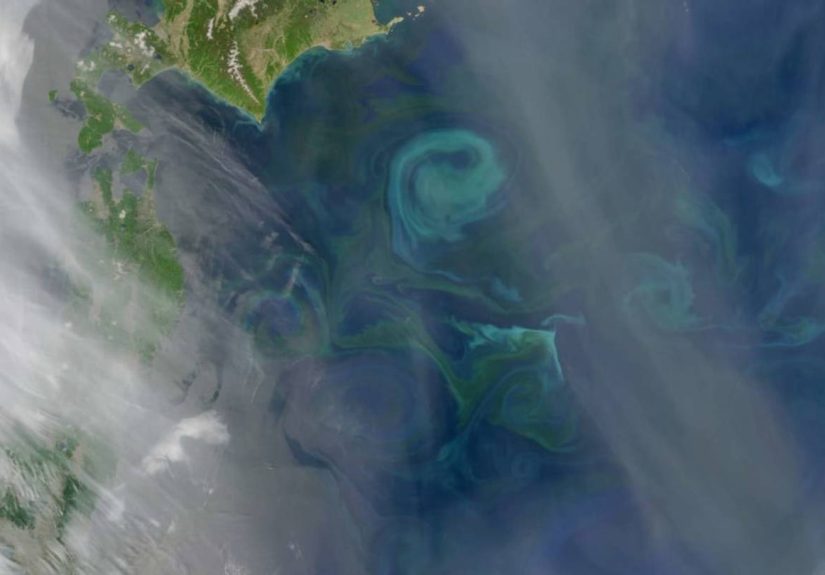
The Kuroshio Current is one of the most powerful western boundary currents on Earth. In simple terms, it is the Pacific Ocean’s answer to the Gulf Stream. Warm water from the tropics moves westward across the Pacific, then turns north near the Philippines, Taiwan, and the Ryukyu Islands. From there, the current races along the edge of Japan, carrying heat, salt, nutrients, marine life, and, sometimes, unlucky human beings.
The name Kuroshio means “black stream” or “black current” in Japanese, not because the water is dirty, but because its deep blue color can appear almost black compared with surrounding coastal waters. That poetic name is surprisingly accurate. From a ship’s deck, the current can look like a moving band of dark silk. Beautiful? Absolutely. Forgiving? Not exactly.
A Fast Ocean River Without Banks
Oceanographers often describe major currents as rivers in the sea. The comparison works, as long as we remember that this river has no banks, no bridges, and no helpful road signs saying, “Next exit: North America, 4,500 miles.” The Kuroshio can move tens of miles per day and transport an enormous volume of water. Its strength changes by season and location, and it frequently meanders, sheds eddies, and interacts with other currents.
As it passes Japan, the Kuroshio eventually separates from the coast and becomes the Kuroshio Extension, a broad eastward-flowing current system. Farther across the Pacific, that water contributes to the North Pacific Current, which moves toward the North American side of the ocean. From there, parts of the circulation branch into the south-flowing California Current and the broader clockwise motion of the North Pacific Gyre.
How Could a Shipwrecked Sailor Cross the Pacific?
For a disabled vessel, the Pacific was both prison and pathway. Once a boat lost its sails, rudder, mast, oars, or crew strength, it became subject to windage, waves, and surface currents. A boat with high sides might be pushed strongly by wind. A low, waterlogged hull might follow current more closely. A storm could throw a vessel into the Kuroshio; the current could carry it north and east; winter winds could shove it farther across the ocean.
This is why historical drift voyages were unpredictable. Two boats leaving nearly the same waters could end up in wildly different places. One might be driven toward the Aleutian Islands. Another might reach the Pacific Northwest. A third might circle, sink, or vanish into that enormous blue filing cabinet where the ocean stores unsolved cases.
The North Pacific Gyre: The Bigger Machine
The Kuroshio was only one part of the system. The North Pacific Gyre is a vast clockwise circulation pattern made up of several currents: the Kuroshio in the west, the North Pacific Current in the north, the California Current in the east, and the North Equatorial Current in the south. It is this large gyre that explains why floating objects from Asia can eventually approach North America.
Modern science gives us a clear example. After the 2011 Tohoku earthquake and tsunami in Japan, huge amounts of debris entered the Pacific. Buoyant items, including docks, boats, balls, and household objects, later appeared along North American shores. Scientists used drift models, wind data, and ocean-current observations to track how debris scattered across the ocean. The lesson was familiar to historians: the Pacific moves things. Not neatly, not kindly, but persistently.
Japanese Castaways and the Black Current
Japan’s coastal communities lived with the Kuroshio for generations. Fishermen and coastal traders benefited from its marine richness, but they also feared its power. Before steam engines and modern navigation, a storm could push a small vessel beyond recovery. Once outside familiar waters, sailors could be carried into the open Pacific with little hope of rowing or sailing home.
From the early nineteenth century alone, records show multiple Japanese vessels drifting to North America or nearby regions. These stories are not myths. They appear in historical accounts, maritime studies, government records, museum narratives, and local histories. They reveal how ocean currents became accidental diplomats, carrying people between societies that were officially separated by politics, geography, and fear.
The Hojun-maru and the Three Kichis
One of the best-known cases is the Hojun-maru, a Japanese vessel that was disabled and drifted across the Pacific in the early 1830s. After roughly fourteen months at sea, the boat washed ashore near Cape Flattery, in what is now Washington State. Only three sailors survived: Iwakichi, Kyukichi, and Otokichi, often remembered collectively as the “Three Kichis.”
Their ordeal was almost unimaginably harsh. Food ran low. Fresh water became a constant crisis. The boat was not built for a cheerful ocean cruise across half the planet. When they finally reached the Pacific Northwest, they were weak, malnourished, and far from any world they understood. Their later journey brought them to Fort Vancouver, where their presence became part of the early history of Japanese contact with the Pacific Northwest.
The Hojun-maru story shows how the Kuroshio and North Pacific circulation could transform local shipwrecks into global events. A coastal Japanese boat, intended for regional waters, became an accidental bridge between Japan and North America.
Tokujomaru: A Drift Toward California
Another famous example is the Tokujomaru, a Japanese vessel that ran aground near Santa Barbara, California, in 1813. Historical summaries often note that only a few members of the original crew survived. Like the Hojun-maru, this case demonstrates that the Pacific current system did not always deliver castaways to the same latitude. Depending on wind, vessel condition, seasonal timing, and current interaction, disabled ships could make landfall far apart along the western edge of North America.
To modern readers, these events may sound unlikely. But the ocean is very good at doing unlikely things repeatedly until humans finally admit the pattern exists.
Nakahama Manjiro: The Castaway Who Helped Change Japan
Perhaps the most famous Japanese castaway story is that of Nakahama Manjiro, also known as John Manjiro. In 1841, as a young fisherman, he was blown off course with his crew and eventually stranded on a remote island. An American whaling ship rescued him, and he later lived and studied in the United States. When he returned to Japan, his knowledge of English, American customs, navigation, and whaling became extremely valuable.
Manjiro’s life did not follow the exact same drift path as the Hojun-maru, but his story belongs to the same oceanic world. The Kuroshio, storms, and the Pacific’s vast circulation created conditions in which ordinary fishermen could become international figures. Manjiro eventually served as a translator and source of Western knowledge during a critical period when Japan was being forced to reconsider its isolation from the outside world.
Why the Kuroshio Was So Dangerous for Traditional Boats
Traditional coastal vessels were designed for specific waters, seasonal conditions, and known routes. They were not meant to lose a mast, get shoved offshore, and politely survive the Pacific’s full personality. Many Japanese boats were built for coastal trade or fishing, where crews expected to remain close enough to land, ports, and familiar weather signs.
Once caught by storms and pushed into the Kuroshio, however, sailors faced multiple dangers at once. The current moved them away from home. Winds could damage sails and steering. Saltwater spoiled supplies. Drinking water became precious. Navigation without instruments became nearly impossible. Even if the boat stayed afloat, survival depended on food stores, rainwater collection, repair skills, luck, and the mental toughness to keep going when the horizon looked exactly the same for weeks.
Currents Do Not Work Alone
One common misunderstanding is that a current simply grabs a ship and carries it like a package on a delivery truck. Real drift is messier. Wind pushes the exposed part of a vessel. Waves rotate it. Storms alter its direction. Eddies can trap it. The current below may flow one way while the wind above pushes another. A disabled boat is not just “in the current”; it is in a negotiation between sea, sky, hull, and chance.
This explains why castaway voyages varied so widely. Some boats crossed quickly by drift standards. Others took more than a year. Some reached shore. Others never did. The Kuroshio opened the door to transpacific drift, but the rest of the ocean decided what happened next.
The Current as a Hidden Bridge Between Japan and North America
Human history often focuses on official voyages: explorers, naval expeditions, trade missions, and government-approved travel. But the Kuroshio reminds us that history also moved by accident. Shipwrecked sailors were not ambassadors by choice. They did not pack formal clothes, phrasebooks, and gifts for foreign officials. Still, their journeys created early moments of contact between Japan and North America.
These castaways challenged assumptions on both sides of the Pacific. For North American communities, the arrival of Japanese sailors proved that Asia was not an abstract place beyond the map. For Japan, returning castaways brought dangerous knowledge: the outside world was real, technologically advanced, and closer than official policy suggested. The ocean was leaking information through the cracks.
Accidental Diplomacy
Some castaways never returned home. Others did, but return could be complicated. During Japan’s period of restricted foreign contact, people who had gone abroadeven unwillinglycould face suspicion. A survivor might bring valuable knowledge, but also uncomfortable questions. Where had he been? Whom had he met? What had he learned? Could he still be trusted?
In this way, the Kuroshio did more than move bodies. It moved ideas. It carried language, technology, stories, maps, religious impressions, shipbuilding observations, and rumors of distant nations. A fisherman blown off course could become a living document, and sometimes a politically inconvenient one.
Ocean Science Behind the Survival Stories
Modern oceanography helps explain what earlier generations could only observe. Satellite altimetry, drifting buoys, computer models, and ocean-temperature measurements now reveal the structure of currents like the Kuroshio. Scientists can watch large-scale circulation, identify eddies, and model probable drift pathways for debris or vessels.
The Kuroshio also plays a major role in climate. It transports tropical heat northward, affects storm development, supports fisheries, and influences the exchange of heat and moisture between ocean and atmosphere. The same current that once carried castaways also helps regulate weather patterns across the Pacific basin. It is not just a historical curiosity. It is part of Earth’s climate engine.
What Floating Debris Teaches Us
Modern debris drift gives scientists a less tragic way to study the same forces. When fishing gear, buoys, docks, or storm debris travel across the Pacific, researchers can compare their actual landfalls with model predictions. These observations improve search-and-rescue planning, marine debris response, invasive species monitoring, and our understanding of surface circulation.
The 2011 Japanese tsunami debris was especially important because it provided many real-world examples of long-distance drift. Items did not arrive as one giant floating island, despite what disaster movies would surely prefer. Instead, they scattered across a huge area, arriving at different times and places. That scatter pattern echoes the older castaway record: the Pacific is connected, but never simple.
Why These Stories Still Matter
The current that carried shipwrecked sailors across the Pacific matters because it connects science and humanity. A current is a physical process: wind stress, density, rotation, pressure gradients, heat transport. But when a broken boat enters that process, physics becomes biography. A line on an oceanographic map becomes hunger, fear, prayer, endurance, and sometimes rescue.
These stories also remind us that people in the past were not passive victims of nature. Castaways repaired hulls, rationed food, collected rainwater, watched birds, read waves, and made decisions under conditions most of us would find unbearable. Their survival depended on skill as well as luck. The ocean carried them, but they had to remain alive long enough to be carried.
Experiences That Bring the Black Current to Life
To understand the Kuroshio Current beyond textbooks, it helps to imagine experiencing its story from several shorelines. Start on Japan’s Pacific coast, where fishing towns face the open water with a mixture of dependence and respect. The sea there is not a decorative backdrop; it is workplace, pantry, weather-maker, and risk. Standing near a harbor, you can picture small boats heading out at dawn while the great current moves offshore, invisible but always present. It is easy to understand how a sudden storm could turn a normal workday into a survival epic.
Next, imagine Cape Flattery in Washington, one of the dramatic edges of the continental United States. Waves strike dark rocks. Fog moves like a curtain. The Pacific seems less like a body of water and more like a decision-making authority. When you know that Japanese castaways reached this coast after more than a year adrift, the landscape changes. It becomes not only beautiful, but historical. Every log, buoy, and battered object on the beach starts to look like a message from somewhere else.
Museums and historic sites add another layer. At places connected to Fort Vancouver or Pacific Northwest maritime history, the story of the Three Kichis turns ocean drift into human encounter. These sailors were not symbols; they were young men who had been hungry, cold, frightened, and exhausted. They entered communities where language, clothing, food, and customs were unfamiliar. Their arrival reminds us that global history was sometimes made not by conquerors or merchants, but by survivors who simply refused to die.
A beach walk after a storm can also make the topic real. Look at what washes ashore: shells, kelp, fishing floats, plastic fragments, driftwood, maybe objects with labels from far away. Modern marine debris is an environmental problem, but it is also evidence of connection. The same ocean pathways that once carried castaways now carry our waste, our lost gear, and the ecological consequences of our habits. The romance of drift has a modern responsibility attached to it.
For writers, teachers, travelers, and curious readers, the Kuroshio offers a rare kind of story: it is scientific without being dry, historical without being dusty, and dramatic without needing exaggeration. It asks us to think in motion. The Pacific is not empty space between continents. It is a moving archive. Its currents remember storms, voyages, disasters, migrations, and accidents. Follow the Black Current, and you follow one of the great hidden routes of human history.
Conclusion: The Ocean Highway That Changed Lives
The Kuroshio Current is more than a warm stream of water near Japan. It is a force that shaped ecosystems, weather, navigation, and history. By feeding into the broader North Pacific circulation, it helped create pathways by which disabled ships and shipwrecked sailors could cross astonishing distances. The stories of the Hojun-maru, the Tokujomaru, Nakahama Manjiro, and later drifting debris reveal the same truth: the Pacific is vast, but it is not still.
For shipwrecked sailors, the Black Current could be a curse, carrying them away from home into hunger and uncertainty. Yet it could also become a strange form of rescue, moving them toward islands, coastlines, and human contact. That dual nature is what makes the story so powerful. The current did not care who survived, but survivors turned its motion into history.
Today, oceanographers can model what castaways once experienced by terror and guesswork. Still, the emotional lesson remains timeless. Beneath the surface of the Pacific, invisible roads are always moving. Some carry heat. Some carry fish. Some carry wreckage. And sometimes, against all odds, they carry people into the pages of history.