Table of Contents >> Show >> Hide
- What Is a Wiccan Circle and Why Cast One?
- Getting Ready: Tools, Space, and Mindset
- Way 1: Cast a Simple Visual Circle (No Tools Needed)
- Way 2: Cast a Traditional Elemental Circle
- Way 3: Adapted Circles for Apartments, Travel, and Low-Key Practice
- Tips, Common Mistakes, and Safety
- Frequently Asked Questions About Wiccan Circles
- Experiences and Reflections on Casting a Wiccan Circle
- Conclusion
If you’ve ever watched a witchy movie and thought, “Okay, but how do you actually do that circle thing?”welcome.
Casting a Wiccan circle is less about Hollywood lightning bolts and more about creating a calm, sacred bubble where you can
focus, feel safe, and connect with your practice. Think of it as putting your phone on “Do Not Disturb” for your soul.
In modern Wicca and witchcraft, a circle is often described as a protective, energized space where the everyday world steps
back for a moment so you can do ritual, meditate, or work magick with intention. There’s no single “correct” method.
Different traditions use different tools, words, and directionsbut they all share the same core idea: this is your
temporary temple.
Below, you’ll learn three practical ways to cast a Wiccan circle:
- Way 1: A simple visual circle you can cast with no tools.
- Way 2: A classic elemental circle with quarters and altar setup.
- Way 3: Adapted methods for tight spaces, travel, or low-key situations.
Use the method that fits your space, your body, and your path. You can mix, match, and personalize as much as you like.
Wicca is not a one-size-fits-all robe.
What Is a Wiccan Circle and Why Cast One?
A Wiccan circle is a temporary sacred spaceusually visualized as a circle or sphere of energycreated before rituals, spells,
seasonal celebrations, or deep meditation. Many practitioners see it as:
- Protective: A boundary that keeps out unwanted energies while you’re working.
- Focusing: A defined space that helps your mind shift into “ritual mode.”
- Energetic: A container that holds, builds, and directs the energy you raise.
- Symbolic: A reminder that you’re stepping into sacred time and sacred space.
Some Wiccans and witches work with circles every time they do magick. Others are more casual and save them for bigger rituals.
There’s also debate about how formal things “have” to bebut most agree that creating a clear boundary helps you feel safer,
more grounded, and more intentional.
One more important note: casting a circle is spiritual and symbolic. It doesn’t replace medical care, legal help, or practical
safety measures. If you’re burning candles, practicing indoors, or working with others, basic physical safety and consent
still come first.
Getting Ready: Tools, Space, and Mindset
Before you cast any type of circle, take a moment to prep both the physical space and your inner world. You don’t need a
Pinterest-perfect altar (unless you want one), but a little preparation goes a long way.
Helpful Tools (Optional but Popular)
You can cast a circle with zero tools, but many Wiccans like to use simple items that represent the elements and
help focus the mind:
- For Earth: A bowl of salt, a stone, or soil.
- For Air: Incense, a feather, or a bell.
- For Fire: A candle (in a heat-safe holder, please).
- For Water: A small bowl or chalice of water.
- Boundary markers (optional): Rope, stones, tealights, chalk, or string laid out in a circle.
- Pointing tool: A wand, an athame (ritual blade), or simply your index finger.
Cleansing Your Space
Most traditions recommend cleansing before you cast:
- Tidy the area: Pick up clutter, move tripping hazards, and make room to move.
- Energetic cleanse: Use incense, a smoke-free spray, a broom, or sound (clapping, a bell, a singing bowl) to “sweep” away stale or heavy energy.
- Personal grounding: Take a few deep breaths, shake out your hands, or sit quietly for a minute. Bring your attention into the present moment.
Once the space feels calm and your mind is more focused than frazzled, you’re ready to cast.
Way 1: Cast a Simple Visual Circle (No Tools Needed)
This first method is ideal for beginners, apartment dwellers, or anyone who doesn’t have a trunk full of witchy gear.
You’ll use your body, your breath, and your imaginationnothing else required.
Step 1: Define Your Working Area
Stand or sit where you plan to work. Imagine an invisible circle around youmaybe about an arm’s length away, or big enough
for you and any tools you’re using. You can picture it as:
- A ring of light (white, gold, or any color that feels protective).
- A bubble of shimmering energy.
- A dome or sphere that rises up around you and seals beneath your feet.
Step 2: Turn and “Draw” the Circle
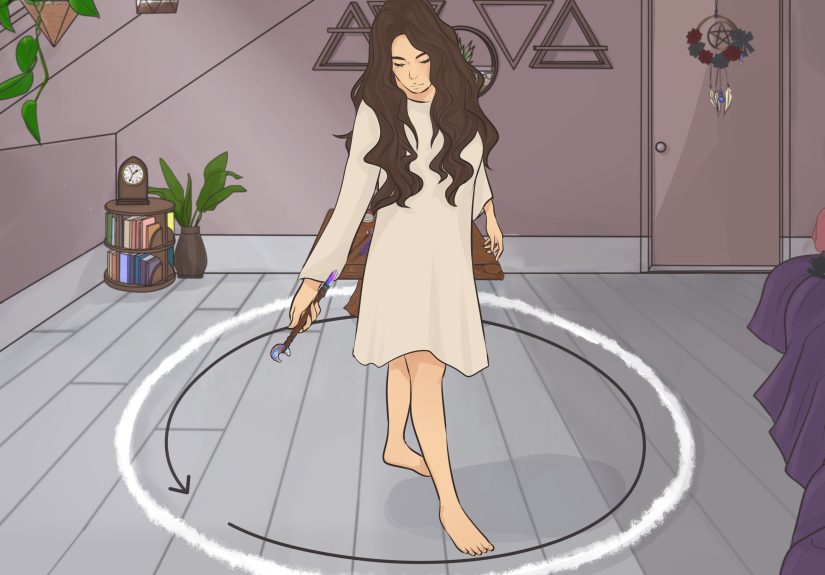
Slowly turn in place, clockwise (often called deosil in Wicca), as if you’re tracing that circle with your finger or
with a beam of light from your heart. You can:
- Extend your arm and “draw” the boundary in the air.
- Visualize your breath creating the circle with each exhale.
- Quietly say something like, “I cast this circle of light and protection.”
Move at a calm, steady pace until you’ve completed the full turn. Finish facing the direction that feels right to you
(many Wiccans finish facing east or north).
Step 3: Seal the Space with Intention
Once your visual circle is complete, affirm what it’s for. Examples:
- “Within this circle, I am safe, focused, and protected.”
- “This circle holds and strengthens the energy of my work.”
- “Only helpful, respectful energies may enter this space.”
Take a few more deep breaths and notice how the atmosphere feels differentquieter, more concentrated, or just more “you.”
That shift means your circle is doing its job.
Step 4: Open the Circle When You’re Done
When your ritual or meditation is complete:
- Thank any deities, spirits, or energies you’ve invited.
- Turn slowly in the opposite direction (counterclockwise) and imagine the bubble gently dissolving.
- Say something like, “This circle is open but unbroken. Blessed be.”
Ground yourself afterwardhave a drink of water, touch the floor, or stretch. It helps bring you fully back into everyday mode.
Way 2: Cast a Traditional Elemental Circle
This way is closer to what many people picture when they think “Wiccan ritual.” You’ll mark a physical circle, arrange your
altar, and call on the four classical elementsEarth, Air, Fire, and Waterassociated with the cardinal directions.
Step 1: Set Up Your Altar
Place your altar in the center of the circle or just inside its edge. On it, you might include:
- Representation of Earth (salt, stone).
- Representation of Air (incense, feather).
- Representation of Fire (candle in a safe holder).
- Representation of Water (chalice or bowl of water).
- Any deity statues, images, or symbols you work with.
- Your wand, athame, or other pointing tool.
Step 2: Mark and Cleanse the Circle
Decide how large you want your circle to be. You can:
- Lay out a rope or cord in a circle.
- Arrange stones, seashells, or small candles around the perimeter.
- Use chalk or tape on the floor, if that’s permitted and safe.
Walk around the inside of this boundary with incense, a broom, or a bowl of salt water, gently cleansing the edge of the space.
As you walk, imagine you’re brushing away negativity and leaving only calm, receptive energy.
Step 3: Cast the Circle with Your Tool
Stand at your chosen starting point, often the north or east. Hold your athame, wand, or hand out toward the boundary and walk
clockwise around the circle. As you walk:
- Visualize energy flowing from your tool to create a glowing barrier.
- Feel the air thicken just a little, like you’re stepping into a quiet bubble.
- Say a short casting phrase, for example:
“I cast this circle in perfect love and perfect trust,
A sacred space between the worlds,
A place of safety, power, and peace.”
When you reach your starting point again, sense the circle “click” into place, like closing a zipper.
Step 4: Call the Quarters (Elemental Guardians)
Now you’ll invite the energies of the four directions and their elements. Customize the language to match your path and comfort level.
- Face East (Air):
“Guardians of the East, powers of Airbreeze of clarity and inspirationplease be present, protect this circle, and bless this work.” - Face South (Fire):
“Guardians of the South, powers of Fireflame of courage and transformationplease be present, protect this circle, and bless this work.” - Face West (Water):
“Guardians of the West, powers of Watertide of emotion and intuitionplease be present, protect this circle, and bless this work.” - Face North (Earth):
“Guardians of the North, powers of Earthrock of stability and growthplease be present, protect this circle, and bless this work.”
Pause after each direction to feel the energy shift. Some people experience a subtle change in temperature, emotion, or
awareness; others just feel a stronger sense of presence.
Step 5: Raise Energy and Do Your Working
With the circle cast and the quarters called, you can:
- Perform a spell or charm.
- Celebrate a Sabbat (seasonal festival).
- Meditate, journal, or commune with deities or guides.
Energy can be raised through chanting, drumming, dancing, singing, or simply focusing on your intention until it feels vivid
and potent. When you sense the energy at its peak, direct it toward your goalthrough visualization, spoken words, or a symbolic
action (such as lighting a candle).
Step 6: Thank and Dismiss the Quarters, Then Open the Circle
When you’re ready to close:
- Face each direction in reverse order (North, West, South, East) and thank the element or guardians for their presence. Invite them to depart in peace.
- Walk counterclockwise around the circle, lowering your tool or hand as you go. Visualize the energy gently dissolving back into the earth and air.
- Finish with a phrase like, “The circle is open but unbroken. Merry meet, merry part, and merry meet again.”
Blow out candles safely, dispose of water or salt respectfully, and return any natural items (like stones or flowers) to their proper place if they were borrowed from outdoors.
Way 3: Adapted Circles for Apartments, Travel, and Low-Key Practice
Not everyone has a backyard grove or a private ritual room. Maybe you live with roommates, share a dorm, or travel a lot.
Good news: your circle can adapt. Wiccan and witchcraft circles are flexible by design.
Option A: Sound-Based or Invisible Circles
If lighting incense or candles isn’t practical, try using sound and visualization:
- Stand or sit where you plan to work.
- Ring a bell, tap a chime, or clap softly as you turn clockwise, imagining the sound building a shimmering boundary.
- Say a brief casting sentencesomething simple you can remember and repeat when you travel.
This method is nearly invisible to anyone watching and still gives you the mental and spiritual boundary of a circle.
Option B: “Micro-Circles” for Tiny Spaces
When you truly have no room to walk around, shrink the circle:
- Place a small cloth or tray on a desk or nightstand and imagine the circle drawn tightly around it.
- Set miniature representations of the elements (a pebble, a thimble of water, a tea light, a feather).
- Cast the circle in your mind’s eye by tracing a circle around the cloth with your finger or tool.
This works well for discreet candle magic, journaling, or quiet meditation when you share space with others.
Option C: Circles on the Go
Traveling or outdoors? You can:
- Use a stick to lightly trace a circle in sand, dirt, or snow (respecting local rules and nature).
- Arrange stones or twigs in a circle, then collect them afterward so you leave no trace.
- Skip physical marks and rely entirely on visualization if privacy or the environment requires it.
The key is intention: as long as you’re clearly setting a boundary in your mind and your actions, the circle “counts,” even if
nobody else can see it.
Tips, Common Mistakes, and Safety
1. Don’t Stress About Perfection
Your first circle will not look like a movie sceneand that’s okay. If you forget a line, trip over your words, or realize
your circle is more egg-shaped than perfectly round, keep going. Magick responds more to sincerity than geometry.
2. Respect Your Limits and Your Environment
Use only as many candles as you can safely monitor. Don’t burn incense if it bothers your lungs or someone else’s. If
you’re outdoors, follow fire regulations and leave nature as you found it. Spiritual practice should never conflict with
basic, real-world safety.
3. Personalize Your Words
Sample phrases are helpful, but your own voice is powerful. Adjust the wording so it reflects your beliefswhether you’re
Wiccan, eclectic Pagan, or simply spiritual and witchy without a label.
4. End What You Begin
Try not to walk away mid-ritual. Closing the circle, dismissing the quarters, and grounding afterward help you “file away”
the experience and transition back into everyday life. Think of it like saving your work before shutting down your laptop.
Frequently Asked Questions About Wiccan Circles
Do I have to be Wiccan to cast a circle?
No. Many non-Wiccan witches and Pagans use circles as a general magickal or spiritual boundary. If you’re borrowing from
Wiccan-style rituals, just do so respectfully and avoid claiming a tradition you don’t actually practice.
What if I can’t walk easily?
You can absolutely cast a circle sitting down or from a wheelchair. Visualize moving around the boundary in your mind, or
trace the circle with a tool or finger in the air while remaining in one place. Your mobility does not limit your connection
to spirit or energy.
Can I cast a circle with friends?
Yes, as long as everyone has consented to be part of the ritual. Typically one person leads the casting while others stand
at the edges or around the altar. You can also assign different people to call each quarter, which makes the ritual feel
more collaborative.
How do I know if it “worked”?
There’s no universal light show or sound effect. Many people report feeling a calmer mood, goosebumps, tingles, or a sense
that time feels slightly slower or deeper. Over time, as you repeat your methods, you’ll begin to recognize how a cast circle
feels to you.
Experiences and Reflections on Casting a Wiccan Circle
Beyond the step-by-step instructions, circle casting is shaped by lived experience. Practitioners often describe their
relationship with the circle changing as they growwhat starts as a very formal, memorized process eventually becomes a
more fluid conversation between themselves, their tools, and the energies they work with.
Many beginners start with long, scripted rituals. They carefully read from notes, checking that they’ve faced the correct
direction and said the “right” names of elements or guardians. At first, this can feel awkward, like reciting lines in a
play. Over time, the same people report that the scripts become training wheels. Once they feel more confident, they shorten
the wording, drop phrases that don’t resonate, and add language that genuinely reflects their beliefs and personality.
A common theme in people’s stories is how the circle influences their sense of emotional safety. For some, casting a circle
becomes a kind of ritual boundary between themselves and everyday stress. They might step into the circle to process grief,
calm their anxiety, or reflect on big life decisions. Knowing they’ve deliberately carved out a “time-out” from the outside
world can make it easier to face feelings they usually push away. In that sense, the circle acts like a sacred room inside
their own mind, even if the physical space hasn’t changed much.
Experienced practitioners often talk about subtle but noticeable differences between types of circles. A quick, visual-only
circle might feel light and airyperfect for a short meditation or tarot reading. A fully elemental circle, with quarters
called and candles burning, may feel more charged and ceremonial, like walking into a small temple. Apartment-friendly or
travel circles, using sound or mini-altars, tend to feel intimate and personal, reminding people that their practice can
travel with them wherever they go.
Some witches mention that their understanding of “protection” changes over time. At first, protection might mean keeping out
anything unknown or potentially scary. Later, it can evolve into something more nuanced: not trying to block all challenge or
discomfort, but instead cultivating a space where they can meet those experiences with clarity and support. The circle then
becomes less of a wall and more of a supportive containera place where they can explore spiritual work without feeling
overwhelmed.
There are also practical lessons that come from experience. People learn how far apart to place candles so nobody singes a
sleeve while turning to call the quarters. They experiment with incense and realize some scents are grounding while others
make them sleepy or distracted. They discover that a small circle is easier to maintain focus in than a huge one, especially
when working alone. Little adjustments like these come from trial, error, and a willingness to adapt rather than forcing
rituals to look a certain way.
Another recurring insight is that the circle doesn’t have to be dramatic to be meaningful. Quiet circlescast at a bedside
table with a single candle and a cup of watercan feel just as powerful as big seasonal rites. Many practitioners keep
journals of their rituals and later notice patterns: maybe circles cast at dawn feel more energetic, while circles cast at
night feel more introspective. These reflections help them fine-tune when, where, and how they work best.
Ultimately, experiences with Wiccan circles show that the real magic lies in consistency, attention, and intention. The more
often you cast a circle, the easier it becomes to slip into that focused state on purpose. The steps you choosewhether
simple or elaborateare tools. What matters most is that, for a little while, you step into a deliberately created space
where you can listen, feel, and act with more awareness than usual. That’s the heart of the practice, no special effects
required.
Conclusion
Learning how to cast a Wiccan circle isn’t about memorizing one official formulait’s about discovering which method helps
you feel protected, focused, and spiritually present. A simple visual circle, a full elemental ritual, or an
adapted apartment-friendly version can all create powerful sacred space.
Start small, stay safe, and let your practice evolve. With every circle you cast and open, you’ll get to know your own rhythm,
your own senses, and your own connection to the energies you invite in. That personal relationship is what transforms
instructions on a page into a living, breathing spiritual practice.