Table of Contents >> Show >> Hide
- What Makes a Car Truly “Hot” or “Cool”?
- The Hottest Cars of All Time: Icons Across Eras
- Jaguar E-Type (1961–1974)
- Lamborghini Miura (1966–1973)
- Aston Martin DB5 (1963–1965)
- Ferrari 250 GTO (1962–1964)
- Chevrolet Corvette (C1 & C2 Generations)
- Ford Mustang (First Generation)
- Porsche 911 (Classic Air-Cooled Era)
- Lamborghini Countach (1974–1990)
- McLaren F1 (1992–1998)
- Bugatti Veyron (2005–2015)
- Volkswagen Beetle (Classic Era)
- Movie & TV Legends: DeLorean, Batmobile, and Beyond
- Why the Coolest Cars Still Matter Today
- Real-World Experiences with the Coolest Cars
Ask a room full of car lovers to name the hottest car of all time and the conversation will go from polite to passionate in about 0.3 seconds.
Some will swear it’s a low-slung Italian supercar with doors that slice upward. Others will argue for a rumbling American muscle car that smells faintly of
gasoline, leather, and poor decisions made in the 1970s. The truth? They’re all a little bit right.
This list of the coolest cars ever built doesn’t try to rank every single legend in strict order. Instead, it brings together icons that consistently show up
in designer surveys, enthusiast polls, and “most beautiful cars” roundups cars that changed the way we see design, speed, and status. From classic grand
tourers to modern hypercars, these are machines that make people turn around in traffic and say, “What was that?”
What Makes a Car Truly “Hot” or “Cool”?
Before we dive into individual models, it’s worth asking: what actually makes a car cool? It’s not just horsepower, and it’s not just price. If it were, every
limited-edition hypercar would automatically win. Instead, the hottest cars tend to share a few key traits.
1. Design That Stops You in Your Tracks
The coolest cars have shapes you can recognize instantly in silhouette: impossibly long hoods, tight rear overhangs, flowing fenders, or razor-sharp creases.
Automotive designers routinely point to cars like the Jaguar E-Type, Lamborghini Miura, and Ferrari 250 series as master classes in proportion and surfacing.
These cars look fast even when they’re parked on a quiet street.
2. Performance That Backs Up the Look
All show and no go? That’s not hot, that’s cosplay. The greatest cars marry beauty with serious engineering: powerful engines, advanced suspensions for their era,
and braking systems that (usually) match the speed. From early disc-brake sports cars to modern hybrids that punch out ridiculous power, the coolest machines
deliver an experience that feels special every single time you drive them.
3. Cultural Impact and Storytelling
Plenty of cars are fast. Very few become posters on bedroom walls, movie stars, or symbols of entire eras. The really iconic cars show up in
James Bond films, racing history books, or family stories about road trips in a beloved Mustang or Beetle. Their stories stick, and those stories make them
cooler than the spec sheet ever could.
4. Rarity, Attainability, and Attitude
Some of the hottest cars are ultra-rare collectibles you only see at concours events. Others, like the original Volkswagen Golf GTI or early Ford Mustangs,
were actually attainable to normal people when new. Coolness isn’t just about rarity it’s about attitude. A car can be humble and still be incredibly cool
if it’s clever, fun to drive, and full of character.
The Hottest Cars of All Time: Icons Across Eras
You could easily build a list of 100 or even 500 of the coolest cars, and many outlets have. Here, we’re focusing on a curated group of standouts that span
eras, body styles, and nations the cars that enthusiasts and designers keep mentioning again and again.
Jaguar E-Type (1961–1974)
If you had to pick one car to represent “automotive beauty” in the dictionary, the Jaguar E-Type would be an excellent candidate. Its impossibly long hood,
tucked-in cabin, and delicate details made even Enzo Ferrari reportedly call it “the most beautiful car ever made.” Beyond its looks, the E-Type backed up
the hype with advanced engineering for its time: disc brakes, independent suspension, and genuine 150 mph performance in the early 1960s.
Today, the E-Type’s value isn’t just measured in auction prices; it’s measured in how often it tops “greatest classic car” and “most beautiful car” lists.
Whether in coupe or roadster form, it remains a near-perfect blend of elegance, speed, and drama.
Lamborghini Miura (1966–1973)
The Lamborghini Miura is the car that turned the supercar into rolling sculpture. With its mid-mounted V12, low-slung stance, and iconic “eyelash” headlamp
trim, the Miura looks like a concept sketch that somehow escaped the studio and made it to the road. Many design and classic-car experts still rank it among
the most beautiful cars ever made.
Beyond the styling, the Miura was wildly advanced for its era, packing serious performance and a soundtrack that made mountain tunnels feel like concert halls.
If you drew a “dream car” as a kid, chances are it looked a little like a Miura, whether you knew it or not.
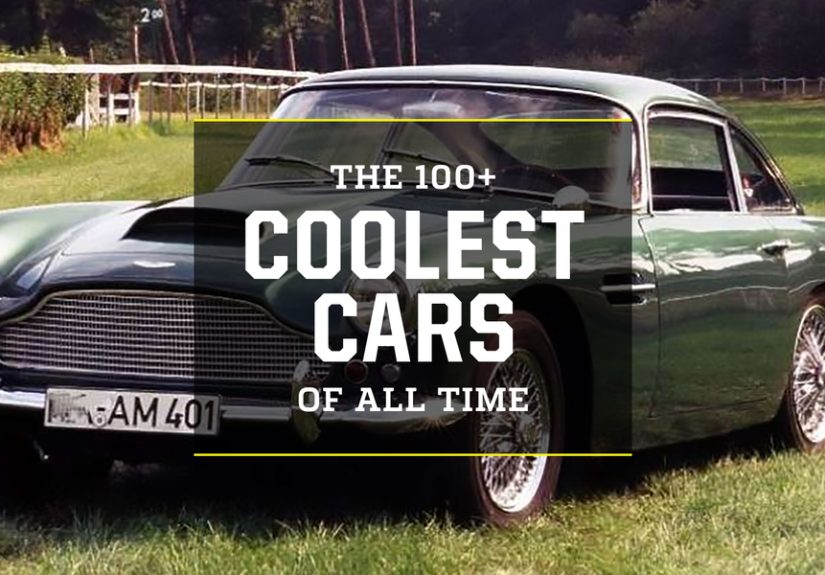
Aston Martin DB5 (1963–1965)
The DB5 is proof that movie casting can make a car immortal. As James Bond’s ride in Goldfinger and several later films, the DB5 embedded itself in
pop culture as the ultimate gentleman spy’s car. Long before anyone said “vehicle placement,” Aston Martin nailed the idea.
With its refined straight-six engine, hand-built interior, and classically British styling, the DB5 is less about raw speed and more about presence. It’s the
automotive equivalent of a tailored tuxedo timeless, understated, and instantly respected wherever it shows up.
Ferrari 250 GTO (1962–1964)
Somewhere between race car and sculpture lives the Ferrari 250 GTO. Built in tiny numbers for GT racing, the 250 GTO has become the holy grail of collectible
cars, with values soaring into the tens of millions of dollars. Underneath its flowing bodywork sits a race-bred V12 that made it devastatingly effective on
track in its day.
What makes it so cool isn’t just the price tag it’s the combination of purposeful engineering, hand-shaped metal, and motorsport pedigree. The 250 GTO is
proof that when form and function are developed together, the result can be nothing short of legendary.
Chevrolet Corvette (C1 & C2 Generations)
The Corvette is the American sports car, and early generations helped prove that the U.S. could build world-class performance machines. The first-generation
C1 (especially in its later, fuel-injected forms) introduced a bold, fiberglass-bodied roadster with styling inspired by European sports cars but filtered
through American optimism.
The C2 “Sting Ray” that followed turned the dial further, with split rear windows, muscular fenders, and serious track capability. Corvette models feature
prominently in lists of hottest and most influential cars because they democratized speed they brought big performance to buyers who didn’t have Ferrari-level
budgets.
Ford Mustang (First Generation)
When the Ford Mustang launched in 1964½, it essentially invented the “pony car” segment. Built on fairly humble underpinnings but styled like a miniature
muscle car, the original Mustang was a runaway hit. It appeared on racetracks, in movies, and in countless driveways almost overnight.
The Mustang’s cool factor comes from its flexibility. It could be a simple six-cylinder commuter, a V8-powered street brawler, or a fully prepped Shelby
track weapon. That mix of accessibility and attitude is why the Mustang still dominates “iconic car” lists decades later.
Porsche 911 (Classic Air-Cooled Era)
The Porsche 911 might be the single most recognizable sports car shape ever made. With its rear-mounted flat-six engine, round headlights, and sloping tail,
it has evolved continuously while somehow remaining unmistakably a 911. Early air-cooled models from the 1960s through the 1990s are especially beloved for
their analog character and razor-sharp feedback.
What makes the 911 so cool is that it’s both an engineering oddball and a runaway success story. Where other brands changed direction, Porsche doubled down,
refining the same basic formula into a family of cars that dominate club racing, rally history, and Sunday-morning canyon runs alike.
Lamborghini Countach (1974–1990)
The Countach is the car that turned bedroom walls into shrines. With its wedge-shaped body, scissor doors, and outrageous wings, it didn’t just look futuristic
it redefined what “supercar” meant for an entire generation. If the Miura is Italian elegance, the Countach is Italian drama.
Was it comfortable? Not particularly. Was rear visibility terrible? Absolutely. But every time you see one, your inner 12-year-old wakes up. The Countach is
cool because it committed fully to the idea of looking like nothing else on the road.
McLaren F1 (1992–1998)
Long before modern hypercars were chasing four-figure horsepower numbers, the McLaren F1 redefined what a road car could be. With a central driving seat,
three-passenger layout, obsessive weight savings, and a BMW-built V12, it delivered world-beating performance while remaining surprisingly usable.
For many enthusiasts, the F1 is still the benchmark for a pure driver’s hypercar: analog, engineering-led, and designed with a singular vision rather than
committee-driven marketing goals. It proves that coolness can be extremely high-tech without feeling cold.
Bugatti Veyron (2005–2015)
The Bugatti Veyron is the car that made the phrase “1,000 horsepower” part of everyday enthusiast conversation. Combining quad-turbocharged power,
all-wheel drive, and a top speed that sounded like a misprint when it was announced, the Veyron rewrote the rulebook for performance.
Yet what really makes the Veyron cool is how civilized it can be. Owners often describe it as absurdly easy to drive at normal speeds a hypercar that
can creep through traffic as smoothly as a luxury sedan, then rocket past 200 mph with a firm press of the throttle.
Volkswagen Beetle (Classic Era)
You might not think of the VW Beetle as “hot” in the same way as a Ferrari, but in terms of cultural impact and recognizability, it’s in a league of its own.
With a friendly, rounded shape and simple mechanicals, the Beetle became transportation for the masses in dozens of countries. It’s one of the most
instantly recognizable car shapes ever created.
The Beetle shows that cool isn’t just about speed. Sometimes it’s about personality, community, and the way a car fits into everyday lives. From surf culture
to road-trip stories passed down through families, the Beetle is proof that “iconic” comes in all sizes.
Movie & TV Legends: DeLorean, Batmobile, and Beyond
Some of the most beloved “cool cars” didn’t earn their status on the racetrack but on the big screen. The stainless-steel DeLorean DMC-12 in
Back to the Future, the 1966 Batmobile, and Speed Racer’s Mach 5 are prime examples. Lists of the coolest cars often give these fictional or
heavily modified vehicles their own category because they exist at the intersection of fantasy and engineering.
Even when the underlying car isn’t especially fast by modern standards, the combination of wild design and pop-culture storytelling makes these machines
permanent residents in the “cool car” hall of fame.
Why the Coolest Cars Still Matter Today
Modern vehicles are safer, cleaner, and often faster in a straight line than many classics on this list, but that doesn’t diminish the importance of the
legends. Automakers constantly reference these icons when designing new models, whether it’s a retro-inspired Mustang, a modern EV with coupe-like lines,
or a limited-edition supercar that borrows cues from 1960s racing machines.
For enthusiasts, these cars are also a way of connecting with history. Restoring a classic Corvette, preserving an early 911, or simply spotting a Miura
at a car show turns automotive history into something you can hear, touch, and smell not just read about online.
Real-World Experiences with the Coolest Cars
Reading about the hottest cars of all time is one thing; being around them is something else entirely. Spend a day at a vintage racing event or a
high-end cars-and-coffee meet and you’ll see how these machines affect people of all ages. Kids who have only ever driven cars in video games suddenly
go quiet when they hear an old V12 fire up. Adults who lived through the muscle-car era get misty-eyed when a perfectly restored ’60s pony car rumbles by.
One of the most striking things about these cars in person is how small many of them are. A classic Miura or E-Type looks impossibly low and narrow next
to modern SUVs. You can see why they felt so exotic in their day: they sit closer to the ground, the glass areas are huge, and the bodywork feels almost
organic, like it was sculpted rather than stamped.
Owners of iconic cars often talk less about raw performance numbers and more about ritual. Starting a classic requires a bit of choreography turning the
key just so, waiting for fuel pumps, listening to the idle settle. Steering can be heavy at low speeds, the clutch might be grabby, and the cabin can smell
like old leather, gasoline, and sun-warmed vinyl. None of this would pass a modern focus group, but it all adds to the sense that you are operating a
living, mechanical thing rather than an appliance.
Riding in or driving one of these cars also changes how you experience speed. On paper, an early 911 or V12 grand tourer might be slower than a modern hot
hatch, but the lack of insulation, the mechanical noises, and the direct steering make 60 mph feel far more intense. The car communicates every surface
change and every input, turning an ordinary back road into something that feels like a special stage.
There’s also a social side to these experiences. Show up at a gas station in a well-loved Beetle or a first-generation Mustang, and strangers will walk over
with stories. “My parents had one of those,” or “I learned to drive in that car,” or “I had a poster of that exact model on my wall.” The coolest cars of all
time are conversation starters; they bridge generations and backgrounds in a way few other hobbies can.
Even for those who never plan to buy a classic or supercar, spending time around these machines can change the way you see everyday transportation. You start
to appreciate thoughtful design details, satisfying steering feel, or a well-tuned exhaust note in whatever you drive. In that sense, the hottest cars of all
time don’t just live in museums and private collections they quietly influence the expectations we bring to every car we encounter.
Ultimately, what makes these cars truly hot isn’t perfection. It’s the way they make people feel: excited, nostalgic, inspired, or simply happy to stand
nearby and listen as an engine crackles down to idle. Coolness, it turns out, isn’t just about looks or speed; it’s about emotion. And on that front, the
legends on this list still run far ahead of the pack.