Table of Contents >> Show >> Hide
- What “AI Time Traveller” is really doing (besides roasting the past)
- The artist’s process: why the images feel convincing
- Why these images go viral: the psychology of the “impossible selfie”
- A quick detour: selfies didn’t start with smartphones
- How generative AI makes “time travel” images possible
- The fun part: examples of what makes these “historic selfies” pop
- The serious part: synthetic images can be hilarious… and still risky
- Why this trend is useful beyond entertainment
- How to appreciate “AI Time Traveller” without getting fooled by the internet
- 500-word experiences: what it feels like to “time travel” through selfies
- Conclusion
If time travel is impossible, at least we can do the next best thing: Photoshop a smartphone into history and pretend Abraham Lincoln just discovered the front-facing camera.
That’s the mischievous magic behind “AI Time Traveller,” a humorous image series imagining famous people from the past taking selfies like they’re headed to brunch, a concert,
or a “just landed on the moon, no big deal” group chat.
On the surface, it’s a simple jokehistory meets Instagram. But the reason these images stick isn’t just because they’re funny. They’re also a surprisingly sharp reminder of
how we read faces, how we trust photographs, and how generative AI can turn “that would never happen” into “wait… did that happen?”
What “AI Time Traveller” is really doing (besides roasting the past)
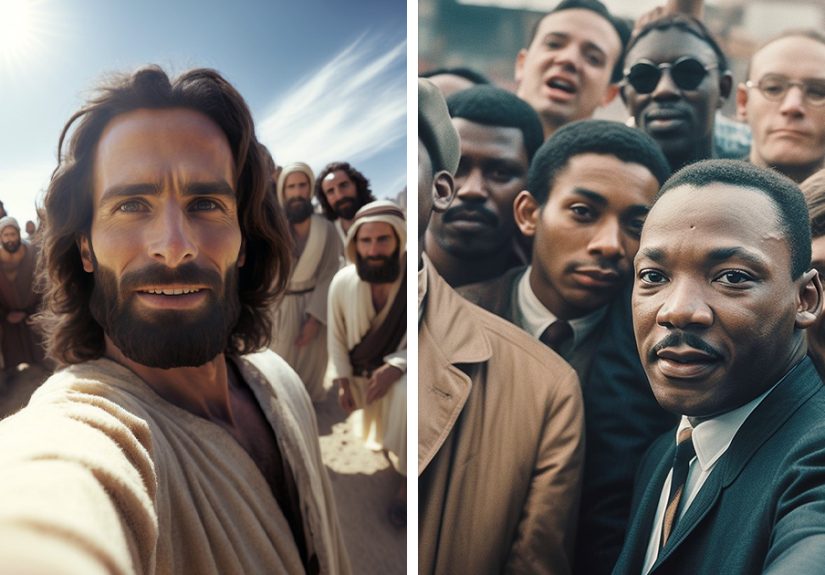
The seriesshared widely onlinereimagines iconic figures holding a phone at arm’s length, angling for flattering light, and accidentally capturing a friend in the background
who looks deeply confused by modern technology. The subjects range from historic leaders and cultural legends to inventors, writers, and even mythic or semi-legendary characters.
The punchline is the same every time: the selfie pose is so familiar that your brain accepts the scene for half a second… then panics and remembers time is linear.
That tiny moment of confusion is the secret sauce. A selfie is a modern visual language with its own grammar: the close-up perspective, the casual expression, the “I was here”
vibe, and the subtle social proof of someone else awkwardly photobombing. When you apply that grammar to a person you only know from statues, textbooks, and formal portraits,
you get a new kind of recognitionless “historic monument,” more “human who would absolutely overshare if given Wi-Fi.”
The artist’s process: why the images feel convincing
The creator, graphic designer and digital artist Jyo John Mulloor, describes a workflow that blends AI image generation with the kind of manual polishing that separates
“AI-ish” from “almost plausible.” The core idea is deceptively simple: generate images from text prompts, then refine the results until they look like one cohesive photo.
Step 1: Start with a concept that has instant cultural clarity
A selfie is immediately readable. You don’t need a caption explaining what’s happeningyour brain fills in the story. That’s especially powerful when the subject is a
famous figure. Even if the facial likeness isn’t perfect, the combination of wardrobe, setting, and “camera energy” can sell the illusion.
Step 2: Use AI for ideation, then “human hands” for realism
Text-to-image tools can generate dramatic lighting, period clothing, and cinematic composition fast. But likeness and anatomy are where things get tricky. Mulloor has noted
that AI doesn’t always capture real people accurately, so he generates multiple options, composites them, and repaints details in Photoshop to reach a more lifelike result.
In other words: AI is the rough draft. Craft is the final edit.
Step 3: Make the selfie camera logic feel right
Great “fake selfies” quietly obey the physics of selfies: wide-angle distortion, face-to-camera distance, the way hands look when they’re closer to the lens than the head,
and the slightly chaotic framing that makes a selfie feel accidental instead of staged. If an image is too perfect, it stops reading as a selfie and starts reading as a
movie poster.
Why these images go viral: the psychology of the “impossible selfie”
1) Selfies are a shortcut to intimacy
Formal portraits create distance. Selfies collapse it. A selfie says, “I’m not being documentedI’m documenting myself.” That shift is why a selfie of a historical icon can
feel oddly personal, even when you know it’s synthetic.
2) They remix history without needing a history lesson
You don’t need deep context to laugh at the idea of a famous leader making a “checking in” face. The humor is accessible. Then, if you’re curious, it can pull you into
questions like: What did this person actually look like? What was their era like? Would this clothing be accurate? That curiosity loop is a big part of the appeal.
3) They exploit a truth about images: we trust “photographic vibes”
For nearly two centuries, photography has carried an aura of evidence. Even though we all know photos can be staged or edited, our instincts still treat “photo-like” images
as more credible than drawings or paintings. Generative AI can imitate that credibilitysometimes for harmless jokes, sometimes for misinformation.
A quick detour: selfies didn’t start with smartphones
The “selfie” conceptphotographing yourselfpredates social media by a lot. One famous early example is Robert Cornelius’ 1839 photographic self-portrait, often cited as an
early (and possibly the earliest surviving) photographic “selfie” in the sense of a self-made portrait. What’s changed isn’t the human urge to self-document; it’s the ease,
the speed, and the massive audience.
Modern selfie culture adds layers: the platform (posting and sharing), the performance (curating identity), and the feedback loop (likes, comments, resharing). “AI Time Traveller”
works because it splices those modern layers onto historical figures who never had the chance to be casually seen.
How generative AI makes “time travel” images possible
Most modern image generators create pictures from text prompts by learning patterns from enormous amounts of training data. In plain English: they’re extremely sophisticated
autocomplete engines for pixels. You type “Victorian-era scientist taking a selfie, candid, wide angle,” and the model predicts what an image matching that description might
look like based on learned visual relationships.
Some systems are built around diffusion-style approaches, which (very roughly) learn to transform noise into meaningful images guided by text. Others may use related
architectures or hybrid techniques. Whatever the underlying math, the practical creative reality is the same: the prompt steers the output, and the artist steers the prompt.
The hidden creative skill: prompting like a director, not a typist
Good prompts aren’t keyword soup. They’re art direction. They specify mood, lens style, lighting, composition, era-appropriate clothing, and the emotional beat of the scene.
The best creators also iterate: they adjust a detail, regenerate, compare, and refinelike a photographer taking 200 shots to get one that feels effortless.
The fun part: examples of what makes these “historic selfies” pop
You’ll often see the series lean into recognizable “selfie genres”:
- The legendary leader selfie: serious person, surprisingly casual pose.
- The genius-at-work selfie: inventor vibe, background chaos, “busy but cute.”
- The celebrity candid selfie: expressive face, confident framing, “I know my angles.”
- The adventure selfie: dramatic setting, slightly reckless camera placement.
- The group selfie: someone in the back looks like they’re about to ask, “What sorcery is this?”
Even when the subject is someone you’ve only seen in black-and-white photos, the selfie format adds story: where they are, who they’re with, what the moment “feels like.”
That’s why the images don’t land like trivia. They land like micro-scenes.
The serious part: synthetic images can be hilarious… and still risky
It’s easy to treat playful AI art as “just memes.” And usually, it is. But the same tools that generate charming anachronisms can also generate convincing fakes that spread
fast. The biggest risk isn’t that people will believe Julius Caesar had an iPhone; it’s that they’ll get used to trusting photo-like images without asking basic questions.
Why labeling matters (even when the joke seems obvious)
When creators clearly tag images as AI-generated, audiences can enjoy the creativity without confusion. And on the broader internetwhere images get reposted without context
provenance matters. That’s why industry efforts around content authenticity, metadata, and “nutrition label” style credentials have gained momentum.
What viewers can do: a simple “three-question” habit
- Who posted this first? (Original context beats repost context.)
- What’s the motive? (Comedy, marketing, propaganda, scam?)
- What would confirm it? (A second source, a reverse image search, a credible outlet.)
You don’t have to become a forensic analyst to stay grounded. You just need a tiny pause before beliefespecially when an image looks “too perfect,” “too cinematic,” or
emotionally engineered to make you share it instantly.
Why this trend is useful beyond entertainment
Education: history as a doorway, not a lecture
Teachers and museums constantly look for hooks that make students care. “Historic selfies” can be a hookif they’re framed responsibly. Imagine using an AI-generated
“selfie” as a warm-up prompt: students identify anachronisms, research the real clothing and tools of the era, and compare the synthetic image to primary sources. The joke
becomes a critical thinking exercise.
Marketing: the format is familiar, so the message travels
For marketers, the lesson is less “make fake history” and more “use recognizable visual language.” The selfie format is instantly legible on social platforms. A campaign
that borrows that visual languagewithout deceivingcan feel native rather than interruptive. The best versions are transparent: playful, clearly fictional, and crafted with
respect for real people and real events.
How to appreciate “AI Time Traveller” without getting fooled by the internet
Enjoy it as what it is: a creative remix that highlights both the power and the weirdness of AI-generated images. Laugh at the anachronism. Admire the craft. Then take one
extra step: notice how quickly your brain wanted to accept it.
That awareness is the real superpower. Because generative AI isn’t going awayit’s becoming normal. And the more normal it becomes, the more valuable it is to keep a clear
mental label: “photographic-looking” is no longer the same thing as “photographic truth.”
500-word experiences: what it feels like to “time travel” through selfies
People who stumble across “AI Time Traveller” online often describe the same first reaction: a quick laugh followed by a tiny mental glitch. Your brain recognizes the selfie
pose instantlyarm out, face close, background slightly chaoticand it tries to process the image as familiar social media content. Then the second layer hits: wait, that’s
a historical icon. The mismatch is funny, but it’s also strangely immersive, like a costume drama that accidentally wandered into your camera roll.
What makes the experience stick is how personal a selfie feels. A textbook photo can be informative, but it rarely feels intimate. A selfie pretends to be a moment you’re
sharing with the subject, not just observing. Even when you know the image is synthetic, the format nudges you into imagining the person’s personality: Would they be a
chronic oversharer? Would they take one photo and call it a day, or would they do 47 takes and still hate their side profile? The comedy works because it borrows the
everyday social rituals we all understand.
Another common experience is “retroactive curiosity.” After the joke lands, you might find yourself wanting to check the real historical visualsportraits, photographs,
statues, or artifactsto compare. That curiosity can be surprisingly productive. It turns passive scrolling into an active question: what did this person actually look like,
and what details are accurate versus invented? In that way, the images can act like a gateway drug to real history (the safe kind of gateway drug: libraries, not trouble).
Creators who experiment with this style often describe a different experience: the tug-of-war between speed and control. AI can generate a “pretty good” result fast, which
is thrilling the first time you see it. But if you want something specificaccurate clothing, a believable expression, a recognizable faceyou quickly learn that “fast” isn’t
the same as “done.” You end up iterating, refining, and making creative decisions that feel less like pressing a button and more like directing a tiny film production. The
reward is when the final image stops looking like a generic AI portrait and starts looking like a snapshot with a story.
And then there’s the viewer’s final experience: the reality check. After you’ve seen enough convincing AI images, you become more aware of how easily visuals can be
detached from truth. That awareness doesn’t have to ruin the funit can deepen it. You can laugh at the “impossible selfie” while also appreciating the craftsmanship and
remembering the new rule of the internet: if an image looks real, that’s not evidence. It’s just good design. The best outcome is a mix of delight and discernmentenjoy the
time travel, but keep your feet planted firmly in reality.
Conclusion
“AI Time Traveller” is funny because it’s absurdand it’s compelling because it feels familiar. By putting modern selfie culture into the hands of iconic people from the past,
the series reveals how powerful visual conventions are, how quickly we trust photo-like images, and how much storytelling can fit into a single frame.
The takeaway isn’t “don’t trust anything.” It’s “enjoy the artand stay conscious of the medium.” In a world where synthetic media can look effortless, the smartest viewers
will be the ones who can laugh, learn, and keep a gentle grip on reality all at once.