Table of Contents >> Show >> Hide
- Why Flank Steak Gets Tough (and Why Cutting Fixes It)
- Step 1: Find the Grain Before You Cook (Your Future Self Will Thank You)
- Step 2: Rest the Steak (Because Juices Deserve a Vacation Too)
- The Foolproof Cutting Method (Do This, Win Dinner)
- Knife and Cutting Board Tips (Small Things, Big Payoff)
- How to Cut Flank Steak for Different Meals
- Common Mistakes (and How to Fix Them Fast)
- Bonus: Tenderness Starts Before You Slice
- The 30-Second Checklist
- Real-World Experiences: What Usually Goes Wrong (and How People Fix It)
- 1) “I cut it against the grain… I think… and it was still chewy.”
- 2) “My slices were tender… but only on the ends.”
- 3) “Fajita night was great, but the steak was weirdly tough in leftovers.”
- 4) “I tried to slice thin, but the meat kept slipping and shredding.”
- 5) “I was in a hurry and sliced right away. Juice. Everywhere.”
- 6) “My friend said ‘cut on a bias’ and suddenly my steak looked fancy.”
- Conclusion
Flank steak is the overachiever of the beef world: big flavor, usually a decent price, and it shows up ready to party in fajitas, salads, and stir-fries. The only catch? If you slice it the wrong way, it will fight backhard. Like, “chewing-a-rubber-band-in-a-denim-jacket” hard.
The good news: tender flank steak is mostly a knife-skills problem, not a luck problem. Once you learn to spot the grain and cut against it (with a small bonus move called the bias slice), you’ll get tender bites every timeno magic, no steak-whispering, no dramatic speeches to the cow.
Why Flank Steak Gets Tough (and Why Cutting Fixes It)
Flank steak comes from a hardworking area of the cow, so it has long, strong muscle fibers. Those fibers run in a clear directionthis is the grain. When you cut with the grain, you leave those fibers long, and your teeth have to do the heavy lifting. When you cut against the grain (perpendicular to the fibers), you shorten themso each bite feels dramatically more tender.
Think of the fibers like a bundle of uncooked spaghetti. If you try to bite a full-length noodle, it pulls and resists. If you break it into small pieces first, suddenly it’s easy. Same steak, same flavorjust less jaw workout.
Step 1: Find the Grain Before You Cook (Your Future Self Will Thank You)
Flank steak is usually shaped like a long, flat rectangle. On the surface, you’ll see lines running in one directionthose are the muscle fibers. That direction is the grain.
Quick grain-spotting tricks
- Look for “racing stripes.” The lines are your roadmap.
- Use the light. Tilt the steak slightlystriations pop out when the surface catches light.
- Mark it. Before cooking, make a tiny notch on one corner that reminds you which way the grain runs.
Important: The grain can sometimes shift slightly across the steak. If you notice the lines angle differently on one end, plan to adjust your slicing direction as you go.
Step 2: Rest the Steak (Because Juices Deserve a Vacation Too)
Cutting isn’t the only tenderness factortiming matters. After cooking, let flank steak rest on a cutting board. Resting helps juices redistribute so they stay in the meat instead of flooding your board like a tiny beef waterfall.
How long to rest?
- 5–10 minutes is a solid range for most flank steaks.
- If it’s a thicker piece, go closer to 10 minutes.
Bonus: resting also makes the grain easier to see once you know what you’re looking for.
The Foolproof Cutting Method (Do This, Win Dinner)
Here’s the technique that works whether you’re serving fajitas, salads, or just standing at the counter “taste-testing” slices until dinner mysteriously disappears.
1) Cut the steak into shorter sections first
Flank steak is wide and long. Instead of trying to slice the entire thing in one awkward marathon, cut it crosswise into 2–3 shorter pieces (think: 3–5 inches long). This makes the next step easier and helps you keep your slices consistent.
2) Turn each section so you can slice against the grain
Rotate a section so the grain lines run left-to-right in front of you. Your knife should cut down across those lines.
3) Add the “secret weapon”: slice on a bias
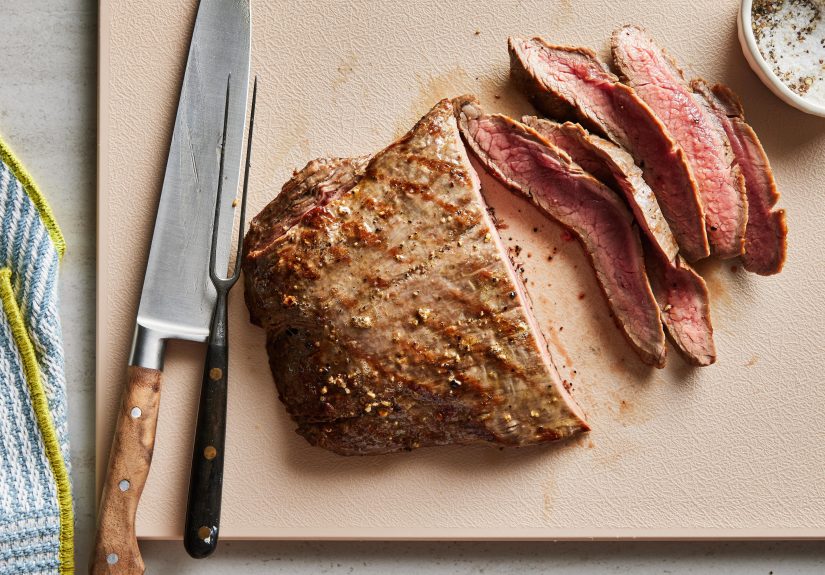
Now the glow-up move: hold your knife at about a 30–45° angle as you slice. This creates wider, thinner slices (more surface area), which makes each piece feel more tender and look restaurant-pretty.
In other words: you’re still cutting against the grain, just doing it on a flattering angle. Like steak contouring.
4) Slice thinly (thickness is tenderness insurance)
For flank steak, thinner is usually friendlier. Use these guidelines:
- Fajitas/tacos: about 1/8–1/4 inch thick (thin, flexible strips)
- Steak salad: about 1/4 inch thick (still tender, a bit more “meaty”)
- Sandwiches: aim for the thinner end, 1/8 inch, especially if serving cold or room temp
Knife and Cutting Board Tips (Small Things, Big Payoff)
You don’t need a sword, but you do need a sharp knife. A dull blade tears fibers instead of cleanly slicing themwhich can make the steak feel tougher, even if you cut against the grain.
Use these simple technique upgrades
- Choose the right knife: a carving knife or chef’s knife with a long blade helps you slice in one smooth stroke.
- Slice, don’t saw: gentle forward motion + downward pressure beats aggressive back-and-forth hacking.
- Stabilize the steak: use tongs or a fork to hold it steady (and keep fingers safely out of the drama).
How to Cut Flank Steak for Different Meals
For fajitas and tacos
Classic approach: rest the steak, then slice thinly against the grain on a bias. If you want long, impressive strips, cut the steak into shorter sections firstthen slice each section against the grain.
For stir-fry (paper-thin slices, no stress)
Stir-fry rewards thin slicing. Two tricks help:
- Chill the steak first: pop it in the freezer for 15–25 minutes so it firms up slightly (not frozen solid). This makes thin slices easier and cleaner.
- Slice across the grain into thin sheets: then cut those sheets into bite-size strips if needed.
If you’re aiming for long, noodle-like strips, you can cut the steak with the grain into manageable chunks first, then rotate and slice each chunk against the grain into thin strips. That way, you get length without sacrificing tenderness.
For steak salads and grain bowls
Go a touch thickeraround 1/4 inchso the slices don’t disappear into the greens. Still: against the grain, ideally on a bias.
For meal prep (leftovers that stay tender)
Flank steak can feel tougher when cold. For meal prep, slice a bit thinner than usual and keep slices loosely stacked (not smashed into a brick). Reheat gentlyoverheating turns “tender” into “trampoline.”
Common Mistakes (and How to Fix Them Fast)
Mistake #1: Cutting with the grain
Fix: Rotate the steak 90 degrees and slice again. If you’ve already cut thick with-the-grain planks, re-slice those planks across into thinner strips.
Mistake #2: Slices are too thick
Fix: Thinly re-slice on a bias. Even a slightly overcooked flank steak can eat well if sliced thin enough.
Mistake #3: Cutting immediately after cooking
Fix: If you already sliced, you can’t “un-slice,” but you can reduce dryness by serving with a saucy friend: chimichurri, salsa verde, pan juices, or a quick lime-and-oil drizzle.
Mistake #4: Dull knife
Fix: Hone the blade if you can. If not, slow down, use longer strokes, and avoid pressing hard (that’s when tearing happens).
Bonus: Tenderness Starts Before You Slice
Cutting is the headline act, but a few supporting players matter too.
Don’t overcook it
Flank steak is lean, so it’s happiest cooked quickly and not taken too far. Many cooks aim for medium-rare for the best texture. For food safety, USDA guidance for whole steaks includes cooking to 145°F and resting for at least 3 minutes.
Marinate smart
Flank steak loves a marinadeespecially ones that balance salt, fat, and aromatics. Acid (like citrus or vinegar) can help, but extremely acidic marinades left too long can make the surface mushy. If you want extra tenderness for quick-cook dishes, you can also explore techniques like “velveting” (popular in stir-fries).
Dry brine if you have time
Salting the steak ahead (even 30–60 minutes) can improve juiciness and flavor. Pat dry before cooking for better browning.
The 30-Second Checklist
- ✅ Identify the grain before cooking (and mark it if you want).
- ✅ Rest the steak 5–10 minutes.
- ✅ Cut into short sections for control.
- ✅ Slice against the grain.
- ✅ Use a 30–45° bias for thinner, wider slices.
- ✅ Slice thin (especially for fajitas, tacos, and sandwiches).
Real-World Experiences: What Usually Goes Wrong (and How People Fix It)
Even after someone hears “cut against the grain,” real kitchens have… real chaos. Here are a few common experiences home cooks reportplus the practical lesson that turns each one into a win.
1) “I cut it against the grain… I think… and it was still chewy.”
This is the classic “the steak got rotated mid-slicing” moment. It happens when you cut the first few slices correctly, then unknowingly turn the steak (or move to the other end) where the grain direction shifts slightly. The fix isn’t fancy: pause and re-check the lines every few minutes, especially after you cut the steak into sections. Many people also find it helpful to make that tiny “grain marker” notch before cookingbecause once the steak is browned and beautiful, the grain can look like it’s playing hide-and-seek.
2) “My slices were tender… but only on the ends.”
Flank steak can have subtle grain changes across the cut. If you slice in one direction the whole time, one section may end up closer to “with the grain” than you intended. The easy fix is to treat flank steak like a map, not a straight highway: adjust your knife angle slightly if the fibers angle differently. People who start doing this often notice an immediate differencesuddenly every bite feels consistent, not just the “lucky” pieces.
3) “Fajita night was great, but the steak was weirdly tough in leftovers.”
Cold steak firms up, and thicker slices feel tougher after chilling. A lot of folks solve this by slicing slightly thinner for meal prep than they would for a hot dinner, then storing slices loosely (not compressed) so they don’t glue together. Gentle reheating helps too: a quick warm-up in a skillet with a splash of water or broth (plus a little oil) can bring back tenderness without overcooking. And if the steak is already a bit dry, adding it to something saucytacos, rice bowls, noodlescan make it feel brand new.
4) “I tried to slice thin, but the meat kept slipping and shredding.”
This is usually a temperature + knife combo. When steak is very warm and your knife isn’t razor-sharp, the surface can drag and tear instead of slicing cleanly. Many cooks report that letting the steak rest fullyand even chilling it briefly for super-thin slicingmakes the process ridiculously easier. A slightly chilled steak behaves more like a firm block you can slice cleanly, especially if you’re going for stir-fry thinness or deli-style sandwich slices.
5) “I was in a hurry and sliced right away. Juice. Everywhere.”
We’ve all watched the cutting board turn into a tiny floodplain. The practical takeaway people learn fast: resting isn’t just a ‘chef thing’it’s a texture thing. When steak rests, the slices stay juicier, and juicier slices feel more tender. If someone forgets and slices immediately, the save is sauce: chimichurri, salsa, yogurt-garlic sauce, even a quick squeeze of lime plus a drizzle of olive oil. The steak may not be perfect, but dinner will still get applause (or at least silence, which is the highest compliment when people are eating).
6) “My friend said ‘cut on a bias’ and suddenly my steak looked fancy.”
Bias slicing is one of those upgrades that feels like a cheat code. People often notice two things right away: the slices look wider and more “restaurant,” and they feel more tendereven if the steak is cooked a touch past ideal. That’s because the bias creates thinner edges and more surface area per bite. It’s a small hand position change with a big payoff, which is exactly the kind of kitchen trick worth keeping forever.
Bottom line: Most “tough flank steak” stories end the same way once slicing clickspeople realize they didn’t need a different recipe, just a better angle. Literally.
Conclusion
If flank steak has ever betrayed you, it probably wasn’t personalit was physics. Find the grain, let the steak rest, slice thinly against the grain, and add a bias cut for next-level tenderness and presentation. Do that, and flank steak becomes what it was always trying to be: bold, beefy, and incredibly easy to love.