Table of Contents >> Show >> Hide
- Why Minimalism and Shadows Are Basically Best Friends
- My Minimalist Light-and-Shadow Workflow
- My 20 Light-and-Shadow Photographs (Descriptions + How They Were Made)
- Photograph 1: “Window Blind Barcode”
- Photograph 2: “Staircase Zigzag”
- Photograph 3: “Fire Escape Geometry”
- Photograph 4: “The Lone Pedestrian”
- Photograph 5: “Plant Shadow on Linen”
- Photograph 6: “Circle of Light”
- Photograph 7: “Silhouette at the Doorway”
- Photograph 8: “Fence Shadow Stripes”
- Photograph 9: “Chair, Mostly Shadow”
- Photograph 10: “Crosswalk Minimalism”
- Photograph 11: “Museum Wall Light Slice”
- Photograph 12: “Curtain Edge Chiaroscuro”
- Photograph 13: “Hands and Shadow”
- Photograph 14: “Umbrella Shadow on Sidewalk”
- Photograph 15: “Parking Garage Light Bands”
- Photograph 16: “Book Spine Shadow”
- Photograph 17: “Streetlight Triangle”
- Photograph 18: “Palm Frond Shadow Dance”
- Photograph 19: “Laptop Glow, Night Minimalism”
- Photograph 20: “The Long Shadow Goodbye”
- Common Mistakes I’ve Made (So You Don’t Have To)
- How This Style Helps Me as a Freelance Artist
- Conclusion: Minimalism Isn’t EmptyIt’s Intentional
- Extra : My Real-World Experiences Chasing Light and Shadow
Minimalism gets a bad rap. People hear “minimalist photographer” and imagine I spend my days taking artsy photos of a single pebble
in an empty parking lot while whispering, “Ah yes… negative space.” (To be fair, I have photographed a pebble. It was a great pebble.)
But here’s the twist: minimalism isn’t about having less to say. It’s about saying it with fewer wordsvisually. And in photography,
nothing “speaks” faster than the relationship between light and shadow. Light is the headline. Shadow is the subtext. Put them
together, and you get drama, geometry, and moodwithout needing a cluttered frame or a 47-piece lighting rig that looks like it could launch
a small satellite.
In this article, I’ll walk you through how I approach minimalist light-and-shadow photography as a freelance artist, then share the ideas,
scenes, and compositions behind 20 photographseach built around simple shapes, sharp contrast, and a “less but better” mindset.
If you’re looking for minimalist photography inspiration, shadow photography ideas, and practical tips for working with hard light, silhouettes,
and chiaroscuro-style contrast, you’re in the right place.
Why Minimalism and Shadows Are Basically Best Friends
Minimalism (as an art movement) is often described as reducing a work to essential formssimple geometry, clean structure, and a strong emphasis
on the viewer’s experience. That mindset maps beautifully onto photography: remove the noise, keep the signal. In a minimalist photograph, the
subject doesn’t fight the background. It negotiates with it.
Shadows are perfect negotiating tools. A shadow can:
- Create shape where there’s no object (a staircase becomes a zigzag without showing the stairs).
- Remove detail to emphasize form (goodbye clutter, hello silhouette).
- Direct attention like a visual arrow (your eyes follow contrast before they follow color).
- Turn ordinary scenes into graphic design (a window blind becomes a barcode of sunlight).
Minimalism also loves negative spacethe open area around a subject that gives breathing room and visual weight. When you combine
negative space with crisp shadow edges, you get the minimalist “snap” that makes a frame feel intentional instead of accidental.
My Minimalist Light-and-Shadow Workflow
I don’t “collect” photos. I build themusually from three ingredients: hard light, strong geometry, and
patient timing. Here’s the process I use whether I’m shooting personal work, editorial content, or minimalist brand imagery.
1) I Look for Hard Light on Purpose
Most photographers run from harsh midday sun like it’s trying to sell them an extended warranty. I get ithard light is unforgiving. But that’s
exactly why it’s useful: hard light creates defined shadows with clean edges, which is basically free graphic design.
Hard light is my favorite for shadow patterns (railings, blinds, lattice, fire escapes). If the sun is high and the shadows are crisp, I’m happy.
If the shadows are soft and vague, I know the light is too diffused for the look I want.
2) I Control Shadow Depth with Fill (and “Negative Fill”)
Minimalist photos live and die by contrast. Sometimes I want the shadow side to open up a littleso I use a reflector (even a plain white surface)
to bounce light back in. Other times, I want shadows to go deeper for drama. That’s where negative fill comes in: I’ll place a piece
of black foam board to soak up stray bounce light and keep the shadow side rich and clean.
This sounds fancy, but it’s basically: “Stop the room from being too bright.” Minimalism is a lot like budgeting. You decide where the light goes,
and you cut the rest.
3) I Compose Like a Minimalist (Not Like a Tourist)
Composition matters more when you have fewer elements. With minimalist composition, I lean on:
- Negative space to isolate the subject
- Leading lines to aim the viewer’s attention
- Balance (visual weight matters even when there’s “nothing” in the frame)
- Simple shapes (triangles, arcs, blocks, repeating stripes)
If a frame feels “busy,” I don’t fix it by adding more. I fix it by subtracting: change angle, step closer, or crop in-camera. Minimalism is the
art of not letting your background audition for the lead role.
4) I Expose for the Story I Want
With light-and-shadow images, exposure is a creative choice:
- For silhouettes, I expose for the bright background and let the subject go dark.
- For shadow detail, I protect highlights while keeping just enough information in the dark areas.
- For graphic contrast, I embrace clipped blacks (and occasionally clipped highlights) if it serves the design.
I check the histogram, especially in harsh light. Minimalist photography often relies on bold tones, but I still want controlespecially if I’ll
be printing or delivering files for a client who expects clean results.
5) I Edit Like a Minimalist, Too
In post, I keep it simple: gentle global adjustments (contrast, highlights, shadows), then targeted local edits. Local adjustments let me darken a
distracting bright patch or lift a detail that supports the storywithout turning the whole image into a crunchy HDR situation that looks like it
was seasoned with “Extra Drama Powder.”
Minimalist editing rule: if the viewer notices the edit before they notice the subject, I went too far.
My 20 Light-and-Shadow Photographs (Descriptions + How They Were Made)
I’m sharing these as a gallery of concepts and compositionseach one built around light direction, shadow shape, and minimalist design. Think of
them as captions to a portfolio: if you want to recreate them, you canbecause the magic isn’t a secret location. It’s the way you see the light.
-
Photograph 1: “Window Blind Barcode”
Morning sun slices through blinds and paints parallel stripes across a blank wall. A single coffee mug sits at the edge of one stripejust
enough to prove this is real life, not a minimalist album cover.How it was made: Side light from a window; exposed to preserve highlight stripes; slight negative fill with a dark cloth to deepen shadows.
Minimalist takeaway: Repetition + one small interruption creates tension.
-
Photograph 2: “Staircase Zigzag”
A stair rail throws a sharp zigzag shadow onto white concrete. The stairs themselves are barely visiblebecause the shadow is the star.
How it was made: Midday hard light; framed tight to remove distractions; high contrast black-and-white conversion.
Minimalist takeaway: Let shadows replace objects when the shadow shape is stronger than the thing casting it.
-
Photograph 3: “Fire Escape Geometry”
The shadow of a fire escape grid lands on a brick wall, turning the scene into a clean pattern of squares and diagonals.
How it was made: Street shooting; waited until the sun aligned with the metal grid; exposure set to avoid blowing out the wall texture.
Minimalist takeaway: Timing is a composition tool.
-
Photograph 4: “The Lone Pedestrian”
A single person crosses a wide, bright sidewalk, their shadow stretching like a punctuation mark. The rest is empty spacequiet, clean, and a
little suspenseful.How it was made: High angle; fast shutter to freeze stride; background simplified by choosing a plain concrete section.
Minimalist takeaway: Negative space turns everyday movement into a story.
-
Photograph 5: “Plant Shadow on Linen”
A houseplant sits off-frame, but its leaf shadow falls onto a linen curtain like a soft botanical drawing.
How it was made: Late afternoon sun; slight underexposure; gentle shadow lift in editing to keep texture.
Minimalist takeaway: You don’t always need the subjectsometimes the shadow is the portrait.
-
Photograph 6: “Circle of Light”
A round patch of sunlight hits the floor through a small window. Inside that circle: one set of keys. Outside the circle: nothing but calm.
How it was made: Spot metering on the highlight; composition centered but balanced with floor texture.
Minimalist takeaway: Simple shapes feel intentional when edges are clean.
-
Photograph 7: “Silhouette at the Doorway”
A figure stands in a doorway flooded with backlight, rendered as a pure black shape. No facial detailsjust posture and outline.
How it was made: Backlit scene; exposed for the bright doorway; kept background uncluttered for a crisp outline.
Minimalist takeaway: Silhouette photography is storytelling with shape, not detail.
-
Photograph 8: “Fence Shadow Stripes”
A simple wooden fence casts evenly spaced stripes onto a driveway. One stripe is broken by a fallen leaf, like a tiny plot twist.
How it was made: Hard morning light; low angle to elongate shadows; minimal color grading to keep neutrals honest.
Minimalist takeaway: Patterns become interesting when something breaks the pattern.
-
Photograph 9: “Chair, Mostly Shadow”
A chair is barely lit, but its shadow is bold and sculpturallike a second chair made of darkness.
How it was made: Single directional light source; controlled spill with negative fill; edited to protect highlight edges.
Minimalist takeaway: Shadow can be a second subject.
-
Photograph 10: “Crosswalk Minimalism”
A crosswalk becomes a set of white rectangles. A cyclist’s shadow slides across them, perfectly aligned for half a second.
How it was made: Pre-framed composition; waited; shot burst mode for timing.
Minimalist takeaway: Pre-visualize, then let life walk into your frame.
-
Photograph 11: “Museum Wall Light Slice”
A clean wall is cut diagonally by a beam of lighthalf bright, half shadow. A tiny “Do Not Touch” sign sits in the corner like a punchline.
How it was made: Exposed for highlights; straightened verticals; kept color neutral for a gallery-clean vibe.
Minimalist takeaway: Minimalism loves a strong division of space.
-
Photograph 12: “Curtain Edge Chiaroscuro”
A curtain edge creates a soft transition from bright to dark, with just enough texture to feel tactile. It’s quiet, but it has depth.
How it was made: Side lighting; gentle contrast curve; avoided crushing blacks to keep the gradient smooth.
Minimalist takeaway: Chiaroscuro doesn’t have to shoutsometimes it whispers.
-
Photograph 13: “Hands and Shadow”
A hand reaches into a beam of light, casting a dramatic shadow on a blank surface. The gesture feels like a question mark.
How it was made: Single light direction; adjusted distance for shadow sharpness; cropped tight to remove context.
Minimalist takeaway: Gesture + shadow = instant narrative.
-
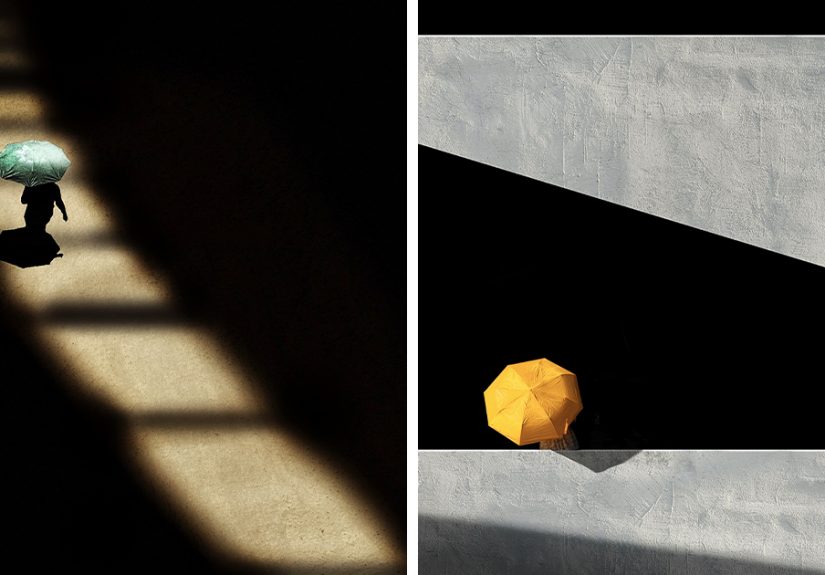
Photograph 14: “Umbrella Shadow on Sidewalk”
The umbrella itself is outside the frame. Only its round shadow appears, moving across a bright sidewalk like a traveling eclipse.
How it was made: Street moment; fast shutter; composed for empty space ahead of the shadow’s path.
Minimalist takeaway: Suggestion can be stronger than description.
-
Photograph 15: “Parking Garage Light Bands”
Light spills through repeating openings, painting bands across the concrete floor. One lone traffic cone stands like a tiny neon exclamation point.
How it was made: Exposed to keep highlight bands clean; used symmetry; subtle de-saturation to reduce color noise.
Minimalist takeaway: Repetition is calminguntil you add one odd element.
-
Photograph 16: “Book Spine Shadow”
A single book on a table casts a long rectangular shadow. The scene is basically: “The geometry of reading.”
How it was made: Desk lamp moved to a steep angle; black foam board to deepen shadows; shot with a longer lens for flatter perspective.
Minimalist takeaway: Small scenes can look big when shapes are strong.
-
Photograph 17: “Streetlight Triangle”
At dusk, a streetlight creates a bright triangle on the pavement, surrounded by darkness. A single shoe steps into the trianglestage lighting for real life.
How it was made: Higher ISO; steady hand; exposed for the lit triangle to keep it crisp.
Minimalist takeaway: Light can be a spotlight without permission.
-
Photograph 18: “Palm Frond Shadow Dance”
Palm fronds cast layered shadows on a smooth wall. The overlapping shapes feel like abstract ink strokes.
How it was made: Midday sun; framed for clean wall; edited for subtle contrast and consistent tones.
Minimalist takeaway: Organic shadows can still be minimalist if the background is controlled.
-
Photograph 19: “Laptop Glow, Night Minimalism”
A laptop screen lights one side of a face while the rest falls into shadow. It’s modern chiaroscuro: the Renaissance, but with email.
How it was made: Single light source (screen); exposed for highlights; kept background dark and distraction-free.
Minimalist takeaway: One light source is often all you need.
-
Photograph 20: “The Long Shadow Goodbye”
A long shadow stretches across an empty road at golden hour. The subject is tiny, but the shadow is hugelike the day leaving a signature.
How it was made: Low angle; waited for the longest shadow; warm tones kept gentle, not syrupy.
Minimalist takeaway: Scale comes from contrast, not complexity.
Common Mistakes I’ve Made (So You Don’t Have To)
1) Letting “Minimal” Become “Accidental”
A blank wall isn’t automatically minimalist. It’s minimalist when the blankness supports a strong subject or shape. If the photo looks like you
forgot to walk closer, that’s not minimalismthat’s cardio avoidance.
2) Ignoring the Edge of the Frame
In shadow photography, frame edges are where distractions hide. I do a quick “border patrol” before I press the shutter: scan corners, scan edges,
remove the bright speck, the half-object, the mystery elbow.
3) Crushing All Shadows Into Nothing
Sometimes pure black is the point (graphic silhouettes). But if every dark area becomes the same blob, you lose depth. Minimalism still needs
dimensionjust not clutter.
4) Forgetting the Freelance Reality: Usage and Releases
If you shoot people or recognizable private property for client work, you may need releases depending on usage. As a freelancer, I treat this like
part of the creative processnot an afterthoughtbecause it affects how (and where) images can be licensed.
How This Style Helps Me as a Freelance Artist
Minimalist light-and-shadow photography is not just a personal obsessionit’s also practical for freelance work:
- Brands love clarity. Minimal images leave room for copy, logos, and design layouts.
- It’s scalable. I can shoot consistent series for campaigns: same light language, different subjects.
- It’s efficient. One strong light source (natural or simple continuous light) can produce a whole set.
- It’s distinctive. In a world of visual noise, clean frames stand out.
Licensing (In Plain English)
In many freelance situations, I’m not “selling the photo” so much as licensing how it can be usedwhere, how long, and in what context. That
conversation gets easier when your work has a consistent style and clear application. Minimalist shadow images are especially useful for editorial,
web design, product storytelling, and brand campaigns that want a modern, graphic look.
My client-friendly approach: I explain usage in terms of scope (platforms, duration, region, exclusivity) and deliver files labeled clearly. It’s
not about being “difficult.” It’s about making sure everyone understands what they’re paying forand what they’re allowed to do with it.
Conclusion: Minimalism Isn’t EmptyIt’s Intentional
Light and shadow photography is one of the fastest ways to train your eye. Once you start noticing shadows as shapes, you’ll see compositions
everywhere: on sidewalks, walls, curtains, stairs, and ordinary objects that suddenly look like they belong in a gallery.
And that’s the heart of minimalist photography: you don’t need more stuff. You need better seeing. The world already provides the light. Your job
is to frame it like you mean it.
Extra : My Real-World Experiences Chasing Light and Shadow
If I could time travel to my early freelance days, I’d hand Past Me two things: a black foam board (for negative fill) and a note that says,
“Stop trying to impress everyone with complexity.” I used to believe “professional” meant complicatedmultiple lights, complicated setups,
complicated explanations. Then I started paying attention to the photographs that actually stuck in people’s minds. They were often the simplest.
One of my first paid gigs with a minimalist brief was a small brand that wanted “clean, modern images that feel calm.” Translation: “Please don’t
make our product look like it’s trapped in a craft store explosion.” I showed up with a tiny kit, a reflector, and a plan to use window light. The
biggest surprise wasn’t that it workedit was how repeatable it was. Once you identify a strong light direction and a clean background, you
can produce a whole consistent set. Consistency is the hidden superpower of minimalism. Clients don’t just want one good photo; they want a family
of images that look like they belong together.
I also learned that minimalist shadow photography is basically an exercise in humility. You can’t force the sun to move faster. You can’t talk a
shadow into being sharper. You can only show up, watch, and wait. I’ve stood next to a wall for ten minutes because the shadow of a railing was
slowly creeping toward the exact spot I needed. From the outside, it probably looked like I was contemplating my life choices. I was, but I was
also timing the universe.
Travel taught me another lesson: if you want minimalist images, you need to be ruthless about backgrounds. In a new city, everything looks
interestingsigns, colors, people, textures. It’s easy to overfill the frame. My trick is to pick one visual “sentence” per photo. If the sentence
is “shadow of a bicycle on a bright wall,” then the rest of the scene has to shut up. I’ll move left, right, up, downuntil the background becomes
quiet enough to support the idea. This is why minimalist photographers walk weird: we’re not lost, we’re subtracting.
Over time, this style has also shaped how I handle creative blocks. When I feel stuck, I don’t hunt for new gear or new locations. I hunt for new
light. I’ll take a normal objecta glass, a book, a plantand change only the light angle. That small constraint becomes a creative engine. Shadows
stretch, edges sharpen, textures appear, shapes transform. It’s like discovering a new scene in the same room.
The best part? Minimalism scales with your life. Some days you have time for a full shoot. Some days you have ten minutes and a patch of sunlight.
Light and shadow don’t care about your schedule. They show up anyway. And if you train your eye, you’ll start seeing opportunities everywherelike
the world is quietly offering you compositions, one shadow at a time.