Table of Contents >> Show >> Hide
- What People Mean by “Babylonian Tablet Trigonometry”
- Meet Plimpton 322: The Clay Celebrity With a Spreadsheet Vibe
- Base-60: The Babylonian Secret Sauce for Clean Ratios
- The Trig Claim: Ratios Instead of Angles
- The Skeptics: “Cool Story, But Is It Really Trig?”
- So What’s Actually on the Tablet?
- How This Relates to “Trig History” Without Starting a Timeline War
- Why Anyone Outside a Math Department Should Care
- Hands-On Experiences With Babylonian Tablet Trigonometry (Try This Yourself)
- Conclusion: The Real Lesson Inside the Clay
If you think trigonometry was invented the moment someone drew a circle and got emotionally attached to angles,
the ancient Babylonians would like a wordpreferably carved into wet clay. “Babylonian tablet trigonometry”
is the modern shorthand for a lively scholarly debate sparked (again) by a famous Old Babylonian tablet called
Plimpton 322: a compact grid of numbers that seems to describe right triangles using ratios,
long before Greek-style trig tables became a thing.
The twist is that Plimpton 322 doesn’t look like your high-school trig sheet. No sine, no cosine, no angle measures
in degrees. Instead, it uses sexagesimal notation (base-60) and lists sets of values tied to
Pythagorean triplesinteger side lengths that satisfy the right-triangle relationship modern students
chant like a spell: a² + b² = c².
What People Mean by “Babylonian Tablet Trigonometry”
In 2017, researchers argued that Plimpton 322 can be interpreted as a kind of trigonometric tableone that organizes
right triangles by side-length ratios rather than by angles and circles.
That claim traveled fast because it’s delightfully disruptive: it suggests a sophisticated “ratio-first” trig-like
approach existed in Mesopotamia more than a millennium before the Greek tradition most textbooks spotlight.
But “can be interpreted” is doing heavy lifting. Other historians and mathematicians have pushed back, warning that
calling it “trigonometry” risks smuggling modern ideas into ancient scribal practiceespecially since part of the
tablet is missing and the surviving columns can support multiple readings.
So the phrase “Babylonian tablet trigonometry” really names a question: Was Plimpton 322 a trig table, a teaching
aid, a problem generator, or something else entirely?
Meet Plimpton 322: The Clay Celebrity With a Spreadsheet Vibe
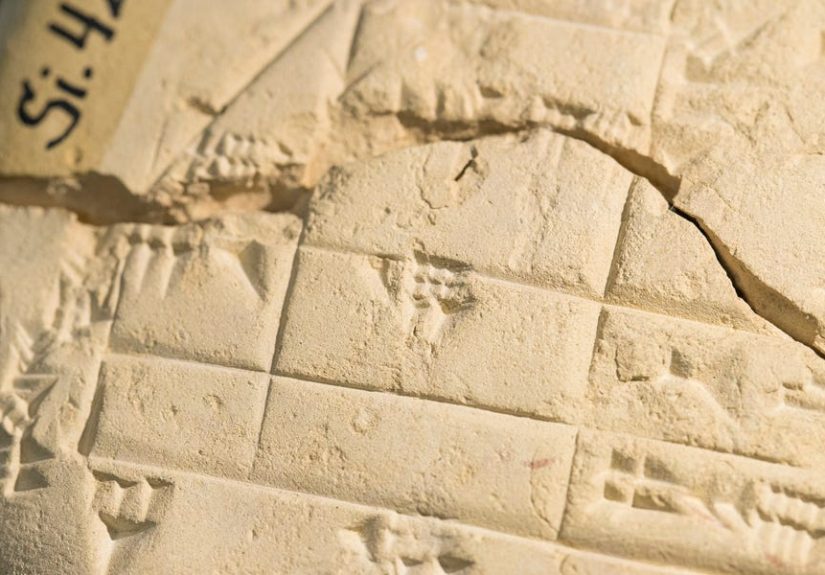
Plimpton 322 is a small clay tablet from the Old Babylonian period (often dated around the early second millennium BCE).
It contains a table with 15 rows of numbers written in cuneiform, and those numbers relate to right triangles
with integer side lengthswhat we call Pythagorean triples today.
Scholars have been arguing about its purpose for decades, which is exactly what you want from a 3,700-ish-year-old artifact:
enduring mystery, minimal maintenance.
One reason the tablet inspires so many theories is that it’s both structured and incomplete. The right side is nicely ruled,
and one edge is broken offmeaning some digits (and possibly an entire column) are missing. That missing chunk is central to
the debate, because it could have held explanatory values that would settle the question of what the table was “for.”
Base-60: The Babylonian Secret Sauce for Clean Ratios
To appreciate why anyone would look at this tablet and think “trigonometry,” you have to understand the Babylonian love
affair with base-60. In our base-10 world, many common fractions produce endless decimals (try dividing 1 by 3 and don’t cry).
In base-60, fractions whose denominators factor nicely into 2, 3, and 5 behave much more politely.
Why base-60 can feel “more exact”
Sixty has lots of divisors: 2, 3, 4, 5, 6, 10, 12, 15, 20, 30. That means many ratios that look messy in base-10 can be written
finitely in sexagesimal. The 2017 interpretation emphasized that Plimpton 322’s triangles are chosen so key ratios remain rational
and can be represented without approximationone reason the authors called it “exact.”
This doesn’t automatically make it a trig table, but it does explain why a list of right-triangle ratios could be genuinely useful
in a scribal culture that prized computational reliability. If you’re trying to design slopes, ramps, or right-angled layouts,
having a ready-made set of “nice” triangles is like having a menu where every item is the chef’s favorite.
The Trig Claim: Ratios Instead of Angles
Modern trigonometryat least the version most of us met under fluorescent classroom lightingconnects angles to ratios of sides,
often via functions like sine and cosine. The 2017 argument flips the emphasis: instead of leading with angles, it treats the tablet
as cataloging right triangles by side ratios, which can be used to compute consistent shapes without ever measuring an angle in degrees.
In that framing, the “trig” part is functional rather than terminological. It’s not that Babylonians wrote “sin(θ).”
It’s that they may have had a systematic way to pick and scale right triangles based on numerical relationshipsachieving some of the
same practical outcomes trig delivers today.
A concrete example: the friendly 3–4–5 triangle
Take the classic triple (3, 4, 5). If you scale it up, you still get a right triangle: (30, 40, 50), (300, 400, 500), and so on.
The ratio of the shorter leg to the longer leg is 3/4; the ratio of the hypotenuse to the longer leg is 5/4. If you’re building a ramp
or laying out a field and you want a repeatable slope, those ratios matter more than whether the angle is 36.87°.
Plimpton 322 contains far larger and more intricate triples than 3–4–5exactly the kind of “precomputed” values you’d want if the goal
was to quickly generate many right triangles with convenient properties.
The Skeptics: “Cool Story, But Is It Really Trig?”
The pushback isn’t “Babylonians weren’t smart.” The pushback is “words matter.” Critics have argued that calling Plimpton 322 “trigonometry”
risks anachronism: importing modern conceptual baggage (angles, functions, formalized trig identities) into an ancient context where the evidence
for those concepts is thin.
One critique highlights that the “exactness” claim hinges on a special subset of right trianglesthose with integer side lengthsso the tablet’s
neat ratios may reflect number-theory-friendly selection rather than an intention to build a trig system.
Another points out the tablet is damaged, and the decisive clue could be in the missing portionmaking any confident “this is definitely a trig table”
conclusion feel premature.
There’s also a cultural argument: Old Babylonian mathematics often appears in problem sets and school exercises. Some scholars see Plimpton 322 less
as a reference table for engineers and more as a teacher’s toolkitstructured data designed to generate many related student problems.
(Translation: the world’s oldest math homework machine, except you can’t “forget it at home” because it is home.)
So What’s Actually on the Tablet?
Without turning this article into a full epigraphy seminar, here’s the broad picture: the tablet’s rows correspond to right triangles, and the columns
list values tied to side lengths and/or derived ratios. The ordering of rows is not random; it appears intentionally arranged, which fuels the idea that
it was meant to be consulted like a table rather than read like a one-off calculation.
Why the missing edge matters
If the broken-off column contained a parameter (or reciprocal pair) used to generate each row, that supports a “problem generator” interpretation.
If it contained a label that ties each row to a specific geometric use (like “slope class” or a standardized ratio), that would strengthen the “reference table”
interpretation. Because we don’t have it, scholars triangulate meaning from patterns, ordering, language, and known Babylonian calculation methods.
How This Relates to “Trig History” Without Starting a Timeline War
The most responsible takeaway is not “Babylonians invented trigonometry, Greeks stole it, roll credits.” History isn’t a relay race where everyone drops a baton.
It’s more like multiple people independently discovering that math is useful… and then arguing about notation for 2,500 years.
What the debate around Babylonian tablet trigonometry really shows is that there were different ways to organize geometric knowledge.
Greek astronomy-driven trig leaned into circles and angle measures; Old Babylonian scribal math leaned into arithmetic regularity and ratio-friendly numbers.
Even if Plimpton 322 wasn’t a “trig table” in the modern sense, it can still represent a powerful, systematic approach to right triangles.
Why Anyone Outside a Math Department Should Care
Beyond the academic fireworks, this topic is surprisingly human. Plimpton 322 is a reminder that:
- Practical math often comes before formal math. People compute what they need long before they name it.
- Notation shapes what feels “natural.” Base-60 nudges you toward certain “clean” fractions and tables.
- Artifacts don’t come with user manuals. Sometimes the most honest answer is “we’re still figuring it out.”
It also offers a neat antidote to the myth that ancient math was primitive. Old Babylonian scribes weren’t doodling; they were running a numerical culture
sophisticated enough to support administration, surveying, construction, and educationusing tools that look foreign until you translate them into the logic
of their system.
Hands-On Experiences With Babylonian Tablet Trigonometry (Try This Yourself)
You don’t need a kiln, a reed stylus, or a time machine to “feel” what Babylonian tablet trigonometry is about. The experience is less “memorize sine”
and more “collect great triangles like you’re building a playlist.” Here are a few ways to get that hands-on, belly-laugh-and-learn vibewithout claiming
you’re about to outsmart 3,700 years of scholarship.
Experience 1: Convert a fraction to sexagesimal and enjoy the weird satisfaction
Pick a simple fraction: 1/2, 1/3, 1/5, 1/8, 1/12. Now convert it into base-60 “minutes” and “seconds” style notation.
For example, 1/2 becomes 0;30 (because 30 is half of 60). 1/3 becomes 0;20. 1/5 becomes 0;12.
The first time you see these terminate cleanly, you’ll understand why a base-60 culture might prefer tables of ratios:
the numbers behave. It’s the mathematical equivalent of a desk drawer that finally closes.
Now try 1/7. Watch it refuse to terminate nicely. That emotional contrastbetween tidy and unruly fractionsis a big part of why “regular” numbers matter
in Mesopotamian computation. The experience teaches you, viscerally, that the number system itself guides what kinds of tables are attractive to build.
Experience 2: Build your own mini “Plimpton-style” right-triangle table
Start with familiar Pythagorean triples: (3,4,5), (5,12,13), (8,15,17), (7,24,25), (20,21,29).
Create a small table with columns like:
short side, long side, diagonal, and diagonal/long.
Then add one more column: (diagonal/long)².
Two things happen when you do this:
(1) You stop thinking of the triangle as “an angle” and start thinking of it as “a stable shape class defined by ratios.”
(2) You notice that some ratios are friendlier than others, especially when you try to express them cleanly.
That’s exactly the mental groove that makes the “Babylonian trig table” interpretation feel plausiblewhether or not it’s ultimately correct.
Experience 3: Use ratios like a builder, not a textbook
Imagine you’re laying out a right angle on a job site with rope lengths (no protractor, no smartphone app, just vibes and measurements).
A 3–4–5 triangle is a classic because it’s scalable and reliable: 30–40–50 works, 300–400–500 works, etc.
Now compare that to using an angle like 37°. Angles are elegant on paper, but ratios are often easier in the dirt.
This is where “Babylonian tablet trigonometry” becomes more than a headline. Even if Plimpton 322 was a teaching tool, the experience of using ratio-based
right triangles is inherently practical. You can feel how a table of pre-vetted triangles would speed up repeated work: slopes, layouts, and consistent
designsespecially in a culture that excels at arithmetic.
Experience 4: Try the historian’s experiencehold two interpretations at once
This is the sneakiest (and most valuable) experience: read the tablet as a trig-like table and read it as a scribal-school generator,
and notice how both stories can fit the same evidence. The “aha” moment isn’t choosing a side; it’s realizing how interpretation works when the artifact
doesn’t come with labels, diagrams, or a “Made in Babylon” instruction booklet.
That tensionbetween pattern recognition and cultural contextis why Plimpton 322 remains famous. It’s not just a set of numbers. It’s a mirror that shows
how we, today, try to reconstruct ancient thinking from partial data. And yes, it’s also a reminder that even the most intimidating math can start as
a neat table someone made because they wanted their calculations to stop being annoying.
Conclusion: The Real Lesson Inside the Clay
“Babylonian tablet trigonometry” is best understood as a modern conversation about an ancient artifact: a clay table of right-triangle relationships that
could plausibly function like a trigonometric resourceyet may also reflect the problem-solving and teaching traditions of Old Babylonian scribal culture.
The debate is the point. It forces us to separate what the tablet does (organizes numerical triangle relationships) from what we call it
(trigonometry, proto-trig, algebraic exercise list, or something in between).
Whatever your preferred label, Plimpton 322 proves one thing beyond dispute: ancient math wasn’t waiting around for Greece to show up with a circle.
It was already busy, already clever, and already making tables that can still start arguments in 2026.