Table of Contents >> Show >> Hide
- Meet the mind behind the fingers
- What makes finger drawings so weirdly irresistible?
- How it works: the anatomy of a finger doodle
- Examples that show why the concept works
- A quick mini-tutorial: try your own cute finger drawing
- Why this trend thrives online
- Finger drawings as a creative practice (not just a gimmick)
- Common mistakes (and how to fix them fast)
- Conclusion: a tiny reminder that play is a creative superpower
- Extra: of Hands-On Experiences Inspired by Finger Drawings
There are two kinds of people in the world: the ones who look at a hand and see “five fingers,” and the ones who look at a hand and see “a dinosaur head, a toucan beak, and a suspiciously smug sea creature waiting to happen.”
Luckily for the internet (and unfortunately for anyone trying to scroll “just one more minute”), there’s an artist who lives in the second categoryand he’s turned his own fingers into a tiny cast of characters.
This style of art is delightfully simple at first glance: a hand enters the frame, a few clean pen lines appear, and suddenly your thumb is a snout. Your index finger is a neck. Your pinky is… well, doing its best.
The result is the kind of “how did I not think of that?” creativity that makes you want to try it immediatelyright after you send it to three friends with the caption, “THIS IS MY NEW PERSONALITY.”
Meet the mind behind the fingers
One of the best-known creators of this “drawings made from real-life stuff” approach is Ecuador-based illustrator and art director Javier Pérez (often known online as “cintascotch”).
He became widely recognized for minimalist works that combine simple line drawings with everyday materialsfood, paper clips, nails, cardboard, and yes, his own hands.
The consistent thread through his projects is playful problem-solving: he finds a shape in the real world, then adds just enough drawn information to let your brain do the rest.
That “brain does the rest” part is key. These aren’t complicated, labor-intensive paintings. They’re clever visual jokesclean setups, sharp punchlines.
They’re also a reminder that creativity doesn’t always need a 48-color marker set and a studio with perfect north light. Sometimes it needs… your hand, a pen, and the willingness to look mildly ridiculous while taking 27 photos of your fingers.
What makes finger drawings so weirdly irresistible?
1) Your hand is the ultimate “found object”
Artists have used everyday objects as building blocks for ages, but hands bring a special advantage: they’re always available, endlessly poseable, and instantly recognizable.
A grape can become a balloon, surebut a curved index finger can become a dinosaur jaw in half a second, because your brain already understands hands.
2) It hits the sweet spot between “cute” and “clever”
Cute alone can be forgettable. Clever alone can be cold. Finger-based doodles do both at once:
the characters are charming, but the concept delivers a tiny aha-moment every time. It’s visual comedy with a soft aesthetic.
3) It’s basically pareidolia with better PR
Humans are meaning-making machines. We see faces in outlets, animals in clouds, andapparentlyentire ecosystems inside a hand pose.
Finger drawings take advantage of that instinct. The art supplies half the information; your imagination supplies the rest, then high-fives itself.
How it works: the anatomy of a finger doodle
The magic is in the restraint. If you’ve ever watched someone “over-explain” a joke, you already understand the risk here:
too many lines, and the illusion collapses. The best finger drawings follow a few unspoken rules.
Rule #1: One dominant real-world shape
The hand pose is the anchor. The drawing should treat the fingers like a sculptural elementalmost like a prop in a photoshoot.
The doodle then supports that prop, instead of fighting it.
Rule #2: Minimal lines, maximum implication
A couple of clean strokes can suggest a spine, a tail, feathers, or scales. You don’t need every detail.
In fact, leaving “blank” space is part of what makes it feel modern and satisfying.
Rule #3: A strong silhouette
If the pose reads clearly in shadow, it will read clearly in the final piece.
A good test: squint at the photo. If the hand shape still looks like “something,” you’re already halfway to an illustration.
Examples that show why the concept works
Finger-based drawings often turn hands into animals because hands already have built-in “limb logic.”
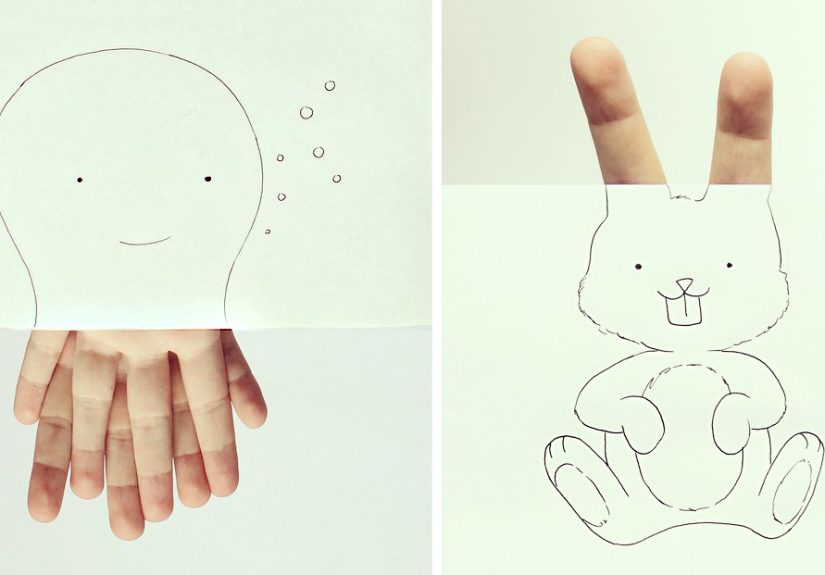
A curled finger can be a beak; two fingers can become legs; a thumb can become a snout; a pinch can become jaws.
Here are a few common “winning setups” you’ll see in this style:
- The “Handsaurus” move: a curved hand becomes a dinosaur head, with line-drawn body extending from it.
- The bird profile: a pinched thumb-and-finger shape reads instantly as a beak, especially with a simple eye line.
- The sea creature trick: spread fingers become tentacles or fins, with just a few lines to suggest a body.
- The tiny monster: a fingertip becomes a head, and the drawn body does something sillylike carrying groceries or wearing a cape.
What’s fun is that this approach doesn’t stop at fingers. The same mindset shows up in projects where artists combine line drawings with grapes, nails, straws, Scrabble tiles, or corrugated cardboardturning ordinary materials into whimsical characters and visual puns.
The “finger chapter” just happens to be especially delightful because it’s personal and interactive: you can literally recreate it at home in five minutes.
A quick mini-tutorial: try your own cute finger drawing
You don’t need to be a professional illustrator to play with this. The goal isn’t perfectionit’s discovery.
Here’s a simple, frustration-resistant way to start.
Step 1: Pick a hand pose with a story
Start with one strong gesture: a pinch, a claw, a curve, a “C” shape, or two fingers like tiny legs.
Avoid “random jazz hands” at first; they’re harder to read.
Step 2: Use clean lighting and a simple background
A plain wall, a sheet of paper, or a tabletop works great. Soft light reduces harsh shadows, which can distract from the illusion.
Step 3: Take the photo first
Photograph the pose. Don’t draw while holding the pose (unless you want to experience what it feels like to lose an argument with gravity).
Shooting first lets you choose the best angle and silhouette.
Step 4: Draw the “support lines,” not the whole character
Add only what’s missing: maybe an eye, a spine, a tail, or a tiny accessory that sells the personality.
The hand already did most of the worklet it keep the credit.
Step 5: Add one “comedy detail”
Cute becomes memorable when it has attitude. Give your creature a tiny backpack, a dramatic eyebrow, or a snack.
One detail is enough; too many turns it into a costume party.
Why this trend thrives online
Finger drawings are built for the modern attention span in the best way. They read instantly in a feed, deliver a quick surprise, and invite viewers to try it themselves.
That last partparticipationis huge. People don’t just like these posts; they recreate them, remix them, and share them.
It also helps that the format naturally supports a “series.” When an artist can reliably produce small, clever pieceseach with a consistent styleaudiences form habits.
You don’t just follow a creator for one image; you follow for the next twist on the same playful constraint.
Finger drawings as a creative practice (not just a gimmick)
The hidden power here is constraint. When you limit yourself to what you can do with a single hand pose and a few lines, your brain switches modes.
Instead of asking “What should I draw?” (the scariest question in art), you ask “What does this already look like?” (a much friendlier question).
That’s why this style can be a great daily creativity exercise:
it trains observation, visual metaphor, composition, and humorall without the pressure of making a “masterpiece.”
It’s a sketchbook habit for people who don’t think they’re sketchbook people.
Common mistakes (and how to fix them fast)
Mistake: The hand pose is unclear
Fix: Rotate the wrist, simplify the gesture, or zoom out slightly. The pose needs to read before the lines are added.
Mistake: Too many lines
Fix: Remove detail. If you can’t remove it, lighten it. The best version is usually the one with fewer strokes.
Mistake: The drawn part fights the real part
Fix: Let the finger be the hero. Make the lines serve the finger shape, not override it.
Mistake: The idea is cute, but not “snap-to-read”
Fix: Add one clarifying clue: an eye direction, a mouth line, or a simple prop that tells the viewer what creature they’re looking at.
Conclusion: a tiny reminder that play is a creative superpower
When an artist creates cute drawings out of his own fingers, it’s more than a fun internet trickit’s a practical lesson in imagination.
The hand becomes a prop, the pen becomes a translator, and the viewer becomes a collaborator, finishing the image in their mind.
And maybe that’s the real charm: it doesn’t ask you to be “talented.” It asks you to be curious.
It says, “Look again. The world is full of characters. Some of them are literally attached to your arm.”
Extra: of Hands-On Experiences Inspired by Finger Drawings
If you’ve ever tried making art from your own fingers, the first experience is usually a mix of confidence and immediate humility.
You’ll put your hand on the table like you’re about to perform a simple magic trick, and your brain will go, “Okay, easythis finger is definitely a dinosaur.”
Then you take the photo, look at it, and realize your “dinosaur” currently resembles a bent paperclip having an existential crisis.
That moment is normal. It’s also the beginning of the fun.
The next phase is the “pose obsession.” You start rotating your wrist a few degrees at a time, like you’re trying to tune a radio station that only plays animal silhouettes.
Suddenly, one angle clicks. A curved index finger becomes a beak. A thumb becomes a nose. Two fingers become legs with a suspicious amount of personality.
You’ll feel a tiny burst of victorybecause it’s not about drawing skill. It’s about noticing.
After a few attempts, you start seeing finger-drawing opportunities everywhere. Waiting for your coffee? Your hand on the counter looks like a little whale.
Sitting through a long meeting? Your hand resting on a notebook becomes a sleepy dinosaur whose body you can doodle during “action items.”
(Disclaimer: only do that if your job is cool, or if you’re extremely good at looking attentive while secretly creating a sea turtle.)
The most satisfying experience is when you add one small line and the whole thing suddenly becomes readable.
It’s like flipping a switch: one eye dot and a mouth curve, and now it’s a bird. One spine line and a tail, and now it’s a lizard.
You’ll catch yourself smiling at your own hand like it just told a joke.
That’s the “aha” payoff people love in this stylethe art is half made by the pen, half made by the viewer’s brain.
If you share your finger drawings, you’ll notice something else: people don’t just compliment themthey respond with their own ideas.
Someone will say, “That pose would make a shark!” Another will send a photo of their hand and ask what it could become.
The experience turns into a small creative game, the kind that spreads because it’s inviting.
It doesn’t demand fancy tools or years of practice. It just says, “Try one. You already have everything you need.”
And if you keep going, you’ll build a tiny habit: five minutes a day of playful thinking.
Over time, that’s not just a cute drawing trendit’s a way of training your imagination to stay awake in everyday life.
The biggest surprise isn’t that your fingers can become animals. It’s that you can become the kind of person who sees animals in fingers at all.