Table of Contents >> Show >> Hide
- Why Chernobyl Disaster Pictures Still Haunt Us
- The Story Behind the Creepiest Chernobyl Pictures
- Dark Tourism: Why People Visit the Places in These Photos
- What Creepy Chernobyl Pictures Don’t Show
- How to View and Use Chernobyl Disaster Pictures Responsibly
- Experiences: What It’s Like to Stand Inside Those Pictures
- Conclusion: More Than Just Creepy Pictures
Few photo collections can give you chills the way creepy Chernobyl disaster pictures do.
It’s not just one haunting snapshot, but a whole frozen world: empty schools, a silent Ferris wheel,
piles of children’s gas masks, and apartment blocks being slowly swallowed by trees.
These images don’t just look eeriethey tell the story of one of the worst nuclear disasters in history
and the people who left in a hurry and never came back.
In this guide, we’ll walk through the most iconic Chernobyl photos, what’s really going on in them,
and how to look at these images with empathy, not just morbid curiosity.
Think of it as a tour of the ghost town of Pripyat and the Chernobyl Exclusion Zoneminus the radiation scan.
Why Chernobyl Disaster Pictures Still Haunt Us
On April 26, 1986, a late-night safety test at Reactor 4 of the Chernobyl Nuclear Power Plant
went catastrophically wrong. A series of explosions ripped through the reactor,
launching a plume of radioactive material into the sky and across Europe.
Dozens of workers and first responders died in the immediate aftermath,
and long-term health effects have been felt by hundreds of thousands of people exposed to the fallout.
Nearby Pripyatthen a brand-new Soviet city of nearly 50,000 peoplewas evacuated within days.
Residents were told to pack a few essentials for “a short time away.”
Most never saw their homes again.
The result is a place that feels like time stopped in 1986.
When photographers enter now, they’re not just shooting ruins; they’re documenting interrupted lives.
That’s what makes Chernobyl pictures so unsettling: they show a normal day that suddenly never finished.
The Story Behind the Creepiest Chernobyl Pictures
The Silent Ferris Wheel and Abandoned Amusement Park
If you’ve seen only one Chernobyl image, it was probably the Ferris wheel in Pripyat’s amusement park.
The wheel was supposed to open on May 1, 1986, for the May Day celebrations.
Instead, it never carried a single paying rider.
Modern photos show the rusted yellow cabins hanging over an empty square,
surrounded by cracked pavement and trees muscling up through concrete.
Nearby, bumper cars sit where they were parked nearly four decades ago,
their once-bright paint faded and their frames half-swallowed by weeds.
These shots hit a nerve because amusement parks are supposed to be loud, chaotic, and alive.
Instead, everything is frozen, as if someone hit “pause” on an entire city.
Schools, Toys, and Children’s Gas Masks
Another recurring set of creepy Chernobyl photos comes from the schools and kindergartens of Pripyat.
Classrooms are littered with textbooks, tiny desks, and overturned chairs.
In some rooms, dolls stare up from the dust, and cribs are lined up in rows like a ghostly nursery.
Perhaps the most disturbing images are of children’s gas maskspiled on floors, slung over bed frames,
or carefully posed by later visitors with dolls and toys.
While some of these scenes have been rearranged over the years by tourists and photographers,
the gear itself is authentic. Gas masks weren’t unusual in Cold War-era Soviet towns near nuclear plants,
but seeing them abandoned in schools next to alphabet charts and coloring books makes
the nuclear threat feel painfully personal.
Hospitals, Operating Rooms, and First Responders’ Gear
Chernobyl hospital photos turn up the creep factor even more.
Photographers have documented peeling paint, rusted stretchers,
and medical equipment scattered through hallways and basements in Pripyat’s hospital complex.
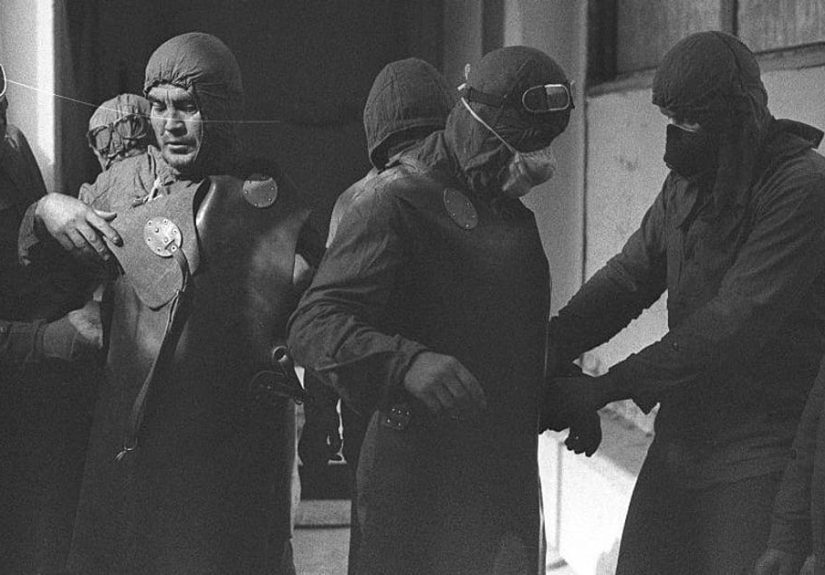
The most chilling detail? Some of the protective clothing and equipment used by firefighters
who responded on the night of the explosion were once stored in hospital basements
because they were so radioactive. Even decades later, certain hot spots in these areas
can still set off Geiger counters. The photos don’t come with a warning label,
but guides strongly discourage lingering in those zones for long.
Control Rooms and the Sarcophagus Over Reactor 4
Inside the plant itself, images of control rooms feel like stills from a dystopian movie.
Rows of switches, dial gauges, and faded warning labels sit under dust and flakes of ceiling paint.
Photos of a nearly identical control room for another reactor show what Reactor 4’s
might have looked like before it was destroyed.
Outside, Chernobyl pictures often feature the hulking structure known as the New Safe Confinement
the gigantic metal “arch” slid over the remains of the original sarcophagus in the mid-2010s.
From a distance, it looks like a giant airplane hangar planted in the middle of a forest.
In photos, this futuristic shell contrasts sharply with the Soviet-era buildings around it,
visually connecting the disaster’s past to decades of ongoing cleanup.
Homes Frozen in 1986
Some of the most powerful Chernobyl pictures don’t show dramatic ruins;
they show small, everyday details.
Travel photo essays document apartments where dishes still sit on tables,
pianos are tucked into corners, sewing manuals and magazines lie open on the floor,
and clothing hangs in closets.
These scenes are creepy not because they’re theatrical, but because they are so ordinary.
The rooms look like people stepped out for a momentmaybe to catch a bus or pick up groceriesand simply never came back.
Dust, broken glass, and plant growth are the only clues that decades have passed.
The Red Forest and the Return of Wildlife
Outside the city, photos of the “Red Forest” and surrounding landscape show a different kind of eeriness.
In the first days after the disaster, trees near the plant turned a rusty reddish-brown and died after enormous radiation exposure.
Recent pictures show a barren, fire-prone woodland and large stretches of wild, unmanaged forest.
At the same time, wildlife has cautiously reclaimed parts of the exclusion zone.
Photo and video studies from journalists and biologists show wolves, wild boar, elk,
foxes, and birds thriving in areas where people no longer live.
These images are unsettling in a different way: they raise questions about a world where animals can flourish
in a contaminated zone that’s still too risky for permanent human settlement.
Dark Tourism: Why People Visit the Places in These Photos
If you’ve scrolled through creepy Chernobyl pictures and thought,
“People actually go there on vacation?”, you’re not alone.
Visiting disaster sitesoften called dark tourismhas become a global trend
that includes locations like Chernobyl, Auschwitz, and certain war zones.
Guided tours into the Chernobyl Exclusion Zone typically start in Kyiv and then pass through checkpoints
before reaching Pripyat and the plant itself.
Reporters and travelers describe walking through silent streets,
climbing dim stairwells in abandoned apartment blocks, and standing under that famous Ferris wheel
with only the wind for company.
At the end of the day, visitors go through radiation scanners to ensure they haven’t picked up
unsafe levels of contamination from soil or dust.
For many people, the goal isn’t just to get a spooky selfie.
It’s to understand the scale of the disaster, honor those who suffered,
and learn what uncontrolled nuclear power can do.
The creepiness of the photos becomes a gateway to a deeper awareness.
What Creepy Chernobyl Pictures Don’t Show
As haunting as the images are, they don’t capture everything.
You rarely see the long-term health issues faced by workers, evacuees, and their families
or the psychological toll of being told your home is too dangerous to return to.
Chernobyl also affected people far from the plant.
Radioactive fallout was detected across Europe, and countries had to monitor and manage contaminated food,
water, and soil. While a single photograph can’t explain cesium or iodine isotopes,
those invisible particles are the reason the buildings remain empty today.
Another missing piece is the story of the workers who have continued to manage, monitor,
and contain the site for decadesbuilding the sarcophagus, installing the New Safe Confinement arch,
and tracking radiation levels in the zone.
Photos might show a lone worker with a Geiger counter,
but behind that image is a massive, long-term engineering and environmental effort.
How to View and Use Chernobyl Disaster Pictures Responsibly
If you’re planning to share Chernobyl photos in an article, project, or social post,
it helps to balance the “creepy” factor with context and respect.
A few guidelines:
- Explain what people are seeing. Don’t just post a doll in a gas mask and caption it “So spooky!”include a note about where it is, why the gas masks were there, and what happened to the children who once used that classroom.
- Avoid glamorizing danger. Many images are taken under strict safety rules with trained guides. Skip language that romanticizes breaking rules or sneaking into restricted areas.
- Center the human story. The eeriness of empty buildings comes from the lives that were lived in them. Mention evacuees, workers, and local communities, not just “abandoned aesthetic.”
- Credit photographers and organizations. When you can, acknowledge the people and outlets who captured the imagesmany have spent years documenting the site responsibly.
Used thoughtfully, creepy Chernobyl disaster pictures can become powerful tools for education and remembrance,
not just shock value.
Experiences: What It’s Like to Stand Inside Those Pictures
So what does it actually feel like to stand in the places you’ve only seen in haunting Chernobyl photos?
Travel writers and journalists who have toured the Exclusion Zone offer a vivid, unsettling picture.
The day usually starts like any other road trip. You leave Kyiv early in the morning,
coffee in hand, driving past gas stations and small villages.
As you approach the 30-kilometer Exclusion Zone, the mood shifts.
The bus slows at a military checkpoint. Passports are checked.
You’re reminded not to touch the ground, sit on the grass, or place your bag on the soil for long.
Once inside, the first thing you notice is the silence.
There’s no traffic hum, no buzzing city soundscapejust wind in the trees and the occasional bird.
Your guide might take you past the plant itself, pointing out the massive New Safe Confinement arch
and explaining how it was slid over the original sarcophagus.
It looks enormous even from far away, like a spaceship hangar dropped onto the landscape.
Then comes Pripyat.
You walk along cracked streets where grass, shrubs, and full-grown trees burst through what used to be sidewalks.
Apartment buildings tower overhead, their windows shattered or missing.
Faded Soviet murals and mosaics peer down from the sides of walls,
celebrating a bright future that never arrived.
Inside one school, the floor is a jumble of books, notebooks, and wooden desks.
The guide explains that many objects have been moved or staged over the years,
but the sense of abandonment is real.
You pick up a textbook for a second, then think about the dust and gently set it down again.
In another room, rows of tiny metal beds fill a nursery.
A single doll sits on a mattress, its face half-obscured by dirt and time.
It looks almost too perfectly creepyuntil you remember that real children once slept there.
At the amusement park, the Ferris wheel dominates the skyline.
Standing directly beneath it, you can see how the cabins have rusted and warped.
Birds nest in the machinery.
Bumper cars rest where they were last driven,
weeds looping through steering wheels like nature’s seat belts.
You might crack a nervous joke, but it lands flat against the stillness.
Even simple sounds feel amplified: the crunch of glass, the echo of footsteps in stairwells,
the click-click of a Geiger counter as your guide checks radiation levels.
Most areas you visit are considered safe for short periods,
but certain patches of moss, soil, or debris still trigger higher readings.
You become suddenly aware of where you’re standing and exactly where you put your hands.
Near the end of the day, your group files through a radiation scanner before exiting the zone.
It looks a bit like an old metal detector,
and for a moment you’re weirdly nervous about “failing” the testeven though you followed every rule.
When the light turns green, you step back into the ordinary world of gas stations,
cell signals, and normal background radiation.
That’s when the photos on your phone feel different.
They’re still creepy, sureabandoned places always arebut now you know how the air smelled,
how the floors sounded, and how it feels to stand under that silent Ferris wheel.
More importantly, you’ve heard the stories behind the images:
the evacuees who never came home, the workers who risked their lives,
and the decades of cleanup it took just to make a day trip possible.
When you scroll through creepy Chernobyl disaster pictures after a visitor even after reading deeply about them
you’re no longer just looking at aesthetics.
You’re seeing evidence: of a technological failure,
of human cost, and of the fragile line between everyday life and irreversible catastrophe.
The eeriness becomes less about “spooky vibes” and more about remembrance and responsibility.
Conclusion: More Than Just Creepy Pictures
Creepy Chernobyl disaster pictures are powerful because they work on multiple levels.
On the surface, they’re visually strikingempty amusement parks, decaying schools,
and wild forests reclaiming city streets.
But underneath, they’re snapshots of a specific moment in history when ordinary people
faced something they couldn’t see, smell, or fully understand.
When we look at these photos thoughtfully, we’re not just indulging in dark aesthetics.
We’re remembering the people who evacuated with one suitcase,
the workers who ran toward the burning reactor, and the generations living with the aftermath today.
Approached with context and care, Chernobyl’s creepiest images become more than nightmare fuel
they’re a visual warning label for what can happen when safety systems fail and transparency disappears.