Table of Contents >> Show >> Hide
- Before You Choose a Staircase, Know What Really Matters
- 14 Types of Staircases Homeowners Should Know
- 1. Straight Staircase
- 2. L-Shaped Staircase
- 3. U-Shaped Staircase
- 4. Spiral Staircase
- 5. Cantilever or Floating Staircase
- 6. Bifurcated Staircase
- 7. Double Staircase
- 8. Winder Stairs
- 9. Curved Staircase
- 10. Circular Staircase
- 11. Ladder Stairs
- 12. Stair Tower
- 13. Staircase With Storage
- 14. Alternating Tread Stairs
- Which Staircase Type Is Best for Your Home?
- Real-World Experiences Homeowners Often Learn the Hard Way
- Final Thoughts
- SEO Tags
If you think a staircase is just a way to get from Point A to Point B, allow me to respectfully disagree on behalf of every dramatic foyer, cozy loft, and under-stairs reading nook in America. A staircase is part transportation system, part architecture, part personality test. Some staircases whisper, “I’m practical.” Others practically wear a tuxedo and announce themselves before dinner.
For homeowners planning a remodel, building a new home, or simply trying to understand why one staircase feels effortless while another feels like a workout designed by a medieval architect, knowing the main staircase types matters. The right staircase can improve flow, save space, support safety, and turn an ordinary entry into one of the most memorable features in the house.
Below, we break down 14 staircase styles every homeowner should know, from the straightforward classics to the scene-stealing showpieces. Along the way, we’ll cover what each type is, where it works best, and what trade-offs come with the beauty. Because yes, some stairs are gorgeous. But some are also terrible at helping you move a mattress.
Before You Choose a Staircase, Know What Really Matters
1. Space and floor plan
Some staircase types are generous and dramatic, while others are basically the compact cars of the home-design world. Straight stairs usually need more linear room. Spiral, ladder, and alternating tread stairs are much more compact. L-shaped, U-shaped, and winder stairs can tuck into corners more gracefully and often work better when you want the staircase to feel integrated instead of parked in the middle of a room like a surprise monument.
2. Daily traffic
Think beyond the pretty rendering. Who will use the stairs every day? Kids carrying backpacks? Adults carrying laundry baskets? Grandparents? A dog who believes every trip upstairs is an Olympic event? Some staircase designs are easier to climb, easier to light, and easier to navigate with real-life cargo. Others are better as secondary stairs, loft access, or architectural features rather than the main route between floors.
3. Safety and code
Every staircase has basic parts, including treads, risers, stringers, handrails, and landings. Those details are not decoration; they affect comfort and safety. Open risers can look sleek, but they may not be ideal for every household. Steep stairs can save precious square footage, but they are not automatically a smart choice for primary circulation. The golden rule is simple: always check local residential code requirements before falling in love with a design that belongs more in a boutique hotel than in your family home.
4. Budget and construction complexity
Straight stairs are usually the easiest and most cost-effective to build. Curved, bifurcated, floating, and custom winder designs are typically more expensive because they require more engineering, more fabrication, or more site-specific work. In staircase terms, “wow” often translates to “where did my budget go?”
14 Types of Staircases Homeowners Should Know
1. Straight Staircase
The straight staircase is the classic, no-nonsense option. It runs in one continuous direction without curves or turns. This style is common for a reason: it is easy to understand, easy to build, and usually the most budget-friendly. If your goal is functionality without architectural gymnastics, a straight stair is a solid choice.
The catch is that straight stairs need enough linear floor space. They also offer less privacy between floors because there is no directional change or landing to soften the transition. Still, for many homes, especially traditional layouts and straightforward remodels, this is the dependable workhorse of staircase design.
2. L-Shaped Staircase
An L-shaped staircase, also called a quarter-turn staircase, is basically a straight staircase that learned how to corner. It changes direction by 90 degrees, usually with a landing. That turn can make the staircase feel more compact and more visually interesting.
Homeowners often like L-shaped stairs because they fit neatly into corners and create a little privacy between levels. The landing can also make the climb feel less intense. On the downside, they are more complex to build than straight stairs, so expect a higher price tag and a bit more structural planning.
3. U-Shaped Staircase
U-shaped stairs, also known as switchback or half-turn stairs, use two parallel flights connected by a landing to create a 180-degree turn. They are efficient, practical, and often surprisingly elegant. If you want a staircase that feels tucked in rather than stretched across the house, this design deserves a serious look.
The landing adds a convenient resting point and can improve comfort on taller stair runs. U-shaped stairs also tend to use space efficiently in multi-level homes. The trade-off is that they need careful planning, and in very small homes, fitting them gracefully can be tricky.
4. Spiral Staircase
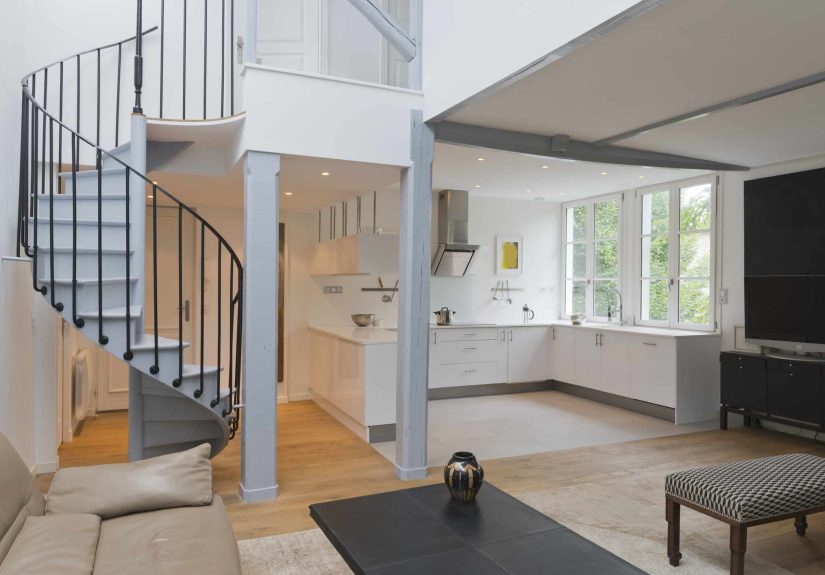
Spiral staircases wrap around a central column, making them one of the most recognizable and space-saving staircase types. They are excellent for tight footprints, lofts, rooftop access, compact additions, and homes that need a secondary stair without sacrificing a big chunk of floor area.
That said, spiral stairs are not always the friendliest choice for daily life. They can be harder to navigate, harder for kids and older adults, and absolutely not the staircase you want when wrestling a dresser upstairs. In the right location, though, a spiral staircase can add charm, character, and just enough drama to make guests say, “Okay, that’s cool.”
5. Cantilever or Floating Staircase
Floating stairs are the sleek celebrities of the staircase world. In a cantilever design, the treads appear to float because the structural support is hidden in the wall or concealed within the design. The result is open, airy, and undeniably modern.
This type works especially well in contemporary homes where natural light and visual openness matter. Glass railings often join the party to keep sightlines clear. The downside is that floating stairs can be expensive and structurally demanding, and households with young children, pets, or mobility concerns may want extra safety features. Beautiful? Yes. Casual DIY weekend project? Not even a little.
6. Bifurcated Staircase
If a staircase could wear a crown, it would be bifurcated. This grand design starts with one wide flight that reaches a landing and then splits into two smaller flights moving in opposite directions. It is the staircase equivalent of making an entrance and then making another entrance just to be safe.
Bifurcated stairs are best for large foyers and formal homes with enough square footage to support the scale. They create a memorable focal point and a strong sense of luxury. They are also expensive, complex, and wildly unnecessary in a modest floor plan. In a compact suburban home, this style can feel less “elegant estate” and more “someone got carried away.”
7. Double Staircase
A double staircase is similar in spirit to a bifurcated staircase, but instead of one broad flight splitting into two, you have two separate full flights rising in the same general direction. It still creates a grand effect, but with a different geometry and flow.
This style is especially useful in large homes where symmetry matters and the staircase is meant to anchor the entry. It is not for the faint of budget. But if you want a house that says, “Please admire my foyer,” this is one way to do it.
8. Winder Stairs
Winder stairs change direction using triangular, pie-shaped treads instead of a flat landing. They are compact, clever, and often used where space is tight but a turn is still needed. Think of them as the staircase equivalent of making a sharp turn without stopping for snacks.
Winders can look stylish and efficient, particularly in smaller homes or older layouts where every inch matters. But the angled treads require more careful design and can feel less predictable underfoot than a landing-based turn. For many homeowners, they are a smart compromise between space savings and architectural interest.
9. Curved Staircase
A curved staircase follows a gentle arc, usually without forming a full circle. It feels softer and more refined than a sharp-turn staircase, and it often becomes a sculptural centerpiece in the home. If straight stairs are practical shoes, curved stairs are custom Italian loafers.
Curved stairs are ideal for larger entries and open spaces where the shape can actually be appreciated. They are generally easier to navigate than very tight spiral stairs, but they are also harder to design and more expensive to build. The curve needs room to breathe, or the elegance disappears fast.
10. Circular Staircase
Circular stairs rotate around an open center and usually turn more than 90 degrees. They have a rounded, helical feel and often look more relaxed than a spiral staircase because the curve is broader. Many homeowners choose circular stairs when they want a dramatic shape without the tightness of a traditional spiral.
This type can be stunning in an entry hall, near a tall window, or beneath a statement light fixture. The trade-off is that circular stairs usually require more open floor space and a higher construction budget than more conventional layouts.
11. Ladder Stairs
Ladder stairs are steep, compact, and built for situations where square footage is scarce. They are common in lofts, libraries, tiny homes, attics, and other secondary-access situations. Some are literal ladder-like designs. Others are stylized to feel more stair-like while keeping a very steep angle.
These can be excellent space savers, but they are not for everyone. They can be harder to climb, less convenient for everyday traffic, and may not meet local rules as a primary staircase. In other words, they are brilliant in the right context and mildly rude in the wrong one.
12. Stair Tower
A stair tower is a vertical stairwell that serves multiple levels, often enclosed or framed by walls and windows to create a tower-like effect. In multi-story homes, this design can organize circulation beautifully and create a strong architectural spine from floor to floor.
Stair towers are especially compelling when they bring in natural light or connect stacked living spaces in a clean, efficient way. They are less about flashy form and more about smart vertical planning. Still, when designed well, they can feel dramatic in a quiet, architectural way.
13. Staircase With Storage
This is the overachiever of staircase design. A staircase with storage uses the often-forgotten space beneath the stairs for drawers, cabinets, shelves, cubbies, benches, or even compact work zones. It is particularly popular in small homes where every square inch has to earn its keep.
Technically, this is less a shape and more a design strategy, but it is one homeowners absolutely should know. Good under-stair storage can make a home feel more organized, more functional, and somehow less annoyed with itself. That awkward dead space under the stairs? It could be holding shoes, seasonal decor, books, dog gear, or your secret snack stash.
14. Alternating Tread Stairs
Alternating tread stairs, sometimes called ship stairs or witches’ stairs, use staggered treads so each foot lands on a different side as you climb. They are steep, compact, and far more specialized than a regular staircase. The design allows for safer foot placement than a pure ladder while still saving space.
These stairs can work well in lofts, tiny homes, and occasional-access spaces. But they require attention, a learning curve, and careful code review. They are not the kind of stairs you want sleepy guests attempting at 2 a.m. while holding a phone charger and a glass of water.
Which Staircase Type Is Best for Your Home?
The best staircase depends on what your home needs most. If budget and simplicity rule the day, go straight. If you want better flow in a corner, consider L-shaped or U-shaped. If square footage is precious, spiral, ladder, or alternating tread stairs may solve the problem. If your goal is architectural impact, curved, circular, floating, or bifurcated stairs can absolutely deliver.
The smartest homeowners do not choose stairs based on looks alone. They think about traffic patterns, furniture moving, lighting, handrails, children, pets, resale appeal, and how the staircase will actually feel ten years from now. Because living with a staircase is different from admiring one in a photo. A lot different. Pinterest never has to haul laundry.
Real-World Experiences Homeowners Often Learn the Hard Way
Homeowners tend to talk about staircase choices in one of two ways: with pride, or with the thousand-yard stare of someone who has carried a vacuum up a spiral stair one too many times. In real life, the little details matter more than the showroom drama. A straight staircase may not be glamorous, but many homeowners end up loving how predictable and comfortable it feels day after day. It is easy to climb, easy to light, easy to clean, and rarely full of surprises. Sometimes boring is just another word for “works beautifully every single day.”
L-shaped and U-shaped stairs often win people over after move-in because landings make the climb feel calmer. Parents like the visual break between floors. Older homeowners often appreciate the pause point halfway up. Even people who never think about stair design suddenly become loyal fans of a good landing after carrying baskets, holiday boxes, or a stubborn toddler upstairs. It turns out that architecture feels very different when it includes socks and groceries.
Floating stairs inspire plenty of admiration, but homeowners frequently discover that open, airy beauty comes with practical questions. Where does the dust go? How easy is it to childproof? Does the dog trust it? Will guests hesitate before taking the first step? The answer to all four questions is usually “more than you expected.” Still, when paired with strong railings, good lighting, and enough width, floating stairs can remain a favorite because they make the whole home feel brighter and less crowded.
Spiral and ladder-style stairs tend to create the strongest opinions. Owners of small homes often love them because they unlock space that would otherwise disappear into a larger stair footprint. But almost everyone admits there is a learning curve. You become more intentional. You hold the railing. You stop pretending you can carry three things at once. In a way, those stairs teach discipline, though perhaps a little more aggressively than necessary.
Under-stair storage, meanwhile, is the quiet hero. Homeowners who add drawers, shelves, or cabinets beneath the stairs almost never regret it. That storage can absorb shoes at the entry, games in the family room, pantry overflow near the kitchen, or seasonal decor that otherwise migrates into every closet. It is not flashy, but it is the kind of upgrade that makes a home feel smarter every single week.
Perhaps the most common lesson of all is this: the best staircase is the one that matches the way you actually live. Not the way a glossy photo shoot lives. Not the way a luxury hotel lives. Your life. Your habits. Your knees. Your storage needs. Your tolerance for steep angles before coffee. Choose well, and your staircase becomes one of the most useful and beautiful features in the house. Choose poorly, and congratulations, you now own a daily reminder that design decisions have consequences.
Final Thoughts
Staircases do much more than connect floors. They shape circulation, influence safety, define style, and often become one of the first things people notice when they enter a home. Whether you love the practicality of a straight run, the elegance of a curve, or the compact genius of a spiral, understanding the main staircase types helps you make a smarter design decision.
So before you pick a staircase based only on the fact that it looks amazing in natural light, ask the real homeowner questions: Will it fit the space? Will it feel good every day? Will it work for the people who live here? If the answer is yes, then congratulations. You are officially one step ahead.