Table of Contents >> Show >> Hide
- Meet the Mango: Why It Fights Back
- What You Need
- Before You Cut: Pick a Mango That Wants to Be Cut
- Method 1: The Classic Cheeks + “Hedgehog” Cubes
- Method 2: Slices and Wedges for Snacking
- Method 3: Peel-First “Standing Mango” for Clean Strips
- Method 4: The Spoon (or Glass) Slide Hack
- Method 5: Using a Mango Splitter
- Zero-Waste Tips: Get the Good Stuff Off the Pit
- Safety Notes (Because Mangoes Are Slippery Liars)
- Storing Mango (Whole and Cut)
- Quick Ideas: What to Do with Your Newly Tamed Mango
- of Mango-Cutting “Been There” Experiences
- Conclusion
Mango is one of those fruits that acts friendly in the produce aislebright colors, tropical vibes, big “treat yourself”
energythen turns into a slippery puzzle the second you bring a knife into the conversation. The problem isn’t you. The
problem is the mango’s oversized, flat pit (seed) running right through the center like a tiny surfboard you’re not allowed
to slice through.
The good news: once you learn the mango’s “anatomy” and a couple of reliable cutting methods, you’ll stop losing half the
fruit to the pit and start getting clean cubes, pretty slices, and snackable wedgeswithout turning your cutting board into
a juice slip ’n slide. This guide breaks it down with multiple techniques so you can pick the best method for what you’re
making (or how patient you’re feeling).
Meet the Mango: Why It Fights Back
A mango has three main parts: the peel (thin but stubborn), the flesh (sweet and juicy), and the pit (large, flat, and
absolutely not interested in your chef’s knife). The pit is widest in the middle and tapers toward the top and bottom. Your
goal isn’t to cut through itit’s to cut around it, taking off the two big “cheeks” (the meaty sides) first, then
dealing with whatever fruit is left clinging to the pit.
Bonus reality check: mango variety affects shape and softness. Common U.S. grocery-store mangoes include rounder, often
red-green types (like Tommy Atkins) and smaller, golden-yellow, more oval types (like Ataulfo/“honey” mangoes). The cutting
logic stays the same; you’re just working with different proportions.
What You Need
- A stable cutting board (put a damp paper towel underneath so it doesn’t skate around)
- A sharp chef’s knife for the main cuts
- A small paring knife for scoring and detail work
- A large spoon for scooping or separating flesh from peel
- Optional: vegetable peeler, Y-peeler, or a mango splitter tool
- Optional but smart: a kitchen towel for gripping the mango if it’s extra slippery
Before You Cut: Pick a Mango That Wants to Be Cut
How to tell if a mango is ripe (without a crystal ball)
Color can be misleading because mangoes come in different shades naturally. Instead, use these cues:
- Gentle squeeze: a ripe mango should give slightly, like a ripe avocadosoft but not mushy.
- Aroma near the stem: ripe mangoes often smell sweet and fruity at the stem end.
- Weight: a mango that feels heavier than it looks usually has more juicy flesh inside.
Wash first. Always.
Even if you’re not eating the peel, your knife passes through the outside and can drag surface residue inward. Rinse the mango
under running water and dry it so your grip is better (and safer).
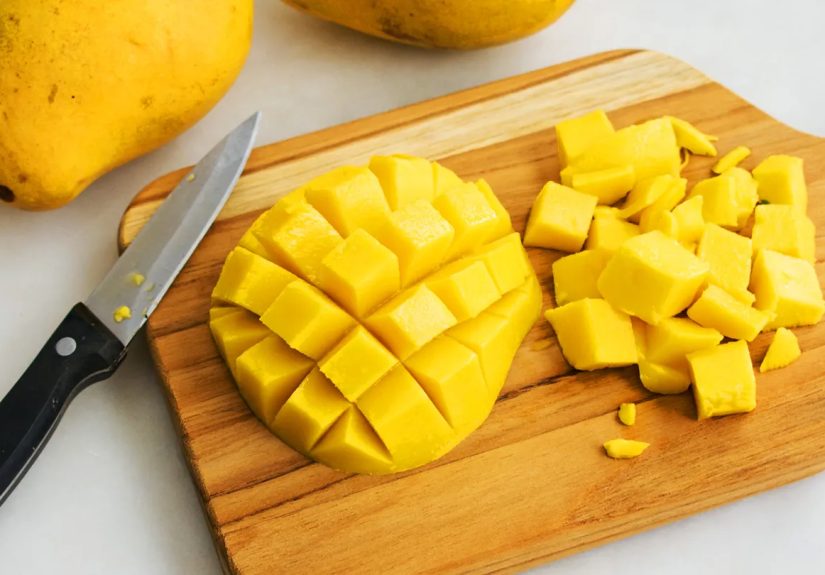
Method 1: The Classic Cheeks + “Hedgehog” Cubes
This is the most popular method because it’s fast, it looks fancy, and it produces tidy cubes for fruit salad, salsa, bowls,
smoothies, and snacking. You’ll cut off the cheeks, score them, then pop the cubes outward like a tropical porcupine.
Step-by-step
-
Stand the mango upright. Place it stem-end down so it’s stable. (If it wobbles, you can slice a very thin
piece off the bottom to create a flat base.) -
Slice off the first cheek. Hold the mango firmly. Position your knife slightly off-center and slice downward,
following the curve of the pit. You’re aiming to “skim” past the pit with minimal resistance. - Slice off the second cheek. Rotate the mango and repeat on the other side.
-
Score the flesh. Place a cheek flesh-side up. Use a paring knife to score lengthwise and crosswise lines to
form a grid. Cut down to the peel but try not to slice through it. -
Invert (“hedgehog” it). Press the peel side upward to pop the cubes out. The mango will look like it’s wearing
tiny yellow armor. (Adorable and edible.) -
Remove the cubes. Either slice them off with the knife, or run a spoon between the peel and flesh to scoop the
cubes out.
Best for
- Mango cubes for salsa, salads, yogurt bowls, and meal prep
- Pretty plating (because the hedgehog method is basically edible confetti)
Method 2: Slices and Wedges for Snacking
If you want mango for snacking or garnishing (think: tacos, desserts, sticky rice, or a fancy brunch plate), slices and wedges
are the move. The trick is still the cheeksthen you slice the flesh into strips instead of cubes.
Step-by-step
- Cut off the cheeks the same way as Method 1.
- Make slices. Lay a cheek peel-side down on the board. Slice it into strips of your desired thickness.
-
Or keep the peel on for handheld wedges. Score long lines through the flesh (not the peel), then scoop with a spoon
or bite the wedges directly like nature intended (with a napkin nearby).
Best for
- Snacking
- Garnishes and dessert toppings
- Plates where you want clean lines instead of cubes
Method 3: Peel-First “Standing Mango” for Clean Strips
Want long, clean stripslike mango “fries,” julienne for slaw, or silky slices for plating? Peel first, then cut the fruit away
from the pit while it stands upright. This method is especially good when the mango is very ripe and the hedgehog method would
turn into mush.
Step-by-step
- Create a stable base. Slice a very thin piece off the bottom so the mango stands without rolling.
- Peel the mango. Use a vegetable peeler (or a small knife if you’re confident) and remove the skin from top to bottom.
-
Slice down the sides. With the mango standing, slice down one side as close to the pit as you can, removing a large slab.
Repeat around the pit, working in panels. - Slice slabs into strips or cubes. Once you’ve removed the panels, stack and slice to your desired shape.
Best for
- Clean mango strips for salads, slaws, and garnishes
- Very ripe mangoes that don’t behave well when scored
- People who like their cutting board to stay less… tropical
Method 4: The Spoon (or Glass) Slide Hack
This is the satisfying “one weird trick” method that’s actually practical. After you cut off the cheeks, you use a large spoon
(or the rim of a sturdy glass) to separate the flesh from the peel in one smooth move. It’s fast, it wastes less fruit, and it
feels like you’re performing a tiny kitchen magic show.
Spoon version
- Cut off the cheeks.
-
Scoop. Hold a cheek in your palm peel-side down. Slide a large spoon between the peel and flesh, following the curve.
The flesh should lift out in one piece (or close to it). - Slice or dice. Put the peeled cheek on the board and cut as needed.
Glass version
- Cut off the cheeks.
- Slide the cheek onto the glass rim. Peel-side out, flesh-side in. Push down so the glass edge separates the flesh from peel.
- Catch the mango. The fruit drops into the glass (or onto a plate) like it’s entering a VIP lounge.
Best for
- Quick prep with less fiddling
- Maximum flesh recovery
- People who enjoy a tiny thrill in the kitchen
Method 5: Using a Mango Splitter
A mango splitter is a tool designed to cut around the pit in one press, creating two large sides and leaving the pit in the middle.
If you cut mangoes often, it can be convenientespecially for firmer mangoes.
How to use it
- Stand the mango upright on the cutting board.
- Center the splitter over the mango so the opening aligns with the widest part of the fruit.
- Press down firmly to separate the flesh from the pit.
- Finish with scoring or scooping depending on whether you want cubes or slices.
Zero-Waste Tips: Get the Good Stuff Off the Pit
After the cheeks come off, you’ll have a center section wrapped around the pit. Don’t throw it away. That strip can hold a lot of
mangoand it’s the part most people abandon out of frustration.
- Trim the sides: Carefully slice off any accessible flesh around the pit in thin pieces.
- Chef’s snack tax: Hold the pit section and nibble the remaining flesh. This is a sacred kitchen tradition.
- Blend it: Scrape what you can into a blender for smoothies or mango lassi. Imperfect chunks welcome.
Safety Notes (Because Mangoes Are Slippery Liars)
- Stabilize your board: Put a damp paper towel underneath so it doesn’t slide.
- Use a sharp knife: Dull knives require more force, and that’s how slips happen.
- Go around the pitnever through it: If you hit resistance, back up and adjust your angle.
- Dry the mango first: Wet fruit = reduced grip.
-
Sensitive skin note: Mango peel (and sap near the stem) can irritate some people, especially those sensitive to poison ivy/oak.
If that’s you, wear gloves, wash the mango well, and avoid eating the peel.
Storing Mango (Whole and Cut)
Whole mangoes
- Unripe: Keep at room temperature until it yields slightly and smells fragrant.
- To speed ripening: Place in a paper bag at room temp.
- Ripe: Refrigerate to slow ripening; whole ripe mangoes generally keep for about 5 days.
Cut mango
- Refrigerate promptly in an airtight container.
- Meal prep tip: Cut into cubes so it’s grab-and-go for bowls and snacks.
- Freeze for later: Freeze pieces in a single layer first, then store in a sealed bag for smoothies and blended drinks.
Quick Ideas: What to Do with Your Newly Tamed Mango
- Mango salsa: Cubes + lime + red onion + cilantro + jalapeño. Put it on fish tacos. Feel instantly superior.
- Breakfast upgrade: Mango cubes on yogurt with granola and honey.
- Salad pop: Mango strips with cucumber, mint, and a citrusy vinaigrette.
- Dessert shortcut: Sliced mango with whipped cream or coconut sticky rice.
- Blended everything: Mango + banana + yogurt (or coconut milk) = smoothie that tastes like vacation.
of Mango-Cutting “Been There” Experiences
If you’ve ever tried to cut a mango without a plan, you know the emotional arc: confidence → confusion → sticky hands → mild
bargaining (“Maybe I’ll just eat cereal instead”). It usually starts with the classic mistake: you put the mango on its side,
aim for the center like it’s an apple, and immediately meet the pitan uncuttable obstacle that makes your knife stop dead.
The mango then rolls a little, the cutting board shifts, and suddenly you’re negotiating with a fruit that is somehow both soft
and dangerous.
Then there’s the “mango is ripe” surprise. One day you buy a mango that feels firm and responsible. Two days later, it’s a
fragrant, buttery delight… that also behaves like a water balloon filled with nectar. The moment you score it for cubes, the
juice starts flowing. Your hands get sticky. The handle of your knife gets sticky. Your phonebecause of course you needed to
check a recipe mid-cutgets sticky. You begin to understand why mango is delicious in part because it demands a sacrifice.
The first time you successfully cut cheeks off cleanly, though? That’s a tiny kitchen victory worth celebrating. You feel like
you’ve cracked a code. The pit is exposed. The cheeks are intact. You score a neat grid and flip it into the hedgehog shape,
and suddenly you’re holding a perfect little mango “bouquet” of cubes. It’s weirdly satisfying, like popping bubble wrap, but
edible and socially acceptable at brunch.
People also tend to discover their personal mango-cutting personality. Some folks are “precision slicers,” lining up clean
strips for plating like they’re styling a magazine cover. Others are “maximum recovery” types, using a spoon to scrape every
last bit off the peel and pit because wasting mango feels like a crime. And then there are the “pit gnawers,” who accept that
the center section isn’t pretty, but it’s still mango, and it will be eatenpreferably over the sink like a raccoon enjoying a
luxury snack.
A common turning point is realizing you don’t need to fight the mango with brute force. The mango rewards strategy: stabilize
the board, dry the fruit, cut slightly off-center, and let the knife glide around the pit. Once you stop trying to force a cut
through the seed, everything gets easierand safer. After that, mango becomes less of a kitchen hazard and more of what it was
always meant to be: a sweet, sunny ingredient that makes even a Tuesday feel a little more like vacation.
Conclusion
Cutting a mango isn’t hardit’s just different. Once you respect the flat pit, choose a method that matches your goal (cubes,
slices, strips, or fast scooping), and set yourself up with a stable board and a sharp knife, mango becomes an easy win. Try
the classic cheeks-and-hedgehog method for cubes, peel-first for clean strips, or the spoon/glass trick when you want speed and
maximum fruit. And don’t forget: the pit scraps are the chef’s snack. That’s not waste. That’s a perk.