Table of Contents >> Show >> Hide
- Why “bizarre” fits Tyson better than “ordinary”
- 1) A pigeon helped launch his fighting career
- 2) He became heavyweight champion at 20and the title win looked like a movie scene
- 3) Cus D’Amato didn’t just train himhe reshaped him
- 4) The face tattoo nearly started as… hearts
- 5) “The Bite Fight” is realand it permanently changed his public image
- 6) He owned pet tigersbecause of course he did
- 7) He earned a fortune… then filed for bankruptcy
- 8) He became a pro-wrestling plot twistand a WWE Hall of Famer
- 9) He turned his life into stage artand it actually worked
- 10) He became a cartoon detective… starring himself
- Bonus twist: the modern Tyson talks openly about psychedelicswhile also warning it’s not a game
- Conclusion: Tyson is a legend, a warning sign, and a comeback storysometimes all in the same week
- Experiences: What it feels like to brush against the Tyson myth (about )
Mike Tyson is one of those rare celebrities who doesn’t just have a “career.” He has chapterswild, messy, unforgettable chapterseach one somehow
louder than the last. He’s been the youngest heavyweight champion in boxing history, a tabloid magnet, a pop-culture cameo machine, and (yes) a man who has
taken life lessons from pigeons with the seriousness most people reserve for therapy.
If you’re searching for bizarre facts about Mike Tyson, you’re in the right ring corner. Below are ten true, strange, and genuinely
“how is that real?” moments from the life of Iron Mike. Some are funny, some are sobering, and all of them help explain why Tyson remains
one of the most talked-about athletes in modern sports history.
Why “bizarre” fits Tyson better than “ordinary”
Plenty of boxing legends have iconic wins. Tyson has iconic everythingfrom a rise that rewrote record books to a public life that’s swung from
chaos to reinvention and back again. He’s the kind of heavyweight champion whose biography reads like three different people arguing over one body.
1) A pigeon helped launch his fighting career
Mike Tyson’s origin story isn’t “I wanted a belt.” It’s more like: “I loved pigeons, and life got weird.” Tyson has repeatedly described how keeping
pigeons as a kid in Brooklyn became a major emotional anchorsomething gentle in a rough environment. He’s also shared that one incident involving a pigeon
pushed him into an early fight, a moment he credits as part of the road that eventually led him to boxing gyms and serious training.
Even decades later, Tyson’s attachment to pigeons hasn’t faded into a cute trivia footnote. It’s a recurring theme in interviews: pigeons were his first
love, his constant, and (in a very Tyson way) a symbol that toughness and tenderness can share the same zip code.
2) He became heavyweight champion at 20and the title win looked like a movie scene
Tyson became the youngest heavyweight champion in history on November 22, 1986, when he stopped Trevor Berbick to win the WBC title.
That alone is legendary. But what makes it “bizarre-fact worthy” is how the ending has lived forever in highlight reels: Berbick goes down, tries to rise,
stumbles, and looks like his legs are negotiating separate contracts.
In one night, Tyson went from terrifying prospect to heavyweight champion, and boxing got a new kind of superstar: young, explosive, and seemingly built
from pure intimidation.
3) Cus D’Amato didn’t just train himhe reshaped him
Tyson’s relationship with legendary trainer Cus D’Amato is one of the most intense mentor-student stories in sports. D’Amato wasn’t
simply teaching combinations; he was building a philosophydiscipline, fear management, and identityaround a teenager who had already seen too much chaos.
The “bizarre” part is how total the transformation was. Tyson didn’t just learn to box; he adopted a complete fighting persona and style (including the
peek-a-boo defense associated with D’Amato’s system). When people say Tyson looked like a force of nature in his early years, that wasn’t an accident.
That was a blueprint.
4) The face tattoo nearly started as… hearts
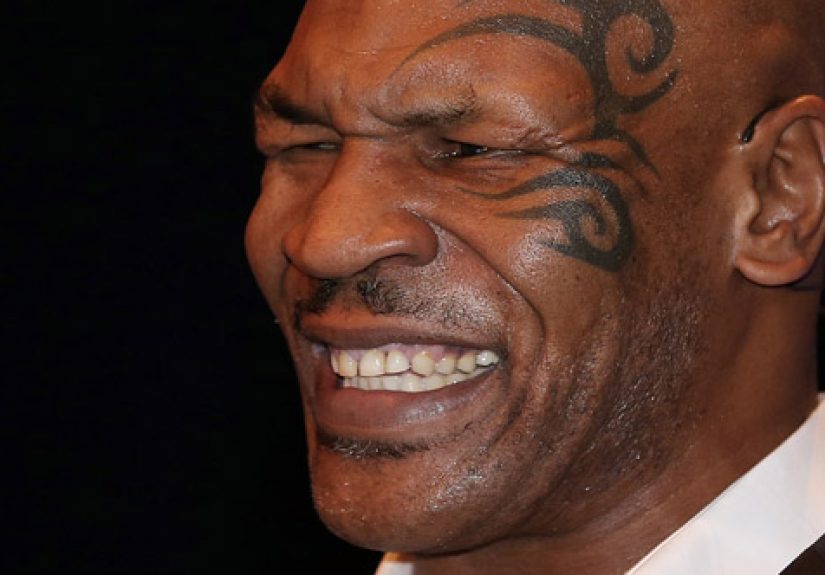
Tyson’s face tattoo is now so iconic that it’s basically part of his silhouette. But one of the strangest details is that the original idea wasn’t
warrior-like at all. Tyson has said he initially wanted hearts on his faceuntil tattoo artist S. Victor Whitmill redirected
him toward the now-famous tribal-inspired design.
The tattoo became such a recognizable piece of pop culture that it even triggered legal drama years later when a similar tattoo appeared in a major comedy
sequel. Only Tyson could turn facial ink into a headline-generating event that involved Hollywood and lawsuits.
5) “The Bite Fight” is realand it permanently changed his public image
You could mention Mike Tyson at a dinner party, and there’s a strong chance somebody will blurt out, “the ear thing!” In the 1997 rematch against
Evander Holyfield, Tyson was disqualified after biting Holyfield’s earan incident so shocking it became a cultural reference point for sports gone off
the rails.
The reason it’s still discussed isn’t just because it happened. It’s because it felt impossible: the most feared puncher on earth didn’t “lose control”
in a normal wayhe did something nobody expected inside a boxing ring. That single moment followed him for decades, shaping how casual fans remember him
as much as his championship run.
6) He owned pet tigersbecause of course he did
Some champions buy sports cars. Tyson bought big cats. At the height of his fame and spending, he owned pet tigers, including one that became part of his
larger-than-life mythology. Stories about Tyson and tigers are so famous they’ve become shorthand for “this person had too much money too fast.”
Beyond the shock value, it’s also a real-life example of how celebrity excess can blur into risky decisions. Tyson himself has spoken about how unrealistic
it is to believe a powerful wild animal can be treated like a house pet just because you’re rich enough to try.
7) He earned a fortune… then filed for bankruptcy
Here’s a bizarre fact that’s less “ha-ha” and more “how does this happen”: Tyson made extraordinary amounts of money in his career, yet later filed for
bankruptcy protection. Reports at the time described financial disarray and massive debtsan outcome that stunned fans who assumed heavyweight champions
simply stayed wealthy forever.
Tyson’s spending became legendarylavish purchases, expensive lifestyles, and the kind of financial decisions that look fun until the bill arrives with a
referee’s count. His story is often cited as a cautionary tale: fame can be fast, but expenses can be faster.
8) He became a pro-wrestling plot twistand a WWE Hall of Famer
If you missed 1998 wrestling culture, it sounds like a fever dream: Mike Tyson shows up at WrestleMania XIV as a special outside enforcer
for the WWE Championship main event. It was a crossover moment that blended boxing celebrity with wrestling spectacle at the exact time WWE was exploding
into mainstream dominance.
Tyson didn’t just pop in and disappear; his involvement became part of WWE lore, and he was later inducted into the WWE Hall of Fame. Not many heavyweight
champions can say they helped define an era in two combat-sports universes without even throwing a jab.
9) He turned his life into stage artand it actually worked
Tyson’s reinventions are almost as famous as his knockouts. One of the most surprising: a one-man stage show,
Mike Tyson: Undisputed Truth, directed by Spike Lee. The concept sounds improbableTyson on stage, unpacking his own life in a
theatrical formatyet it became a notable cultural moment.
The bizarre part is how well it fits. Tyson’s story is dramatic, contradictory, and emotionally charged. Put it on a stage and it stops being “just gossip”
and turns into a narrative about trauma, fame, choices, and consequences. For an athlete who spent years being reduced to headlines, the stage gave him a
different kind of control.
10) He became a cartoon detective… starring himself
Most athletes get a documentary. Tyson got an Adult Swim animated series where a fictionalized version of Mike Tyson solves mysteries with an oddball crew.
That sentence should not be real, but it is. The show leaned into surreal humor and treated Tyson’s voice and persona as part of the punchlinesometimes
literally.
It’s also a fascinating marker of Tyson’s cultural footprint: you don’t get turned into a cartoon version of yourself unless you’re already a myth. Tyson
moved from sports figure to pop-culture charactersomeone recognizable even to people who have never watched a full boxing match.
Bonus twist: the modern Tyson talks openly about psychedelicswhile also warning it’s not a game
Tyson has discussed experiences with psychedelics in interviews and profiles, describing them as part of his personal transformation in adulthood. It’s a
surprising chapter for a man once known primarily for rage and intimidation: older Tyson speaking about spirituality, self-reflection, and trying to be less
destructive.
Important context: none of this should be treated as advice or a blueprint. Many psychedelic substances are illegal and can be dangerousespecially for
teens, for people with certain mental health risks, and without medical supervision. Tyson’s story here is best understood as biography, not a “try this.”
Conclusion: Tyson is a legend, a warning sign, and a comeback storysometimes all in the same week
The reason these 10 bizarre facts about Mike Tyson hit so hard is that they aren’t random trivia. They map the contradictions of his
life: tenderness (pigeons) next to chaos (headlines), historic greatness (youngest champ) next to public collapse (bankruptcy), and reinvention (stage,
cartoons, new ventures) next to the weight of his past.
Tyson’s story is ultimately about extremesof talent, fame, consequence, and the very human desire to become someone better than the version the world
remembers. Whether you admire him, criticize him, or feel both at once, one thing is certain: “ordinary” has never been his lane.
Experiences: What it feels like to brush against the Tyson myth (about )
People who grew up in the late ’80s and early ’90s often describe Mike Tyson as less of an athlete and more of a weather event. You didn’t just “watch a
Tyson fight.” You braced for it, the way you’d brace for a thunderclap you knew was coming. Sports bars went quiet. Living rooms got loud. Someone always
said, “This won’t last long,” andmore often than notthey were right.
In boxing gyms, trainers still talk about Tyson’s early style with the kind of reverence usually reserved for sacred techniques. It’s not just nostalgia.
The experience of studying peak Tysonhis head movement, his angles, the way he closed distanceis like being shown a shortcut through a maze. Beginners
learn quickly that boxing isn’t only about power; it’s about timing and geometry. Tyson, at his best, looked like he was solving math problems with his
shoulders.
For many fans, the “bizarre” part of Tyson’s legacy is how it keeps showing up in unexpected places. Someone watches a comedy movie and suddenly Tyson is
thereplaying himselflike a surprise guest at his own cultural afterparty. Someone scrolls TV late at night and sees an animated Tyson solving mysteries,
which feels like the universe admitting it ran out of normal storylines. Even people who don’t follow sports recognize the face tattoo as instantly as a
famous logo.
There’s also a more complicated experience people describe: revisiting Tyson’s story as an adult and realizing it isn’t a simple highlight reel. It’s
uncomfortable in places. It includes real harm, real consequences, and years that can’t be edited into something neat. That can create a strange split
feelingbeing amazed by the athlete while also wrestling with the human being.
And then there’s the quieter, oddly moving experience of hearing Tyson talk nowolder, reflective, sometimes surprisingly emotionalabout things like
insecurity, fear, and what it means to try to change. For some listeners, that’s the most startling plot twist of all: not the belts, not the bite, not
the tigersjust a man trying to outgrow the most infamous version of himself.
That’s why “bizarre facts” about Tyson don’t feel like random internet candy. They feel like snapshots from a life lived at maximum volume. Reading them
can be entertaining, surebut it can also be a reminder that celebrity is a magnifier: it makes talent brighter, mistakes louder, and reinvention harder.
Tyson’s story lingers because it’s not just about boxing. It’s about what happens when a human being becomes a myth while still trying to be a person.