Table of Contents >> Show >> Hide
- 1. Earth Was Once a Blazing Magma World
- 2. The Young Moon Loomed Huge in the Sky
- 3. Earth May Have Worn an Orange Methane Haze
- 4. The Planet May Have Had Purple Microbial Landscapes
- 5. Ancient Seas Were Filled With Living Rock Towers
- 6. The Oceans Once Rusted
- 7. Earth Turned Into a Snowball
- 8. The Seafloor Was Covered With Quilt-Like Creatures
- 9. Land Was Once Dominated by Giant Fungus-Like Spires
- 10. Giant Insects Ruled Oxygen-Rich Swamps
- Why Ancient Alien Earth Matters
- Experiences: Imagining Earth When It Looked Like an Alien Planet
- Conclusion
Today, Earth looks like the friendly blue marble of postcards, weather apps, and astronaut selfies. It has oceans, forests, breathable air, and just enough clouds to make satellite images dramatic. But rewind the planet’s history, and our home world becomes almost unrecognizable. At different times, Earth has looked like a lava planet, an orange smog ball, a frozen moon, a purple microbial world, a swampy insect empire, and a strange underwater garden filled with life-forms that seemed designed by a committee of jellyfish and sofa cushions.
The phrase “alien planet” usually makes us think of Mars, Titan, Venus, or some distant exoplanet orbiting a star with a name that sounds like a Wi-Fi password. Yet Earth itself has gone through scenes that would fit perfectly in a science-fiction film. The difference is that these worlds were real, and they happened right here beneath our feet.
From the Hadean Eon to the Carboniferous Period, ancient Earth changed repeatedly because of impacts, volcanism, atmospheric chemistry, continental drift, microbial evolution, oxygen levels, and climate extremes. These changes did not happen overnight. They unfolded across billions of years, turning Earth into a planetary shapeshifter. Here are 10 ways Earth once looked like an alien planetand why each version matters.
1. Earth Was Once a Blazing Magma World
Before Earth had oceans, trees, beaches, or anything that could complain about humidity, it was a young rocky planet still recovering from violent formation. The early Earth likely endured repeated impacts from leftover planetary debris. The most dramatic event was the giant impact thought to have formed the Moon. In the aftermath, enormous amounts of energy melted rock and may have left parts of Earth covered by a global or near-global magma ocean.
Imagine standing on a planet where the “ground” glowed orange, molten rock moved like a burning sea, and the atmosphere was thick with vaporized minerals and gases. Actually, do not imagine standing there too longyou would not have a good customer experience.
This early Earth looked less like the modern blue planet and more like an exoplanet still under construction. The sky may have been choked with dense clouds, the surface unstable, and the young Moon much closer and larger in the sky than it appears today. Earth’s alien appearance was not decorative; it was part of planetary assembly. As the surface cooled, crust formed, water condensed, and the stage slowly opened for oceans and, eventually, life.
2. The Young Moon Loomed Huge in the Sky
One of the strangest views on ancient Earth would have been the Moon. After its formation, the Moon was much closer to Earth than it is today. Over time, tidal interactions pushed it farther away. In the deep past, however, the Moon would have appeared dramatically larger in the sky, turning night into a cosmic theater with premium seating.
This nearby Moon would have raised stronger tides than those we know today. Coastal environments, once oceans existed, may have experienced extreme tidal movements. The rhythm of day and night was also different because early Earth rotated faster. A day could have been much shorter than 24 hours in parts of Earth’s early history.
The result would be a world that felt physically different: faster sunrises, stronger tides, and a giant companion hanging overhead. If modern humans could look up from that ancient landscape, the Moon might have felt less like a calm silver ornament and more like a dominating planetary neighbor. It was not an alien planet in the sky; it was our own Moon acting like it had main-character energy.
3. Earth May Have Worn an Orange Methane Haze
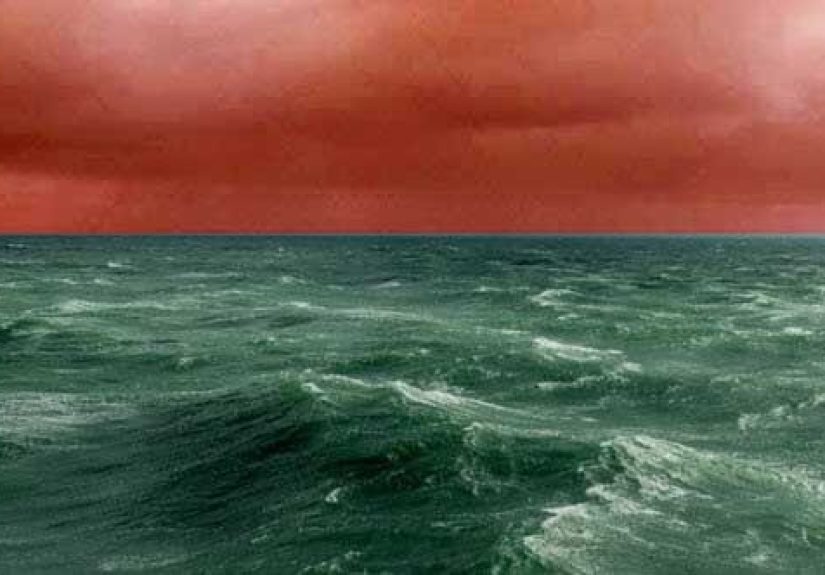
During parts of the Archean Eon, long before plants and animals, Earth’s atmosphere was very different from today’s oxygen-rich air. Methane and other gases may have contributed to a thick organic haze, giving the planet a pale orange appearance from space. Scientists studying hazy exoplanets often use ancient Earth as a comparison because this version of our planet may have resembled Saturn’s moon Titan more than modern Earth.
This haze was not just visual drama. It affected climate by filtering sunlight and interacting with greenhouse gases. The early Sun was dimmer than it is today, so greenhouse warming helped keep Earth from freezing completely. Methane-producing microbes may have played an important role in this atmospheric balance.
From orbit, Earth may not have looked blue at all. It could have looked like a fuzzy orange marble wrapped in photochemical smog. The oceans were there, but the sky above them was not the crisp blue ceiling we know. It was a chemical laboratory with weather.
4. The Planet May Have Had Purple Microbial Landscapes
Green is the color we associate with life today because plants use chlorophyll. But early Earth’s life was microbial, and some researchers have explored the possibility that ancient microbial communities may have used pigments such as retinal, which can appear purple. This idea, often discussed in astrobiology, does not mean the entire planet was definitely grape-flavored in appearance. It means that some early microbial mats and shallow-water environments may have displayed colors very different from modern forests and grasslands.
Picture shallow shorelines covered not in green algae or reeds, but in slick microbial carpets with purple, red, brown, or black tones. These communities would have been simple compared with modern ecosystems, yet they were powerful. Microbes helped transform Earth’s chemistry, influenced the atmosphere, and laid the groundwork for complex life.
For anyone searching for life on other planets, this is a useful lesson: alien life may not wave green leaves at us. It may stain rocks, tint water, or quietly rewrite an atmosphere for millions of years. Early Earth was a reminder that life does not need to look familiar to be revolutionary.
5. Ancient Seas Were Filled With Living Rock Towers
Stromatolites are layered structures built mainly by microbial communities, especially cyanobacteria. They are among the oldest widespread evidence of life on Earth, with examples dating back more than three billion years. In ancient shallow seas, stromatolites could form mounds, domes, columns, and reef-like structures that looked more like an alien city than a typical beach scene.
These microbial builders trapped sediment, grew layer by layer, and performed photosynthesis. Over immense stretches of time, cyanobacteria helped add oxygen to the atmosphere. That oxygen eventually made complex animal life possible, though it first caused major chemical and environmental disruptions.
A shoreline dominated by stromatolites would have been quiet but strange. No birds. No crabs. No palm trees leaning photogenically for a travel brochure. Just shallow water, microbial mats, mineral layers, and the slow engineering of a planet. It was not loud, but it was world-changing. If ancient Earth had a construction crew, microbes wore the hard hats.
6. The Oceans Once Rusted
Before oxygen accumulated widely in the atmosphere, Earth’s oceans contained large amounts of dissolved iron. When oxygen produced by microbes mixed with iron-rich water, iron oxidized and sank to the seafloor as iron minerals. Over time, this process helped create banded iron formationsstriking layers of iron-rich and silica-rich rock.
In plain language, parts of the ocean were rusting. That sounds like something a mechanic would say about a neglected truck, but it describes one of the most important chemical transformations in Earth history. The oxygen that later allowed animals to breathe first reacted with iron, volcanic gases, and other materials. Only after these oxygen “sinks” were reduced could oxygen build up more significantly in the atmosphere.
Visually, ancient seas may have looked very different from today’s blue oceans. Iron-rich waters, microbial activity, and chemical reactions could have created unusual colors and sediments. The seafloor became a striped record of planetary change. Those ancient rocks now help scientists reconstruct when and how oxygen reshaped Earth.
7. Earth Turned Into a Snowball
At least twice during the Neoproterozoic Era, Earth may have entered extreme global glaciations often called “Snowball Earth” events. During these episodes, ice may have reached low latitudes, possibly covering most or nearly all of the planet’s surface. From space, Earth might have looked less like a blue marble and more like a giant cue ball that lost a fight with a freezer.
The causes are still studied, but possible triggers include changes in atmospheric carbon dioxide, continental weathering, volcanic activity, and feedbacks involving ice and sunlight. Ice reflects sunlight, and the more ice spreads, the more cooling can accelerate. This feedback can push a planet into a deeply frozen state.
Yet Earth escaped. Volcanic gases likely continued adding carbon dioxide to the atmosphere while ice limited weathering processes that normally remove it. Eventually, greenhouse warming helped melt the ice. The aftermath may have produced dramatic climate swings and major changes in ocean chemistry.
This frozen Earth would have been astonishingly alien. Oceans hidden beneath ice, limited open water, extreme cold, and a bright white planet from space: it sounds like a moon of Jupiter, not the future home of coffee shops and tax forms.
8. The Seafloor Was Covered With Quilt-Like Creatures
By the Ediacaran Period, roughly 635 to 541 million years ago, Earth’s oceans hosted some of the strangest organisms in the fossil record. The Ediacaran biota included soft-bodied creatures shaped like fronds, discs, ribbons, and quilted mats. One famous example, Dickinsonia, looked somewhat like an oval ribbed pancake that had committed to being mysterious.
These organisms lived before the Cambrian explosion, when many familiar animal body plans became more common. Ediacaran ecosystems lacked many of the hard shells, claws, teeth, and active predators that later defined marine life. The seafloor may have looked like a calm alien garden of soft, flat, and frilly organisms spread across microbial mats.
Scientists still debate how some Ediacaran organisms lived, fed, moved, and related to later animals. That uncertainty makes them even more fascinating. They remind us that evolution does not always begin with familiar shapes. Sometimes it starts with biological experiments that look like throw pillows from another galaxy.
9. Land Was Once Dominated by Giant Fungus-Like Spires
Before tall trees became common, some ancient landscapes may have been dominated by Prototaxites, a mysterious fossil organism that lived hundreds of millions of years ago. Researchers have long debated what Prototaxites actually was. It has been interpreted as a giant fungus, a lichen-like organism, or perhaps something from an extinct branch of life. Whatever its precise identity, it could grow into large trunk-like structures several meters tall.
Imagine a mostly low-growing landscape where small early plants hugged the ground while enormous spires rose above them. No birds sang in the branches because there were no branches in the modern forest sense. No mammals rustled below. The land was still being colonized, and the scenery would have seemed sparse, odd, and slightly unsettling.
This version of Earth challenges the assumption that forests came first and weirdness came later. In reality, the early land biosphere was full of experiments. Long before redwoods, oaks, and maples, Earth may have displayed giant column-like organisms that looked more like props from an alien desert than members of a familiar ecosystem.
10. Giant Insects Ruled Oxygen-Rich Swamps
During the Carboniferous Period, vast swamp forests spread across parts of the planet. These ecosystems buried enormous amounts of plant material, helping form many coal deposits. Atmospheric oxygen levels were higher than today, and this oxygen-rich environment is often linked to the evolution of unusually large arthropods.
Giant dragonfly-like insects called griffinflies had wingspans far larger than modern dragonflies. Massive millipede-like animals such as Arthropleura moved through swampy landscapes. Add towering lycopsid trees, humid air, and dense vegetation, and the Carboniferous begins to feel less like “ancient Earth” and more like a deleted scene from a monster movie.
The world was not alien because it lacked life. It was alien because life had taken forms and sizes that feel improbable today. A walk through a Carboniferous swamp would have involved enormous plants, thick air, strange insects, and the strong suspicion that your hiking shoes were not enough.
Why Ancient Alien Earth Matters
These strange chapters of Earth history are more than fun trivia. They help scientists understand how planets evolve. Earth’s past shows that habitability is not a fixed condition. A planet can be molten, hazy, frozen, oxygen-poor, microbe-dominated, and still eventually become a world rich with complex life.
That matters for astrobiology. When astronomers search for life beyond Earth, they do not look only for planets that resemble our modern world. They also study ancient Earth as a guide to what a living planet might look like at different stages. A hazy orange planet, a world with unusual atmospheric gases, or a surface dominated by microbial pigments might not be dead. It might be young, transitional, or simply different.
Earth’s transformations also reveal how deeply life and geology are connected. Microbes changed the atmosphere. Oxygen changed the oceans. Continents changed climate. Volcanism helped freeze and unfreeze the planet. Evolution responded to chemistry, and chemistry responded to life. Our planet is not just a rock with biology sprinkled on top. It is an interactive system that has been editing itself for more than four billion years.
Experiences: Imagining Earth When It Looked Like an Alien Planet
One of the best ways to appreciate ancient Earth is to visit places where pieces of those lost worlds still remain. A banded iron formation in a museum case may look like a striped rock, but it is really a message from a time when the oceans were changing chemically on a planetary scale. A stromatolite fossil may seem humble, but it represents microbial communities that helped make breathable air possible. These objects are not just old; they are almost absurdly old. They make a dinosaur fossil seem like yesterday’s receipt.
Walking through a natural history museum can feel like time travel with better lighting. You may pass from meteorites to early life, from trilobites to giant insects, from ancient forests to mammal skeletons. The experience can be oddly emotional because it shrinks human history to a thin final page. Earth spent billions of years becoming a place where humans could exist, and most of that story involved worlds we would not recognize or survive.
Another powerful experience is hiking in places where ancient rocks are exposed. The landscape may look ordinary at first: cliffs, layers, hills, dry washes, or mountain trails. But once you understand that some rocks formed in vanished seas, ancient volcanic zones, or long-dead shorelines, the scenery changes. A canyon wall becomes a library. A fossil ripple mark becomes a beach that disappeared hundreds of millions of years ago. A reddish rock layer may hint at oxygen, iron, and water interacting before familiar life existed on land.
Even simple stargazing can connect you to Earth’s alien past. Look at the Moon and imagine it much closer, brighter, and more imposing. Look at Mars and remember that early Earth may also have been battered, volcanic, and hostile. Look at Titan in spacecraft images and think about ancient Earth’s possible methane haze. The solar system stops being a collection of separate worlds and becomes a family album of planetary possibilities.
For writers, teachers, students, and curious readers, the most exciting lesson is that “alien” does not always mean elsewhere. Sometimes it means elsewhen. The weirdest planet we know in detail is Earth, because Earth has been many planets in one: lava world, ocean world, ice world, microbial world, swamp world, and animal world. Every ordinary day happens on top of an extraordinary archive.
That perspective makes the modern planet feel more precious. The blue sky, green leaves, oxygen-rich air, and stable climate are not guaranteed features of a rocky planet. They are outcomes of deep time, chemistry, biology, and luck. Earth once looked alien, and one day it will change again. For now, we live in one of its gentler chapters. That is worth noticing before we go back to scrolling through pictures of actual aliens with suspiciously human cheekbones.
Conclusion
Earth’s history is a reminder that our planet has never been boring. It has burned, frozen, rusted, hazed over, grown microbial towers, hosted quilt-like sea creatures, raised giant fungus-like spires, and filled swampy skies with oversized insects. These ancient versions of Earth looked alien because they belonged to environments with different atmospheres, climates, continents, oceans, and life-forms.
The main keyword, “10 Ways Earth Once Looked Like An Alien Planet,” is not just a catchy title. It is a scientific doorway into deep time. By studying ancient Earth, we learn how planets become habitable, how life changes atmospheres, and how strange our own world can be. The next time Earth seems ordinary, remember: this planet has worn more costumes than a science-fiction convention, and every one of them helped shape the world we know today.