Table of Contents >> Show >> Hide
- What “mobile pendant lighting” actually means
- Why moving parts are worth it
- 12 mobile pendant light styles with moving parts
- 1) Pulley “rise-and-fall” pendants
- 2) Counterweight pendants with sliding balance points
- 3) Off-center “counterbalance” or secondary-support pendants
- 4) Swing-arm pendant lights
- 5) Industrial articulating pendants with joints
- 6) Telescoping-stem pendants
- 7) Cord-gripper adjustable drop systems
- 8) Tilt-and-swivel shade pendants
- 9) Rotating-arm “mobile” chandeliers that behave like pendants
- 10) Multi-head pendants with movable drops
- 11) Track-mounted pendants you can slide and re-aim
- 12) Cord-reel or winch-style pendants
- Placement tips: height, spacing, and “don’t bonk your head” clearance
- Buying checklist: what matters most for moving-part pendants
- Installation and safety notes (because gravity is undefeated)
- Style tips: make the movement look intentional
- Maintenance: keep it smooth, quiet, and not squeaky
- Real-world experiences with mobile pendant lighting (the stuff people only learn after living with it)
- Conclusion
Some pendant lights just hang therequietly doing their job, like a well-behaved houseplant. Mobile pendant lights are not those pendants.
These are the fixtures with moving parts: pulleys you can pull, counterweights you can slide, arms you can swing, shades you can tilt, and systems you can reposition.
In other words: lighting that refuses to be “one-and-done.”
If you’ve ever wished your kitchen island light could drop lower for chopping onions (or dramatic late-night cereal) and then scoot back up for a party,
you’re already thinking like a mobile-pendant person. This guide breaks down what “mobile” really means in lighting, why it’s useful, and
12 practical styles of pendant lighting with moving partsplus how to choose the right one without accidentally installing a ceiling chandelier that behaves like a medieval weapon.
What “mobile pendant lighting” actually means
In lighting, “mobile” usually points to a fixture that can change height, position, or direction after it’s installedwithout needing tools,
rewiring, or a full emotional breakdown. The moving parts might be mechanical (pulleys, hinges, rotating joints), modular (track adapters),
or kinetic (balanced elements that shift gently with air movement).
The payoff is simple: you can tune the light to the momenttask lighting when you need focus, ambient glow when you want cozy, and a clean ceiling line when you want the room to feel open.
Why moving parts are worth it
- Flexibility: Adjust height for different activitiescooking, dining, working, entertaining.
- Better light placement: Shift the beam where you actually need it (instead of lighting the countertop behind your elbows).
- Space-friendly: Raise or tuck the fixture out of the way for traffic flow, tall guests, or enthusiastic toddlers.
- Design drama: Moving mechanisms look intentional and sculpturallike functional art that happens to brighten your life.
- Fewer regrets: If your table moves, your room layout changes, or your needs evolve, you’re not stuck with “that light” forever.
12 mobile pendant light styles with moving parts
1) Pulley “rise-and-fall” pendants
These are the classics: a pendant head on a cord that runs through a pulley (or a series of pulleys), letting you raise or lower the light with a simple pull.
Many designs include a counterweight so the fixture stays where you set it. They’re ideal above a dining table or kitchen island because you can
drop the light lower for task work and lift it higher when you want a more open sightline.
Look for: smooth pulley action, a stable counterweight, and a cord rated for the system. Watch out for: tangled cords if the mechanism is fussy or the run is too long.
2) Counterweight pendants with sliding balance points
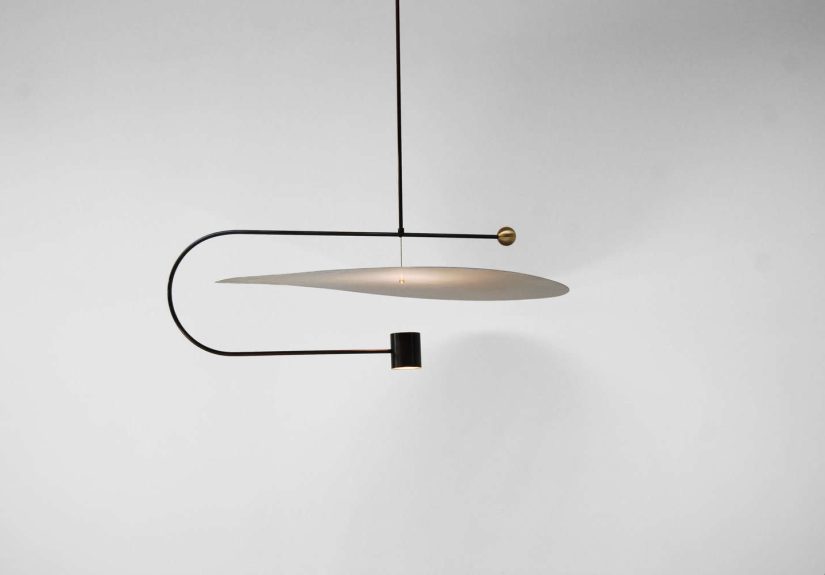
Counterweight pendants use a ballast (often a decorative weight in stone or metal) that balances the fixture and allows controlled movementusually height adjustment,
sometimes with a “floating” look. They feel upscale and engineered, like the fixture went to finishing school.
Best for: modern dining areas, statement lighting over a breakfast nook, and rooms where you want a little sculptural edge without chaos.
3) Off-center “counterbalance” or secondary-support pendants
Some counterbalanced designs don’t just change heightthey also change where the pendant visually “lands” under the ceiling.
A secondary support line or counterbalanced element can let the shade hang away from the canopy location.
That’s a huge win if your electrical box isn’t perfectly centered over the table (because homes love to humble us).
Best for: renters or remodel-minimizers who want better alignment without opening drywall.
4) Swing-arm pendant lights
A swing-arm pendant combines a hanging fixture with an arm that rotatessometimes 90°, sometimes 180°, sometimes a full 360° if it’s feeling ambitious.
It’s like a pendant and an adjustable lamp had a very practical baby. The movement helps you aim light over a specific spotlike a reading chair, kitchen prep zone,
or a table that isn’t always in the same place.
Best for: flexible living spaces, small dining rooms, and “one room that does everything” layouts.
5) Industrial articulating pendants with joints
Inspired by workshop and task lighting, these fixtures use multiple jointsthink elbows, swivels, and pivot pointsto move the shade exactly where you want it.
The vibe can lean “vintage dental office” (in a cool way) or “modern studio,” depending on finish and shade shape.
Best for: kitchen work areas, craft rooms, home studios, and anyone who loves a little mechanical honesty in their decor.
6) Telescoping-stem pendants
Telescoping pendants adjust height using a sliding stem section (or a set of connectable stems). The movement is more controlled and “architectural”
than a corded pulley. This style is great when you want adjustability but prefer a cleaner, straighter line than a visible cord loop.
Best for: entryways, dining rooms, and modern kitchens where you want a tailored look.
7) Cord-gripper adjustable drop systems
Many modern pendants use cable grippers that let you fine-tune height by releasing and re-locking the cord. Some are “set it once,” while others are designed
for occasional re-adjustmentespecially in multi-pendant clusters where you might change the staggered effect over time.
Best for: stairwells, vaulted ceilings, and clusters over round tables.
8) Tilt-and-swivel shade pendants
Not all “moving” has to be dramatic. Some pendants keep their height fixed but allow the shade to tilt or swivel,
directing light toward a countertop, wall art, or a reading spot. This is a smart choice when you don’t want cords moving up and down,
but you still need directional control.
Best for: task lighting near walls, kitchens with uneven work zones, and lighting that supports art or shelving.
9) Rotating-arm “mobile” chandeliers that behave like pendants
Some fixtures blur the pendant/chandelier line with rotating arms that reposition the light sources around a central suspension.
These designs often reference hanging mobilesbalanced, sculptural, and adjustable. The moving parts let you widen the spread for entertaining,
then tighten the layout for everyday use.
Best for: dining rooms, open-plan living areas, and anyone who wants lighting that doubles as a conversation piece.
10) Multi-head pendants with movable drops
Think of a linear canopy with multiple pendant dropseach drop can be raised, lowered, or repositioned (depending on the system).
This is perfect if you want even illumination across a long island but still want the ability to adjust individual heads for task zones.
Best for: long kitchen islands, bars, and dining tables where people actually sit in different places.
11) Track-mounted pendants you can slide and re-aim
A track system turns “mobile” into a lifestyle: you can move pendants along the track, swap heads, or shift the layout as the room evolves.
Some systems support quick-connect pendants and accessories, making updates easier than committing to one fixed canopy location forever.
Best for: galleries, studios, retail-style home spaces, kitchens with changing layouts, and anyone who rearranges furniture for fun.
12) Cord-reel or winch-style pendants
Cord-reel pendants use a spool-like mechanism to adjust heightmore like a controlled “retractable” system than a simple cord.
Done well, it’s smooth and tidy. Done poorly, it’s like fighting a stubborn yo-yo in front of company.
Best for: workspaces, loft-style interiors, and rooms where height needs to change frequently.
Placement tips: height, spacing, and “don’t bonk your head” clearance
Mobile pendants are forgiving, but they still need a smart starting point. A common guideline for many spaces is to hang pendants roughly
12–20 inches below an 8-foot ceiling, then add about 3 inches for each additional foot of ceiling height.
Over surfaces like islands and dining tables, you’ll also want comfortable sightlines across the room.
If your pendant moves (pulley, swing arm, rotating shade), plan for the full “movement zone.” Make sure it won’t clip cabinet doors,
smack into open shelves, or drift into the path of a very determined tall friend.
Buying checklist: what matters most for moving-part pendants
- Weight + support: Moving mechanisms can add weight. Confirm your ceiling box and mounting hardware are appropriate for the fixture.
- Strain relief: If the design uses cord movement, it needs proper strain relief so the cord isn’t carrying structural load.
- Movement quality: Test for smooth actionpulleys shouldn’t grind, arms shouldn’t wobble, joints shouldn’t feel loose out of the box.
- Dimming compatibility: Especially with integrated LEDs. “Dimmable” and “dims nicely in real life” are not always the same thing.
- Bulb type and glare control: Clear bulbs can glare at eye level; diffusers and deeper shades are more forgiving.
- Finish durability: Touch points (counterweights, pulley pulls, joints) get handled more, so choose finishes that age well.
Installation and safety notes (because gravity is undefeated)
Pendant lightsespecially adjustable onesshould be installed with the right electrical box, support method, and wiring practices.
In many home setups, the electrical box also plays a role in supporting the fixture, and heavier fixtures may require additional framing support.
If you’re unsure, a licensed electrician can confirm the box rating and mounting approach for your specific ceiling.
For movable cord systems, the key idea is simple: the cord should deliver power, not act like a climbing rope. Good designs use proper support
and strain relief so movement doesn’t stress electrical connections over time.
Style tips: make the movement look intentional
- Match mechanism to mood: pulleys feel industrial or nautical; counterweights feel modern and sculptural; swing arms feel playful and practical.
- Use repetition carefully: two or three matching mobile pendants over an island look crispunless the cords tangle like spaghetti. Keep movement paths clear.
- Embrace asymmetry (on purpose): off-center counterbalance designs can make an “imperfect” ceiling box feel like a design choice.
- Keep it reachable: if you plan to adjust it often, don’t put the pull cord where only a ladder can find it.
Maintenance: keep it smooth, quiet, and not squeaky
Moving parts need occasional attention. Dust buildup can make pulleys feel gritty and joints feel stiff. About once a season,
wipe down moving components, check that screws and set points are snug (not over-tightened), and confirm cords aren’t fraying or twisting.
If the fixture starts squeaking, don’t ignore itmost lights are not supposed to sound like a haunted swing set.
Real-world experiences with mobile pendant lighting (the stuff people only learn after living with it)
Here’s what tends to happen once a mobile pendant moves from “pretty online listing” to “daily-life coworker.” First, people fall in love with the
control. A pulley pendant over a dining table becomes the unofficial host of every gathering: lowered for intimate dinners, raised for game nights,
and somewhere in the middle for that one friend who always brings a centerpiece tall enough to block the sun.
The surprise benefit? It’s not just moodit’s practicality. When the table turns into a homework station or a craft zone, dropping the light a few inches
can make details pop without adding extra lamps.
Swing-arm pendants often become the heroes of awkward layouts. One homeowner story you hear again and again: “Our ceiling box wasn’t centered, and we didn’t want drywall work.”
A movable arm let them shift the light to where the table actually sat. In open-plan spaces, this matters because furniture moves. People add a bench, rotate a table,
or swap a dining setup for a deskand suddenly the ability to aim the pendant feels like cheating (in the best way).
The same goes for articulating industrial-style pendants in kitchens: they’re wildly satisfying when you can pull the light toward the cutting board,
then push it back when you’re carrying a hot pan and don’t want to joust with your own fixture.
Counterweight pendants tend to earn compliments from guests who don’t even care about lightingbecause the mechanism reads as design, not just function.
But living with them teaches a few lessons. One: touch points show wear. If the counterweight gets handled daily, fingerprints happen,
and some finishes demand more wiping than others. Two: movement needs boundaries. In homes with kids (or enthusiastic adults), anything that moves
will be tested. The fix is usually simple: set rules (“adjust, don’t yank”) and choose fixtures with a stable mechanism.
Track-mounted pendants are where real-life flexibility becomes obvious. People who like to rearrange furniture (or who can’t stop collecting art)
love being able to slide pendants along a track rather than re-centering canopies. One common “wish we’d known” moment:
plan the track layout like you’d plan outletsfuture you will thank you. The track can support a new pendant position for a different island seating plan,
or it can shift light toward a wall when you turn the dining area into a mini gallery.
Finally, there’s the everyday reality check: mobile pendants are still ceiling fixtures. If you expect to change height constantly, you’ll want a design
that adjusts smoothly and stays put without drama. If you only adjust once in a while, a telescoping stem or gripper system may feel cleaner and easier to live with.
The “best” mobile pendant isn’t the one with the most movementit’s the one whose movement matches your routine.
When it does, you stop thinking about the light… until someone visits and says, “Wait, your pendant does what?” and you get to show off a little.
Conclusion
Mobile pendant lights with moving parts aren’t just trendythey solve real problems: imperfect ceiling box placement, shifting room layouts,
changing tasks, and the universal desire to make a space feel both functional and stylish. Whether you want a pulley you can pull, a counterweight you can slide,
an arm you can swing, or a track you can reconfigure, the goal is the same: put light exactly where you need it, when you need it,
and make it look good doing it.