Table of Contents >> Show >> Hide
- Why the Spirit Halloween Twitter Thread Went Viral
- The 18 Costumes and Accessories That Sparked the Conversation
- Why “It’s Just a Costume” Is Not Always a Good Defense
- Native American Costumes Remain One of the Biggest Flashpoints
- Blackface, Afro Wigs, and Black Hairstyles Are Not Costume Accessories
- Día de los Muertos Is Not “Spicy Halloween”
- Religious Costumes Need More Thought Than a Plastic Beard
- Why Retailers Are Finally Paying Attention
- How to Choose a Halloween Costume Without Becoming the Group Chat Villain
- What the Spirit Halloween Thread Reveals About Modern Halloween
- Experience-Based Reflection: What This Topic Teaches Shoppers, Workers, and Parents
- Conclusion
Halloween is supposed to be the one night of the year when adults can wear capes without explaining themselves and children can demand candy with the confidence of tiny tax collectors. But every October, along with pumpkins, fake cobwebs, and suspiciously flammable wigs, another tradition crawls out of the retail crypt: racist Halloween costumes.
The viral discussion around 18 racist costumes that Spirit Halloween decided to get rid of, as shared by an employee on Twitter, hit a nerve because it showed something many shoppers have noticed for years. Some costumes do not celebrate a character, a monster, or a clever idea. They reduce real cultures, religions, hairstyles, histories, and communities into props. That is not spooky. That is just awkward with a barcode.
The thread, posted by a Spirit Halloween employee, showed items that workers at one store reportedly chose not to sell. The list included costumes and accessories connected to Native American stereotypes, Day of the Dead imagery, Black hairstyles, religious caricatures, taco costumes, turbans, bamboo hats, and other products the employees considered culturally insensitive or racist. It was not presented as a formal companywide corporate announcement. Still, the thread became a useful case study in how retail workers, consumers, and brands are rethinking what “just a costume” really means.
Why the Spirit Halloween Twitter Thread Went Viral
Spirit Halloween is a massive seasonal retailer, known for popping up in empty storefronts like a caffeinated ghost with a lease agreement. Because it sells costumes at scale, its shelves reflect larger trends in American Halloween culture. When an employee shared photos of items their team chose to remove from sale, people reacted immediately.
Some praised the employees for refusing to profit from offensive stereotypes. Others argued that certain items were harmless, misunderstood, or overly scrutinized. That debate is exactly why the thread mattered. It forced people to ask: when does a costume move from playful to harmful?
The answer usually depends on context. A vampire cape is not targeting a living community. A fake “Native princess” outfit, black body paint, or a caricatured religious costume can reinforce real-world stereotypes attached to groups that have experienced discrimination. In other words, Dracula is not checking Twitter. Real people are.
The 18 Costumes and Accessories That Sparked the Conversation
The employee’s Twitter thread featured a range of products. Some were obviously offensive to many viewers; others generated debate because they sat in a gray area between costume, cultural object, and stereotype. Here are the main examples discussed in the thread and why they raised concerns.
- Bamboo hat: Often sold as a generic “Asian” accessory, this kind of item can flatten many different Asian cultures into one visual cliché.
- Turbans: Turbans have religious, cultural, and historical meanings for many communities. Treating them as costume props can feel disrespectful when stripped of context.
- Day of the Dead makeup kits: Día de los Muertos is a Mexican cultural and spiritual tradition centered on remembrance, not simply “Mexican Halloween.”
- Day of the Dead costumes: When sugar skull imagery is packaged as a spooky costume without cultural context, it can turn a meaningful tradition into decoration.
- Rabbi accessories: Religious identity is not a gag costume. Fake beards, hats, and robes can turn Jewish identity into a caricature.
- Rabbi costume: Full religious-costume packaging can cross from representation into mockery, especially when designed for laughs.
- Black afro wigs on white models: Black hairstyles have long been stigmatized, policed, and mocked. Selling them as joke accessories can carry ugly historical baggage.
- Additional afro wigs and “hippie” packaging: Even when marketed as retro, the presentation matters. A hairstyle tied to Black identity should not become a disposable punchline.
- Black body makeup spray: This raised immediate blackface concerns. Darkening skin for a costume has a long racist history and remains widely condemned.
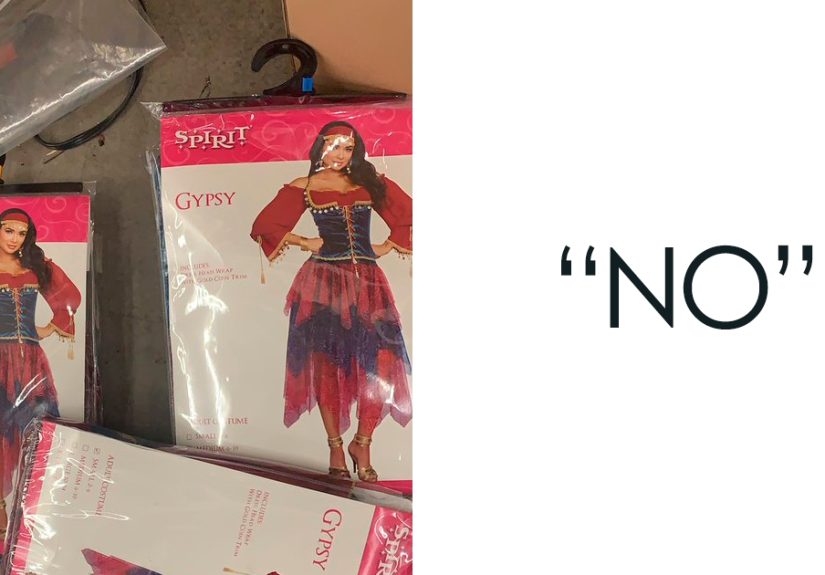
- “Gypsy” costume: The term is considered offensive by many Romani people, and the costume often relies on stereotypes of Romani women as exotic or mystical.
- Child taco costume with sombrero styling: Food costumes can be silly fun, but when paired with ethnic stereotypes, the joke can shift from “taco” to “Mexican caricature.”
- Adult beef taco costume: Similar concerns applied to the adult version, especially when combined with sombrero imagery.
- “Queen of the Tribe” costume: This type of naming turns Indigenous identity into fantasy branding, usually without connection to any specific Native nation.
- “Reservation Royalty” costume: The phrase itself is loaded, and the design sexualizes Native women while borrowing sacred or cultural visual cues.
- “Native American Princess” costume: Native communities have repeatedly criticized these costumes for reducing diverse living cultures to a single inaccurate fantasy.
- Western headband accessory: Generic feathered headbands can imitate regalia or sacred adornments without understanding their meaning.
- Sugar skull staff: Decorative skull items tied to Día de los Muertos can become appropriative when sold as spooky props detached from remembrance and ceremony.
- “Locs” accessory: Faux locs marketed as a costume accessory can be offensive because natural Black hairstyles are often discriminated against in real life.
Why “It’s Just a Costume” Is Not Always a Good Defense
The phrase “it’s just a costume” sounds simple, but it skips the most important question: a costume of what, exactly? Dressing as a dragon is different from dressing as a race, ethnicity, religion, or marginalized community. One is fantasy. The other is someone’s real identity, history, and daily experience.
That distinction matters because stereotypes do not vanish when the party ends. A person can take off a fake headdress, afro wig, or religious costume at midnight. People who belong to those communities do not get to remove the discrimination attached to those images.
Costumes Can Turn People Into Props
Many offensive Halloween costumes work by taking one visible element from a culture and exaggerating it. A sombrero becomes “Mexican.” A feather becomes “Native American.” A beard and hat become “Rabbi.” A hairstyle becomes a joke. That shortcut is the problem. It teaches people to see communities as symbols instead of full human beings.
Humor Does Not Erase Harm
Halloween should be funny. Nobody wants a holiday so serious that even skeletons have to submit an HR complaint. But humor needs a target. If the joke depends on mocking a culture, religion, skin color, accent, or hairstyle, it is not clever. It is lazy writing with a receipt.
Native American Costumes Remain One of the Biggest Flashpoints
Several items in the thread involved Native American imagery, including “Native American Princess,” “Reservation Royalty,” “Queen of the Tribe,” and feathered headbands. These costumes are among the most criticized because they compress hundreds of distinct Native nations, languages, ceremonies, and traditions into a single fantasy aesthetic.
The problem is not that Native clothing or art is unimportant. It is the opposite. Regalia, beadwork, hairstyles, feathers, and ceremonial clothing can carry deep meaning. Many items are connected to specific communities, achievements, responsibilities, and spiritual practices. A mass-produced costume rarely communicates any of that. Instead, it sells a simplified image for one night of entertainment.
The sexualization of Native women in Halloween costumes adds another layer of harm. “Princess” and “royalty” costumes often present Indigenous women as exotic, available, or fictional. That imagery does not exist in a vacuum. Native women and relatives continue to face disproportionate violence, and activists have long connected dehumanizing stereotypes to broader patterns of harm.
Blackface, Afro Wigs, and Black Hairstyles Are Not Costume Accessories
The black body makeup spray in the thread drew strong reactions because it immediately reminded people of blackface. In the United States, blackface is tied to minstrel shows and a long tradition of racist entertainment that mocked Black people for white audiences. That history is not ancient dust in a museum cabinet; it still appears in Halloween scandals, school controversies, and viral apology posts every year.
Afro wigs and faux locs can also be complicated. Some people argue that an afro wig could be part of a 1970s disco or Bob Ross-inspired costume. Context matters. But the employee’s concern focused on how Black hairstyles were packaged and modeled, especially when white models were used to sell hair textures historically associated with Black identity.
Here is the uncomfortable truth: Black people have often been punished professionally or socially for natural hairstyles, while costume companies have profited from selling similar looks as funny accessories. That double standard is why many shoppers see these products as more than harmless wigs.
Día de los Muertos Is Not “Spicy Halloween”
Day of the Dead imagery has become extremely popular in Halloween aisles, especially sugar skull makeup, skeleton dresses, and decorative staffs. The visuals are beautiful, which is exactly why they get copied. But Día de los Muertos is not simply a spooky aesthetic. It is a Mexican tradition rooted in remembrance, family, food, altars, prayer, art, and honoring the dead.
That does not mean nobody outside Mexican culture can learn about or respectfully participate in Día de los Muertos events. Appreciation is possible. The problem comes when retailers strip the symbols from their meaning and package them as generic “sexy skeleton” or “creepy fiesta” merchandise. At that point, the tradition becomes a costume rack, and the cultural context gets shoved somewhere behind the fog machine.
Religious Costumes Need More Thought Than a Plastic Beard
The thread also included rabbi costumes and accessories. Costumes based on religious dress can be risky because they often rely on exaggeration. Jewish identity, like any religious identity, is not a novelty outfit. When a costume reduces a faith tradition to a beard, hat, robe, or accent, it invites mockery rather than understanding.
That does not mean religious figures can never appear in theater, education, film, or satire. But mass-market Halloween costumes rarely provide nuance. They are built for instant recognition, which often means they lean on stereotypes. If the only reason people recognize the costume is because it exaggerates a group, that is a warning sign flashing brighter than a haunted-house exit sign.
Why Retailers Are Finally Paying Attention
Retailers do not operate outside culture. They respond to consumer demand, social media backlash, employee feedback, and changing public expectations. Over the past decade, brands have faced criticism for costumes involving Native stereotypes, immigration enforcement, religious caricatures, blackface-adjacent makeup, and sexualized cultural outfits.
Some companies have removed controversial products after public complaints. Others have updated language, changed marketing photos, or stopped carrying certain themes. The business reason is obvious: offensive costumes can damage trust. But the ethical reason matters more. Selling a costume is not neutral when the costume turns a community’s pain into a party theme.
How to Choose a Halloween Costume Without Becoming the Group Chat Villain
You do not need a graduate seminar before buying fake vampire teeth. But a quick gut check helps. Ask yourself: Is this costume based on a real race, ethnicity, religion, nationality, or marginalized identity? Does it use skin darkening, fake accents, sacred clothing, religious symbols, or stereotyped hairstyles? Is the joke aimed at a group of people rather than a fictional character or idea?
If the answer is yes, pick something else. The world is overflowing with costume options: ghosts, aliens, witches, robots, movie characters, vegetables, puns, historical figures handled carefully, pop culture moments, and whatever “sexy traffic cone” situation the internet invents next. You can be memorable without turning someone else’s identity into packaging.
Better Costume Ideas
Try a concept rather than a culture. Be a thunderstorm. Be a haunted vending machine. Be a vampire accountant. Be the Wi-Fi signal that disappears when guests arrive. These costumes are funny because they are imaginative, not because they punch down.
What the Spirit Halloween Thread Reveals About Modern Halloween
The viral Spirit Halloween employee thread was not just about 18 products. It was about a cultural shift. People are no longer willing to treat every costume as harmless simply because it comes in plastic packaging. Employees are questioning inventory. Customers are calling out stereotypes. Parents are teaching children that admiration and imitation are not the same thing.
That shift is healthy. Halloween can still be chaotic, funny, weird, and wonderfully overdecorated. Removing racist or culturally insensitive costumes does not ruin the holiday. It makes room for better creativity. Honestly, if your costume only works because it stereotypes a living community, maybe the problem is not “cancel culture.” Maybe the problem is that your costume has the comedic range of a damp paper plate.
Experience-Based Reflection: What This Topic Teaches Shoppers, Workers, and Parents
One of the most useful lessons from the discussion around these 18 racist costumes is that awareness often begins in ordinary places. Not in a university lecture hall. Not in a corporate diversity memo. Sometimes it begins in the back room of a Halloween store, where seasonal employees are unpacking boxes and suddenly realize, “Wait, why are we selling this?”
That moment matters. Retail workers are often the first people to see how products are labeled, displayed, and explained to customers. They also hear the jokes shoppers make in the aisles. A worker may notice when a costume encourages people to laugh at an ethnic group, imitate a religion, or treat sacred clothing like party gear. The Spirit Halloween thread resonated because it showed employees exercising judgment rather than blindly scanning whatever came through the register.
For shoppers, the experience is different but just as important. Many people have bought questionable costumes in the past without thinking deeply about them. Maybe they saw a packaged outfit, recognized the stereotype, and assumed that if a major retailer sold it, it must be acceptable. That assumption is fading. Consumers now understand that availability does not equal respect. A costume can be legal, popular, and still harmful.
Parents face a special version of this challenge. Kids often choose costumes based on what looks cool, colorful, or familiar. A child may not understand why a headdress, sugar skull look, or religious outfit could bother someone. That creates a teaching opportunity. Instead of simply saying “no,” parents can explain that some clothing and symbols mean a lot to real people. They can guide children toward costumes inspired by values such as bravery, creativity, kindness, humor, or adventure rather than costumes based on someone else’s identity.
There is also an experience many people recognize from parties: the uncomfortable moment when someone walks in wearing a costume that makes the room freeze. Nobody wants to be the person explaining racism next to the snack table while dressed as a pirate. But silence can make the harm feel normal. A simple, calm response can help: “I know you may not have meant harm, but that costume plays into a stereotype.” It does not have to become a courtroom drama with chips and salsa as evidence.
The best Halloween experiences come from creativity, not cruelty. The funniest costumes usually come from observation, wordplay, nostalgia, or absurdity. A person dressed as “404 Error: Costume Not Found” will always beat a person wearing a lazy cultural stereotype. The first gets laughs because it is clever. The second gets attention because everyone is wondering who invited the human red flag.
Ultimately, this topic teaches that respect and fun are not enemies. In fact, they work well together. When people stop relying on racist costumes, they become more inventive. They build costumes, remix pop culture, create group themes, and find humor that does not require turning anyone’s heritage into a prop. That is the Halloween upgrade nobody talks about: fewer stereotypes, better jokes, and far fewer apology posts on November 1.
Conclusion
The story of 18 racist costumes that Spirit Halloween decided to get rid of, as shared by an employee on Twitter, is less about one store and more about a bigger cultural question: what kind of fun are we willing to defend? Halloween should be strange, silly, dramatic, and a little unhinged. It does not need costumes that mock Native cultures, Black hairstyles, religious identities, Romani people, Mexican traditions, or any other real community.
The good news is that avoiding racist Halloween costumes does not make the holiday boring. It makes it smarter. There are endless ways to dress up without borrowing someone else’s identity for laughs. Choose imagination over stereotype, context over convenience, and humor over harm. Your costume will be better for itand your future self will thank you for not becoming a screenshot.
Note: This article is written for web publication in standard American English and synthesizes publicly reported information, cultural-sensitivity guidance, and real examples from the viral employee thread while avoiding unnecessary source-link clutter in the body copy.