Table of Contents >> Show >> Hide
- Quick Jump Menu
- Pressure Washer Basics: PSI, GPM, and Why Your House Cares
- Safety Rules That Actually Matter (Because Water Can Cut)
- Setup: From “Where’s the Wand?” to Ready-to-Spray
- Technique: How to Clean Without Turning Your Project Into a Repair
- Step-by-Step Examples for Common Jobs
- Detergents: When Soap Is Smarter Than More PSI
- Shutdown, Storage, and Maintenance (So It Works Next Weekend)
- Troubleshooting Fast Fixes
- Real-World Experiences and Lessons (About )
- Final Takeaway
A pressure washer is basically a garden hose that went to the gym, got a personal trainer, and now won’t stop talking about “gains.”
Used correctly, it can erase a year of grime in minutes. Used incorrectly, it can turn “quick cleanup” into “why does my driveway have my initials carved into it?”
This guide will walk you through how to use a pressure washer safely and effectivelysetup, nozzle choices, technique, detergents, and step-by-step examples for common jobs.
Important: Pressure washers can cause serious injuries and damage surfaces fast. Always read your specific machine’s manual,
follow local rules for wastewater/runoff, and if you’re under 18, don’t operate it solohave a trained adult handle the wand and supervise the entire job.
Quick Jump Menu
- Pressure Washer Basics (PSI, GPM, Electric vs. Gas)
- Safety Rules That Actually Matter
- Setup: From Box to Ready-to-Spray
- Technique: How to Clean Without Damage
- Step-by-Step Examples: Driveway, Siding, Deck, Car
- Detergents: When Soap Beats More Pressure
- Shutdown, Storage, and Maintenance
- Troubleshooting Fast Fixes
- Real-World Experiences ()
Pressure Washer Basics: PSI, GPM, and Why Your House Cares
PSI vs. GPM (The “Punch” and the “Rinse”)
Pressure washers are usually described by PSI (pounds per square inch) and GPM (gallons per minute).
PSI is the “punch” that breaks grime loose; GPM is the “flow” that carries it away. Two machines can share the same PSI but clean differently if one moves more water.
That’s why a moderate-PSI unit with decent flow can feel surprisingly effective on everyday dirt.
Electric vs. Gas: Which One You’re Actually Using
Electric pressure washers are typically lighter, quieter, and great for cars, patio furniture, grills, and small concrete areas.
Gas pressure washers tend to be more powerful and faster for large driveways, heavy buildup, and big exterior projectsbut they’re louder,
require engine maintenance, and must be used outdoors with good ventilation.
Nozzles: The Secret Language of Color (and Chaos)
Most pressure washers use quick-connect spray tips. The lower the degree number, the narrower (and more aggressive) the spray.
Start wide, then step down only if you need more bite.
| Nozzle Color (Common) | Spray Angle | Typical Use | “Personality” |
|---|---|---|---|
| White | 40° | Rinsing, delicate surfaces, windows (from a safe distance), cars | Gentle, forgiving, beginner-friendly |
| Green | 25° | General cleaning: siding, walkways, deck boards (carefully), patio furniture | The “daily driver” tip |
| Yellow | 15° | Stubborn concrete stains, heavy grime, paint-prep (use extreme caution) | Effective, but can damage surfaces fast |
| Red | 0° | Spot treatment on hard surfaces only, when you truly know what you’re doing | Laser beam of regret if misused |
| Black | Soap / Low-pressure (often ~65°) | Applying detergent/soap (many machines only siphon soap on low pressure) | More foam, less damage |
Pro tip: Nozzle colors are common but not guaranteed. Always confirm with your washer’s manual and test on an inconspicuous area first.
Safety Rules That Actually Matter (Because Water Can Cut)
Wear the Right Gear
- Eye protection (debris and grit can ricochet)
- Closed-toe shoes/boots with good traction (wet concrete is basically a cartoon banana peel)
- Gloves for grip and to reduce sting from backsplash
- Hearing protection for louder gas units
Never Aim at People, Pets, or Your Own Body
A pressure washer is not a toy and not a “fun squirt gun.” High-pressure spray can cause serious injuries, including injection-type wounds that may look small at first
but can be medically urgent. Keep bystanders well away, and keep the nozzle pointed downrange at all times.
Don’t Use a Ladder (Seriously)
The kickback and slippery overspray make ladders a bad combo. If you must reach high areas, use an extension wand or hire a professional for upper stories.
If you can’t keep stable footing, it’s not a DIY moment.
Electric Shock and Carbon Monoxide Risks
- Keep cords and plugs out of pooled water. Use only grounded, GFCI-protected outlets.
- Never run a gas pressure washer in enclosed or poorly ventilated areas. Exhaust can build up fast.
If you’re a teen: Follow the “no solo operation” rule. Have an adult operator. Your job can be prepmoving furniture, taping outlets, holding the hose,
and being the safety spotter.
Setup: From “Where’s the Wand?” to Ready-to-Spray
1) Prep the Area Like a Pro
- Move outdoor furniture, planters, grills, and anything you don’t want soaked.
- Close windows and doors. Cover exterior outlets and sensitive fixtures if needed.
- Sweep loose debris from concrete so you’re not power-washing gravel into orbit.
- Check for cracked caulk, loose siding, rotten wood, or flaking paintpressure can worsen weak spots.
2) Inspect the Pressure Washer
- Look for damaged hoses, loose fittings, and worn O-rings.
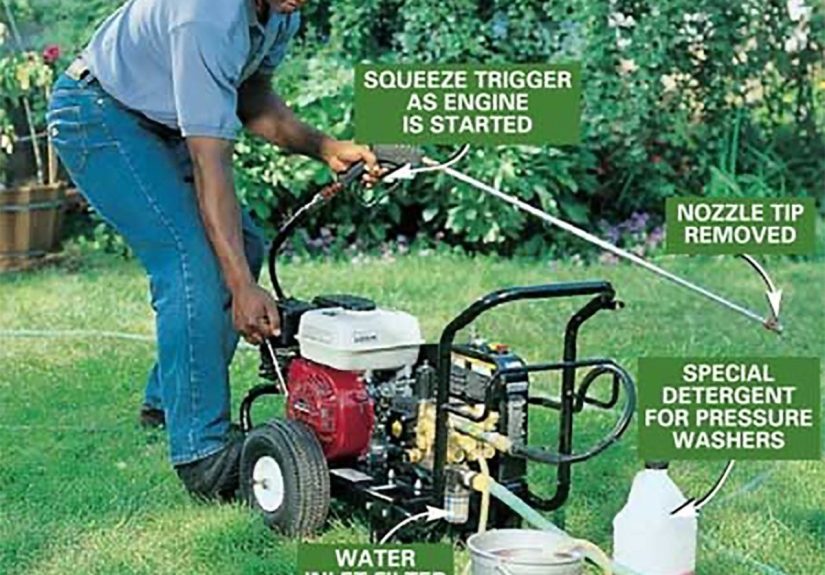
- Confirm the inlet filter screen is clean (clogs reduce pressure and stress the pump).
- If gas: check oil and fuel level. If electric: confirm you’ve got a safe outlet and cord rated for outdoor use.
3) Connect Everything in the Right Order
- Attach the garden hose to the washer’s water inlet (tight, no leaks).
- Connect the high-pressure hose to the pump and to the spray gun.
- Attach the wand to the gun (if separate).
- Start with a wide nozzle (usually 40° white) to reduce surprise kickback.
4) Turn on Water First, Then Purge Air
Turn on the spigot fully, then squeeze the trigger for 30–60 seconds to purge air from the line.
You want steady water flow before the motor/engine startsthis helps protect the pump and prevents sputtering.
5) Start the Machine
- Electric: Plug into a grounded GFCI outlet, keep the connection dry, then power on.
- Gas: Follow your model’s steps (fuel valve on, choke as needed, pull-start or electric start). Let it stabilize before you begin.
Technique: How to Clean Without Turning Your Project Into a Repair
Start Wide, Stay Moving, Sneak Up on the Dirt
Think of pressure washing like seasoning food: you can always add more, but you can’t un-salt a soup.
Begin with a wider nozzle and a greater distance, then move closer or step down a nozzle size only if the grime laughs at you.
Work at an Angle (Usually 30–45°)
Spraying straight-on can drive water into seams, under siding, or into cracks. A slight angle helps lift dirt and push it away
instead of forcing it into places it shouldn’t go.
Use Overlapping Passes
Move in smooth strokes and overlap each pass. If you “scribble” randomly, you’ll get zebra stripes.
A grid pattern is your friend: side-to-side, then step down and repeat.
Know When NOT to Pressure Wash
Avoid blasting roofs, old mortar, fragile trim, peeling paint you aren’t planning to repaint, and anything with delicate seals (like older windows).
When in doubt: try a gentler nozzle, increase distance, or switch to a brush-and-hose method.
Step-by-Step Examples for Common Jobs
Example 1: Cleaning a Concrete Driveway or Patio
- Sweep first. Wet leaves and grit turn into sludge you’ll chase forever.
- Start with a 25° (green) nozzle from a comfortable distance.
- Work in sections (think 4 ft x 4 ft). Use overlapping passes.
- For stains, try detergent made for concrete or a pre-treatment (follow label directions), then rinse thoroughly.
- If you have a surface cleaner attachment, use itfaster, more even, fewer streaks.
Watch out: Holding a tight spray too close can etch the surface. If you see “clean lines” that look like permanent stripes, back off immediately.
Example 2: Washing House Siding (Vinyl, Fiber Cement, Painted Surfaces)
- Pick a calm day (wind turns spray into a neighborhood weather event).
- Use 25° (green) or 40° (white) to start.
- Keep the stream angled downward and avoid spraying into seams, vents, and window trim gaps.
- Work top to bottom when rinsing so dirty runoff doesn’t redecorate clean panels.
- If you use detergent, apply it low-pressure first, let it dwell briefly (don’t let it dry), then rinse.
Distance matters: Many DIY guides suggest keeping extra space from siding to avoid paint damage and forcing water behind panels.
If you see siding flexing, you’re too close or too aggressive.
Example 3: Cleaning a Wood Deck Without Fuzzing It Up
- Inspect boards for rot or splinters. Pressure won’t “fix” weak wood; it will expose it.
- Start with 40° (white), then try 25° (green) only if needed.
- Stay farther back than you think, and keep the wand moving with the grain.
- Use a deck cleaner if appropriate, then rinse well.
Deck mistake to avoid: If the surface gets fuzzy, you’re lifting wood fibersuse a wider nozzle, lower pressure, and more distance.
Example 4: Washing a Car (Safely)
- Use an electric unit if possible; it’s usually easier to control for paint-safe rinsing.
- Choose 40° (white) for rinsing and keep distance. Avoid 0° entirely on paint.
- Pre-rinse to knock off grit (this reduces scratching when you hand-wash).
- Apply car soap with a low-pressure soap tip or foam cannon if you have one.
- Hand-wash with a mitt, then rinse with the wide nozzle.
Car warning: Don’t blast badges, weather stripping, or chipped paint from close range. You’re not trying to pressure-wash your clear coat into a new hobby.
Detergents: When Soap Is Smarter Than More PSI
Use the Right Cleaner
Use detergents labeled for pressure washers and for the surface you’re cleaning (car wash soap for vehicles, siding wash for exteriors, concrete cleaner for driveways).
Household chemicals can discolor surfaces or damage plantsand some combinations are dangerous.
How to Apply Detergent Without Streaks
- Switch to the soap/low-pressure nozzle (often black) or engage your detergent setting.
- Apply detergent bottom-up on vertical surfaces to reduce streaking.
- Let it dwell briefly so it can loosen grime (don’t let it dry on the surface).
- Rinse top-down with a wider nozzle.
Plant protection: Wet nearby plants before and after using detergents, and avoid spraying chemicals directly onto landscaping.
Shutdown, Storage, and Maintenance (So It Works Next Weekend)
Proper Shutdown Steps
- Release the trigger and engage the safety lock.
- Turn off the machine (engine off / motor off).
- Turn off the water supply.
- Squeeze the trigger briefly to relieve pressure in the hose.
- Disconnect hoses and store neatly (kinks are the enemy).
Flush Detergent
If you used soap, run clean water through the system for a minute. Detergent left inside can clog or gum up parts over time.
Winterizing (If Temperatures Drop Below Freezing)
Water expands when it freezesinside a pump, that’s a recipe for expensive sadness. Follow your manufacturer’s winterizing instructions.
Many owners use a pump-protect solution or fully drain the unit and hoses before storage.
Troubleshooting Fast Fixes
- No pressure / weak spray: Check water supply, inlet screen, nozzle clog, and hose connections. Purge air again.
- Pulsing/surging: Usually air in the line, a partially clogged nozzle, or inconsistent water supply.
- Soap won’t siphon: Many washers only draw detergent in low-pressure modeuse the soap tip/setting and confirm the tube isn’t kinked.
- Leaks at connections: Replace worn O-rings, tighten fittings, and inspect hoses for damage.
- Streaks on siding: Apply detergent bottom-up, rinse top-down, and don’t let soap dry on the wall.
Real-World Experiences and Lessons (About )
If you ask a dozen homeowners what pressure washing is like, you’ll get the same vibe: “It’s incredibly satisfying… right up until it isn’t.”
The first lesson most beginners learn is that a pressure washer is not a “set it and forget it” tool. It’s more like driving in a snowstorm:
tiny adjustments in angle, distance, and speed make a huge difference.
One of the most common experiences is the False Confidence Phase. You start with a wide tip, see dirt melt away, and think,
“I was born for this.” That’s usually when someone swaps to a narrower nozzle and gets too close. On concrete, you may notice the surface gets
visibly “whiter” in a narrow stripe. It looks greatuntil you realize you’ve cleaned one lane at a different intensity than the rest. Suddenly your driveway
resembles a very clean barcode. The fix is simple but humbling: back off, go wider, and clean the whole section evenly instead of spot-chasing stains.
Another real-world surprise is how much prep affects results. People who skip sweeping or moving furniture end up pressure washing the same grit twice:
once off the surface and again after it splashes back from the chair leg they forgot to move. And if you don’t cover or avoid sensitive areas (outlets, lights, door seals),
you spend the afternoon “cleaning” while quietly inventing new words to describe regret.
Detergent also changes the game. A lot of first-timers try to solve everything with more pressure, when the faster route is often:
rinse, apply soap, dwell briefly, and rinse again. The “soap + time” combo loosens grime so you can use a safer nozzle and less aggressive technique.
People often report that the moment they stop trying to laser-blast algae and instead let detergent do its job, the work gets easierand the surfaces look better.
On siding and decks, many beginners learn the Angle Lesson: spraying straight-on can drive water into seams or lift paint.
The “aha” moment is using a gentle downward angle and treating the wand like a paintbrushsteady strokes, overlap, keep moving.
That technique feels slower at first, but it’s faster than repairing trim or sanding fuzzy deck boards later.
Finally, there’s the Cleanup Reality. The job isn’t done when the dirt is gone. Coiling hoses, relieving pressure, flushing detergent,
and storing the washer properly is what makes the next session smooth instead of a “why won’t this thing start” mystery. Most experienced users end up with a simple habit:
five extra minutes at the end saves an hour next time.
If you take only one lesson from all those shared experiences, make it this: start gentle, test a small spot, and earn your way to more power.
Pressure washing is a skill, not a button.
Final Takeaway
Using a pressure washer well is mostly about control: the right nozzle, the right distance, and a steady technique.
Pair that with smart prep and safe habits, and you’ll get the satisfying “brand-new” lookwithout the surprise repair bill.