Table of Contents >> Show >> Hide
- Step 1: Start with the Habitat
- Step 2: Count Legs and Check the Basic Body Shape
- Step 3: Examine Color Patterns and Markings
- Step 4: Watch How It Moves on or in the Water
- Step 5: Use Size and Eyes to Separate Water Spiders from Lookalikes
- Step 6: Understand Their Behavior and Safety
- Putting It All Together: A Quick 6-Step Identification Checklist
- 500-Word Experience: What It Is Really Like to Spot a Water Spider
If you’ve ever looked down at a pond and thought, “Wow, that spider is breaking the laws of physics,” you’ve probably met a water spider or one of its close cousins. Some spiders can literally walk on water, some dive beneath the surface, and others build tiny underwater “air houses.” Learning how to identify a true water spider (and not confuse it with a water strider or just a very adventurous land spider) is easier when you know what details to look for.
This guide walks you through six practical steps to identify water spiders, especially common semi-aquatic fishing spiders in the genus Dolomedes and the fully aquatic diving bell spider Argyroneta aquatica. We will also help you tell them apart from water striders and wolf spiders, using simple visual cues you can remember the next time you are out near a lake, stream, or marsh.
Step 1: Start with the Habitat
Look for calm or slow-moving water
Most “water spiders” you see around North America are fishing spiders (Dolomedes species). They like slow-moving streams, ponds, marshes, and quiet shoreline edges where they can sit partly on vegetation and partly on the water’s surface. They are commonly seen on rocks, floating logs, or low vegetation right at the waterline.
The true diving bell spider, Argyroneta aquatica, spends almost all of its life underwater in ponds or still waters, living in an air-filled silk “bell” anchored to submerged plants. If you are in Europe or parts of Asia and you see a small spider surrounded by a silvery bubble clinging to aquatic plants under the surface, that is likely a diving bell spider rather than a fishing spider.
Check what the animal is actually doing
- Standing or running on the water surface with long, thin legs and a very slender body? That might be a water strider (an insect, not a spider).
- Sitting at the edge of the water with front legs resting on the surface, ready to grab prey? That is more typical of a fishing spider.
- Fully underwater in a bubble or under submerged vegetation? That behavior is classic diving bell spider.
In short: if there is calm water nearby and the animal is using the surface like a hunting platform or refuge, “water spider” is already a strong possibility.
Step 2: Count Legs and Check the Basic Body Shape
Confirm that it is really a spider
Before you go any further, make sure you are not accidentally studying an insect. Water striders, for example, are often mistaken for water spiders. They skate around on the surface film and can be quite large, but they are true bugs, not arachnids.
- Spiders: 8 legs, 2 main body sections (a combined head/thorax called the cephalothorax, and an abdomen), no antennae.
- Insects (like water striders): 6 legs, 3 main body sections (head, thorax, abdomen), often visible antennae.
If what you are seeing clearly has eight legs radiating around a more rounded body and no antennae, congratulations, you are definitely looking at a spider. Now we can narrow it down further.
Look for the classic fishing spider profile
Fishing spiders are usually fairly large compared to common house spiders. Many species have a body length of about 0.6–1 inch (1.5–2.5 cm), with a leg span that can stretch several inches across. The body is somewhat flattened, helping them rest comfortably against rocks or the water surface.
Diving bell spiders, by contrast, are smaller. Females are typically under about half an inch (around 8–13 mm), with males sometimes a bit larger but still nowhere near the leg span of a typical fishing spider.
Step 3: Examine Color Patterns and Markings
Common fishing spider markings
North American fishing spiders, like the six-spotted fishing spider (Dolomedes triton) and striped fishing spider (Dolomedes scriptus), tend to be brown, gray, or tan with distinctive patterns:
- A pale stripe running down each side of the cephalothorax (the front body section).
- Rows of pale spots or W-shaped markings down the abdomen.
- Long legs that may have banding or subtle striping.
The overall impression is of a subtly camouflaged spider that blends into wet wood, rocks, and vegetation. Some species look mossy or mottled, which helps them disappear when they freeze in place.
Color and sheen of the diving bell spider
The diving bell spider is usually brownish, with a silvery appearance when it is underwater. That “silver suit” effect comes from a layer of air trapped in waterproof hairs on its body, giving it a metallic, reflective look when submerged.
If you see a small spider underwater that looks like it is wrapped in shiny foil while clinging to plants or a dome-like web, you are almost certainly looking at Argyroneta aquatica.
Step 4: Watch How It Moves on or in the Water
Surface walking and “rowing”
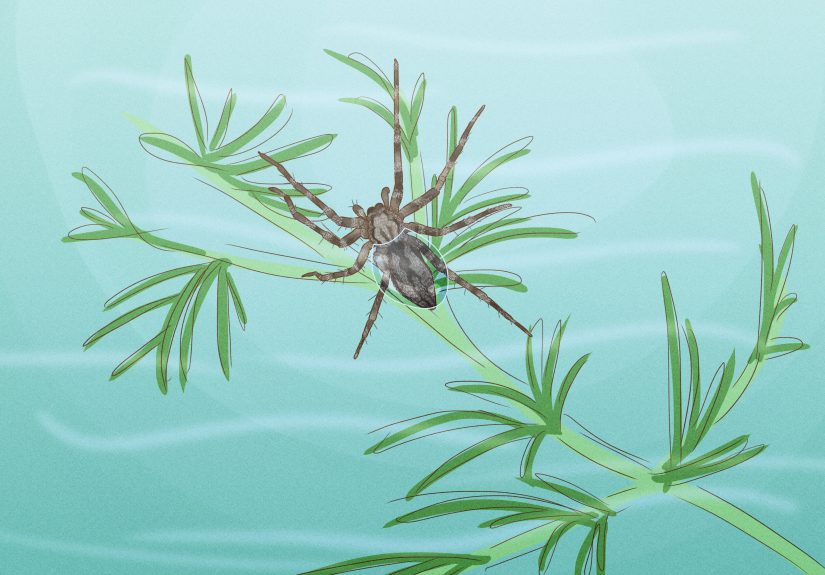
Fishing spiders are semiaquatic athletes. They use water-repellent hairs on their legs to stand on the surface of the water and can even run or “row” across it when chasing prey or escaping threats. Their front legs often rest lightly on the water, picking up vibrations from struggling insects, tadpoles, or small fish.
When startled, they may sprint across the surface or suddenly dive beneath it, clinging to rocks or vegetation while surrounded by air trapped in their body hairs. They can stay underwater for many minutes, breathing from this trapped air film.
Diving bell behavior
Diving bell spiders are more about underwater life than surface skating. They build a silk “bell” between submerged stems, then carry air down from the surface to inflate it using the hairs on their abdomen. Inside this bell, they rest, molt, eat, and even raise their young.
So, if you mainly see the spider walking on the surface and darting back to shore, think fishing spider. If you spot a tiny underwater dome with a spider tucked inside, think diving bell spider.
Step 5: Use Size and Eyes to Separate Water Spiders from Lookalikes
Fishing spider vs. wolf spider
Many people confuse large fishing spiders with wolf spiders. Both are big, hairy, and fast. However, wolf spiders are usually found on the ground away from water and have a different eye arrangement.
- Fishing spiders: Eight eyes arranged in two or three rows, giving a more flattened “mask-like” look from above. They are often directly associated with water habitat.
- Wolf spiders: Two very large, prominent eyes on top of the head that reflect light strongly, with four smaller eyes in a straight row below. They are often seen in dry grassy or wooded areas instead of water’s edge.
If you are near a pond and see a big spider with long legs spread wide and a more horizontal body, especially one that is not afraid to step right onto the water, that points strongly toward a fishing spider.
Water spider vs. water strider
Water striders are slim insects with extremely long middle and hind legs and a narrow “stick-like” body that stays high above the surface. They often move in quick, gliding bursts, leaving ripples behind them.
A water spider, on the other hand, looks exactly like you would expect a spider to lookrounded body, thicker legs, and a lower, more grounded stance. Instead of endlessly skating around the open water, fishing spiders often stay close to cover, hugging rocks, roots, or reeds.
Step 6: Understand Their Behavior and Safety
What water spiders eat
Water spiders are impressive predators. Fishing spiders feed on insects, aquatic larvae, and sometimes even small fish or tadpoles that venture too close to the surface. They use vibrations on the water surface to detect prey and deliver a venomous bite to immobilize it, then haul it to a safer spot to eat.
Diving bell spiders focus on aquatic invertebrates, pulling them into their bell to consume them in private.
Are water spiders dangerous to humans?
Good news: water spiders look intimidating, but they are not considered aggressive toward people. Like most spiders, they prefer escape over conflict. Their venom is strong enough to subdue their prey, and a bite can be painful, but it is generally not medically significant for a healthy human unless there is an allergic reaction.
As a rule of thumb, admire them from a respectful distance. If you overturn rocks or logs near water, gently place them back after you are done so you do not accidentally crush their hiding spots.
Putting It All Together: A Quick 6-Step Identification Checklist
- Check the habitat: Calm or slow-moving freshwater with nearby vegetation or rocks? Good sign.
- Confirm it is a spider: 8 legs and no antennae, not the slim insect body of a water strider.
- Look at body size and shape: Flattened, medium-to-large spider for fishing species; smaller, bubble-wrapped spider underwater for the diving bell spider.
- Notice coloration: Brown, gray, or tan with pale side stripes and spots or W-shaped markings for many fishing spiders; silvery underwater sheen for the diving bell spider.
- Observe movement: Walking or running on the water surface, sometimes diving below and resurfacing = water spider behavior.
- Compare with lookalikes: Far from water with big “headlight” eyes? Probably a wolf spider. Super thin body skating nonstop on the surface? Likely a water strider.
If your mystery creature matches most of these traits, you can confidently say you have identified a water spider.
500-Word Experience: What It Is Really Like to Spot a Water Spider
Field guides are great, but nothing beats the first time you actually encounter a water spider in real life. Imagine standing at the edge of a quiet pond on a warm evening. The sun is dropping behind the trees, and the surface of the water looks like glassuntil a tiny “eight-legged boat” glides into view.
At first, you might think it is a water strider. That is usually the first guess because most people know those long-legged insects from childhood. But as your eyes adjust, you notice that this creature is stockier. Its body is broader, and its legs are not stick-thin. Instead of constantly zipping around the open water, it pauses along a rock, front legs just grazing the surface. If you are close enough (and patient enough), you might see it freeze when a small insect lands nearby. A second later, it lunges. The ripples spread outward like miniature shockwaves, and the spider drags its prize back to the shoreline.
This is classic fishing spider behavior. Witnessing it in person makes all those identification tips suddenly click. The pale side stripes along the body become more obvious, and you start to see the subtle patterning on the abdomen that field descriptions talk about. You might notice how the spider’s legs dimple the water surface without breaking througha clear sign of those water-repellent hairs that let it “float” on the film.
Sometimes, the most memorable lesson comes from seeing how quickly a fishing spider can vanish. Disturb it with a shadow, a sudden movement, or even a dropped leaf, and it may sprint across the water like an eight-legged speedboat. If it really feels threatened, it dives. One moment it is there; the next it has slipped beneath the surface, leaving only a faint swirl where it went down. If you look closely with a flashlight or in clear water, you may see a silvery shape clinging to a submerged rockair trapped around its body, keeping it dry even underwater.
If you are lucky enough to observe a diving bell spider (more likely in European ponds than in typical North American backyard settings), the experience is even stranger. Peering through the water, you might notice what looks like a tiny transparent balloon attached to a plant stem. Inside, a small spider hangs upside down, safe in its personal diving chamber. Watching it swim to the surface, grab more air, and return to inflate the bell is like seeing a miniature scuba diver at work. It is one of those moments when you realize just how inventive nature can be.
Over time, repeat encounters make identification almost automatic. You start to link behavior, habitat, and appearance without consciously ticking through a checklist. A spider sitting at the water’s edge with front legs touching the surface becomes “obviously a fishing spider.” A silver-coated spider bell underwater becomes “obviously a diving bell spider.” The more you see them, the more comfortable you feel distinguishing them from wolf spiders hiding in leaf litter or water striders skimming across open pond water.
For many people, that familiarity transforms fear into fascination. Instead of thinking, “Yikes, a huge spider!” you catch yourself saying, “Oh wow, look at that fishing spider hunting; that is incredible.” You may even find yourself explaining to a friend that no, it is not going to attack them, and yes, it really can walk on water. In that sense, learning how to identify water spiders is not just about naming a speciesit is about seeing a small, often misunderstood animal as part of a bigger aquatic ecosystem, doing exactly what it evolved to do.