Table of Contents >> Show >> Hide
- The Story Behind the Cat, the Chaos, and the Cult Following
- Why the Concept Works So Well
- 15 Famous Paintings That Became Even Funnier With One Ginger Cat
- 1. Mona Lisa
- 2. Girl with a Pearl Earring
- 3. The Starry Night
- 4. Ophelia
- 5. The Kiss
- 6. The Birth of Venus
- 7. Lady with an Ermine
- 8. Washington Crossing the Delaware
- 9. Whistler’s Mother
- 10. Arnolfini Portrait
- 11. The Creation of Adam
- 12. Bridge over a Pond of Water Lilies
- 13. Irises
- 14. Sunflowers
- 15. The Scream
- Why People Keep Coming Back to Fat Cat Art
- Related Experiences: Why This Kind of Cat Art Feels So Strangely Personal
- Conclusion
There are two kinds of people in this world: those who admire classical art from a respectful distance, and those who look at a centuries-old masterpiece and think, “You know what this needs? One gloriously overconfident orange cat.” Luckily for the rest of us, artist Svetlana Petrova belongs to the second camp. Her now-famous project, Fat Cat Art, drops her fluffy ginger muse, Zarathustra, into iconic paintings with the kind of confidence usually reserved for cats who have never once paid rent.
The result is exactly what you’d hope for: part art-history joke, part internet-era absurdity, and part genuine craft. These images are not random throwaway edits made in five sleepy minutes. They work because Petrova understands composition, mood, gesture, and the sacred comic power of a cat who looks like he believes every museum was built for him personally. Whether he’s interrupting a romantic embrace, judging a Renaissance beauty, or acting like he invented symbolism, Zarathustra turns famous paintings into something fresh, weird, and delightfully shareable.
And that is the magic of this project. It does not mock art so much as lovingly pounce on it. It invites viewers who may never casually browse a museum catalog to suddenly care about Whistler’s Mother, The Starry Night, or Girl with a Pearl Earringbecause now there is a chunky orange cat sitting in the middle of the frame like a fuzzy art critic who showed up uninvited and somehow improved the room.
The Story Behind the Cat, the Chaos, and the Cult Following
Zarathustra is not some anonymous internet feline who accidentally wandered into fame. He is the beating orange heart of Fat Cat Art, a project Petrova built with both humor and real artistic discipline. The premise is simple: photograph the cat in the perfect pose, then carefully insert him into well-known paintings so he looks as though he belonged there all along. Simple in concept, yes. Simple in execution? Not even slightly.
That is part of why the series took off. Petrova has explained that getting the right image of Zarathustra can take a long time, because the cat has to match the posture, expression, balance, and emotional rhythm of the original painting. That means the joke lands on two levels. First, there is the instant laugh of seeing a rotund ginger cat pop up in a revered masterpiece. Second, there is the delayed appreciation that this ridiculous feline intruder actually fits. He does not merely appear in the image. He commits to the bit.
There is also a sweet emotional thread under all the comedy. Zarathustra came into Petrova’s life after the death of her mother, and the cat became both companion and collaborator in a project that eventually reached a global audience. Over time, the work expanded from a clever visual gag into a recognizable brand, a book, calendars, exhibitions, prints, and an ongoing stream of new art-world mischief. That blend of sincerity and silliness is a big reason the project has endured. It is funny, yes, but it also feels loved.
Why the Concept Works So Well
Cats and classical paintings make an oddly perfect pair. Great paintings already thrive on drama, mystery, vanity, spectacle, and strange body language. Cats, meanwhile, specialize in all of those things before breakfast. A cat can look regal, offended, flirtatious, suspicious, sleepy, revolutionary, or spiritually unavailable in the span of thirty seconds. That gives Zarathustra a bizarre kind of range. He can be comic relief in one painting and the emotional center of another.
There is also the delicious contrast between high culture and total nonsense. Museums ask us to slow down, observe, interpret, and appreciate nuance. Cats ask us to accept that they are sitting on our laptop now and that this is no longer our laptop. When you merge those energies, you get comedy with extra texture. The paintings still matter. The composition still matters. But now the whole thing feels more human, because someone dared to ask the art-history question nobody knew they needed answered: what if Baroque grandeur had more fur?
On a deeper level, projects like this succeed because they make old art feel socially alive. A person who might scroll past a textbook image of Mona Lisa will absolutely stop for a version where a smug cat has inserted himself into the visual hierarchy. Humor becomes the doorway. Curiosity walks in right after it. That is why Fat Cat Art is more than a meme. It is pop culture sneaking art appreciation into your feed while dressed as a cat joke.
15 Famous Paintings That Became Even Funnier With One Ginger Cat
1. Mona Lisa
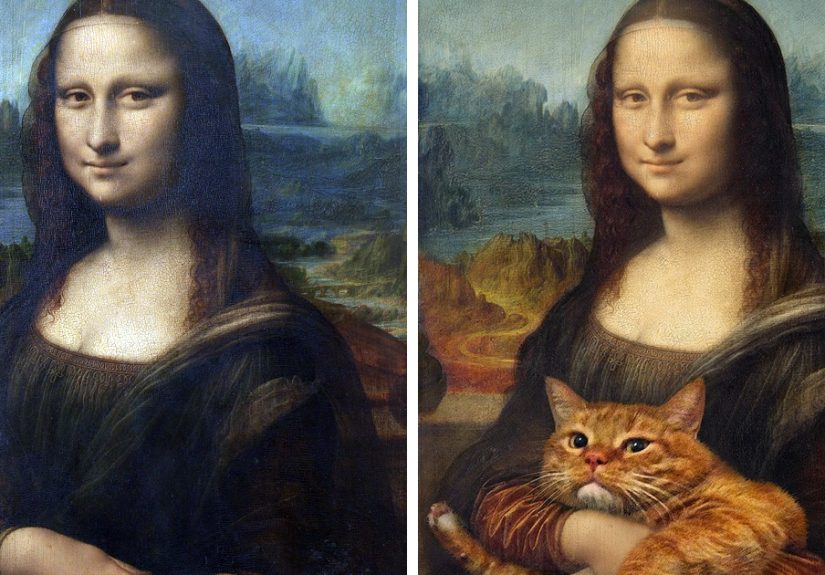
Leonardo da Vinci’s most famous smile has survived centuries of scrutiny, travel, theft, scholarship, and tourist flash photography. But somehow the biggest shock to the composition may be the arrival of Zarathustra. In this reimagining, the cat throws off the painting’s already fragile emotional equilibrium in the best possible way. The calm mystery of the original turns into the universal experience of trying to take one nice photo while your pet decides it is now a group portrait.
2. Girl with a Pearl Earring
Vermeer’s luminous “girl” already has a quietly theatrical presence, so adding a giant ginger cat should not work. And yet it absolutely does. The cat’s fluffy self-importance creates a visual joke without ruining the softness that makes the original so memorable. Instead, the scene feels like a very dramatic roommate moment. She brings the pearl. He brings the audacity.
3. The Starry Night
Van Gogh’s swirling sky has always looked a little alive, so Zarathustra slips into it like he was born there. This version is funny because it leans into the painting’s restless energy. The cat does not calm the composition; he amplifies its chaos. It feels less like a landscape and more like the inside of a feline brain at 3 a.m., right before something valuable gets knocked off a shelf.
4. Ophelia
Sir John Everett Millais painted one of the most haunting images in Western art, and then along comes one orange cat to make it weirdly adorable. The brilliance here is tonal. Zarathustra’s presence does not erase the lush, floating beauty of the scene; it introduces a surreal interruption that feels both absurd and strangely natural. It is the art equivalent of hearing a phone ring during Shakespeare and somehow laughing without ruining the mood.
5. The Kiss
Klimt’s golden embrace is one of the most recognizable images of intimacy in art history. So naturally, inserting a cat into it creates a masterpiece of emotional sabotage. The romance remains, but now it has competition. Zarathustra becomes the visual third wheel nobody invited and everybody notices. It is funny because every pet owner knows this truth: affection is never fully private when a cat believes he is the main character.
6. The Birth of Venus
Botticelli gives us elegance, mythology, and idealized beauty emerging from the sea. Zarathustra gives us a fluff-based counterargument. The cat’s shape is hilariously at odds with the airy grace of the original, which is exactly why the image works. Instead of fragile perfection, we get abundance, presence, and a deeply unserious reminder that beauty standards are no match for a cat who looks delighted to be included.
7. Lady with an Ermine
Leonardo’s painting already includes one furry co-star, so replacing or complicating that arrangement with a much larger, much more opinionated cat feels like destiny. This is one of the cleverest mashups in the series because it riffs on the original subject matter. Zarathustra does not merely photobomb the painting. He escalates it. The result is less “lady with an ermine” and more “lady with a complete orange management problem.”
8. Washington Crossing the Delaware
Nothing humbles heroic history painting like a cat who looks as though he wandered into the revolution for snacks. The grand patriotic drama of Leutze’s composition becomes instantly funnier when one fluffy orange creature claims visual authority over the whole boat. Instead of a frozen moment of national myth, the image starts to feel like a perilous group project led by someone with paws and absolutely no maritime qualifications.
9. Whistler’s Mother
This one is a near-perfect match because the original painting is already composed with such restraint. Enter Zarathustra, and the quiet dignity turns into dry comedy. He does not need to do much. He just needs to exist in that severe little universe and radiate the energy of a pet who respects nothing but cushions and attention. It is low-key, deadpan, and wonderfully effective.
10. Arnolfini Portrait
Jan van Eyck’s interior is famous for its detail, symbolism, and eerie precision. Adding a cat sounds risky, but Zarathustra slips into the image as though he has always owned the room. This may be one of the funniest examples because the original painting already invites close looking. The longer you stare, the more the cat feels like the one figure who truly understands the household power structure.
11. The Creation of Adam
Michelangelo’s near-touch is one of the most iconic gestures in Western art. Turning that sacred visual tension into a cat moment is both bold and ridiculously effective. Zarathustra’s presence deflates the monumental seriousness just enough to make it fresh again. Suddenly the scene feels less like divine spark and more like that familiar household drama where a cat decides whether your outstretched hand deserves acknowledgment.
12. Bridge over a Pond of Water Lilies
Monet’s garden scenes are all atmosphere, color, and soft immersion. Adding a large orange cat should blow up the tranquility, but instead it creates a new kind of peace: the peace of accepting that nature belongs to cats now. Zarathustra turns Impressionist calm into something warmer and funnier. It feels less like formal contemplation and more like the pleasant delirium of a lazy afternoon with sunlight, flowers, and one spoiled pet.
13. Irises
Van Gogh’s flowers already feel vivid and alive, which makes them ideal terrain for Zarathustra’s theatrical bulk. The cat’s color harmonizes beautifully with the intensity of the painting, and that visual logic makes the joke stronger. He is not randomly pasted on top of beauty. He becomes part of the bloom, the visual noise, the joyful excess. It is floral drama with whiskers.
14. Sunflowers
This version may be one of the easiest to love because sunflowers already have a kind of cheerful absurdity, and a plump ginger cat only pushes that mood further. The warmth of the yellow palette meets the warmth of orange fur, and suddenly the image becomes almost too perfect. It looks like summer, ego, sunshine, and cat hair got together and made a thesis statement.
15. The Scream
If there were ever a painting ready for cat energy, it was this one. Munch’s iconic anxiety pairs beautifully with the expression of a feline who has just been told “no” for the first time in his life. Zarathustra does not reduce the existential panic. He translates it into a language the internet knows intimately: the look of a cat experiencing outrage at a closed door, an empty bowl, or consequences.
Why People Keep Coming Back to Fat Cat Art
The internet is full of jokes that flare up and vanish by lunchtime, but Fat Cat Art has staying power because it is built on more than novelty. The images are funny on first glance, but they also reward repeat viewing. You notice how the cat’s curve echoes a drapery fold, how his expression changes the emotional center of a scene, how a solemn composition suddenly becomes domestic and relatable. These are not just cat edits. They are visual remixes with timing.
There is also something comforting about the project’s tone. It is playful without being mean, clever without becoming smug, and referential without excluding people who never took Art History 101. You do not need to know the symbolism of every masterpiece to get the joke. But if you do know the paintings, the joke gets even better. That double accessibility is rare, and it explains why the project appeals to museum lovers, meme addicts, pet owners, and anyone who has ever laughed because an animal looked suspiciously more composed than a human being.
Most of all, the series works because it understands a timeless truth: cats already behave as if portraits, monuments, and global institutions were created in their honor. Petrova simply had the good sense to stop arguing with that premise and start making art out of it.
Related Experiences: Why This Kind of Cat Art Feels So Strangely Personal
One reason people connect so quickly with a project like this is that it mirrors everyday life with pets in a surprisingly accurate way. Anyone who has lived with a cat knows the sensation of trying to complete a normal human activity and suddenly realizing that the cat has decided to become central to the event. You try to read, and the cat sits on the book. You try to work, and the cat occupies the keyboard. You try to fold laundry, and the cat becomes a monument to non-cooperation in the middle of the clean shirts. In that sense, putting a ginger cat into famous paintings is not fantasy. It is documentary realism with better lighting.
There is also the experience of seeing your own animal’s personality reflected in art. Pet owners are professional interpreters of expression. We know the difference between a sleepy blink, a judgmental stare, a fake apology, and the look that says, “I have committed a crime and I regret nothing.” That is exactly why Zarathustra’s face carries so much of the humor here. People do not simply see a cat in a painting. They recognize a very specific type of cat confidencethe kind that makes an animal look more socially powerful than everyone else in the room.
Another related experience is the joy of sharing these images with other people. Cat humor travels fast because it creates instant recognition. One person sees an edited masterpiece and laughs because it is visually absurd. Another laughs because it reminds them of their own orange menace at home. Another sends it to a friend who loves museums. Suddenly a single image is doing three jobs at once: it is a joke, a conversation starter, and a tiny emotional gift. That is a big part of why projects like this spread so widely online. They are easy to enjoy alone, but even better when passed from one person to another with the universal caption, “This is absolutely your cat.”
There is a museum angle, too. A lot of people feel intimidated by classical art until humor opens the door. A playful reinterpretation makes the paintings feel less remote. Once that happens, curiosity tends to follow. You laugh at the cat version of The Starry Night, then you look up the original. You smile at the parody of Girl with a Pearl Earring, then you start noticing Vermeer’s light. The joke becomes an invitation. That experience is valuable because it shows art appreciation does not always have to begin with solemn reverence. Sometimes it begins with a cat shaped like a fuzzy loaf of confidence.
And finally, there is a very human experience underneath all of this: the pleasure of seeing affection turned into creativity. People do strange, funny, tender things for the animals they love. They photograph them, narrate their lives, invent voices for them, frame their weirdest poses, and build entire private mythologies around their habits. Fat Cat Art feels so memorable because it takes that familiar devotion and scales it up into public, polished, delightfully ridiculous art. At heart, it is one person looking at her cat and deciding he deserves a place in history. Honestly, that may be the most relatable masterpiece of all.
Conclusion
Owner Puts Her Fat Ginger Cat Into Famous Paintings, And The Result Is Hilarious is the kind of premise that sounds like a one-joke internet post and ends up becoming something richer. With Zarathustra at the center, Svetlana Petrova has created a body of work that is witty, technically sharp, and unexpectedly charming. These 15 cat-filled takes on famous paintings remind us that art can be revered without becoming stiff, and that sometimes the fastest way to make people look more closely is to give them something impossible to ignorelike a majestic orange cat barging into art history with zero concern for tradition and flawless comic timing.