Table of Contents >> Show >> Hide
- What Exactly Is Concrete, Anyway?
- Concrete Before Rome: Ancient Experiments in Stone
- Rome’s Superpower: Opus Caementicium
- The Long Pause: Concrete Loses the Plot
- The Portland Cement Revolution
- Reinforced Concrete: When Stone Meets Steel
- Organizing the Concrete World: ACI, PCA, and the Age of Standards
- Concrete and the Making of Modern Life
- Smarter, Stronger, Greener: Concrete in the 21st Century
- Lessons from 2,000 Years of Concrete
- Experiences with Concrete: Living in a World Built on Stone Paste
Look around: the odds are good that the chair you’re sitting on, the road outside, the bridge into town, and the stadium where your team just lost (again) all have one thing in commonconcrete.
It’s the quiet overachiever of building materials: not flashy like glass, not warm like wood, but absolutely everywhere and undeniably essential.
The history of concrete is a surprisingly dramatic story full of ancient experiments, Roman engineering flexes, industrial-era breakthroughs, and modern climate-conscious innovation.
In this deep dive into the rock solid history of concrete, we’ll trace how a simple mix of stone, water, and binding material became the backbone of civilizationliterally.
From Roman harbors that have shrugged off 2,000 years of crashing waves to the development of Portland cement and today’s smart, sustainable mixes, concrete’s timeline is as layered as a core sample.
What Exactly Is Concrete, Anyway?
Before we time-travel, let’s get one thing straight: concrete and cement are not the same thing.
Cement is just one ingredient in concretethink of it as the flour in a cake. Concrete is the entire cake: a mix of cement, water, and aggregates like sand, gravel, or crushed stone.
When water reacts with the cement, it creates a paste that coats the aggregate and hardens into the tough, stone-like material we walk and drive on every day.
Modern structural concrete mostly relies on Portland cement, a finely ground powder made by heating limestone and clay to high temperatures and then grinding the resulting clinker.
This type of cement, invented in the early 1800s and named because it resembled a stone quarried on the Isle of Portland in England, became the global standard and set the stage for modern construction.
Concrete Before Rome: Ancient Experiments in Stone
Humans have been tinkering with concrete-like materials for thousands of years.
As early as around 1300 BCE, builders in the Middle East discovered that coating mud-brick walls with a thin layer of burned limestone (a primitive lime plaster) helped them resist weather and erosion.
The Egyptians used gypsum and lime mortars in their monumental stone constructions, and the ancient Greeks mixed lime with sand to create basic mortar for masonry.
These early materials weren’t concrete in the modern sensethere were no steel reinforcements, no standardized mixes, and certainly no mixing trucks backing up into job sites.
But the idea was there: use a binding material to glue together smaller particles into a larger, more durable whole.
The concept would reach its first true peak with a civilization that loved arches, aqueducts, and big engineering statements.
Rome’s Superpower: Opus Caementicium
If concrete had an origin story with dramatic lighting and theme music, it would be ancient Rome.
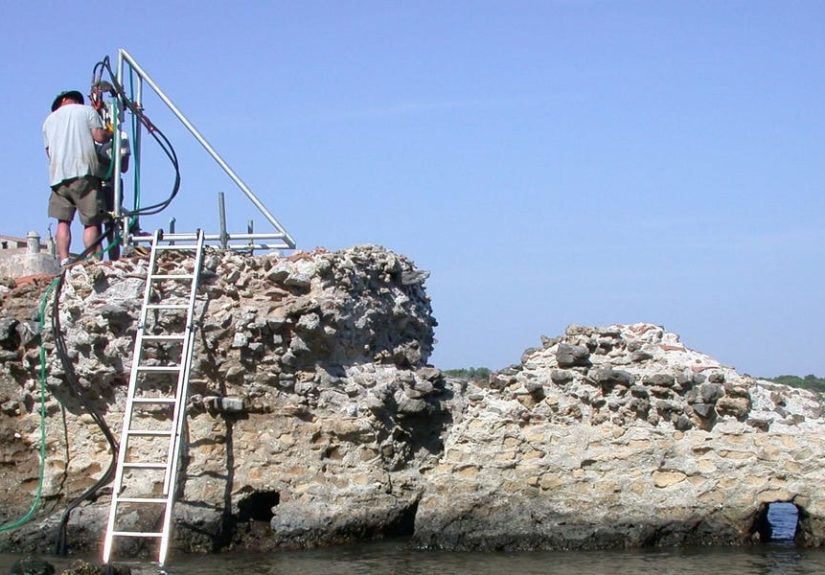
Roman engineers developed a concrete known as opus caementicium, a mix of lime, water, rock or brick fragments, and a special ingredient that still impresses modern scientists: volcanic ash.
The Romans discovered that volcanic ashparticularly from areas around the Bay of Naplesreacted with lime and water to create a strong, durable binder.
This “pozzolanic” material allowed their concrete to harden even in contact with seawater, which is why many of their harbor structures are still standing.
By roughly 200 BCE, concrete had become a standard building material in Rome, used alongside brick and stone for everything from foundations to domes and vaults.
Why Roman Concrete Lasted So Long
For centuries, modern engineers looked at ancient Roman structures and asked, “How is this still here?”
Buildings like the Pantheonwith its massive unreinforced concrete domeand sprawling harbor piers have survived earthquakes, wars, and relentless coastal erosion.
Recent research has revealed that Roman concrete doesn’t just resist damageit may actually self-heal.
Tiny lime clasts (little white chunks in the concrete) can dissolve when cracks form and water seeps in.
As these minerals recrystallize, they can seal cracks from the inside, making the structure more resilient over time.
Combined with the volcanic ash chemistry that forms durable crystals in marine environments, Roman concrete is less like a static stone and more like a slow, geological repair system.
In other words, Roman engineers accidentally stumbled into something that modern materials scientists are now trying very hard to reinvent on purpose.
The Long Pause: Concrete Loses the Plot
After the fall of the Roman Empire, the exact recipes and techniques for Roman concrete faded.
Builders still used lime mortars and masonry, but large-scale structural concrete as the Romans knew it largely disappeared from Europe.
For centuries, stone and brick took the lead roles in construction while concrete waited offstage.
It wasn’t until the 18th century that engineers began seriously revisiting concrete-like materials.
One key moment came when British engineer John Smeaton experimented with hydraulic limelime that could set under waterwhile rebuilding the Eddystone Lighthouse off the coast of England.
His work helped revive interest in binders that could hold up in harsh, wet environments, echoing some of the Roman innovations.
The Portland Cement Revolution
The real comeback star of concrete history is Portland cement.
In 1824, English bricklayer Joseph Aspdin patented a new kind of cement made by heating finely ground limestone and clay and then grinding the result into powder.
He named it “Portland cement” because the hardened material looked like a popular building stone from the Isle of Portland.
Later refinements by other manufacturers improved the strength and consistency of Portland cement, turning it into a reliable industrial product.
By the mid-1800s, this cement was being used in increasingly ambitious projects: sewers, bridges, tunnels, and massive public works.
As production scaled up, cement and concrete stopped being artisanal curiosities and became standardized materials with published specifications and test methods.
By the late 19th century, concrete blocks, pipes, and pre-cast elements were being mass-produced.
Cities and infrastructure projectsfrom metro tunnels to long-span bridgesleaned heavily on this new, predictable version of an ancient idea.
Reinforced Concrete: When Stone Meets Steel
Concrete can handle huge compressive forcessqueezingbut it’s relatively weak in tensionbending and stretching.
That’s where steel comes in. In the mid-1800s, innovators began embedding iron and later steel bars into concrete, creating reinforced concrete.
This hybrid material uses concrete to resist compression and steel to resist tension, making it ideal for beams, floors, and slabs.
Reinforced concrete opened the door to new architectural possibilities: longer spans, thinner slabs, soaring columns, and, eventually, skyscrapers.
Engineers developed new design methods to calculate how loads are shared between steel and concrete, and building codes evolved to standardize these practices.
In the United States, early landmarks in reinforced concrete constructionfrom houses and warehouses to bridgesproved that the material could be both strong and economical.
Over time, prestressed and post-tensioned concrete systems pushed performance even further, allowing for lighter, longer, and more elegant structures.
Organizing the Concrete World: ACI, PCA, and the Age of Standards
As concrete use exploded in the late 19th and early 20th centuries, the need for standards, testing, and education became obvious.
Two major organizations shaped the material’s modern history, especially in the United States:
- American Concrete Institute (ACI) – founded in the early 1900s (originally as the National Association of Cement Users), ACI became a key source of building codes, design guides, and technical knowledge for concrete professionals worldwide.
- Portland Cement Association (PCA) – established in the early 20th century, PCA represents cement manufacturers and promotes research, innovation, and best practices in cement and concrete use, particularly in North America.
These organizations helped transform concrete from a “good idea with inconsistent results” into a rigorously engineered, thoroughly tested, and globally standardized material.
Their researchon durability, mix design, curing, and structural performancehas shaped everything from your local highway to the tallest towers on the skyline.
Long-term testing programs, including century-long studies of concrete cylinders and structures exposed to real environments, have built a deep database of how concrete behaves over decades.
That data helps modern engineers design structures to last 50, 75, or 100 yearsor longer.
Concrete and the Making of Modern Life
It’s hard to overstate how much concrete has shaped modern life.
In the 20th century, it became the default material for dams, bridges, tunnels, parking garages, power plants, office towers, and apartment blocks.
The suburban boom relied on concrete for foundations, driveways, sidewalks, and highways.
Airports, sports arenas, data centers, and hospitals all lean heavily on concrete’s strength and versatility.
Concrete is cheap, moldable, and strongit can be pumped, sprayed, precast in factories, or poured on site into just about any shape.
With the right mix design and reinforcement, it can handle freezing climates, aggressive marine environments, and scorching deserts.
It’s no exaggeration to say that concrete is the backboneand often the skinof modern civilization.
Smarter, Stronger, Greener: Concrete in the 21st Century
Of course, there’s a catch: producing cement is energy-intensive and emits significant carbon dioxide.
As climate concerns have grown, the concrete industry has faced pressure to cut emissions while still delivering safe, durable structures.
Modern concrete research is tackling this from multiple angles:
- Supplementary cementitious materials (SCMs) – Fly ash, slag, and natural pozzolans can partially replace Portland cement in mixes, reducing the clinker content and improving long-term durability.
- Lower-clinker and alternative cements – New chemistries aim to cut the carbon footprint of cement while maintaining or improving performance.
- High-performance and ultra-high-performance concrete – Carefully engineered mixes with very low permeability can last longer and require fewer repairs, reducing lifetime environmental impact.
- Self-healing concrete – Inspired in part by Roman concrete, today’s researchers are embedding special additives, microcapsules, or bacteria to help concrete seal its own cracks.
In short, concrete is getting smarter. We’re asking it not only to stand up and stay put, but to do so more sustainably, with less maintenance, and for longer periods of time.
The next generation of bridges, seawalls, and cityscapes could owe as much to materials science as to traditional structural engineering.
Lessons from 2,000 Years of Concrete
Looking back across the history of concrete, a few big themes stand out:
- Ingredients matter. The difference between a sidewalk that flakes in a decade and a Roman pier that lasts 2,000 years can come down to the chemistry of the binder and aggregates.
- Environment matters. Roman harbor concrete thrived in seawater; poorly designed modern concrete can struggle in freeze–thaw cycles or deicing salts. Good design always respects local conditions.
- Standards matter. The rise of organizations like ACI and PCA shows how shared knowledge, testing, and codes prevent disasters and improve performance across the board.
- Innovation never stops. From volcanic ash to industrial kilns to self-healing mixes, concrete keeps evolving as we learn more about its microstructure and environmental impact.
Concrete’s story is ultimately about humans learning to control and improve a simple mix of rocks, water, and powder until it could support cathedrals, skyscrapers, and entire highway systems.
It’s a material that quietly reflects our best engineering, our worst planning mistakes, and our ongoing efforts to build structures that last.
Experiences with Concrete: Living in a World Built on Stone Paste
The history of concrete isn’t just something in textbooksit’s under your feet, over your head, and all around you every day.
Once you start noticing it, concrete is everywhere, and it changes the way you experience the built environment.
Imagine visiting an ancient Roman site and standing beneath the Pantheon’s dome.
You’re surrounded by concrete that was mixed, poured, and shaped nearly 2,000 years agowithout computers, ready-mix trucks, or finite-element analysis.
The air feels heavy with history, but the structure itself feels remarkably modern.
The smooth curves of the dome, the coffers overhead, the way the light pours through the oculusall of it depends on concrete being just strong and predictable enough to make the geometry work.
Now fast forward centuries and shift continents: you’re driving across a massive concrete bridge on an interstate highway in the United States.
You might not think about the reinforced concrete beneath your tires, but every expansion joint, pier, and deck panel represents decades of engineering lessons learnedabout load patterns, corrosion, and durability.
That bridge is a direct descendant of those Roman harbors and early Portland cement experiments.
On a smaller scale, many homeowners have their own concrete stories.
Maybe it’s the driveway that cracked after a brutal winter, teaching an impromptu lesson in freeze–thaw cycles, drainage, and the importance of control joints.
Or the DIY patio project that started with a weekend enthusiasm and ended with a deep respect for finishing timing, trowels, and how quickly “workable” concrete can turn into “immovable”.
Interior design trends have also given concrete a surprising second life indoors.
Polished concrete floors, concrete countertops, and even concrete accent walls show up in modern homes and lofts.
People discover that the same material used in parking structures can, with the right finishing and sealing, look sleek and refined in a kitchen or living room.
It’s a reminder that concrete is not just structuralit can also be aesthetic, with color, texture, and pattern.
For engineers and builders, concrete carries a different kind of emotional weight.
There’s a certain moment on a job sitewhen the forms are ready, the steel is tied, and the trucks arrivethat feels like game day.
The pour has to go smoothly: the mix design needs to be right, the placement uniform, the vibration adequate, and the curing conditions controlled.
Everyone on site knows that what happens over a few intense hours will affect the performance of that structure for decades.
Even for people outside the construction world, concrete shapes daily experiences in subtle ways.
The quiet solidity of a well-built concrete apartment building during a storm, the reassuring mass of a bridge during high winds, or the cool, slightly rough feel of a sidewalk on a summer eveningthese are all sensory reminders of how deeply concrete is woven into our lives.
Understanding the rock solid history of concrete adds a layer of appreciation to all of this.
The next time you stroll across a plaza, lean on a concrete balustrade, or park in a concrete garage, you’re not just interacting with a gray slab.
You’re touching the product of thousands of years of trial, error, chemistry, and creativitya material that has quietly shaped human civilization and is still evolving under our feet.