Table of Contents >> Show >> Hide
- Why Decluttering Feels So Hard When You Have ADHD
- The ADHD-Friendly Way to Declutter
- 1. Start Smaller Than You Think Is Reasonable
- 2. Use a Timer Like It Owes You Money
- 3. Make Decisions Easier with Simple Categories
- 4. Don’t Organize Before You Reduce
- 5. Make Homes for Items Ridiculously Easy
- 6. Use Visual Supports Instead of Trusting Memory Alone
- 7. Try Body Doubling
- 8. Build a Maintenance Routine, Not a One-Time Miracle
- Smart Decluttering Strategies for Common ADHD Trouble Spots
- What Not to Do
- When It Makes Sense to Ask for Help
- Real-Life Experiences: What Decluttering with ADHD Often Feels Like
- Conclusion
- SEO Tags
If you have ADHD, decluttering can feel less like “a quick tidy-up” and more like a reality show called Why Is There a Blender in the Bedroom? You start with one sock, find an old receipt, remember you need batteries, open your phone to add batteries to a shopping list, and 27 minutes later you are watching a video about building floating shelves. This is not a character flaw. This is a brain style meeting a task that demands planning, decision-making, memory, prioritizing, and follow-through all at once.
That is exactly why learning how to declutter with ADHD has to look different from generic organizing advice. A color-coded spreadsheet and twelve matching bins may look gorgeous online, but if the system is too complicated to maintain, it becomes just another museum exhibit dedicated to abandoned good intentions.
The good news is that an ADHD-friendly approach to decluttering does not require perfection, a minimalist personality, or a sudden transformation into a person who alphabetizes their spice rack for fun. It requires smaller decisions, lower friction, better visibility, and a lot more self-compassion. When you build your home around how your brain actually works, clutter becomes easier to manage and much less emotionally loaded.
In this guide, we’ll break down why clutter can pile up when you live with ADHD, how to create practical systems that stick, what mistakes to avoid, and what real-life decluttering experiences often feel like. The goal is not to create a showroom. The goal is to make your space easier to live in, easier to maintain, and far less likely to judge you from across the room.
Why Decluttering Feels So Hard When You Have ADHD
ADHD and clutter are often connected because decluttering is not one skill. It is a pile of skills wearing a trench coat. To clear one surface, you may need to decide what stays, what goes, where each item belongs, how long the task will take, what to do first, and how to keep going when your brain begs for literally any other activity. That is a lot.
Many adults with ADHD struggle with organization, procrastination, time management, remembering daily tasks, and losing things. Those challenges can turn ordinary home maintenance into a constant game of catch-up. A pile of unopened mail is not just paper. It is a stack of delayed decisions. A cluttered kitchen counter is not just “mess.” It may represent unfinished tasks, visual overload, and the mental traffic jam of too many competing priorities.
Executive dysfunction also plays a major role. When executive skills are stretched thin, it can be harder to plan steps, resist distractions, regulate emotions, and stay with one boring task long enough to finish it. That is why someone with ADHD may fully understand what needs to be done and still feel unable to start. Knowledge is not the problem. Activation often is.
There is also the classic ADHD issue of “out of sight, out of mind.” If items are hidden away too well, they may as well be teleported to another dimension. Many people leave things visible on purpose because visibility acts like memory support. The problem is that visibility can easily become visual clutter, and visual clutter can become stress. So the challenge is not to hide everything. It is to create systems that are visible enough to remember and simple enough to use.
Emotions matter, too. Decluttering can bring up guilt about money spent, shame about past messes, nostalgia about sentimental items, and frustration about how long everything seems to take. Some people also get a burst of excitement from acquiring new things but a wave of dread when it is time to organize them. That emotional seesaw can keep clutter stuck in place for months.
In other words, if decluttering feels harder for you than it seems to be for other people, you are not lazy, broken, or “just bad at adulting.” You are probably trying to do a high-executive-function task with a brain that needs a different playbook.
The ADHD-Friendly Way to Declutter
1. Start Smaller Than You Think Is Reasonable
The fastest way to trigger overwhelm is to announce, “Today I am decluttering the whole apartment.” Your brain hears that and immediately files for emotional bankruptcy. Instead, shrink the mission until it feels almost silly.
Try one drawer. One shelf. One corner of the bathroom counter. One bag of old cosmetics. One doom basket. One chair that has accidentally become a respected member of the laundry industry.
Small wins matter because they create momentum. When you finish a tiny zone, your brain gets proof that the task is doable. That matters more than motivation speeches ever will.
2. Use a Timer Like It Owes You Money
Long decluttering sessions often backfire with ADHD. A short, defined sprint works better. Set a timer for 10, 15, or 20 minutes and commit only to that. Not forever. Not all afternoon. Just one round.
This does two useful things. First, it lowers the mental barrier to starting. Second, it creates urgency, which many ADHD brains find surprisingly helpful. You are not “organizing the closet.” You are racing the clock to clear one shelf before the microwave of destiny dings.
If you still have energy when the timer ends, do another round. If not, stop without guilt. Progress still counts when it is boring, brief, and unimpressive on Instagram.
3. Make Decisions Easier with Simple Categories
One reason clutter becomes exhausting is that every object turns into a courtroom case. Do I keep this? Donate it? Store it? Repair it? Sell it? Repurpose it into a craft project I will definitely never do?
Reduce the options. Use a simple sorting method like:
- Keep
- Trash/Recycling
- Donate
- Not sure
The “not sure” bin is important. It keeps you moving instead of spiraling on one emotional decision for 18 minutes. Just give that box a deadline. If you revisit it in two weeks and still cannot justify keeping half the items, that tells you something.
4. Don’t Organize Before You Reduce
Buying containers before you know what you are keeping is how many of us end up with organized clutter. Very tidy clutter, yes. Still clutter.
Decluttering comes first. Storage comes second. Otherwise, you are basically purchasing cute little apartments for things you do not even want.
As you reduce, ask practical questions:
- Do I use this now?
- Would I buy it again today?
- Do I have duplicates?
- Is this worth the space it takes up?
- Am I keeping this out of guilt, fantasy, or obligation?
That last question stings a little, which is why it works.
5. Make Homes for Items Ridiculously Easy
ADHD-friendly organization has one golden rule: the easier the system, the more likely it is to survive contact with real life. Open bins are often better than lidded bins. Hooks are often better than hangers. Clear containers are often better than opaque boxes. A laundry basket where clothes actually land is better than a complicated system you admire but avoid.
If an item does not have a clear home, it will wander. Keys, chargers, mail, shoes, bags, medications, and paperwork are frequent escape artists. Give them obvious landing zones near where you naturally use or drop them.
Think less “Pinterest masterpiece,” more “friction-free habitat.”
6. Use Visual Supports Instead of Trusting Memory Alone
ADHD often makes working memory unreliable. That means your environment may need to hold reminders for you. Labels, clear containers, baskets for categories, whiteboards, sticky notes, and simple checklists can all help.
You are not cheating by externalizing memory. You are being efficient. The same way glasses are not a moral failure for people who need help seeing, visual supports are not a moral failure for people who need help remembering.
7. Try Body Doubling
Body doubling means having another person present while you work, whether they are physically there, on video, or even quietly doing their own task nearby. For many people with ADHD, this creates accountability, structure, and enough social energy to make boring tasks more doable.
This can look like:
- Calling a friend while you clear a kitchen counter
- Cleaning while your partner folds laundry nearby
- Joining an online focus session
- Asking someone to stay on speaker while you sort mail
Sometimes you do not need help doing the task. You just need help staying in the same universe as the task.
8. Build a Maintenance Routine, Not a One-Time Miracle
A dramatic all-day purge can feel satisfying, but it does not solve the real problem if there is no maintenance plan. ADHD-friendly decluttering works best when you build tiny resets into your routine.
Try these:
- A 10-minute evening reset
- A Sunday paper-and-mail sort
- A one-in, one-out rule for clothes or hobby supplies
- A donation bag kept in a closet year-round
- A weekly “surface sweep” for counters and tables
Consistency beats intensity. Every time.
Smart Decluttering Strategies for Common ADHD Trouble Spots
Paper Clutter
Paper is sneaky because every sheet looks “important enough to keep for now.” Use one inbox for all incoming paper. Then sort it on a schedule, not randomly whenever panic strikes. Keep categories simple: action, file, shred, recycle. The fewer piles, the better.
Bedroom Clutter
The bedroom often becomes a holding zone for clothes in every stage of their life cycle: clean, worn once, definitely dirty, emotionally complicated. Use clear categories here, too. A hamper for dirty clothes, a hook or basket for “wear again,” and easy-access storage for everyday clothes can prevent the dreaded floordrobe from becoming a permanent installation.
Kitchen Counters
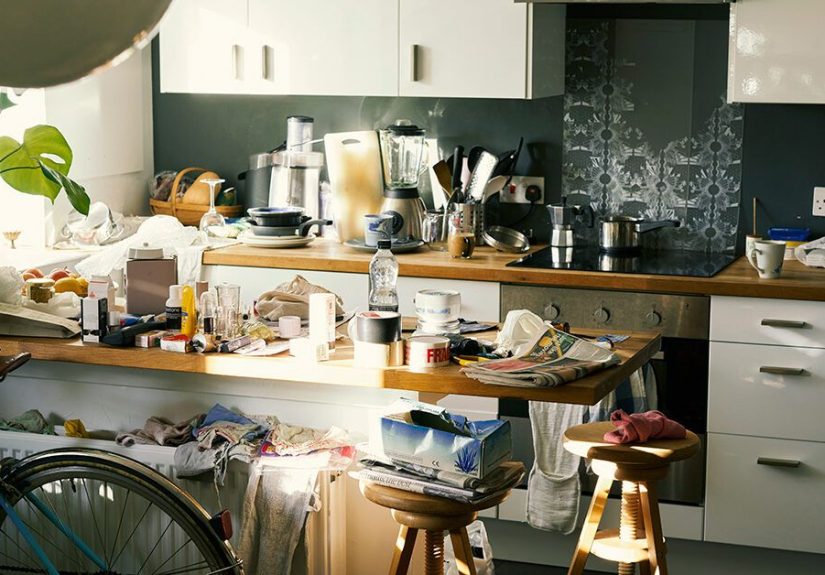
Counters attract clutter because they are flat, convenient, and always available for bad decisions. Keep only the items you use regularly on display. Create one catch-all tray if needed, but make it small. When the tray is full, it is time to reset. The tray is a boundary, not a lifestyle.
Hobby Supplies
ADHD and hobbies often go together like peanut butter and “I bought all the equipment before learning the basics.” Instead of forcing yourself to keep every supply forever, set limits by container. One bin per hobby. One shelf per craft. One drawer per project. Space limits make decisions easier without requiring you to become an emotionless robot.
What Not to Do
Some decluttering advice sounds productive but is secretly chaos in a cardigan. Avoid these common traps:
- Do not wait to feel fully motivated. Action usually creates motivation, not the other way around.
- Do not make every decision sentimental. A cracked mug from 2017 is not a blood oath.
- Do not create systems with too many steps. If putting something away requires five motions and a philosophical commitment, it will not happen.
- Do not compare your home to someone else’s highlight reel. Your system only needs to work for your life.
- Do not turn one task into six. If you are putting laundry away, do not suddenly reorganize your entire closet, design a capsule wardrobe, and start researching cedar hangers.
When It Makes Sense to Ask for Help
Sometimes clutter is a practical problem. Sometimes it is also a mental health problem. If your clutter is causing intense shame, major conflict, safety issues, financial strain, or making rooms unusable, it may be time to get support. A therapist, ADHD coach, or professional organizer familiar with ADHD can help you build systems that match your brain instead of fighting it.
It is also worth getting extra help if you feel extreme distress about throwing things away, keep large amounts of items you do not have space for, or avoid decisions so long that the clutter seriously affects daily life. Not all clutter is hoarding, but when the emotional pain and impairment are high, support matters.
And if ADHD symptoms are broadly interfering with work, relationships, home life, or self-esteem, talk with a qualified healthcare professional. Decluttering gets easier when the underlying ADHD symptoms are being addressed, too.
Real-Life Experiences: What Decluttering with ADHD Often Feels Like
For many people with ADHD, the experience of decluttering is not just about objects. It is about emotion, identity, shame, and the exhausting gap between intention and execution. Someone may genuinely want a calmer home and still freeze at the first pile. They may look at a messy room and immediately know what needs to happen, but their brain cannot figure out the first step clearly enough to begin. That gap can feel maddening.
One common experience is the “side quest spiral.” A person starts cleaning the bedroom, finds a coffee mug, walks it to the kitchen, notices the dishwasher needs unloading, remembers they are out of dish soap, checks their phone to add it to a list, sees a text, answers the text, and then somehow ends up researching standing desks. Forty minutes later, the original room is still a disaster, but now they also feel guilty, scattered, and weirdly tired.
Another common experience is emotional overload. A simple box of old papers can turn into a parade of unfinished plans, forgotten hobbies, expired coupons, birthday cards, and random receipts from a year when life felt different. Decluttering then stops being “cleaning” and starts feeling like a weird museum tour through every version of yourself you have ever been. No wonder people shut the box and walk away.
Many adults with ADHD also describe the frustration of being mislabeled as lazy or careless. They are not ignoring the mess because they do not care. In fact, they often care deeply. The problem is that caring does not automatically create activation, structure, or sustained attention. So they may spend the entire day thinking about cleaning without actually cleaning, which is a special kind of psychological torture only a cluttered kitchen can provide.
There is also the experience of creating a perfect system that collapses three days later. Maybe the labels were beautiful. Maybe the containers matched. Maybe there was even a brief moment of standing in the doorway whispering, “I have changed.” Then real life happened. The lids were annoying. The categories were too specific. The filing system required too much energy. The whole thing fell apart, and it felt like proof of failure. But usually it was not failure. It was feedback. The system was too complicated.
On the positive side, people often describe a huge sense of relief when they stop trying to organize like someone else and start organizing like themselves. Hooks by the door work better than closet perfection. Clear bins work better than pretty hidden baskets. A visible medication station works better than a tidy drawer nobody remembers to open. Once the system fits the brain, maintenance becomes far less exhausting.
Many people also find that self-compassion changes everything. When the inner voice shifts from “Why can’t I be normal?” to “What support does my brain need here?” progress becomes more possible. Shame tends to paralyze. Curiosity tends to solve problems.
And perhaps the most encouraging experience of all is discovering that decluttering does not have to happen in one heroic burst. It can happen in ordinary, messy, imperfect rounds. One drawer today. One shelf tomorrow. One bag of donations this weekend. ADHD-friendly decluttering is rarely glamorous, but it can absolutely work. Slowly, your home starts to feel less like a battlefield and more like a place where your brain can exhale.
Conclusion
Learning how to declutter with ADHD is not about becoming a different person. It is about creating a space that works with your attention, memory, energy, and emotional reality. The best systems are the ones you will actually use, not the ones that look the most impressive. Start tiny, use timers, keep categories simple, make things visible, and build maintenance into real life. Most of all, do not confuse difficulty with failure. Decluttering with ADHD can be hard, but it can also get easier with the right tools and a much kinder game plan.
Note: This article is for educational purposes only and is not a substitute for medical advice, diagnosis, or treatment.