Table of Contents >> Show >> Hide
- Why Meat Safety Is Trickier Than It Looks
- Safe Internal Temperatures You Should Actually Remember
- Burgers Need Special Attention
- Steaks Can Be Safe and Still Taste Like a Reward
- The Food Thermometer Is the Unsung Hero of the Kitchen
- Safe Meat Handling Starts Before the Cooking Begins
- Grill Safety and Cookout Timing Matter More Than You Think
- Leftovers Deserve Respect Too
- Common Myths That Need to Retire Immediately
- A Quick Safe-Cooking Checklist
- Real-World Experiences: What Safe Meat Cooking Looks Like in Everyday Life
- Conclusion
- SEO Tags
You can own the fanciest grill tongs in the neighborhood, give your steak a spa-day marinade, and flip burgers with the swagger of a TV chef. But if you are guessing doneness by color, juices, or vibes alone, your cookout may be running on confidence instead of food safety.
That matters because meat safety is not just about taste. It is about temperature, handling, timing, and a few habits that separate a great dinner from a long night of regret. The good news is that cooking meat safely does not mean turning every burger into a hockey puck or every steak into a sad gray plank. It means knowing which meats need what temperature, using a thermometer the right way, and avoiding a few common mistakes that trip up otherwise smart cooks.
Let’s break down how to cook burgers, steaks, and other meats safely, while keeping them juicy, flavorful, and nowhere near the danger zone.
Why Meat Safety Is Trickier Than It Looks
Not all meat behaves the same way. A whole steak and a burger patty may both come from beef, but they play by different rules. Whole cuts like steaks, chops, and roasts usually carry bacteria mainly on the outside. When you sear the exterior well, you reduce that risk. Ground meat is different because grinding can move bacteria throughout the product. That means the center of a burger has to reach a safe internal temperature, not just look brown on the edges.
This is where many home cooks get fooled. A burger can look done and still be undercooked inside. A steak can look pink and still be safe when it has reached the right temperature and rest time. In other words, meat can lie to your eyeballs. Rudely, too.
Safe cooking also goes beyond the stove or grill. Cross-contamination, sloppy thawing, reusing dirty marinade, leaving cooked meat out too long, or storing leftovers carelessly can undo your hard work. So yes, this is about cooking temperatures, but it is also about what happens before and after the sizzle.
Safe Internal Temperatures You Should Actually Remember
If you remember only one thing from this article, make it this: a food thermometer beats guessing every single time. Here is the practical cheat sheet for common meats.
| Food | Safe Minimum Internal Temperature | Rest Time / Notes |
|---|---|---|
| Beef, pork, veal, and lamb steaks, chops, and roasts | 145°F | Rest at least 3 minutes before cutting or eating |
| Ground beef, ground pork, ground veal, ground lamb, and mixed-meat burgers | 160°F | No guessing by color; check the center |
| Ground turkey and ground chicken burgers | 165°F | Especially important for poultry burgers |
| Whole poultry and poultry parts | 165°F | Check the thickest part, away from bone |
| Leftovers and casseroles with meat | 165°F | Reheat thoroughly before serving |
That temperature chart is not trying to ruin dinner. It is trying to keep harmful bacteria from tagging along to your plate. Once you know the numbers, cooking becomes less stressful and a lot more consistent.
Burgers Need Special Attention
If burgers had a warning label, it would say: Do not judge me by my color. Ground meat needs more caution because bacteria can be distributed throughout the patty during grinding. That is why a beef burger should reach 160°F in the center, while a turkey or chicken burger should reach 165°F.
The color trap is real. Some burgers turn brown before they are safely cooked. Others can stay a little pink even after they have hit a safe temperature. The same goes for juices. “Clear juices” sounds reassuring, but it is not a reliable doneness test. A thermometer is the only way to know whether the center has reached a safe temperature.
If you are cooking thick burgers, especially on a grill, check more than one patty and be sure the probe reaches the center. For thin patties, insert the thermometer through the side rather than stabbing straight down from the top. That gives you a more accurate reading in the thickest part of the meat.
Also, resist the urge to press burgers flat with a spatula like you are in an action movie. Sure, it makes a satisfying sizzle, but it squeezes out juices and does nothing helpful for safety. Better to cook the burger steadily, check the temperature, and pull it off the heat when it reaches the proper number.
Steaks Can Be Safe and Still Taste Like a Reward
Steaks often cause confusion because people mix up tenderness, doneness, and food safety. For beef, pork, veal, and lamb steaks, chops, and roasts, the safe minimum internal temperature is 145°F, followed by a rest of at least 3 minutes. That rest time matters because the temperature remains steady or can continue to rise slightly, helping finish the job while keeping the meat juicy.
This is one reason a steak does not need to be cooked like a punishment to be safe. You can still get a flavorful, tender result without turning it into shoe leather. The trick is measuring the thickest part and letting it rest before slicing. If you cut into it immediately, you lose juices and miss the benefit of that rest period.
For thicker cuts, check temperature away from bone and fat pockets. Bone can affect the reading, and fat does not tell you much about the lean center. If you are pan-searing and finishing in the oven, the same rule applies: measure the center, not your hopes.
One important note: whole cuts and ground meats are not interchangeable in safety guidance. A steak cooked properly to 145°F with a rest is one thing. A burger at 145°F is another thing entirely, and that other thing is “not done safely yet.”
The Food Thermometer Is the Unsung Hero of the Kitchen
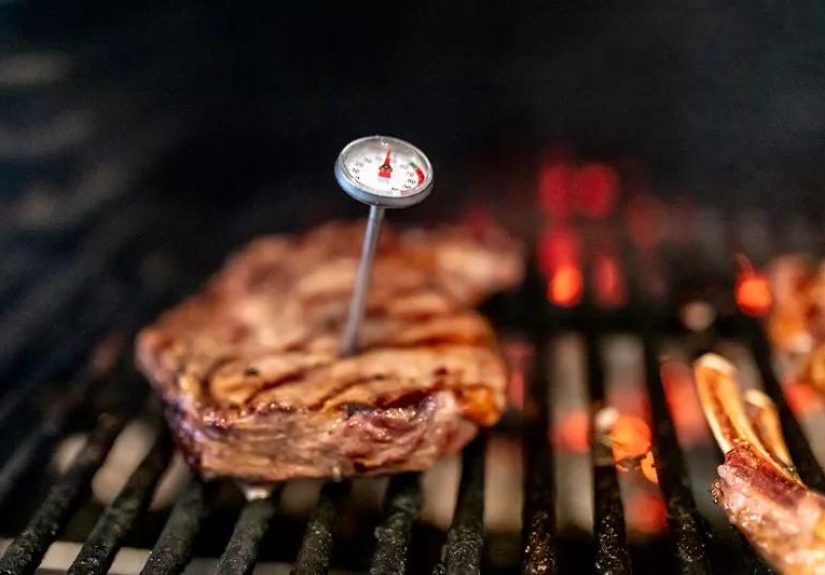
A digital instant-read thermometer is one of the cheapest upgrades you can make to your cooking. It helps you avoid undercooking, prevents overcooking, and gives you repeatable results. In other words, it saves both dinner and drama.
How to use it correctly
- Insert the probe into the thickest part of the meat.
- For thin foods like burger patties, insert the thermometer through the side.
- Avoid touching bone, gristle, or the pan.
- Wait until the reading stabilizes before making decisions.
- Clean the thermometer between checks, especially when moving from raw to cooked foods.
Thermometers are not just for beginners. They are for anyone who likes certainty more than guesswork. Even experienced grillers get fooled by flare-ups, cold spots, uneven thickness, and the occasional burger that looks ready for its close-up but is not safe in the middle.
Safe Meat Handling Starts Before the Cooking Begins
Thaw meat the smart way
There are three safe ways to thaw meat: in the refrigerator, in cold water, or in the microwave. Refrigerator thawing is the best slow-and-steady method. Cold-water thawing works faster, but the food should be in a leak-proof bag and the water should be changed every 30 minutes. Microwave thawing is fine when you are in a hurry, but the meat should be cooked immediately afterward.
What should not happen? Leaving meat on the counter for hours like it is sunbathing. The outer portion can move into the temperature danger zone long before the center has thawed. That gives bacteria a head start you do not want.
Keep raw meat separate
Raw meat should not mingle with foods that are ready to eat, like salad, buns, sliced fruit, or cooked items. Use separate plates, separate utensils, and ideally separate cutting boards. The plate that carried raw burgers to the grill should not also carry the cooked burgers back to the table unless it has been washed first.
This sounds obvious, but cookout chaos has a way of making obvious things disappear. One minute you are flipping steaks, the next minute Uncle Dave is setting cooked chicken on the “clean-ish” tray that held raw meat ten minutes ago. That is how cross-contamination sneaks in.
Do not wash raw meat
Many people still rinse raw meat in the sink, thinking it removes germs. It does not. Cooking removes the danger, not rinsing. Washing raw meat can actually spread bacteria through water droplets onto nearby surfaces, utensils, and foods. So skip the rinse and head straight to safe cooking.
Marinate safely
Marinate meat in the refrigerator, not on the counter. If you want to use marinade as a sauce later, reserve some before it touches raw meat. If raw-meat marinade must be reused, it should be boiled first. Otherwise, that “flavor booster” becomes a bacteria delivery service.
Grill Safety and Cookout Timing Matter More Than You Think
Outdoor cooking adds extra variables: heat swings, distractions, weather, and the universal urge to chat while forgetting the cooler lid is open. Keep cold foods cold and hot foods hot. Perishable food should not sit out for more than 2 hours, or more than 1 hour when the temperature is above 90°F.
That means burger trays, steak platters, mayo-based sides, and meat leftovers should not linger on the picnic table all afternoon. Refrigerate promptly, and keep your refrigerator at 40°F or below. If you are serving over several hours, use coolers, ice, or warming methods instead of hoping the food “is probably still fine.” Hope is not a food safety tool.
Leftovers Deserve Respect Too
Food safety does not end when dinner does. Refrigerate cooked meat and leftovers within 2 hours, or within 1 hour if it is very hot outside. Store leftovers in shallow containers so they cool more quickly. Most cooked leftovers are best used within 3 to 4 days.
When reheating, bring leftovers to 165°F. This is especially important for meat dishes, mixed dishes, and anything reheated in the microwave, where hot and cold spots can be annoyingly dramatic. Stir, rotate, and check the temperature in more than one place when needed.
If leftovers smell weird, look suspicious, or have spent too long on the counter, let them go. A trash can is cheaper than a bout of food poisoning.
Common Myths That Need to Retire Immediately
- “If it is brown inside, it is safe.” Not always. Color is not a reliable doneness test for burgers.
- “If the juices run clear, it is done.” Also unreliable.
- “I have cooked meat for years. I can tell by feel.” Sometimes, maybe. A thermometer still tells the truth better.
- “Washing raw meat makes it cleaner.” No. It spreads bacteria around the sink area.
- “Food is fine if it sat out only a little too long.” Bacteria do not care about your optimism.
A Quick Safe-Cooking Checklist
- Thaw meat safely in the refrigerator, cold water, or microwave.
- Keep raw meat separate from ready-to-eat foods.
- Wash hands, utensils, and surfaces after handling raw meat.
- Do not rinse raw meat.
- Use a clean food thermometer every time.
- Cook whole cuts to 145°F with a 3-minute rest.
- Cook ground meats to 160°F and poultry to 165°F.
- Refrigerate leftovers promptly and reheat to 165°F.
Real-World Experiences: What Safe Meat Cooking Looks Like in Everyday Life
Most people do not learn meat safety from a chart taped to the fridge. They learn it from moments. The first time a burger looks done outside but stays suspiciously soft in the center. The first time a beautifully seared steak gets sliced too early and floods the cutting board like it is escaping the scene. The first time leftovers sit out during a long game night and everyone starts doing mental math nobody wants to do.
A classic example is the family cookout. Someone is handling burger patties, someone else is slicing tomatoes, and somehow one pair of tongs becomes the community property of the entire backyard. That is where safe habits earn their keep. Using one platter for raw burgers and a clean one for cooked burgers sounds small, but it makes a huge difference. So does keeping the cheese, lettuce, and buns away from raw meat juices. These are not glamorous tips, but neither is spending the next day apologizing to your stomach.
Steak night brings a different kind of overconfidence. People spend good money on ribeye, New York strip, or sirloin, then turn into gamblers the second the meat hits the pan. They poke it, squint at it, and announce that it “feels medium-rare-ish.” A thermometer cuts through the guesswork. Once you start checking the center and letting the steak rest for three minutes, you notice two things fast: the steak is safer, and it tastes better. Funny how science keeps showing up and ruining all the dramatic guessing games.
Weeknight cooking offers another lesson. Ground beef tacos, meatballs, meatloaf, or skillet burgers often happen when people are distracted, tired, or juggling a dozen tasks. This is when shortcuts look tempting. Maybe the meat gets thawed on the counter too long. Maybe the cooked meat goes back onto the same plate that held it raw. Maybe leftovers cool down at room temperature because everyone forgets them while streaming “just one more episode.” Safe cooking in real life is less about perfection and more about building easy routines: thaw in the fridge, keep a thermometer nearby, wash hands and tools, and put leftovers away before the kitchen closes for the night.
Outdoor parties add heat, time pressure, and a level of snack-related confusion that deserves its own documentary. Burgers and steaks come off the grill in batches. Guests wander in and out. Someone opens the cooler every two minutes. In that environment, temperature control becomes just as important after cooking as during it. Hot foods should stay hot, cold foods should stay cold, and cooked meat should not lounge around in the sun pretending it is on vacation. The best hosts are not the ones with the flashiest grill marks. They are the ones whose food tastes great and does not make anybody text, “You feeling weird too?” the next morning.
In the end, safe meat cooking is not about fear. It is about confidence. Once you know the numbers, use the thermometer, and keep raw and cooked foods from crossing paths, the whole process feels easier. Burgers stay juicy, steaks stay worthy of the hype, leftovers stay usable, and you get the best possible outcome: food that is both delicious and safe enough to serve without a speech, a disclaimer, or a prayer.
Conclusion
If you love burgers, steaks, chops, roasts, and all the other glorious forms meat can take, safe cooking should be part of the flavor plan. The basics are simple: use a thermometer, know the right internal temperatures, rest whole cuts when needed, keep raw meat separate, thaw safely, and refrigerate leftovers on time. That is how you get meals that taste amazing without playing roulette with foodborne illness.
So the next time someone says, “I can tell it is done just by looking at it,” smile politely, grab your thermometer, and continue being the responsible legend of the grill.