Table of Contents >> Show >> Hide
- Why CLTV Is Useful (and Why It Still Lies by Omission)
- Second-Order Revenue: The Money CLTV Doesn’t See
- How Second-Order Revenue Gets Shortchanged
- What to Measure Instead (or In Addition)
- How Second-Order Revenue Changes Your Strategy
- 7 Practical Moves to Stop Shortchanging Second-Order Revenue
- Field Notes: Experiences from the Second-Order Trenches (About )
- Conclusion: CLTV Is a Chapter, Not the Book
Customer Lifetime Value (CLTV) is the metric everyone loves to put on a slide, circle with a laser pointer, and treat like a magical number that grants permission to spend money. And to be fairCLTV is incredibly useful. It tells you what a customer relationship is worth to you.
But here’s the problem: CLTV mostly tells you what a customer is worth through youtheir purchases, renewals, upgrades, and maybe support costs if you’re feeling emotionally brave. It often fails to capture what that customer is worth because of you: the new customers they influence, the demand they create, the reputation they reinforce, and the future acquisition costs they quietly reduce.
That “value that happens because the customer exists” is what we’ll call second-order revenue. Ignore it, and you’ll do something tragic: you’ll underinvest in the exact things that make your growth cheap, durable, and slightly unfair to competitors.
Why CLTV Is Useful (and Why It Still Lies by Omission)
CLTV answers a real question
At its best, CLTV helps you decide:
- How much you can spend on customer acquisition cost (CAC)
- Which segments deserve premium service
- Whether retention or pricing changes are worth the effort
- How long your CAC payback period can be before your finance team starts stress-baking banana bread
CLTV can also put guardrails around growth. If your LTV:CAC ratio is upside down, the fastest way to grow is often the fastest way to run out of money. “Efficient growth” is not a vibe; it’s math with consequences.
But CLTV is often built on fragile assumptions
Many CLTV models are stitched together with averages: average order value, average churn, average gross margin, average everything. Averages are fineuntil they hide what’s actually happening:
- Segment mismatch: One cohort is sticky and expands; another churns on day 31 like it’s a subscription gym membership.
- Timing blindness: $1,000 over 24 months is not the same as $1,000 in month one (discounting matters).
- Attribution optimism: CLTV might assume marketing “caused” the customer when the customer actually came from a coworker, a review, or sheer destiny.
None of this makes CLTV “bad.” It just makes it incomplete. And incomplete metrics tend to win arguments in the short termright up until reality shows up holding a spreadsheet.
Second-Order Revenue: The Money CLTV Doesn’t See
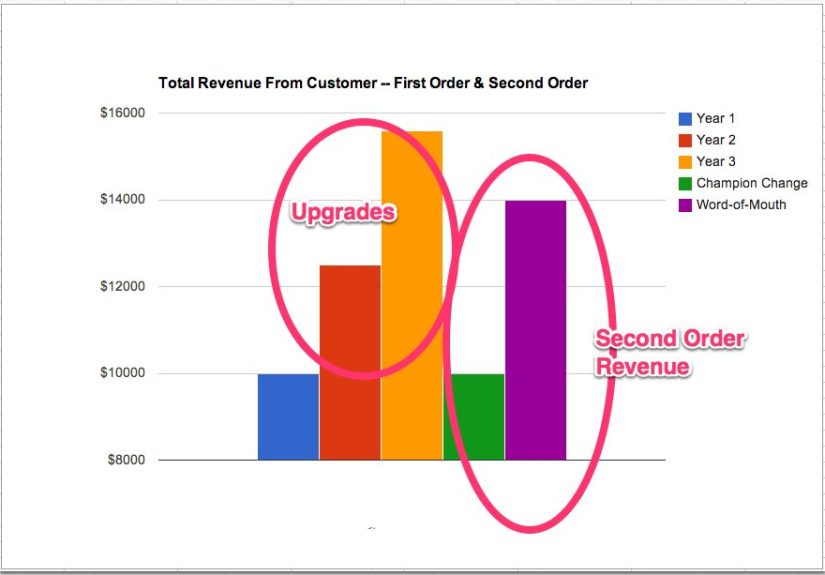
Second-order revenue is value that comes from the customer’s impact beyond their own purchases. Think of it as the ripple effects your model forgot to invite to the meeting.
1) Referral and word-of-mouth revenue
Some customers don’t just buythey recruit. They forward your product, talk about you in group chats, mention you in meetings, or casually ruin your competitors’ day by saying, “We tried them. It was… fine.”
In other words: customer advocacy is revenue. It’s just revenue that arrives wearing a disguise.
2) Expansion revenue (upsells, add-ons, usage growth)
In SaaS and subscription businesses, the best customers often expand. More seats. Higher tier. Add-ons. More usage-based spend. This is why net revenue retention (NRR) / net dollar retention (NDR) matters: it captures whether your existing base is growing even after churn and downgrades.
If your CLTV model treats customers as “buy once, then slowly fade away,” it will undervalue product adoption, customer success, onboarding, packaging, and all the unglamorous work that turns “signed” into “stays and expands.”
3) Network effects and ecosystem lift
For some productsmarketplaces, collaboration tools, platformsthe value increases as more people use it. That can reduce incremental CAC over time, increase organic acquisition, and create defensibility that doesn’t show up in a basic CLTV formula.
Translation: you might be buying growth today that makes growth cheaper tomorrow. CLTV doesn’t always capture that compounding.
How Second-Order Revenue Gets Shortchanged
CLTV is usually “single-customer accounting”
Most CLTV models focus on direct cash flows from one customer. But second-order revenue is relationalit flows through networks, reputation, and market dynamics. If you don’t model it, it won’t show up. And if it doesn’t show up, it gets cut in budget season.
Blended metrics blur the truth
When you blend channels (“paid + organic”), you can’t see whether paid is actually workingor whether organic is dragging paid across the finish line like a heroic golden retriever.
This is one reason teams get confused: CLTV looks steady, CAC looks acceptable, and yet growth feels harder every quarter. What’s changing is often the mix: fewer referrals, weaker brand pull, less organic, more expensive clicks.
Second-order effects are delayed, so they look “optional”
Referral lift, reputation, retention compounding, and ecosystem momentum don’t always pay off this month. Which means they get treated like “nice-to-haves.” Until you meet a competitor with stronger second-order revenuethen suddenly they look like they discovered a cheat code.
What to Measure Instead (or In Addition)
You don’t need a PhD or a 47-tab spreadsheet. You need a small set of metrics that force your business to see the full picture.
A simple map of first-order vs. second-order value
| Metric | What it captures | What it can miss |
|---|---|---|
| CLTV / LTV | Direct revenue (and sometimes margin) from a customer | Referrals, reputation lift, CAC reduction from advocacy |
| LTV:CAC | Unit economics efficiency | Channel mix shifts, delayed payoffs, “blended CAC” confusion |
| NRR / NDR | Expansion + retention dynamics in existing cohorts | New customer acquisition quality (unless segmented) |
| Cohort LTV | Actual value by acquisition source / segment / time | Social spillover unless explicitly measured |
| Referral share | How many new customers come from referrals/reputation | Hidden word-of-mouth if tracking is weak |
1) Cohort analysis: stop averaging your business into nonsense
Measure cohort LTV and NRR by acquisition source, segment, and time period. Cohorts show reality: which customers retain, expand, and repay CAC. Averages show a comforting bedtime story.
2) Measure word-of-mouth like it’s a real channel (because it is)
Start simple:
- Add “How did you hear about us?” (and treat it like data, not a trivia question)
- Track referral codes/links where possible
- Estimate “reputation-driven” conversions (reviews, communities, peer recommendations)
- Monitor direct traffic and branded search as directional signals (not perfect, but useful)
If you want to get serious, use controlled experiments: referral program holdouts, geo tests, or time-boxed incentives to estimate incremental lift.
3) Track expansion as a growth engine, not a rounding error
Make expansion revenue visibleby segment. Expansion is where compounding lives: it’s growth that doesn’t require starting from zero trust with a brand-new customer.
4) Look for “CAC deflation” over time
In businesses with network effects or strong advocacy, incremental CAC can fall as organic acquisition rises. Track CAC by market age, cohort maturity, and channel mix. If you only track blended CAC, you’ll miss the moment your flywheel is either taking offor quietly falling apart.
How Second-Order Revenue Changes Your Strategy
Customer success stops being “support” and becomes “growth”
When you acknowledge second-order revenue, retention and customer experience aren’t just cost controls. They’re growth levers. Better onboarding improves adoption, which increases expansion, which increases advocacy, which lowers CAC. That’s not fluffthat’s a machine.
Product teams start building “shareable moments”
Second-order revenue often comes from moments customers want to talk about: a delightful feature, a saved hour, a clean dashboard, a collaboration win. The product becomes the marketingnot as a slogan, but as a mechanism.
Marketing stops optimizing clicks and starts optimizing customers
When you include second-order revenue, the “best” customer is not always the one with the biggest first purchase. It might be the one who retains, expands, and refers others. Your paid strategy changes when you’re bidding for advocates, not just buyers.
7 Practical Moves to Stop Shortchanging Second-Order Revenue
- Split CLTV by cohort (channel, segment, time). No more one-number myths.
- Add NRR/NDR to the dashboard and make it a weekly conversation.
- Instrument referrals (codes, invites, “heard about us,” post-purchase prompts).
- Quantify expansion revenue and set targets by customer segment.
- Track branded demand (direct traffic, branded search) as a proxy for reputation.
- Model CAC payback with margin, not revenue. Profit is the point.
- Run one experiment per quarter that isolates second-order impact (referral holdout, CS intervention, onboarding test).
Field Notes: Experiences from the Second-Order Trenches (About )
Below are a few real-world patterns teams repeatedly run into when they stop worshiping CLTV as a single sacred number and start treating it like a chapter in a longer story. These are written as composite “field notes” (meaning: common scenarios, not one specific company’s confidential diary).
Field Note #1: The “Cheap Customer” Who Was Actually Expensive
A team celebrated a low CAC channellooked like a growth hack. Customers came in fast, converted quickly, and the early CLTV estimate looked fine. Then cohorts matured and the truth showed up: these customers churned early, filed more tickets, and never expanded. They were “cheap” only at the front door.
Meanwhile, another channel looked pricey. CAC was higher, conversion took longer, and the funnel was painfully slow. But those customers stayed, adopted deeper features, and introduced colleagues. Once the team tracked cohort NRR and referral share, the “expensive” channel turned out to be the one that produced second-order revenuecustomers who made other customers cheaper to acquire later.
Field Note #2: The Referral Program That Didn’t Work (Until It Did)
A referral program launched with the classic mistake: random incentives that had nothing to do with the product. Participation was low. The team concluded, “Our customers don’t refer.” (Which is like concluding “fish don’t swim” after observing a goldfish in a blender.)
Later, they redesigned referrals around a native rewardsomething that increased product value for both sides. They added the referral moment inside the product flow (when customers were happiest, not when they were busy rage-clicking through a billing page). Referrals rose, but more importantly, referred customers retained better. The program wasn’t just acquisitionit was a quality filter that improved cohort economics.
Field Note #3: Expansion Revenue Is a Product Problem Wearing a Sales Hat
A SaaS company tried to “sell harder” for upsells. It barely moved. The real constraint wasn’t persuasionit was adoption. Customers didn’t understand the advanced features, onboarding wasn’t tailored, and value realization took too long.
When the team rebuilt onboarding around time-to-value, simplified packaging, and used customer success to guide adoption, expansions increased without adding headcount. CLTV rose, yesbut the bigger win was second-order: happier customers drove stronger reviews, more peer recommendations, and improved close rates across the funnel. The business didn’t just make more per customer; it made future customers easier to win.
Field Note #4: “Brand” Was Actually a CAC Strategy
A leadership team treated brand as decorativenice for conferences, optional for growth. Paid CAC kept creeping up quarter after quarter. The team optimized ads, landing pages, creative. Marginal gains. Then they noticed something: when a customer already trusted the brand (heard of it from peers, saw it in the industry, recognized the name), conversion improved and sales cycles shortened.
Brand wasn’t “awareness.” It was CAC compression. Once they invested in trust-building content, community, and customer proof, organic demand roseand paid became more efficient because the market already believed. CLTV didn’t “go up” overnight, but unit economics improved because second-order effects strengthened the entire system.
Conclusion: CLTV Is a Chapter, Not the Book
CLTV is still essential. You should calculate it, segment it, sanity-check it, and use it to keep your growth grounded. But if you stop there, you’ll underfund the engines that make growth compound: word-of-mouth, referrals, expansion revenue, network effects, and brand-driven CAC reduction.
The fix isn’t complicated: treat second-order revenue as real revenue. Measure it with cohorts. Track NRR/NDR. Instrument referrals. Watch CAC change over time. Then invest accordinglybecause the most dangerous budget cut is the one that quietly breaks your flywheel while your dashboard still looks “fine.”