Table of Contents >> Show >> Hide
- What the Standard Deduction Actually Does
- Current Federal Standard Deduction Amounts
- Standard Deduction vs. Itemized Deductions
- Who Usually Benefits Most From the Standard Deduction?
- Special Rules That Can Change Your Standard Deduction
- When Itemizing Might Beat the Standard Deduction
- Common Mistakes People Make
- Can the Standard Deduction Affect Whether You Need to File?
- Everyday Experiences With the Standard Deduction
- Final Takeaway
If tax season had a mascot, the standard deduction would be the reliable friend who shows up on time, brings snacks, and saves you from doing unnecessary extra work. In simple terms, the standard deduction is a fixed amount you can subtract from your income before federal income tax is calculated. That lowers your taxable income, which can lower your tax bill. Not glamorous, sure. But wildly useful.
For many Americans, the standard deduction is the fastest, cleanest way to claim a tax break without turning the dining room table into a paper blizzard of receipts, donation letters, mortgage statements, and mysterious pharmacy printouts. Instead of itemizing deductions one by one on Schedule A, you take one flat amount based mainly on your filing status.
That is why the standard deduction matters so much: it simplifies filing, reduces taxable income, and helps millions of people avoid extra paperwork. It also plays a big role in deciding whether itemizing deductions is worth the trouble. For some taxpayers, itemizing still wins. For many others, the standard deduction is the better deal and the easier one too.
What the Standard Deduction Actually Does
The standard deduction reduces the amount of income the IRS can tax. It does not reduce your tax bill dollar for dollar the way a tax credit does. That difference matters. A deduction lowers taxable income first, and then your tax is calculated from that lower number.
Here is a quick example. Say you are single and your adjusted gross income for tax year 2025 is $70,000. If you claim the standard deduction of $15,750, your taxable income drops to $54,250 before any other eligible deductions or credits are applied. That is a meaningful cut, and it happens without itemizing a single expense.
So if you have ever wondered, “What is the standard deduction, and why does everybody keep talking about it?” the answer is straightforward: it is the IRS-approved shortcut that lets you reduce taxable income without listing every deductible expense separately.
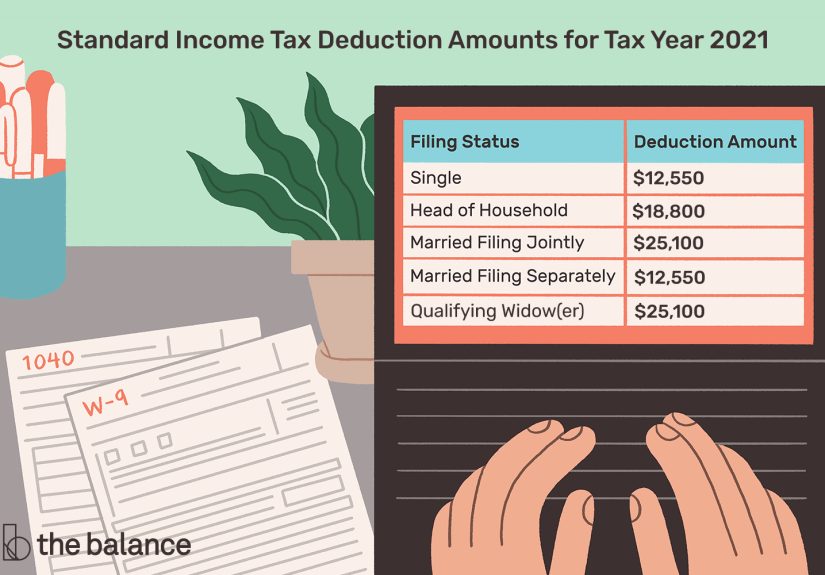
Current Federal Standard Deduction Amounts
Tax Year 2025 (the return most people file in 2026)
| Filing Status | Standard Deduction |
|---|---|
| Single | $15,750 |
| Married Filing Separately | $15,750 |
| Head of Household | $23,625 |
| Married Filing Jointly | $31,500 |
| Qualifying Surviving Spouse | $31,500 |
Tax Year 2026 (for planning ahead)
| Filing Status | Standard Deduction |
|---|---|
| Single | $16,100 |
| Married Filing Separately | $16,100 |
| Head of Household | $24,150 |
| Married Filing Jointly | $32,200 |
| Qualifying Surviving Spouse | $32,200 |
These numbers are federal figures. Your state income tax return may use different rules, different deduction amounts, or no standard deduction at all. In other words, your federal return and your state return do not always dance to the same song.
Standard Deduction vs. Itemized Deductions
This is where the real decision happens. You generally choose either the standard deduction or itemized deductions. You cannot take both. Think of it as a tax fork in the road: one lane is simple and flat, the other is detailed and sometimes more rewarding.
If you itemize, you list eligible expenses on Schedule A. Common itemized deductions can include:
- Home mortgage interest
- State and local taxes, including certain income, sales, and property taxes
- Charitable contributions
- Medical and dental expenses above the applicable threshold
- Certain disaster-related losses
Itemizing makes sense when your total eligible deductions add up to more than your standard deduction. If they do not, the standard deduction usually wins on both savings and sanity.
For example, imagine a married couple filing jointly in 2025. They have $9,000 in mortgage interest, $7,500 in property and state taxes, and $2,000 in charitable donations. Their total itemized deductions would be $18,500. Since the standard deduction for married filing jointly is $31,500, taking the standard deduction would likely be the smarter move.
Now flip the scenario. Suppose another couple has much higher deductible expenses: substantial mortgage interest, large charitable gifts, and significant eligible medical bills. If their total itemized deductions exceed $31,500, itemizing may save more money. In short, the “best” deduction is not the one that sounds sophisticated. It is the one that leaves you with the lower tax bill.
Who Usually Benefits Most From the Standard Deduction?
The standard deduction is especially helpful for people whose deductible expenses are modest or inconsistent. That often includes:
- Renters with limited itemizable expenses
- Young workers filing relatively simple returns
- Retirees who do not have large mortgage or medical deductions
- Families whose eligible itemized deductions simply do not clear the standard deduction threshold
- Anyone who values easy filing and fewer records to track
It is also important to remember that taking the standard deduction does not mean you lose every other tax break. Some deductions can still reduce income even if you do not itemize, such as eligible IRA contributions, health savings account contributions, student loan interest, certain educator expenses, and some self-employed deductions. That is one of the most common misunderstandings around this topic.
Special Rules That Can Change Your Standard Deduction
If You Are 65 or Older or Blind
The standard deduction can be higher if you are age 65 or older or legally blind. For tax year 2025, the extra amount is generally:
- $2,000 if you are unmarried and not a surviving spouse
- $1,600 for each qualifying person if you are married filing jointly, married filing separately, or a qualifying surviving spouse
That means the standard deduction is not always just one flat amount pulled from a table. In real life, age and blindness can increase it. So a 67-year-old single taxpayer in 2025 would generally start with the base $15,750 and add $2,000, for a total standard deduction of $17,750, assuming no other adjustments apply.
There is also a newer wrinkle for 2025 and later years: eligible seniors may qualify for an enhanced deduction for seniors of up to $6,000 per person, subject to income limits. That deduction is separate from the regular age-based add-on and, importantly, can apply whether you take the standard deduction or itemize. Yes, tax law occasionally enjoys layering complexity on top of something that was supposed to be simple.
If Someone Else Can Claim You as a Dependent
If you can be claimed as a dependent on someone else’s tax return, your standard deduction is usually lower. For tax year 2025, it is generally limited to the greater of:
- $1,350, or
- Your earned income plus $450
But there is a cap: the total usually cannot exceed the regular standard deduction for your filing status.
Here is a simple example. A college student earns $3,000 from a summer job and can be claimed as a dependent by a parent. That student’s standard deduction would generally be $3,450, because earned income plus $450 beats $1,350 and still stays below the normal single filer amount.
If You Are Married Filing Separately
This rule trips up a lot of people. If you are married filing separately and your spouse itemizes deductions, you generally cannot take the standard deduction. You also have to itemize, even if your own itemized deductions are tiny. Tax law can be romantic like that.
If You Are a Nonresident Alien or Dual-Status Alien
Many nonresident aliens and dual-status aliens generally cannot claim the standard deduction, though some exceptions apply. This is one of those areas where a quick check with the IRS instructions or a tax professional is worth it, because the details can get technical fast.
When Itemizing Might Beat the Standard Deduction
If you are trying to decide between itemized deductions and the standard deduction, start with the biggest categories that move the needle. These usually include home mortgage interest, charitable giving, state and local taxes, and major unreimbursed medical expenses.
A homeowner in a high-tax area who makes large charitable donations may still come out ahead by itemizing. The same can be true for someone who had an unusually expensive medical year. For example, a major surgery, lengthy treatment, or large dental bill can push itemized deductions high enough to beat the standard deduction in a single year.
Some taxpayers also use a strategy called “bunching.” Instead of spreading deductible expenses evenly across several years, they stack them into one year so the total climbs above the standard deduction. Charitable contributions are one common example. It is not the right move for everyone, but it can be a smart planning tactic when your deductions hover just below the threshold.
Common Mistakes People Make
- Confusing deductions with credits. A deduction lowers taxable income. A credit lowers tax directly.
- Assuming itemizing is always better. More paperwork does not automatically mean more savings.
- Forgetting about age or blindness add-ons. Those extra amounts matter.
- Missing the dependent rule. A dependent’s standard deduction often works very differently from an independent filer’s.
- Ignoring state tax rules. Federal and state deductions may not match.
- Thinking the standard deduction blocks every other tax break. Several above-the-line deductions may still apply.
Can the Standard Deduction Affect Whether You Need to File?
Often, yes. The standard deduction is closely related to basic filing thresholds, which is why people sometimes use it as a quick mental benchmark. But it is not the whole story. Some taxpayers still need to file even if their income is below the standard deduction, especially if they owe certain special taxes, had self-employment income, received advance credits, or want to claim a refundable tax credit and get money back.
So if your income is low, do not assume “I do not owe, therefore I do not file.” Sometimes filing is how you collect a refund that would otherwise sit there waiting for you like forgotten cash in a winter coat pocket.
Everyday Experiences With the Standard Deduction
The standard deduction sounds dry on paper, but in real life it shows up in surprisingly human ways. Below are a few composite, realistic examples that reflect how people actually experience this rule.
The First-Time Filer Who Expected Chaos
A 24-year-old graphic designer files a return for the first time without a parent handling it in the background. She has one W-2, a little bank interest, and a strong fear that taxes require a shoebox full of documents and a candlelit ritual. Then she learns about the standard deduction. Suddenly the process becomes much less dramatic. She does not own a home, did not make huge charitable gifts, and has no major medical deductions. The standard deduction gives her a clean way to lower taxable income without itemizing. Her biggest emotional reaction is not excitement, exactly. It is relief. The kind of relief normally reserved for realizing the strange noise in your car was just a water bottle rolling around under the seat.
The Family That Assumed Homeownership Automatically Meant Itemizing
A married couple with two children buys their first home and assumes that now, finally, they have joined the glamorous club of people who itemize deductions. They gather mortgage interest paperwork, property tax records, donation receipts, and every tax document that ever looked official. After adding everything up, their itemized deductions still fall below the standard deduction for married filing jointly. At first they feel oddly cheated, as if adulthood made a promise it did not keep. But then it clicks: the standard deduction gives them a bigger federal tax benefit with less paperwork. They still use the mortgage forms for reference, but they no longer treat itemizing as a badge of honor. Their experience is a useful reminder that owning a home does not automatically mean itemizing wins.
The Retiree Who Nearly Missed an Extra Break
A widowed retiree in her late sixties prepares her return and assumes the standard deduction is just one fixed number from a chart. During the process, she discovers that being over 65 can raise that deduction. That extra amount may not sound flashy, but it meaningfully reduces taxable income. In 2025, she also learns there may be a separate enhanced deduction for seniors, depending on income and eligibility. Her experience is common: many taxpayers know the phrase “standard deduction,” but not the special rules sitting quietly behind it. For her, the biggest lesson is that tax tables are not always one-size-fits-all. Sometimes the line on the form looks simple, but the number behind it has a backstory.
The High-Deduction Year That Changed the Strategy
A single professional usually takes the standard deduction every year and barely thinks twice about it. Then one year, life gets expensive in a very tax-relevant way. There are large charitable gifts, major unreimbursed medical expenses, and enough deductible costs to make itemizing worthwhile. For the first time, she runs the numbers both ways and finds that itemizing beats the standard deduction. That experience changes how she plans future years. She starts paying attention to timing, especially for donations and elective expenses, and realizes tax planning is not only for business owners or finance obsessives. Sometimes the standard deduction is the winner. Sometimes it is not. The real-world experience is less about loyalty to one method and more about checking the math before making the call.
Final Takeaway
So, what is the standard deduction? It is a built-in tax break that lets you subtract a fixed amount from income before federal tax is calculated. For many taxpayers, it is the simplest path and the most valuable one. It can reduce paperwork, lower taxable income, and make tax filing feel less like decoding a legal thriller written in spreadsheet form.
The key is not to assume. Check your filing status, look at any extra amounts you may qualify for, compare the standard deduction with your itemized deductions, and choose the option that gives you the bigger benefit. Fancy is optional. Lower taxes are not.
Note: This article is for general informational purposes only and is not tax, legal, or accounting advice. Federal rules can change, state rules may differ, and the best deduction method depends on your filing status, income, and eligible expenses.