Table of Contents >> Show >> Hide
- The Quick Verdict: Yes, Sometimes. No, Sometimes.
- Why Homeowners Consider Heating the Garage in the First Place
- When a Garage Heater Is Probably Not Worth It
- Before You Buy a Heater, Fix the Garage First
- What Type of Garage Heater Makes the Most Sense?
- How Big Should a Garage Heater Be?
- What Does a Garage Heater Cost?
- Garage Heater Safety: The Part Nobody Should Skip
- So, Is Getting a Garage Heater Worth It?
- Real-World Experiences With Garage Heaters: What Homeowners Usually Learn
- Final Thoughts
If your garage turns into a walk-in freezer every winter, you’ve probably asked yourself a very reasonable question: should I just get a garage heater and stop pretending finger numbness is a personality trait? The short answer is that a garage heater can be absolutely worth it, but only when the garage is doing more than babysitting your car and old holiday decorations.
A heated garage makes sense for people who use the space as a workshop, home gym, hobby zone, laundry room, storage area for temperature-sensitive items, or all-purpose project cave. It can also help protect tools, paints, adhesives, batteries, and plumbing from deep cold. But if your garage is poorly insulated, rarely occupied, and located in a mild climate, heating it may feel like tossing dollar bills into a drafty shoebox and hoping for the best.
Like most home upgrades, the real answer depends on how you use the space, how cold your winters get, how leaky the garage is, and whether you’re willing to fix the envelope before you buy the heater. In other words, the heater matters, but the garage itself matters just as much.
The Quick Verdict: Yes, Sometimes. No, Sometimes.
A garage heater is usually worth it if you regularly spend time in the garage during cold weather. That includes woodworking, wrenching on cars, lifting weights, washing pets, running a side hustle, or just trying to locate the screwdriver you swear you put “somewhere obvious.” If the space has a clear purpose, a heater can turn it from a seasonal punishment chamber into a room you actually use.
It is also worth considering when the garage contains pipes, a mudroom, a laundry area, or a finished room above it. Keeping garage temperatures more stable can help reduce cold transfer into adjacent living areas and make the rest of the home feel more comfortable.
On the other hand, a heater may not be worth the cost if your garage is used only for parking, your winters are relatively mild, or the structure leaks air through every seam, panel, and mystery gap around the side door. In that situation, heating the garage becomes expensive, uneven, and deeply annoying.
Why Homeowners Consider Heating the Garage in the First Place
1. Comfort and usability
This is the obvious one. A cold garage is unpleasant, and an unpleasant space becomes wasted square footage. A heater can make the garage usable for projects, workouts, repairs, and storage tasks that don’t magically disappear just because it’s January.
2. Better conditions for tools and materials
Some items simply hate extreme cold. Paint, caulk, adhesives, certain finishes, batteries, and some power tools perform better when they aren’t stored in near-freezing conditions. A heater can help reduce temperature swings that shorten the life of materials or make them miserable to use.
3. Protection for plumbing and equipment
If your garage has water lines, a utility sink, a washer, or anything else involving pipes, maintaining a modest temperature can help prevent freezing issues. Even keeping the garage comfortably cool instead of downright arctic can make a big difference.
4. Added value for a multipurpose space
For many homeowners, the garage is not just a garage anymore. It may double as a workshop, a hobby studio, a storage room, a home gym, or a weekend retreat from the rest of the household noise. In that case, heating it can feel less like a luxury and more like finally admitting what the space really is.
When a Garage Heater Is Probably Not Worth It
Let’s save you from buyer’s remorse. A garage heater often disappoints in the following situations:
You have a badly insulated garage
If cold air pours in under the garage door, around the framing, through the walls, or from the ceiling, the heater will spend its life fighting physics and losing. The result is a high utility bill and a room that still feels chilly around the edges.
You only step into the garage for three minutes at a time
If your interaction with the garage is limited to parking, unloading groceries, and muttering at a tangled extension cord, a permanent heater may be overkill. A better garage door seal, more insulation, or a small spot-heating solution might be enough.
You live in a mild climate
Not every garage needs serious heating. In regions with short or gentle winters, it may make more sense to improve insulation and use a portable heater occasionally instead of investing in a permanent system.
You are trying to make an attached garage feel like a finished living room
A garage should be comfortable, but it is still a garage. It houses cars, chemicals, dust, and fumes. That means the goal is usually functional warmth, not “let’s host Thanksgiving next to the snow shovel” levels of coziness.
Before You Buy a Heater, Fix the Garage First
This is the step people love to skip and then regret later. Heating a garage without improving the shell of the space is a little like buying a designer winter coat and refusing to zip it.
Start with air sealing
Seal gaps around the garage door, the side entry door, windows, framing penetrations, and any cracks where air sneaks in. Weatherstripping, caulk, and bottom door seals are usually the cheapest wins. They are not glamorous, but neither is paying to heat the outdoors.
Upgrade insulation where it matters
Walls, ceilings, and the space above the garage all matter. If there is living space above the garage, proper air sealing and insulation become even more important. Cold garage air can affect floors above it, making rooms colder and energy bills higher.
Check the garage door
An uninsulated garage door is basically a giant thermal shrug. Upgrading to an insulated door or adding insulation panels can improve comfort, especially in attached garages and workspaces. It will not solve every problem by itself, but it can absolutely help.
Think about moisture and ventilation
Garages are tricky because they are often damp, dusty, and full of fumes. Any heating plan should account for safe airflow, combustion rules, and separation from the house. Warm is good. Warm and weirdly toxic is not the vibe.
What Type of Garage Heater Makes the Most Sense?
Electric garage heaters
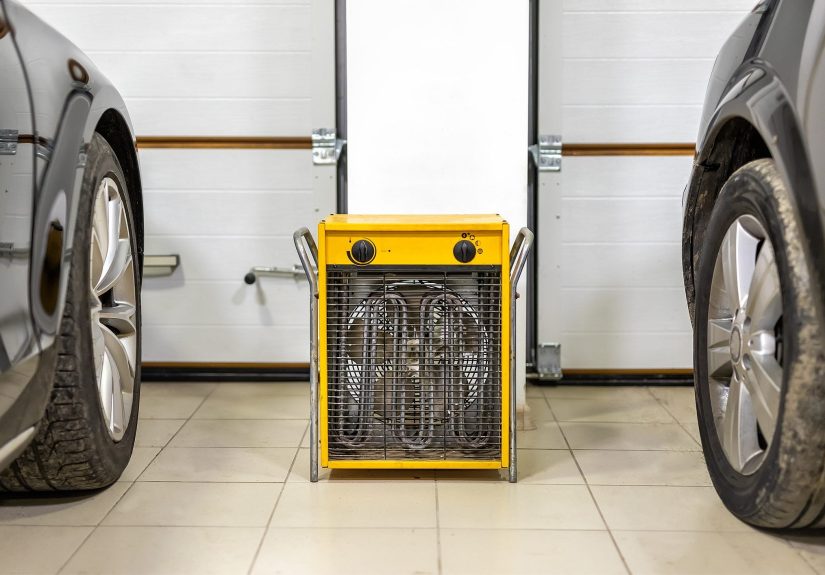
Electric units are popular because they are simpler to install, especially in garages that do not already have a gas line. They are often cleaner, quieter, and easier to control. Ceiling-mounted electric fan-forced units are common in workshops because they stay out of the way and distribute heat across the room.
They are usually a strong choice for smaller garages, attached garages, and homeowners who want lower maintenance. The downside is operating cost. Electricity can be more expensive than gas in many areas, and larger units may require a dedicated 240-volt circuit. Translation: your heater may also introduce you to an electrician.
Infrared electric heaters
Infrared heaters warm objects and people more directly instead of just heating the air. That can feel especially nice in a workshop where you stand in one area for long periods. They are useful when you want targeted comfort rather than trying to create an even, whole-room temperature.
They are less ideal if you want every corner of the garage equally warm. If your goal is to keep the whole space at a steady temperature, fan-forced electric heat may work better.
Natural gas or propane garage heaters
Gas heaters usually offer higher heating capacity and can make sense for larger garages or colder regions. They are often attractive for homeowners who need stronger heat output and lower fuel costs over time.
That said, gas systems come with more complexity. Installation can require gas piping, venting, code compliance, and professional help. In attached garages, safety matters even more, especially when combustion appliances and vehicle exhaust are part of the equation. If you go this route, cutting corners is a terrible hobby.
Ductless mini-split systems
If your garage is basically a bonus room in disguise, a mini-split may be the most satisfying long-term option. It gives you both heating and cooling, offers efficient temperature control, and works well for finished garages used year-round.
The catch is cost. A mini-split is usually more expensive upfront than a standard garage heater, but it can be worth it if the space is used daily as a studio, gym, workshop, or office.
Radiant floor heat
This is the luxury sedan of garage heating: smooth, comfortable, and usually not cheap. It makes the most sense in new construction or major renovations. For most existing garages, it is more dream board than practical first move.
How Big Should a Garage Heater Be?
Garage heater size is not a guessing game you win with optimism. If the unit is too small, it will run constantly and still leave the room cold. If it is too big, it may short-cycle, waste energy, and heat the space unevenly.
A common rule of thumb is to size the heater based on square footage and then adjust for insulation quality, ceiling height, and climate. A one-car garage often needs far less output than a large two-car or workshop-style garage. Insulated garages need less heating muscle than drafty ones. High ceilings also increase heating demand because warm air loves to throw a party near the rafters.
As a practical example, a compact one-car garage may be served by a modest heater, while a larger two-car garage in a cold climate may need a much more powerful unit or a better-insulated shell before any heater performs well. This is why buying based only on “looks strong” is not a strategy.
What Does a Garage Heater Cost?
The price depends on the type of system, the size of the garage, the fuel source, and whether installation requires new wiring, gas work, venting, or mounting. A simple electric unit may be relatively affordable compared with a more permanent gas setup or a full mini-split system.
In many cases, the installation costs matter as much as the heater itself. Hardwired electric models may need a dedicated circuit. Gas models may require licensed installation and venting. A mini-split may cost more upfront but offer better year-round performance if you also want cooling.
That is why the cheapest heater on paper is not always the cheapest solution in real life. A bargain heater that requires major electrical upgrades stops being cute very quickly.
Garage Heater Safety: The Part Nobody Should Skip
This is the difference between a smart upgrade and a cautionary tale.
Keep the garage separated from the house
Attached garages need strong air sealing between the garage and the living space. That includes doors, penetrations, shared walls, and ceilings. The goal is to prevent fumes and contaminants from migrating into the home.
Never run a vehicle in an attached garage
Even with the garage door open, carbon monoxide can build up in dangerous ways. A heated garage does not change that rule. It just makes it easier to forget you are standing inside a box that is very good at holding air when it feels like it.
Watch clearances and combustibles
Keep heaters away from gasoline, paint, sawdust, cardboard, rags, and anything else that burns or melts. Garages are full of sneaky fire fuel. This is one reason ceiling-mounted units are so popular in workshops: they stay above the chaos.
Use professional installation when needed
Gas lines, venting, and hardwired electrical work are not great places to improvise. A licensed installer can help make sure the system meets code, operates safely, and actually performs as expected.
Add carbon monoxide and safety devices
If you are using fuel-burning equipment anywhere near the garage setup, CO protection is a must. Also look for features like overheat protection, tip-over shutoff on portable units, and thermostatic controls that prevent waste and improve safety.
So, Is Getting a Garage Heater Worth It?
For the right homeowner, yes. A garage heater is worth it when the space is used regularly, the garage is reasonably sealed and insulated, and the heating choice matches the garage size and how you actually use it. It is especially worthwhile for workshops, home gyms, hobby spaces, utility-heavy garages, and anyone who is tired of doing winter chores in a room that feels like a refrigerated warehouse.
But the heater is not the whole story. If the garage leaks air everywhere, lacks insulation, or is only used occasionally, the smarter investment may be sealing and insulating first. In many cases, those improvements deliver more comfort per dollar than the heater itself.
So yes, a garage heater can be worth it. Just make sure you are buying heat for a space that can actually keep it, not funding a warm breeze for the neighborhood.
Real-World Experiences With Garage Heaters: What Homeowners Usually Learn
When people talk about whether a garage heater was “worth it,” their answers are usually less about the heater itself and more about what happened after installation. And honestly, that’s where the useful lessons live.
A common experience goes like this: a homeowner buys a powerful heater, mounts it on the ceiling, flips the switch, and expects instant cozy workshop bliss. The heater absolutely works, but the room still feels uneven. Their hands are warm, their feet are cold, and the garage door seems to be personally committed to letting winter inside. That is usually the moment they realize insulation and air sealing should have come first. Once they add weatherstripping, seal edge gaps, and deal with the door, the exact same heater suddenly seems twice as good. The lesson is simple: the garage often needs a tune-up before the heater gets to be a hero.
Another frequent experience comes from woodworkers and DIY hobbyists. They tend to love ceiling-mounted electric heaters because the units stay out of the way, free up floor space, and deliver heat where people are actually standing. Many of these homeowners also discover that they do not need the garage to feel like a living room. Keeping it at a steady cool-to-comfortable range is enough to make projects enjoyable and tools easier to handle. In other words, success often comes from aiming for “usable” instead of “tropical.”
People with attached garages often report a different benefit: the rooms next to or above the garage feel less miserable. They may not even care that much about doing workouts in the garage itself, but they definitely care when the bedroom floor above it stops feeling like a tray of ice. In these cases, the combination of air sealing, insulation, and modest heat tends to feel more valuable than the heater alone.
Then there are the regret stories, and they usually sound familiar. Some homeowners buy portable propane heaters because they want fast heat and low upfront cost. At first, they love the blast of warmth. Later, they get tired of fuel refills, ventilation concerns, and the general hassle. Others install oversized units and realize they are paying to heat space they barely use. A heater that sounds impressive in the store can become expensive background scenery if the garage only sees action twice a month.
The happiest garage-heater owners usually have three things in common. First, they use the garage often enough to justify the upgrade. Second, they improved the garage shell instead of relying on brute-force heating. Third, they picked a system that matched the actual job, whether that meant a simple electric unit for a workshop corner or a mini-split for a polished, year-round flex space. Funny enough, the people who are happiest with garage heat are often the ones who stopped trying to “win winter” and simply designed the space to work better.
Final Thoughts
If your garage is a real working part of your home, heating it can be a smart, comfort-boosting, productivity-saving upgrade. If it is a cold storage box you visit for 90 seconds at a time, maybe not. The best garage heater decision starts with an honest question: what is this space for? Answer that well, and the rest gets much easier.