Table of Contents >> Show >> Hide
- What Is the “Old Roadside Pics” Bot, Exactly?
- Why Vintage Roadside Photos Hit So Hard
- How to “Read” a Roadside Photo Like a Pro (Without Becoming Insufferable)
- 30 Of The Most Interesting Vintage Roadside Pics (The Greatest Hits, Road Edition)
- Roadside Americana in Context: Route 66, Neon, and the Business of Being Seen
- How to Enjoy the Bot Without Just Mindlessly Scrolling
- Conclusion: A Beautiful Archive of Everyday America
- Extra: of Roadside “Experience” (A.K.A. Time Travel You Can Do on Your Couch)
You know that feeling when you’re “just checking your phone for a second” and suddenly it’s 1:47 a.m., you’ve learned three
different ways to restore neon tubing, and you’re emotionally attached to a 1978 bowling alley sign in San Diego?
Congratulations: you’ve been gently mugged by roadside nostalgia.
That’s the magic trick behind Old Roadside Pics, a social account originally built as a Twitter/X bot that posts
public-domain vintage photos of America’s wonderfully weird commercial roadside landscape. The images span the
late ’60s through the 2000s, which means you get everything from peak neon optimism to “we just discovered beige, and we’re
using it everywhere.” This isn’t just aesthetic candy. It’s a rolling documentary of how Americans ate, slept, shopped, and
entertained themselves along the nation’s roadsone motel sign, drive-in marquee, and improbably cheerful hot dog stand at a time.
What Is the “Old Roadside Pics” Bot, Exactly?
The bot curates photographs from the John Margolies Roadside America Photograph Archive, a massive set of images
housed at the Library of Congress. Think: restaurants, theaters, gas stations, motels, cocktail lounges, mini-golfs, and all the
big, loud signs that tried their best to lure tired travelers into buying pie and/or a keychain shaped like a cactus.
The photos feel like a time machine with excellent composition. One post might show a glowing “VACANCY” sign that could guide ships
through fog. Another might capture a roadside teepee structure that appears to have been designed by a committee of aliens who only
had five minutes to study “American vacation.” It’s part history lesson, part design museum, part “I swear my grandparents owned
that exact ashtray.”
Why Vintage Roadside Photos Hit So Hard
1) They’re “small history” in high definition
Big history gives you presidents and wars. Roadside history gives you the real stuff: where people stopped for coffee, which towns
advertised the world’s best fried chicken, and how many fonts were considered “too many” in 1982 (spoiler: none).
2) They capture a car-first Americaand its consequences
Much of America’s mid-to-late 20th century identity was shaped by mobility. Families vacationed by highway. Businesses competed for
attention at 55 miles per hour. Roadside architecture became the original scroll-stopping contentbuilt for speed, visibility,
and impulse decisions like: “Honey, the sign says ‘AIR CONDITIONED’ in seven-foot letters. We have to stop.”
3) The signs are basically pop art with a wiring problem
Neon, hand-painted lettering, giant arrows, cartoon mascots, and sculptural signage weren’t just advertisementsthey were
folk art designed to be read at a glance. On corridors like Route 66, neon signs became iconic “beacons” for
travelers, turning Main Streets into glowing nightscapes that were part commerce, part theater.
4) The photos show what we lost when everything became a chain
Mom-and-pop motels and independent diners once dominated highways. Over time, many were replaced by standardized brands and
interstates that pulled traffic away from older routes. The photos don’t just romanticize the pastthey document the shift from
quirky local identity to uniform convenience. Both have their place, but only one of them gives you a cowboy-shaped sign holding
a hamburger.
How to “Read” a Roadside Photo Like a Pro (Without Becoming Insufferable)
If you want to get more out of these images than “cool sign,” here are a few things to look for:
-
Typography tells a story: block letters signal practicality; script suggests romance; neon outlines mean
“we want your money at night.” -
Architecture follows anxiety: exaggerated rooflines, Googie angles, and bright colors were designed to grab
attention in a competitive landscape. -
Parking is policy: the size of the lot can hint at how car-centric a place wasand how many customers it
expected to handle at once. -
Clues in the background: cars, gas prices, clothing, and even the condition of the pavement can date a photo
as reliably as any caption. - Local flavor: look for place names, regional foods, and oddly specific boasts like “Home of the 96-oz steak.”
30 Of The Most Interesting Vintage Roadside Pics (The Greatest Hits, Road Edition)
Since the bot posts from an enormous archive, the fun is in the variety. Here are 30 classic “types” of images
you’ll seeeach one a tiny capsule of roadside Americana.
- The “VACANCY” neon that feels like a warm hug a motel sign that promises sleep and possibly a vibrating bed.
- A drive-in theater marquee where the double feature is “Family Comedy” + “Absolutely Not for Families.”
- A diner exterior with giant coffee imagery subtle messaging: “You will be awake. You will eat pie.”
- A sculptural sign shaped like the product hot dog stands, giant donuts, ice cream cones the size of regret.
- Bowling alley signage bright, geometric, and confident that you will rent shoes.
- A cocktail lounge that takes itself very seriously velvet vibes, questionable carpeting, impeccable confidence.
- Roadside “trading post” aesthetic part souvenir shop, part cultural collage, part “How is this still standing?”
- Gas stations with era-perfect pumps the kind that look like they’d also dispense milkshakes if asked politely.
- Mini-golf wonderlands castles, pirates, and a dragon that hasn’t blinked since 1976.
- Family restaurants with hand-painted menus where “home cooking” is both a promise and a warning.
- Motels with themed rooms because nothing says vacation like sleeping in a concrete teepee.
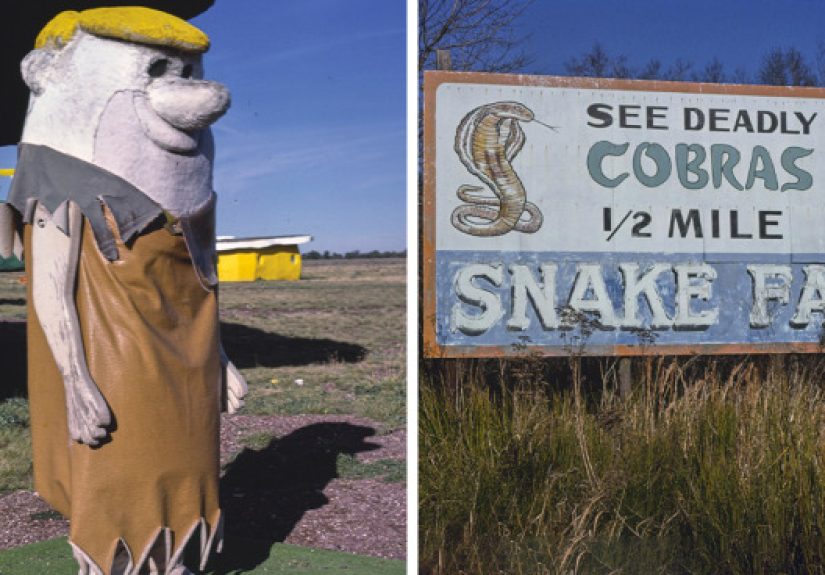
- Roadside attractions advertising “THE WORLD’S LARGEST” the original clickbait, but with parking.
- A roadside zoo sign charming in the photo, complicated in the modern conscience.
- Pizza places with mascot characters a cartoon chef who looks like he’s seen everything.
- Old pharmacies and drugstores typography so clean it makes modern branding cry.
- Motels with courtyards and pools the pool is kidney-shaped and the vibes are immaculate.
- Roadside “BBQ” signs the size of a small planet smoke is the real marketing budget.
- Fast-food prototypes the early, experimental era before everything got “streamlined.”
- Roadside fruit stands painted signs, local produce, and the faint scent of summer.
- Old theaters ornate facades, huge marquees, and the ghost of a Saturday night crowd.
- Arcades and boardwalk storefronts bright signage, louder vibes, and the promise of sticky floors.
- Motels that advertise “COLOR TV” like a flex because it was. And it mattered.
- Auto repair shops with personality names like “Honest Al’s” that demand your trust immediately.
- Roadside churches with big signs faith, community, and a surprisingly strong sense of typography.
- Tourist courts and cabin motels the pre-chain version of “we have lodging, please don’t keep driving.”
- Roadside bars with neon beer logos glowing invitations to questionable decisions and good stories.
- Shopping centers before “mall aesthetic” took over bold, open, and wildly optimistic.
- Regional restaurant specialties signs that scream “CATFISH” or “CHILI” with missionary zeal.
- State-line photo ops where the sign is the destination and the camera is the proof.
- The “this place is gone now” gut punch the most haunting category: beautiful, specific, and vanished.
Roadside Americana in Context: Route 66, Neon, and the Business of Being Seen
If you want to understand why these photos look the way they do, follow the moneyand the headlights. Historic routes like
Route 66 helped define the roadside economy, and signs became literal lifelines for businesses. Neon wasn’t just
decoration; it was visibility and survival. When the interstate system rerouted travelers, many towns lost drive-by customers,
and the “roadside show” dimmed.
That’s why preservation groups and local initiatives now treat signs and midcentury roadside structures as cultural artifacts,
not clutter. The modern “neon revival” isn’t only nostalgiait’s a recognition that these places were built by local hands and
reflect local identity in a way that standardized branding rarely does.
How to Enjoy the Bot Without Just Mindlessly Scrolling
Create your own “then-and-now” project
Pick a photo that includes a clear location. Search whether the building still exists. If it does, compare what changed. If it
doesn’t, look up what replaced it. This is history you can do in sweatpants.
Use it as a road trip planner (the cool version)
Instead of planning a trip around “top attractions,” plan around signage: neon motels, old diners, drive-ins, classic
bowling alleys. You’ll end up in towns you never would’ve clicked on otherwise.
Learn the vocabulary of the roadside
Terms like “commercial archeology,” “vernacular architecture,” and “Googie” can sound academicbut they’re just ways to describe
the everyday built world that shaped people’s lives. Once you notice it, you can’t unsee it (sorry in advance).
Conclusion: A Beautiful Archive of Everyday America
Old Roadside Pics works because it’s more than “old photos.” It’s a curated reminder that America’s roads were once lined with
handmade spectaclesigns that winked at you in neon, buildings shaped like their own advertisements, and businesses that relied on
personality instead of a national brand guide.
So the next time you see a vintage roadside photo of a motel promising “AIR CONDITIONED” like it’s a miracle (it was), take a
second to appreciate the audacity. Then take another second to screenshot it, because yes, you absolutely need that bowling alley
sign as your phone wallpaper. This is who you are now.
Extra: of Roadside “Experience” (A.K.A. Time Travel You Can Do on Your Couch)
Here’s a weirdly specific modern ritual: you’re waiting for your food delivery, and you open Old Roadside Pics “just to kill a
minute.” The first image is a neon motel signan arrow pointing down like it’s giving you the world’s most enthusiastic direction.
You zoom in. The tubing looks hand-bent. The letters aren’t perfectly even. And somehow that imperfection is the point: a human
made this thing to catch another human’s attention at night, at speed, in a rainstorm, with kids in the back seat chanting, “Are
we there yet?” like a metronome of chaos.
The experience is less “looking at a photo” and more “falling into a scene.” You can practically hear the highway hum. You can
smell hot asphalt and cheap coffee. You can imagine the lobby: key rack behind the counter, a bowl of mints, a brochure stand
featuring local attractions that are either wholesome (“historic courthouse tour”) or unhinged (“largest fiberglass prairie dog”).
Somewhere nearby, a pool glows a little too blue under floodlights. The air is warm. The night is loud with crickets and
possibility.
Then the bot hits you with a diner exterior. The sign boasts breakfast all day. The windows promise pie. Suddenly you’re craving
hash browns even if it’s 2 p.m. on a Tuesday. That’s roadside culture: it doesn’t ask what time it is; it asks what you want and
how quickly you can pull into the parking lot. Next comes a drive-in marquee. You remember (or invent) the feeling of sitting in a
car, the speaker crackling, the screen enormous against the sky. It’s not just entertainmentit’s a whole temporary neighborhood
made of cars and shared attention.
If you want to make the experience richer, try a “three-photo road trip.” Save three images from the same state. Build a mini
route between them. Look up the towns. Read a little local history. You’ll start to see patterns: how certain regions favored
certain colors, how motel layouts evolved, how typography shifted from clean midcentury modern to later-era loudness, and how the
rise of standardized chains quietly erased a lot of the charming weirdness.
And here’s the best part: once you’ve spent an evening with these images, you’ll notice your own surroundings differently.
Suddenly, a surviving hand-painted sign in your neighborhood feels like a treasure. A fading marquee feels worth photographing.
You become the kind of person who points at old signage in the wild and says, “That’s gorgeous,” like you’re a museum curator who
also owns three hoodies and forgets to drink water. Welcome. We’ve been expecting you.