Table of Contents >> Show >> Hide
- 1. Check Your Sink and Countertop Configuration First
- 2. Choose the Right Faucet Type for How You Use the Kitchen
- 3. Think About Handles, Controls, and Accessibility
- 4. Measure Spout Height, Reach, and Sink Clearance
- 5. Prioritize Build Quality, Valves, and Safety Certifications
- 6. Pick a Finish That Matches Your Style and Cleaning Tolerance
- 7. Understand Flow Rate and Water Efficiency
- 8. Compare Features, Warranty, Installation, and Total Cost
- Kitchen Faucet Buying Checklist
- Specific Examples: Matching Faucets to Real Kitchens
- Common Mistakes to Avoid When Buying a Kitchen Faucet
- Real-World Experience: What You Learn After Living With a Kitchen Faucet
- Conclusion
Buying a kitchen faucet sounds simple until you meet the faucet aisle. Suddenly, you are comparing pull-down sprayers, touchless sensors, matte black finishes, ceramic disc valves, flow rates, mounting holes, deck plates, and handles that look like they were designed by a tiny architect with strong opinions. The good news? Choosing the right kitchen faucet is not about buying the fanciest model. It is about matching the faucet to your sink, your cooking habits, your cleaning style, your budget, and your patience level when someone leaves fingerprints on polished chrome.
A kitchen faucet is one of the hardest-working fixtures in the home. It fills pasta pots, rinses muddy vegetables, washes sticky hands, saves burnt pans from permanent shame, and stands front and center in your kitchen design. A great faucet makes daily chores smoother. A bad one drips, splashes, wobbles, stains, or forces you to perform weird sink yoga just to rinse a baking sheet.
This guide breaks down the eight most important things to consider before buying a kitchen faucet, using practical examples and real-world buying logic. By the end, you will know how to choose a faucet that looks good, works well, fits properly, and does not turn your sink area into a tiny water park.
1. Check Your Sink and Countertop Configuration First
Before falling in love with a gorgeous faucet, check how it will actually install. This is the unglamorous step, but it prevents the classic home improvement tragedy: buying something beautiful that does not fit.
Most kitchen sinks and countertops have one to four faucet holes. A single-hole faucet usually combines the spout and handle in one unit. A two-hole setup may support a faucet plus a side sprayer or accessory. Three-hole layouts often fit traditional two-handle faucets, while four-hole sinks may include a separate sprayer, soap dispenser, or filtered-water faucet.
If you are replacing an existing faucet, look under the sink and count the holes. Do not guess from above, because escutcheon plates and old hardware can hide surprises. A one-hole faucet can often be installed on a three-hole sink with a deck plate, but the reverse is usually not true. In plain English: you can cover extra holes, but you cannot magically create new ones without tools, courage, and possibly a contractor.
Quick buying tip
Choose a faucet that matches your current hole configuration unless you are also replacing the sink or countertop. If your sink has extra holes, use them wisely for a soap dispenser, filtered-water tap, or air gap if your dishwasher setup requires one.
2. Choose the Right Faucet Type for How You Use the Kitchen
Kitchen faucets come in several main types, and each has a personality. Some are practical workhorses. Some are design statements. Some look like they are ready to power-wash a restaurant kitchen, even if your most intense cooking project is reheating soup.
Pull-down kitchen faucets
A pull-down faucet has a spray head that pulls downward from the spout. This style is extremely popular because it works well with deep sinks and large cookware. If you regularly rinse big pots, sheet pans, colanders, or a sink full of vegetables, a pull-down sprayer can make the job easier.
Pull-out kitchen faucets
A pull-out faucet has a spray head that pulls outward toward you. It is often a smart choice for smaller sinks, shallow basins, or compact kitchens. Pull-out models can offer a flexible range of motion without needing a tall arc.
Bridge faucets
Bridge faucets connect hot and cold handles to the spout with a visible horizontal bar. They bring a traditional, farmhouse, or vintage-inspired look. They are charming, but they usually require more space and more installation planning.
Commercial-style and semi-pro faucets
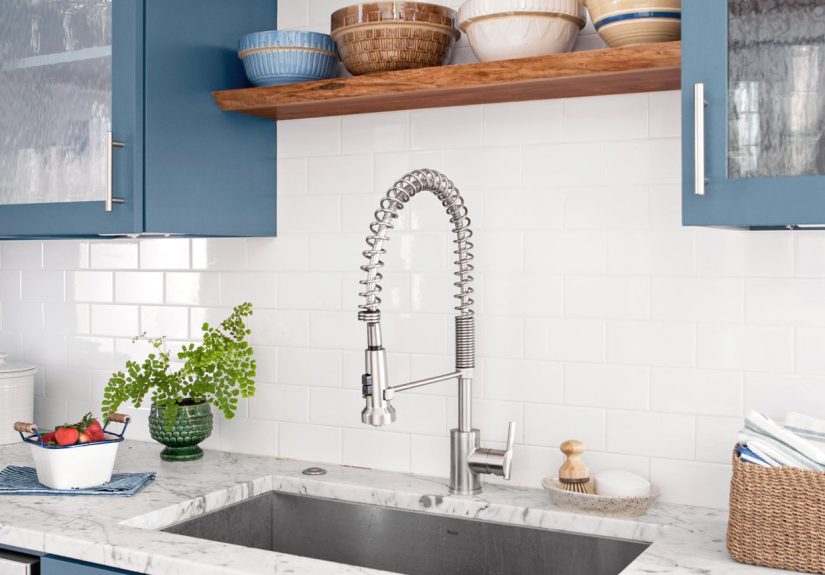
These faucets often feature tall springs, flexible hoses, and powerful sprayers. They look bold and professional, which is great if your kitchen design can handle the drama. Just measure carefully because some models are tall enough to argue with upper cabinets.
3. Think About Handles, Controls, and Accessibility
The handle style affects both appearance and daily comfort. A single-handle faucet lets you control water temperature and flow with one hand. It is simple, modern, and convenient when your other hand is holding a skillet, a toddler’s cup, or a suspiciously slippery tomato.
Two-handle faucets offer separate hot and cold controls. They can look classic and give precise temperature adjustment, but they may require more space and a little more effort to operate. If accessibility matters in your home, a single lever or touchless faucet is often easier to use.
For people with limited hand strength, arthritis, or mobility concerns, look for easy-to-operate handles that do not require tight gripping, pinching, or twisting. Lever handles and touchless controls can make everyday sink tasks more comfortable. This is not just about convenience; it is about making the kitchen usable for everyone in the household.
Touch, touchless, and smart controls
Touch faucets turn water on or off when you tap part of the faucet body. Touchless faucets use motion sensors. Smart faucets may offer voice commands, app controls, measured dispensing, or temperature indicators. These features can be fantastic when your hands are covered in dough or raw chicken juice. However, they also add cost, batteries, power requirements, and more parts that may need troubleshooting later.
If you love technology, a smart faucet can feel like a tiny kitchen assistant. If you prefer appliances that never need firmware updates, a solid manual faucet may be your soulmate.
4. Measure Spout Height, Reach, and Sink Clearance
Spout height and reach are easy to overlook, but they determine how comfortable the faucet feels. A high-arc faucet gives you more room to fill tall pots and rinse bulky items. It also creates a strong visual focal point, especially in an open kitchen.
However, bigger is not always better. A very tall faucet paired with a shallow sink can cause splashing. A spout that reaches too far forward may send water too close to the front edge of the sink. A spout that does not reach far enough may make rinsing awkward. This is where measuring saves your future self from muttering under your breath every time you wash lettuce.
What to measure
Measure the distance from the faucet mounting hole to the center of the sink basin. Compare that with the faucet’s spout reach. Also check the height from the countertop to any upper cabinets, shelves, or windowsills. If you have a windowsill behind the sink, make sure the handle can move freely without bumping into it.
For deep single-bowl sinks, a pull-down high-arc faucet often works beautifully. For shallow double-bowl sinks, a medium-arc or pull-out faucet may reduce splashing and feel more balanced.
5. Prioritize Build Quality, Valves, and Safety Certifications
A kitchen faucet should look good, but its internal parts matter even more. The faucet’s valve controls water flow and helps prevent leaks. Many modern quality faucets use ceramic disc valves, which are known for smooth operation and durability because they do not rely on old-style rubber washers that wear out quickly.
Look for solid construction and reputable materials. Brass and stainless steel are common choices for durable faucets. Be cautious with extremely cheap faucets from unknown sellers, especially if they lack clear certifications. A faucet touches water you may drink, cook with, and use every day, so safety is not the place to play mystery-box shopping.
Certifications to look for
For drinking-water contact, look for products tested and certified to recognized standards such as NSF/ANSI 61 for drinking water system components and NSF/ANSI 372 for lead content. In the United States, “lead free” plumbing fixtures must meet strict lead-content limits across wetted surfaces. Labels such as cUPC, IAPMO certification, NSF certification, and compliance with ASME faucet standards can help confirm that the product is designed for safe, code-conscious use.
Do not rely only on pretty product photos. Read the specification sheet. If the faucet listing avoids mentioning materials, certifications, warranty, or replacement parts, consider that a red flag wearing a chrome finish.
6. Pick a Finish That Matches Your Style and Cleaning Tolerance
The faucet finish is where design meets reality. Chrome is shiny, affordable, and widely available, but it can show water spots and fingerprints. Stainless steel and brushed nickel are popular because they blend with many appliances and are usually easier to maintain. Matte black adds modern contrast and looks sharp in white, wood, or stone-heavy kitchens. Brushed gold, champagne bronze, and warm brass finishes can make a kitchen feel custom and polished.
But here is the practical question: how much wiping are you willing to do? A finish that looks stunning in a showroom may behave differently after spaghetti night. Spot-resistant, fingerprint-resistant, or PVD-style finishes can help reduce visible marks and improve durability, depending on the manufacturer.
Match, coordinate, or contrast?
Your faucet does not have to match every metal in the kitchen perfectly. Many modern kitchens mix finishes successfully. For example, a stainless faucet can work with black cabinet pulls, or a brass faucet can warm up a kitchen with stainless appliances. The trick is to repeat each finish at least once so it looks intentional rather than accidental.
If your kitchen already has a strong design direction, let the faucet support it. Traditional kitchens often pair well with bridge or two-handle styles. Modern kitchens look great with sleek single-handle faucets. Farmhouse kitchens can handle taller, more sculptural designs. Minimalist kitchens usually benefit from clean lines and quiet finishes.
7. Understand Flow Rate and Water Efficiency
Flow rate tells you how much water the faucet uses, usually measured in gallons per minute, or GPM. Federal efficiency standards require kitchen faucets to have a maximum flow rate of 2.2 GPM at 60 PSI. Many modern kitchen faucets are designed with lower flow rates, often around 1.5 to 1.8 GPM, to save water while still providing enough power for everyday rinsing.
Lower flow can reduce water use, but performance matters. A faucet should rinse dishes efficiently, fill pots in a reasonable time, and feel strong enough for kitchen tasks. Some faucets include spray modes that improve rinsing power without simply dumping more water down the drain.
Spray modes matter
Common spray options include an aerated stream for filling glasses and pots, a stronger spray for rinsing dishes, and sometimes a pause function to stop water temporarily while moving the sprayer. Some models include boosted flow modes for filling large pots faster, though local rules may affect what is allowed in your area.
For most households, a faucet in the 1.5 to 1.8 GPM range offers a practical balance of efficiency and usefulness. If your home has low water pressure, read reviews carefully and check the specifications before choosing an ultra-low-flow model.
8. Compare Features, Warranty, Installation, and Total Cost
Kitchen faucets range from budget-friendly basics to luxury models that cost more than some small appliances. The best value is not always the cheapest faucet or the most expensive one. It is the faucet that gives you the right mix of durability, function, support, and style.
Useful features worth considering
Magnetic docking helps a pull-down spray head snap back into place and stay there. Dual spray modes make it easier to switch between filling and rinsing. A pause button can reduce mess while moving the sprayer. A removable aerator makes cleaning mineral buildup easier. Pre-attached supply lines may simplify installation. A matching soap dispenser can make the sink area look cleaner and more organized.
Features that depend on your lifestyle
Touchless activation is great for busy cooks, families, and anyone who hates cleaning faucet handles. Voice control and measured dispensing are fun and useful for some people, especially bakers who often need specific water amounts. But these features are not essential for everyone. If your budget is tight, prioritize the valve, body material, spray-head quality, and warranty before paying for smart features.
Installation costs
If you are handy and replacing a similar faucet, installation may be a manageable DIY project. If plumbing lines are old, valves are stuck, holes do not match, or you are changing the sink or countertop, hiring a plumber may be the better choice. Also remember to check whether the faucet includes supply lines, mounting hardware, deck plate, batteries, or AC adapter if needed.
Read the warranty carefully. A limited lifetime warranty on finish and function from a reputable brand can add peace of mind. Also check whether replacement cartridges, spray heads, hoses, and aerators are easy to find. A faucet is only as good as the parts you can get when something eventually wears out.
Kitchen Faucet Buying Checklist
Before you click “add to cart,” run through this quick checklist:
- How many mounting holes does your sink or countertop have?
- Do you need a deck plate, soap dispenser, side sprayer, or filtered-water tap?
- Would pull-down, pull-out, bridge, commercial-style, or touchless work best?
- Does the spout height fit under cabinets or windows?
- Does the spout reach the right part of the sink basin?
- Is the faucet made from durable materials with a ceramic disc valve?
- Does it meet recognized drinking-water and plumbing standards?
- Is the finish practical for your cleaning habits?
- Is the flow rate efficient but still useful?
- Are replacement parts and warranty support available?
Specific Examples: Matching Faucets to Real Kitchens
For a small apartment kitchen
Choose a compact pull-out or medium-arc single-handle faucet. It will give you flexibility without overwhelming a small sink. A brushed nickel or stainless finish is usually forgiving and easy to match.
For a family kitchen
A pull-down faucet with magnetic docking, dual spray modes, and a spot-resistant finish is a smart choice. Families use the sink constantly, so durability and easy cleaning matter more than delicate design details.
For a farmhouse kitchen
A bridge faucet, warm brass finish, or high-arc pull-down model can complement farmhouse sinks and natural materials. Just make sure the faucet reach works with the deep apron-front basin.
For a modern kitchen
A sleek single-handle faucet in matte black, stainless steel, or chrome can keep the look clean. Touchless technology fits especially well in modern kitchens, as long as you are comfortable with sensors and power requirements.
Common Mistakes to Avoid When Buying a Kitchen Faucet
The first mistake is buying by looks alone. A faucet can be gorgeous and still splash everywhere, hit the backsplash, or feel awkward to use. The second mistake is ignoring measurements. Spout reach, height, and handle clearance are not decorative trivia; they are the difference between daily comfort and daily irritation.
The third mistake is choosing the cheapest unknown faucet without checking certifications, parts, or warranty. A bargain faucet is not a bargain if it leaks, corrodes, or needs replacing in a year. The fourth mistake is assuming every pull-down sprayer docks well. Read reviews for comments about drooping spray heads, weak magnets, stiff hoses, or buttons that fail.
Finally, do not forget your water conditions. If you have hard water, choose a finish that hides spots and a spray head with easy-clean nozzles. Clean the aerator regularly to keep water flowing smoothly. A little maintenance can make a good faucet last much longer.
Real-World Experience: What You Learn After Living With a Kitchen Faucet
After using different kitchen faucets in real homes, one truth becomes clear: the best faucet is the one you stop noticing because it simply works. It turns on smoothly, aims water where it should, pulls out without fighting back, docks without drooping, and does not need a dramatic polishing ceremony after every sandwich plate.
One of the biggest lessons is that sink depth changes everything. A high-arc pull-down faucet over a deep single-bowl sink can feel like a dream. You can rinse stockpots, wash cutting boards, and fill a vase without playing kitchen Tetris. But put that same tall faucet over a shallow sink, and every strong spray can bounce water onto the counter. Suddenly, you are not washing dishes; you are mopping the backsplash. For shallow sinks, a medium-arc faucet or a pull-out model often feels more controlled.
Another experience-based lesson is that finish matters more than people expect. Polished chrome looks crisp and classic, but it shows fingerprints quickly. Matte black looks stylish, but in homes with mineral-heavy water, pale water spots may appear if the faucet is not wiped down. Brushed stainless and spot-resistant nickel tend to be forgiving choices for busy households. If you cook often, have kids, or share the kitchen with someone who believes “clean enough” is a lifestyle, choose a finish that can survive real life.
Sprayer quality is also a big deal. A pull-down faucet sounds convenient, but the hose and docking system determine whether it feels premium or annoying. A smooth hose with a secure magnetic dock is worth paying more for. When the spray head snaps back neatly, the whole faucet feels better. When it hangs slightly loose, it becomes one of those tiny household annoyances that grows larger every time you make coffee.
Touchless faucets can be wonderful, especially when handling raw ingredients. Waving a hand to turn on water keeps the handle cleaner and can reduce cross-contamination during cooking. But they are not perfect for every household. Some people love the convenience; others get annoyed by sensors that activate unexpectedly or require battery changes. The best approach is honest self-knowledge. If you enjoy smart-home features, touchless may be a delight. If you still argue with your printer, a manual faucet may bring more peace.
Installation teaches its own lessons. The space under a kitchen sink is rarely spacious, glamorous, or emotionally supportive. Before buying, check shutoff valves, supply line condition, and access around the mounting nut. A faucet that advertises “easy installation” may still be challenging if your old hardware is corroded. When in doubt, budget for a plumber. Paying for proper installation is often cheaper than fixing a leak that quietly turns your cabinet floor into oatmeal.
Finally, the faucet should match your actual habits, not your fantasy kitchen personality. If you cook big meals, prioritize sprayer power, reach, and durability. If you mostly rinse cups and make coffee, a simpler faucet may be perfect. If your kitchen is a design centerpiece, invest in finish and silhouette. If your sink is a hardworking utility zone, choose function first and beauty second. The right faucet does not need to impress the entire internet. It just needs to make your kitchen better every single day.
Conclusion
Choosing a kitchen faucet is part design decision, part plumbing decision, and part lifestyle confession. The perfect faucet should fit your sink, clear your cabinets, match your kitchen style, operate comfortably, use water wisely, and hold up to daily use. Start with measurements and mounting holes, then narrow your options by faucet type, handle style, spout reach, materials, finish, flow rate, and features.
Do not be distracted by looks alone. A beautiful faucet that splashes, leaks, stains, or does not fit is just a shiny problem. Instead, choose a kitchen faucet that makes cooking, cleaning, rinsing, and living easier. When you find the right one, your sink becomes more efficient, your kitchen looks more polished, and your dishes still will not wash themselvesbut at least the faucet will be doing its part.