Table of Contents >> Show >> Hide
- How The Sydney Sweeney American Eagle Ad Became A Culture-War Bonfire
- Lizzo’s Parody: A Denim Joke With A Very Sharp Seam
- Why Lizzo’s Response Hit So Hard
- Was Lizzo Supporting Women Or Stirring The Pot?
- The Role Of Race, Beauty Standards, And “Great Genes” Messaging
- American Eagle’s Marketing Gamble
- Why Celebrity Parodies Now Shape The News Cycle
- What Brands Can Learn From The Lizzo And Sydney Sweeney Ad Controversy
- Experience-Based Reflection: Watching A Denim Ad Become A Digital Earthquake
- Conclusion
In the wild kingdom of celebrity marketing, it takes only one denim ad, one pun, and one superstar with perfect comedic timing to turn a fashion campaign into a full-blown internet rodeo. That is exactly what happened when Sydney Sweeney’s American Eagle campaign, built around the tagline “Sydney Sweeney Has Great Jeans,” became one of pop culture’s most debated ads. Then Lizzo entered the chat wearing denim, wit, and a blowtorch.
The original American Eagle campaign was supposed to sell jeans. Simple enough, right? Put a famous actress in flattering denim, add a cheeky slogan, collect the sales, and let the internet do what it does best: zoom in. But the wordplay between “jeans” and “genes” quickly sparked criticism because Sweeney, a blonde-haired, blue-eyed actress, was featured in ads that referenced inherited traits such as hair color and eye color. Some viewers argued the campaign carried uncomfortable undertones connected to beauty standards, race, and eugenics. Others thought the backlash was overcooked, like microwave pizza left in for six minutes.
Then Lizzo made her own parody. Her caption, “My jeans are black,” instantly transformed the controversy from a debate about advertising language into a larger conversation about race, satire, body confidence, celebrity clapbacks, and the strange modern art form known as “posting through it.”
How The Sydney Sweeney American Eagle Ad Became A Culture-War Bonfire
The American Eagle campaign launched with an old-school denim-ad energy: movie-star glamour, coy camera work, and a pun designed to be memorable. The problem was that the slogan did not exist in a vacuum. “Great jeans” sounds like “great genes,” and one campaign clip leaned directly into that double meaning by discussing how genes are passed down from parents to children and may influence traits such as hair color, personality, and eye color.
For many viewers, that wording landed awkwardly. Some critics said the “genes” language, paired with Sweeney’s appearance, echoed old ideas about idealized whiteness and genetic superiority. The word “eugenics” entered the discussion, and once that happens, a denim campaign is no longer just a denim campaign. It becomes a group project assigned to the entire internet, and somehow everyone is both the professor and the student who did not read the syllabus.
American Eagle later responded by saying the campaign was always about jeans, confidence, individuality, and how everyone wears denim in their own way. The brand’s message attempted to pull the conversation back to fashion. But by then, the campaign had already escaped the mall and entered the arena of politics, media commentary, and celebrity reactions.
Lizzo’s Parody: A Denim Joke With A Very Sharp Seam
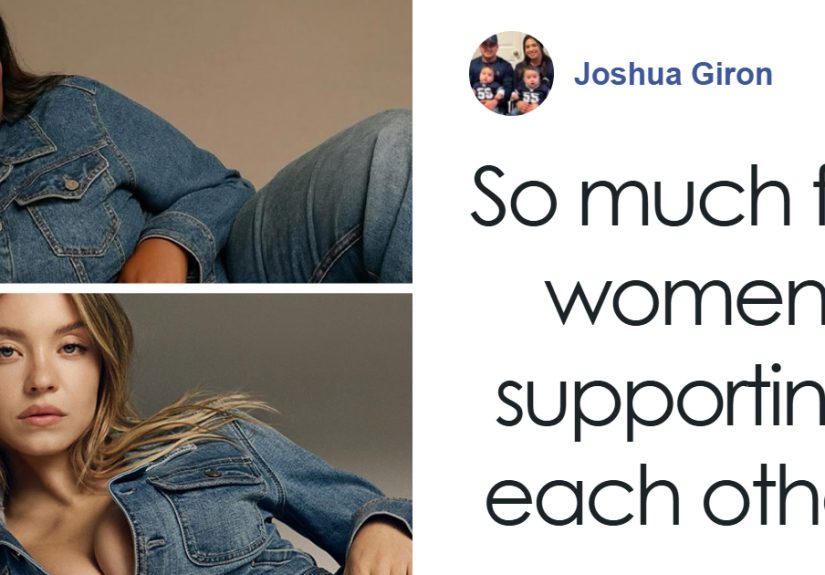
Lizzo did not write a 3,000-word thread. She did not hold a press conference in front of a wall of bootcut jeans. She did what Lizzo does best: she turned the moment into performance. By posting a parody image of herself in denim with the caption “My jeans are black,” she both mocked the ad’s wording and reframed the conversation around race, identity, and who gets celebrated in mainstream fashion campaigns.
The joke worked because it was short, visual, and loaded with meaning. It took the original “my jeans are blue” framing and flipped it into a punchline. The caption did not need a paragraph of explanation. In four words, Lizzo managed to reference the American Eagle ad, the public criticism, and the broader issue of who is seen as desirable, marketable, and “all-American” in advertising.
She later kept the joke moving with clips connected to new music, including lyrics that played on the “good jeans” phrase. That second layer mattered. Lizzo was not only reacting to the controversy; she was using it as a launchpad for her own brand of pop-culture theater. It was marketing responding to marketing, satire wearing platform boots.
Why Lizzo’s Response Hit So Hard
Lizzo’s parody landed because it matched her public persona: confident, funny, self-aware, and unwilling to let the internet define her body or her place in pop culture. She has built much of her public image around body positivity, performance, humor, and direct engagement with critics. So when a controversy about “great genes” exploded, Lizzo’s response felt less like random commentary and more like a perfectly timed entrance.
There is also a reason the parody spread quickly. The best internet jokes are easy to understand in one glance. Lizzo in denim plus “My jeans are black” did not require a media studies degree, although having one probably made the moment even spicier. It gave supporters a memeable response and gave critics another reason to debate whether the backlash had gone too far.
In other words, Lizzo did not end the controversy. She poured premium gasoline on it, lit a sparkler, and danced next to the flames.
Was Lizzo Supporting Women Or Stirring The Pot?
One of the loudest reactions to Lizzo’s parody came from people who asked whether she was unfairly piling onto Sydney Sweeney. Some argued that women in entertainment already face enough scrutiny and that turning Sweeney’s ad into a joke only made the actress a bigger target. Others said Lizzo was not attacking Sweeney personally, but criticizing the campaign’s message and the cultural response around it.
Both reactions reveal why the controversy became so sticky. The ad was not received as one simple thing. To some, it was a harmless jeans commercial starring a famous actress. To others, it was an example of a brand using loaded language without fully considering the historical and social baggage attached to that language. To still others, it became a symbol in a larger political argument over “wokeness,” beauty standards, and who gets to decide what counts as offensive.
Lizzo’s parody sharpened those divisions. Fans saw it as clever satire. Critics saw it as unnecessary shade. Neutral observers saw it as another reminder that modern celebrity culture has turned every advertisement into a potential courtroom, comedy club, and political debate stage.
The Role Of Race, Beauty Standards, And “Great Genes” Messaging
At the center of the debate was not merely a pun. It was the collision between language and imagery. “Great genes” has a long cultural history tied to beauty, heredity, attractiveness, and social value. When an ad connects “genes” to physical traits, viewers may interpret the message differently depending on who is featured and what traits are being highlighted.
That does not automatically mean everyone involved intended harm. Advertising mistakes often happen when a clever concept is tested for catchiness but not for cultural meaning. A slogan can sound brilliant in a conference room and bizarre in public. This is why brand teams now need more than copywriters and stylists. They need cultural readers, historical awareness, and at least one person in the room brave enough to say, “Are we sure this won’t become a six-day internet emergency?”
Sydney Sweeney’s image also played a major role. She is a popular actress known for roles in Euphoria and The White Lotus, and she has become a high-profile figure in fashion and beauty campaigns. Her celebrity, appearance, and public mystery made the ad more powerful and more vulnerable. The campaign did not feature an unknown model. It featured someone whose image was already loaded with conversation about femininity, desirability, politics, and Hollywood branding.
American Eagle’s Marketing Gamble
From a pure attention standpoint, the campaign achieved what many brands dream of: everyone talked about it. The ad was discussed by entertainment outlets, political commentators, fashion critics, social media users, and celebrities. It became bigger than a product launch. That kind of visibility can be valuable, especially in a crowded retail market where most denim ads disappear faster than a phone charger in a shared apartment.
But attention is not always the same as trust. When a campaign becomes controversial, the brand has to decide whether to apologize, clarify, defend, or stay quiet. American Eagle chose clarification and defense, saying the campaign was about jeans and confidence. That statement helped define the brand’s official position, but it did not erase the debate.
The lesson for marketers is clear: provocative language can be powerful, but it is also unpredictable. If a campaign depends on a pun, the pun must survive contact with history, politics, social media, and screenshots. The internet does not grade ads on intention alone. It grades them on interpretation, timing, visuals, and vibes. And vibes, unfortunately for brand managers, do not come with a warranty.
Why Celebrity Parodies Now Shape The News Cycle
Lizzo’s parody shows how celebrities can now influence the life span of a controversy. In the past, a questionable ad might have generated newspaper columns or television segments. Today, one celebrity post can extend the story, reframe it, and create a second wave of commentary.
That is exactly what happened here. The original ad created the controversy. The brand response gave it structure. Political commentary gave it fuel. Lizzo gave it a punchline. Once satire entered the story, the conversation became easier to share and harder to contain.
Parody is especially powerful because it does not have to argue like an essay. It can make a point through imitation. By echoing the style of the original campaign while changing the words, Lizzo invited viewers to reconsider what the ad sounded like when placed in a different body, identity, and cultural context. That is the magic of parody: it turns the original into a mirror, and sometimes the reflection is not exactly flattering.
What Brands Can Learn From The Lizzo And Sydney Sweeney Ad Controversy
1. Wordplay Is Not Harmless Just Because It Is Clever
A pun can be memorable and still be risky. “Jeans” and “genes” is a natural advertising joke, but when the campaign includes language about inherited traits, the meaning expands. Brands should test taglines not only for humor but also for historical and cultural associations.
2. Representation Changes Interpretation
The same line can feel different depending on who says it, how it is filmed, and what cultural symbols surround it. Casting, styling, camera angles, and copy all work together. If the message involves beauty and heredity, representation matters even more.
3. The Internet Rewards Speed And Simplicity
Lizzo’s parody succeeded because it was fast, funny, and easy to understand. In online culture, the sharpest response often wins the conversation before the longest explanation even loads.
4. Controversy Can Sell, But It Can Also Define You
Brands often chase buzz, but not all buzz is equal. A campaign can gain visibility while also creating reputational risk. The question is not only “Are people talking?” It is “What are they learning to associate with us?”
Experience-Based Reflection: Watching A Denim Ad Become A Digital Earthquake
One of the most interesting experiences connected to the Lizzo and Sydney Sweeney controversy is the way it mirrors how people now consume pop culture. Many viewers did not encounter the American Eagle campaign as a regular ad. They encountered it through reaction videos, screenshots, stitches, headlines, memes, and celebrity responses. That means the controversy itself became the main product. The jeans were almost secondary. Somewhere, a pair of denim pants was probably whispering, “Remember me?”
For everyday audiences, this kind of moment can feel exhausting and entertaining at the same time. On one hand, it is just an ad. On the other hand, advertising is never only advertising. Commercials tell us who is desirable, who is aspirational, who is funny, who is normal, and who belongs at the center of the frame. When people react strongly, they are often responding not only to the specific campaign but to years of accumulated messaging.
Lizzo’s parody gave many viewers a way to laugh at that tension. It turned a heavy conversation into something more digestible without completely removing the seriousness underneath. That is often how modern audiences process cultural conflict. A joke becomes the doorway to a deeper point. A meme becomes a miniature essay. A caption becomes a critique.
There is also a personal-viewing experience many people can recognize: the moment when an ad makes you pause and think, “Wait, did they mean that?” Maybe the brand did not. Maybe the creative team simply loved the pun and trusted the celebrity power behind it. But once the public sees another meaning, the brand no longer controls the full message. That is the reality of publishing anything in the digital age. The audience is not passive. It edits, remixes, challenges, jokes, and sometimes completely hijacks the narrative.
Another relatable experience is watching different groups interpret the same content in opposite ways. One person sees a fashion campaign. Another sees racial undertones. Another sees manufactured outrage. Another sees a political symbol. Social media then compresses those interpretations into combat-ready sound bites. Nuance gets shoved into the back pocket, usually next to a receipt from 2018.
What made Lizzo’s parody effective was that it did not pretend the controversy was simple. It leaned into the mess. Her “My jeans are black” caption worked because it acknowledged the racial conversation without turning the post into a lecture. It was funny, but not empty. It was playful, but pointed. It showed how satire can create a shared language for people who feel that a mainstream campaign missed something obvious.
The broader experience for brands, celebrities, and audiences is this: cultural meaning moves fast. A campaign that begins as a seasonal denim push can become a national debate in days. A celebrity parody can revive the story just when the brand hopes it is cooling down. And an audience that once simply watched ads now participates in rewriting them. That is the new media environment. The jeans may be blue, black, ripped, baggy, or low-rise, but the conversation is always tailor-made by the crowd.
Conclusion
The Lizzo Sydney Sweeney ad controversy proves that in today’s culture, advertising is not just about selling products. It is about symbols, timing, identity, and interpretation. American Eagle wanted a bold denim campaign. Instead, it got a national argument about race, beauty standards, celebrity branding, and the risks of clever copy. Sydney Sweeney became the face of a debate bigger than jeans, while Lizzo turned the moment into a parody that was funny, pointed, and impossible to ignore.
Whether people saw Lizzo’s response as comedy, criticism, or pot-stirring, it kept the controversy alive and showed why celebrity satire has become one of the internet’s most powerful tools. In a media world where every campaign can become a culture-war headline, the smartest brands will remember that the audience does not just watch the message anymore. It talks back, remixes it, and sometimes shows up in better jeans.