Table of Contents >> Show >> Hide
- Who Is Michael Simon Toon?
- The Fibonacci Sequence, Without the Fairy Dust
- How a Synthetic Tree Can Produce a Fibonacci Pattern
- Why This Matters for Synthetic Tree Design
- Biomimicry: Learning From Trees Instead of Imitating Them
- The Role of Fractals in Tree-Inspired Architecture
- What Makes the Fibonacci Discovery Different?
- Potential Applications Beyond Solar Energy
- The Beauty of “I Didn’t Do It on Purpose”
- Challenges and Questions Still Ahead
- Experiences and Practical Reflections on Synthetic Tree Design
- Conclusion: When Design Follows Nature, Math Sometimes Follows Design
Editorial note: This article is based on publicly reported information about Michael Simon Toon’s synthetic tree design, Fibonacci mathematics, solar tree concepts, biomimicry, and tree-branching research.
Every now and then, design wanders into mathematics, knocks over a cup of coffee, and accidentally discovers something beautiful. That is roughly the delightful story behind designer Michael Simon Toon and his synthetic tree design, a tree-inspired structural system in which the famous Fibonacci sequence appeared not as decoration, not as branding, and not as a mystical sticker slapped on a product brochure, but as an emergent result of following practical branching rules.
The headline sounds almost too good: Designer Michael Simon Toon Finds Fibonacci Sequence in Synthetic Tree Design. But the idea is not that Fibonacci numbers suddenly started growing on aluminum. The more interesting point is that Toon’s work sits at the intersection of biomimicry, sustainable design, fractal branching, photovoltaic mounting systems, and the old but still fascinating question: why are trees so good at being trees?
Natural trees are not symmetrical sculptures. They are living machines shaped by light, gravity, wind, water transport, structural stress, and millions of years of trial-and-error engineering. When humans try to design “solar trees,” the result often looks like a pole with panels attached, which is fine if the goal is a stylish charging station, but less convincing if the goal is to learn from how real trees distribute surface area. Toon’s synthetic tree concept takes a more ambitious route: instead of merely copying the look of a tree, it attempts to borrow the logic behind one.
Who Is Michael Simon Toon?
Michael Simon Toon is known as a designer, builder, photographer, and filmmaker whose work often crosses the borders between art, engineering, architecture, and experimental systems. His design background includes modernist structures, lighting concepts, and bio-inspired projects. That matters because the synthetic tree design is not simply a math puzzle. It belongs to a broader design mindset: form should do something, beauty should have a job, and a structure should earn its dramatic silhouette.
In reports about the project, Toon is described as working on a solar energy concept called the Tree of Water and Power. The design was developed as a branching structure for distributing functional components such as photovoltaic cells, LEDs, sensors, or other devices that benefit from being spread across a large surface area. In plain English: imagine a tree-like framework that can hold energy-generating or light-emitting “leaves,” but with fewer wasted parts and a stronger reason for its shape than “because trees are pretty.”
The Fibonacci Sequence, Without the Fairy Dust
The Fibonacci sequence is one of the most recognizable patterns in mathematics: 0, 1, 1, 2, 3, 5, 8, 13, 21, and so on. Each number is the sum of the two numbers before it. Simple rule, huge personality. Like a quiet intern who somehow ends up running the company, Fibonacci numbers appear in plant spirals, pinecones, sunflower heads, branching patterns, and many models of biological growth.
Still, it is easy to overhype Fibonacci. Not every seashell is a golden-ratio shrine, and not every attractive spiral is a secret message from the universe. In serious design and science, Fibonacci is most useful when it appears as a consequence of spacing, growth, packing, or branching rules. That is what makes Toon’s synthetic tree story compelling. The sequence was not pasted onto the design after the fact. According to the reported account, it showed up when Toon counted how many branch connectors of each size the structure required.
How a Synthetic Tree Can Produce a Fibonacci Pattern
Toon’s synthetic tree design uses a branching system inspired by real tree architecture. A trunk splits into branches. Those branches split again. But unlike a cartoon tree, where every branch might divide neatly into identical parts, real trees are irregular. One branch is often larger, another smaller, and the total structure balances strength with surface-area distribution.
A central concept behind Toon’s design is Leonardo da Vinci’s rule of tree branching. In simplified terms, the rule suggests that the combined thickness or cross-sectional area of branches above a split relates to the thickness of the branch or trunk below it. Modern research debates and refines the rule, but the underlying idea remains powerful: trees distribute material in ways that preserve structural and transport efficiency.
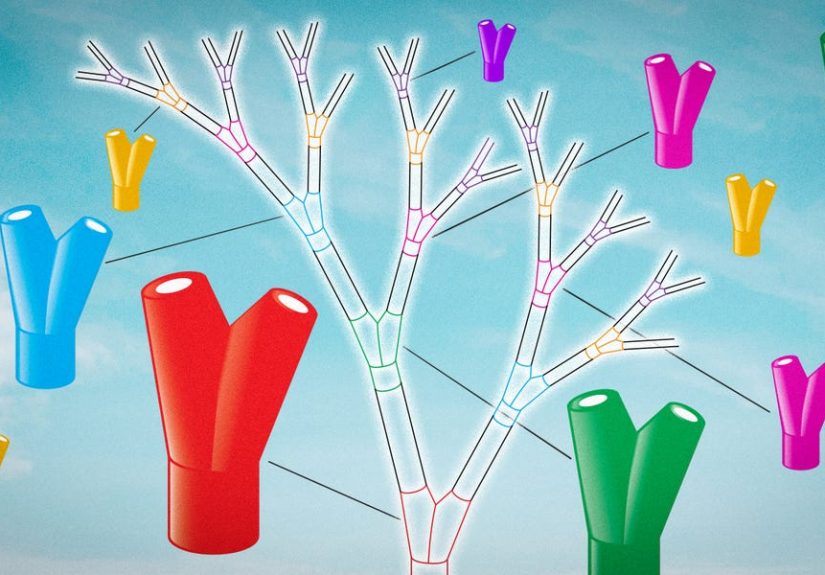
To translate that into a built object, Toon worked with different sizes of tubes and custom connectors. Each connector acts like a branch junction. It has one larger opening below and two smaller openings above, allowing one tube to split into two. The branch sizes are not random. They follow fixed relationships so the structure can scale upward while maintaining a tree-like logic.
Here is where the surprise enters. If each connector size must match specific tube sizes, and if each branching junction must connect to other junctions in a consistent hierarchy, then the number of required connectors at each scale begins to follow a familiar numerical rhythm. Toon reportedly found that the counts lined up with the Fibonacci sequence. In other words, the famous sequence appeared because the system had to solve a branching problem, not because someone typed “make it Fibonacci” into a design brief.
Why This Matters for Synthetic Tree Design
The phrase “synthetic tree design” may sound like something from a futuristic city park, but the practical stakes are real. Solar energy systems need surface area. Lighting systems need distributed points. Sensors, communication devices, shade structures, and environmental monitoring tools can all benefit from smart placement in three-dimensional space. Flat panels are efficient in many settings, but cities, parks, roadsides, campuses, and small sites often demand structures that do more than lie flat in a field.
A tree-inspired structure can potentially solve several problems at once. It can lift functional surfaces above the ground. It can distribute components in multiple directions. It can reduce land-use pressure. It can become part of public architecture instead of hiding on a roof. And, if designed intelligently, it can look less like machinery that wandered into a plaza and more like infrastructure that belongs there.
That last point is not shallow. Aesthetics influence whether communities accept public technology. A solar tree in a park, school, transit stop, or outdoor gathering space has to perform, but it also has to feel intentional. People are more likely to welcome clean-energy infrastructure when it is beautiful, useful, and legible. Nobody wants a public square that looks like a robot sneezed spare parts everywhere.
Biomimicry: Learning From Trees Instead of Imitating Them
Biomimicry is the practice of learning from nature’s strategies and applying them to human design. The best biomimicry does not simply copy an animal, plant, or shell. It asks what problem nature solved and how that principle can be translated into materials, structures, or systems.
In Toon’s case, the key lesson is not “trees have branches, so let’s add branches.” The deeper lesson is that trees are masters of distribution. A tree spreads leaves through space to capture sunlight. It moves water through branching networks. It resists wind by combining flexibility and strength. It grows efficiently because material is expensive; a tree that wastes too much energy building unnecessary mass does not win the forest Olympics.
For synthetic trees, that means the branching structure should serve a purpose. The arrangement of tubes, connectors, and terminal points should help distribute functional cells. If those cells are photovoltaic, the design can explore how solar surfaces might be positioned in three dimensions. If they are LEDs, the structure can become a light sculpture. If they are sensors, it can become a monitoring network. The same branching logic can support different technologies.
The Role of Fractals in Tree-Inspired Architecture
Tree forms are often described as fractal because similar branching patterns repeat at different scales. A large branch resembles a smaller tree; a smaller branch resembles a tiny version of the larger system. This self-similar quality is not perfect in biology, because real trees are messy, injured, wind-shaped, and gloriously disobedient. Still, fractal thinking helps designers model how branching systems can expand without becoming chaotic.
Fractal solar arrays and tree-shaped photovoltaic systems have been explored in academic research and engineering prototypes. The attraction is easy to understand: sunlight comes from a moving source, shadows shift, and three-dimensional forms can sometimes offer design advantages where conventional flat arrays are limited. The challenge is equally obvious: complex structures can become expensive, hard to maintain, and structurally demanding.
This is why Toon’s connector-based approach is interesting. A repeatable family of scaled components can make complexity more manageable. Instead of fabricating every branch as a one-off art object, a designer can use a limited set of parts that combine into a larger system. That is where mathematics becomes less of a museum exhibit and more of a shop-floor assistant wearing safety glasses.
What Makes the Fibonacci Discovery Different?
Fibonacci patterns in plants usually relate to growth, spacing, and efficient exposure. Leaves and seeds often arrange themselves in ways that reduce overlap and improve access to light or space. Toon’s discovery is different because it appears in the inventory of a designed branching system. The relevant question is not where leaves sit around a stem, but how many connectors of each size are required when a tree-like structure follows certain scaling rules.
That is a subtle but important distinction. The Fibonacci sequence does not need to look like a spiral to be present. It can appear in counts, recursions, growth models, and dependency chains. If each level of a system depends on previous levels, and if parts must connect according to stable relationships, Fibonacci-like behavior can emerge.
For designers, this is a lovely reminder: patterns are often discovered by building. Sketches can suggest an idea, software can simulate it, and equations can describe it, but the act of making parts and counting what the system actually needs can reveal relationships that were not obvious at the beginning. Sometimes the prototype knows something the designer does not yet know.
Potential Applications Beyond Solar Energy
Although the synthetic tree design is closely associated with solar energy and photovoltaic mounting, the broader idea could apply to many distributed systems. A branching framework could support environmental sensors in agricultural fields. It could hold LED lighting in public spaces. It could carry communication nodes, misting devices, shade elements, or art installations. It could even support hybrid systems where lighting, energy, data, and climate-responsive features share one structural language.
Urban design is increasingly hungry for multipurpose infrastructure. A streetlight can also be a charger. A shade structure can also collect energy. A public sculpture can also measure air quality. A canopy can provide comfort while producing data, power, or both. Synthetic tree design fits neatly into that conversation because trees themselves are multipurpose infrastructure. They cool streets, manage water, store carbon, host wildlife, shape public space, and look fantastic while asking for very little applause.
The Beauty of “I Didn’t Do It on Purpose”
One of the most charming parts of this story is Toon’s reported reaction: he did not set out to force a Fibonacci sequence into the design. He followed the rules of the tree, and the numbers appeared. That is the kind of sentence designers love because it sounds like nature leaving a note on the workbench.
But it also carries a practical lesson. Good constraints can produce elegance. When a design has no constraints, it can become arbitrary. When it has smart constraintsmaterial limits, structural rules, scaling relationships, fabrication logicit can develop coherence. The Fibonacci sequence in Toon’s synthetic tree is not magic. It is a sign that the system has internal order.
Challenges and Questions Still Ahead
Of course, a beautiful mathematical pattern does not automatically make a product commercially successful or technically superior. Synthetic tree design must still answer tough questions. How much does it cost to manufacture? How easy is it to install? Can it withstand wind, heat, corrosion, and long-term outdoor exposure? How efficient is it compared with conventional photovoltaic systems? Can maintenance crews replace components without needing a PhD in tree poetry?
These questions are not criticisms; they are the normal path from design concept to real-world infrastructure. Every promising system must move from “That is fascinating” to “Can it survive Tuesday afternoon in a dust storm?” The strongest version of synthetic tree design will be the one that combines mathematical elegance with boring reliability. Boring reliability, in engineering, is secretly glamorous.
Experiences and Practical Reflections on Synthetic Tree Design
Anyone who has worked with tree-inspired design, even at the sketching or model-making level, quickly learns that trees are much harder to imitate than they look. A child can draw a trunk with branches in ten seconds. A designer can spend months trying to make that same idea stand upright, hold weight, distribute parts, avoid awkward symmetry, and not resemble a coat rack having an identity crisis.
The first practical experience is that asymmetry is essential. Beginners often draw artificial trees with perfectly balanced branches on both sides because symmetry feels safe. Real trees do not behave that way. They reach toward light, compensate for damage, thicken where stress demands it, and adjust to space. In synthetic tree design, allowing controlled asymmetry can make the structure feel more natural and may also help distribute functional components more intelligently.
The second experience is that connectors matter more than expected. In a branching system, the glamorous parts are the sweeping limbs and terminal “leaves,” but the junctions do the quiet heavy lifting. A weak connector ruins the whole design. A clumsy connector makes the system expensive. A poorly scaled connector interrupts the visual rhythm. Toon’s focus on custom branch connectors is therefore not a minor fabrication detail; it is central to the concept. In tree-inspired structures, the joint is the story.
The third experience is that mathematical rules can reduce creative anxiety. Designers sometimes fear that rules will make work stiff or mechanical. In reality, a good rule can free the designer from guessing. If tube sizes, branching ratios, and connector relationships are defined, the structure can grow in a disciplined way. The designer still makes aesthetic and functional decisions, but the system provides a backbone. It is like jazz: improvisation works better when someone knows the key.
The fourth experience is that scale changes everything. A small desktop model can look graceful with delicate branches, but a full-size outdoor installation must deal with wind load, manufacturing tolerance, fasteners, foundations, transportation, and maintenance access. A synthetic tree that carries solar cells or LEDs is not only a sculpture. It is a piece of infrastructure. It must be beautiful from a distance and sensible up close.
The fifth experience is that public reaction often depends on whether people understand the purpose. A tree-like solar structure can invite curiosity, but it should communicate why it exists. Is it generating energy? Providing shade? Lighting a path? Collecting data? Demonstrating biomimicry? The best synthetic tree designs do not hide their function; they make function visible in a friendly way. People enjoy technology more when they can read it without needing a manual the size of a sandwich.
Finally, Toon’s Fibonacci moment is a reminder that discovery is often hiding inside process. Designers do not always begin with a grand theory. Sometimes they begin with a practical question: how can this branch split, how can this tube fit, how can this part repeat, how can this system grow? When those questions are answered honestly, patterns can appear. The reward is not only a better object, but a deeper understanding of why nature’s forms remain so stubbornly inspiring.
Conclusion: When Design Follows Nature, Math Sometimes Follows Design
Michael Simon Toon’s synthetic tree design is fascinating because it connects several big ideas without turning them into buzzword soup. It involves Fibonacci numbers, but it is not just numerology. It involves solar energy, but it is not just a panel on a pole. It involves biomimicry, but it does not merely copy the appearance of a tree. Instead, it explores how branching rules, scalable connectors, and distributed functional surfaces can work together.
The discovery of a Fibonacci sequence in the connector counts gives the project its headline sparkle, but the deeper value is in the design philosophy. Trees are not decorative accidents. They are efficient, adaptive, structural systems. When a designer studies them seriously, the result can be more than a pretty object. It can become a new way to think about infrastructure, public space, solar mounting, and sustainable technology.
In the end, the best part of the story is not that Fibonacci numbers appeared. It is that they appeared after the designer followed the logic of the tree. That is the real magic trick: not forcing nature into design, but designing carefully enough that nature’s logic has room to show up.