Table of Contents >> Show >> Hide
- Why Build a Storage Bed Instead of Buying One?
- Choose the Right Storage Bed Design
- Plan the Size and Layout
- Tools and Materials You Will Need
- Step-by-Step: How to Build a Storage Bed
- Step 1: Sketch the Bed and Make a Cut List
- Step 2: Cut the Plywood Panels
- Step 3: Build the Storage Boxes
- Step 4: Add Internal Supports
- Step 5: Build Drawer Boxes
- Step 6: Install Drawer Slides
- Step 7: Attach Drawer Fronts
- Step 8: Add the Platform or Slats
- Step 9: Sand, Trim, and Finish
- Step 10: Assemble the Bed in the Room
- Smart Design Tips for a Better DIY Storage Bed
- Common Mistakes to Avoid
- How Much Does It Cost to Build a Storage Bed?
- Experience Notes: What Building a Storage Bed Teaches You
- Conclusion
A storage bed is one of those rare DIY projects that solves two problems while pretending to be furniture. You get a sturdy place to sleep, plus hidden storage for blankets, shoes, off-season clothes, mystery cables, and that one tote labeled “important stuff” that has not been opened since 2019. In small bedrooms, guest rooms, apartments, and kids’ rooms, a DIY storage bed can work harder than a dresser without swallowing extra floor space.
The good news: learning how to build a storage bed is not as scary as it looks. At its core, a storage bed is usually a platform bed frame built from plywood, dimensional lumber, or modular box sections. The storage can be open cubbies, rolling drawers, side drawers on slides, or a mix of all three. The best design depends on your room layout, skill level, tools, mattress size, and how much patience you have for drawer alignment. Spoiler: drawers are very useful, but they do enjoy testing human character.
This guide walks you through planning, materials, construction, assembly, finishing, and real-world tips so you can build a bed that looks polished, supports your mattress properly, and does not wobble like a cafeteria table with one short leg.
Why Build a Storage Bed Instead of Buying One?
A store-bought storage bed can be convenient, but building your own gives you control over size, materials, finish, storage layout, and strength. Many retail beds use thin panels, limited drawer capacity, or hardware that feels heroic for the first month and tired by month six. A DIY storage bed lets you choose thicker plywood, stronger fasteners, better drawer slides, and a design that fits your exact room.
Another major benefit is customization. Need drawers only on one side because the other side sits against a wall? Build it that way. Want open cubbies for baskets instead of drawers? Easy. Need a queen storage bed that breaks into modular sections because you move apartments every year? Design it like three or four separate boxes that bolt together. Your future self will thank you when you are not trying to rotate a giant wooden rectangle through a hallway like a contestant on a furniture-themed game show.
Choose the Right Storage Bed Design
Before cutting wood, decide what kind of storage bed makes sense for your space. The most common DIY designs are platform beds with drawers, cubby storage beds, captain’s beds, and lift-up beds. Each has strengths and trade-offs.
Platform Bed with Drawers
This is the classic storage bed style. The mattress sits on a flat platform or slatted base, while drawers slide out from one or both sides. It is great for clothes, linens, extra pillows, and seasonal bedding. Use full-extension drawer slides if you want easy access to the back of each drawer.
Cubby Storage Bed
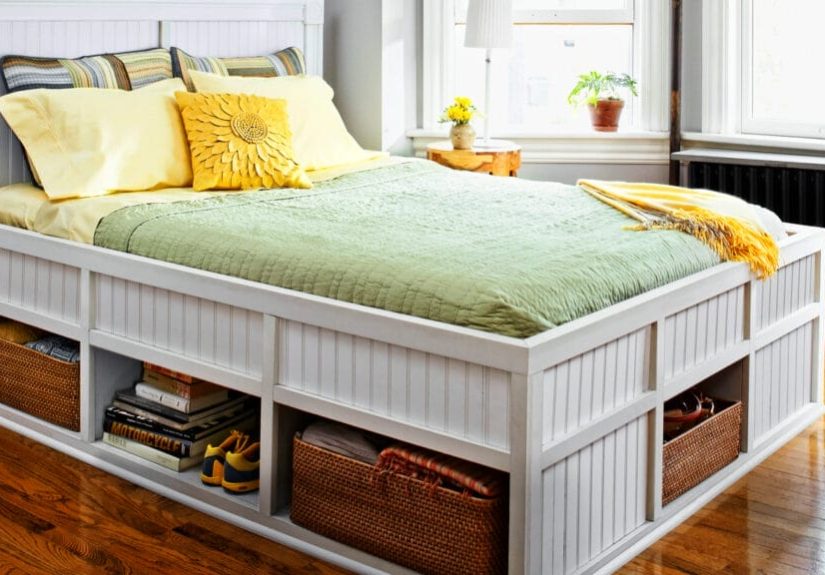
A cubby bed uses open compartments instead of enclosed drawers. It is easier to build because there are fewer moving parts. Add baskets or bins if you want a cleaner look. This design works especially well for kids’ rooms, guest rooms, and spaces where you want storage that is visible and quick to access.
Modular Box Storage Bed
A modular design uses separate storage boxes or benches arranged under the mattress platform. For example, a king bed might be built from three long bench-like units: one on each side and one down the center. This makes the bed easier to assemble, move, repair, and customize.
Lift-Up Storage Bed
A lift-up bed uses hinges and gas struts so the mattress platform rises to reveal one large storage cavity. It offers huge storage, but the hardware and installation require more care. For most weekend builders, drawers or cubbies are simpler, safer, and easier to maintain.
Plan the Size and Layout
Start with the mattress size. A standard queen mattress is approximately 60 inches wide by 80 inches long, while a king is about 76 inches wide by 80 inches long. Your bed frame should support the mattress evenly without squeezing it. Add a small clearance allowance so bedding can tuck in neatly.
Next, measure the room. Pay attention to doors, closets, radiators, baseboard heaters, nightstands, and walking paths. If drawers will open on the sides, you need enough clearance to pull them out comfortably. A deep drawer is wonderful until it crashes into a wall, a dresser, or your ankle at 6:00 a.m.
For small bedrooms, consider drawers on only one side or open cubbies at the foot of the bed. If the bed will sit against a wall, do not waste effort building functional drawers on the hidden side unless you enjoy storing things you can never reach.
Tools and Materials You Will Need
The exact shopping list depends on the mattress size and storage style, but most DIY storage bed projects use similar materials.
Common Materials
- 3/4-inch plywood for structural boxes, platform panels, and drawer parts
- 1/2-inch plywood for drawer bottoms if storing heavier items
- 1/4-inch plywood for lighter drawer bottoms
- 2×4 or 2×3 lumber for internal supports and cleats
- Wood glue
- 1 1/4-inch and 1 1/2-inch screws
- 2-inch or 2 1/2-inch screws for structural framing
- Drawer slides, preferably full-extension for easier access
- Edge banding or trim to cover exposed plywood edges
- Sandpaper in 120-, 150-, and 220-grit
- Primer, paint, stain, polyurethane, or furniture wax
- Drawer pulls or knobs
Helpful Tools
- Circular saw, table saw, or track saw
- Miter saw for trim and framing pieces
- Drill and driver bits
- Pocket hole jig if using pocket-hole joinery
- Clamps
- Speed square and measuring tape
- Level
- Random orbit sander
- Brad nailer, optional but useful for trim
If you do not own a table saw, ask your lumberyard or home center to break down large plywood sheets into manageable pieces. Accurate cuts matter more than owning fancy tools. A straight edge, patience, and careful measuring can take you surprisingly far.
Step-by-Step: How to Build a Storage Bed
Step 1: Sketch the Bed and Make a Cut List
Draw the bed from the top, side, and front. Mark every drawer, cubby, support, and panel. Then create a cut list before buying materials. Include the thickness of the plywood in your calculations. This is where many beginners make mistakes: they design a 24-inch opening, forget the two 3/4-inch side panels, and suddenly the drawer is having an identity crisis.
A simple queen design might include two long side storage boxes, a center support rail or box, a foot panel, a head panel, slats or platform panels, and four to six drawers. For a beginner-friendly version, build two side boxes with open cubbies and place slats across the top. For a more finished version, add drawer boxes and drawer fronts.
Step 2: Cut the Plywood Panels
Cut your plywood according to the plan. Label each piece as you cut it. Use painter’s tape and a pencil so you can keep track of sides, dividers, drawer parts, platform panels, and trim. Labeling may feel excessive, but after the tenth rectangle of plywood, everything begins to look like “maybe the left thing.”
For cleaner cuts, support the plywood fully and use a sharp blade. If using a circular saw, clamp a straight guide to the sheet. Sand rough edges lightly after cutting, but do not round over edges that need to join tightly.
Step 3: Build the Storage Boxes
Assemble the main storage boxes first. These are the structural foundation of the bed. Use 3/4-inch plywood for the sides, bottoms, tops, and dividers. Apply wood glue at the joints and secure with screws or pocket-hole screws. Check for square by measuring diagonally from corner to corner. If the measurements match, the box is square. If they do not, adjust before the glue dries.
For long beds, add vertical dividers every 20 to 30 inches. Dividers strengthen the case and create separate storage bays. If you are building drawers, these dividers also define drawer openings.
Step 4: Add Internal Supports
The mattress and sleepers need reliable support. Install cleats along the inside top edges of the storage boxes to hold slats or platform panels. Add a center support rail or center box for queen and king beds. Larger beds should not rely only on the side boxes. Without a center support, the mattress platform may sag over time, and no one wants a bed shaped like a very shallow taco.
If you use slats, space them closely enough to support your mattress type. Many foam and hybrid mattresses need narrow slat spacing, often around 3 inches or less, but always check the mattress manufacturer’s instructions. If in doubt, use a solid or ventilated platform panel, or add a bunkie board for more continuous support.
Step 5: Build Drawer Boxes
For drawer storage, build simple boxes from plywood. A practical drawer box has two sides, a front, a back, and a bottom panel. For heavy bedding or clothes, use 1/2-inch plywood for the bottom. For lighter storage, 1/4-inch plywood can work if it is captured in grooves or well supported.
Measure the drawer opening after the storage box is assembled. Do not rely only on the original drawing. Wood thickness, saw kerfs, and tiny assembly differences affect the final opening. Most side-mount drawer slides require 1/2 inch of clearance on each side, so the drawer box should usually be 1 inch narrower than the opening. Always follow the slide manufacturer’s clearance requirements.
Step 6: Install Drawer Slides
Install the drawer slides carefully and consistently. Mark level lines inside each opening. A simple spacer block or drawer-slide jig can help keep slides at the same height. Attach the cabinet-side slide members first, then attach the drawer-side members to the drawer boxes.
Test each drawer before adding drawer fronts. The drawer should move smoothly without rubbing, tipping, or binding. If it complains loudly, something is out of square, out of level, or just being dramatic. Adjust the slides before moving on.
Step 7: Attach Drawer Fronts
Drawer fronts create the finished look, so take your time. Use playing cards, tile spacers, or thin wood shims to create even gaps around each drawer front. Temporarily hold the front in place with double-sided tape or clamps, then screw it from inside the drawer box.
After the front is attached, drill holes for pulls or knobs. A hardware jig makes this easier, especially when you have multiple drawers. Consistent hardware placement makes the whole bed look more professional.
Step 8: Add the Platform or Slats
Now install the mattress support. Slats allow airflow and are easier to remove when moving the bed. Plywood panels create a flatter, more continuous surface. If you use plywood, consider drilling ventilation holes or using multiple panels with small gaps to help airflow under the mattress.
Secure slats so they do not slide around. If the bed creaks, add felt tape, rubber pads, or a thin bead of construction adhesive where wood contacts wood. A quiet bed is an underrated luxury.
Step 9: Sand, Trim, and Finish
Sand all visible surfaces, starting with 120-grit and moving to 150- or 220-grit. Apply edge banding to exposed plywood edges for a clean furniture-grade appearance. You can also use simple trim, cove molding, or flat lattice strips to hide seams and add style.
Choose paint for a modern built-in look, stain for a wood-forward design, or a clear protective finish if you like the natural grain. If painting, prime first, especially on plywood edges. Plywood edges absorb finish quickly and can look fuzzy if not sealed and sanded.
Step 10: Assemble the Bed in the Room
Whenever possible, assemble large sections in the bedroom rather than building the entire bed in the garage and discovering it will not fit through the doorway. Modular storage boxes make this easier. Bring the sections into the room, position them, level them, and fasten them together with screws or connector bolts.
Check that the frame is square and stable before placing the mattress on top. Open every drawer fully. Make sure nothing rubs against baseboards or nearby furniture. Finally, add the mattress, bedding, and a triumphant cup of coffee. You built furniture. That is worth at least one dramatic room reveal.
Smart Design Tips for a Better DIY Storage Bed
Use Modular Sections
Large storage beds are heavy. Modular sections are easier to cut, assemble, move, and repair. A queen bed can be built from two long side units and a center support. A king bed may benefit from three or four separate base units.
Do Not Skip the Center Support
Queen and king beds need strong center support. Use a center rail with legs, a center storage box, or cross supports that transfer weight to the floor. This prevents sagging and improves mattress performance.
Choose Hardware Based on Storage Weight
If drawers will hold jeans, blankets, or books, choose heavy-duty drawer slides. Full-extension slides are especially useful because they let you reach the back of deep drawers without performing bedroom yoga.
Think About Cleaning
One benefit of a storage bed is fewer dust bunnies under the frame. Still, drawers and cubbies collect lint over time. Make drawers removable and avoid sealing every hidden area permanently.
Match the Bed Height to Your Mattress
A tall storage base plus a thick mattress can create a bed that feels like climbing onto a parade float. Before finalizing the design, calculate the combined height of the storage platform and mattress.
Common Mistakes to Avoid
The biggest mistake is building before measuring the room. Drawer clearance, outlet location, nightstand placement, and closet doors all matter. The second mistake is using weak materials for structural parts. Thin particleboard may be cheaper, but plywood and solid lumber create a stronger, longer-lasting bed.
Another common issue is poor drawer spacing. Drawers need consistent gaps and square openings. If the frame is racked, the drawers will bind. Build slowly, clamp parts, check for square, and test fit often.
Finally, do not ignore mattress support requirements. A beautiful bed that causes mattress sagging is not a success; it is a very expensive shelf for back pain. Use proper slat spacing, a strong platform, or a compatible foundation.
How Much Does It Cost to Build a Storage Bed?
The cost depends on mattress size, lumber prices, finish, and hardware. A simple cubby-style twin storage bed can be relatively affordable, especially if you use basic plywood and paint. A queen or king bed with six full-extension drawers, hardwood trim, premium plywood, and soft-close slides will cost more.
For most DIY builders, the big cost categories are plywood, drawer slides, finish, and hardware. Do not buy the cheapest drawer slides if the drawers will be used daily. Smooth, strong slides make the bed feel professional instead of homemade in the “my uncle built this during a thunderstorm” sense.
Experience Notes: What Building a Storage Bed Teaches You
Building a storage bed teaches you that furniture is mostly a conversation between straight lines, square corners, and your willingness to measure one more time. The project looks huge at first because a bed is physically large, but the work itself is a series of manageable steps: cut panels, build boxes, add supports, install drawers, finish surfaces, and assemble everything in place. Once you stop thinking of it as “a bed” and start thinking of it as “several sturdy cabinets holding up a mattress,” the whole project becomes less intimidating.
One of the most useful experiences is learning how much planning matters. A storage bed is not the kind of project where you can casually wing it with a pencil behind your ear and heroic confidence. The drawer layout, mattress size, room clearance, and support system all affect one another. If the drawers are too deep, they may hit the wall. If the platform is too high, the bed becomes awkward to climb into. If the slats are spaced too far apart, the mattress may not be properly supported. A good plan saves lumber, time, and emotional damage.
You also learn that plywood quality matters. Cabinet-grade plywood is flatter, cleaner, and easier to finish than rough construction panels. It costs more, but it can reduce sanding and make the finished bed look like furniture rather than a storage crate that got promoted. If the budget is tight, use better plywood for visible parts and more economical material for hidden structural areas.
Drawer installation is often the part that separates a decent project from a polished one. The first drawer may take longer than expected because you are learning the hardware, checking clearances, and adjusting tiny differences. By the third drawer, the process usually becomes smoother. Spacer blocks, careful marks, and patience are your best friends. Rushing drawer slides is how you create a drawer that opens like it has a personal grudge.
Another lesson is that finishing takes longer than building. Sanding, priming, painting, staining, and waiting for coats to dry can stretch the project timeline. Do not treat finishing as an afterthought. A well-built storage bed with a rushed finish will always look unfinished. Fill screw holes, sand edges, seal plywood, and let each coat cure properly. The result will feel cleaner, sturdier, and more intentional.
Finally, building a storage bed changes how you think about bedroom space. Instead of seeing the bed as a giant object that consumes the room, you start seeing it as usable square footage. The space under the mattress becomes organized storage, the sides become drawers, and the footboard can become a place for extra blankets or baskets. It is a practical project, but it also feels surprisingly satisfying. Every time you open a drawer and pull out exactly what you need, you get a tiny reminder that you built something useful with your own hands. That is a pretty good return on a pile of plywood.
Conclusion
Learning how to build a storage bed is a smart way to upgrade your bedroom, add hidden organization, and create custom furniture that fits your space. The project requires planning, accurate measuring, strong materials, and careful assembly, but it does not require a professional workshop. Start with a clear design, build sturdy modular boxes, support the mattress properly, and take your time with drawers and finishing.
A DIY storage bed can be simple and practical or detailed and furniture-grade. Either way, it gives you more storage without adding another bulky dresser to the room. And unlike most storage solutions, this one rewards you with a good night’s sleep after the work is done. Not bad for a few sheets of plywood and a weekend or two of determined sawdust-making.