Table of Contents >> Show >> Hide
- What Is a Miniature High Voltage Power Supply?
- Why Makers Love Small High Voltage Supplies
- How a Mini High Voltage Supply Works
- Common Uses for Miniature High Voltage Power Supplies
- What Makes a Good Mini High Voltage Power Supply?
- Safety: The Part That Keeps the Fun Fun
- Choosing a Miniature High Voltage Module
- Bench Testing Without Drama
- Design Lessons from Mini High Voltage Projects
- Experience Notes: Working With a Miniature Power Supply For High Voltage Hacking
- Conclusion
There is something wonderfully suspicious about a device small enough to hide behind a coin but capable of producing hundreds or thousands of volts. A miniature high voltage power supply is the electronics equivalent of a tiny dragon: cute, compact, and absolutely not something you poke with a bare finger. For hardware tinkerers, instrument builders, radiation-detector fans, Nixie tube restorers, and curious engineers, these little modules open a fascinating door into high voltage hacking.
Of course, “hacking” here does not mean villainous keyboard smashing in a hoodie. It means experimenting, adapting, repairing, learning, measuring, and building with respect for physics. A mini high voltage power supply can energize a Geiger-Müller tube, bias a photomultiplier tube, drive an electrostatic experiment, test insulation, power a small ionizer, or support a vintage display project. It can also bite, arc, destroy components, and make your workbench smell like toasted plastic if used carelessly. In other words, it is exciting because it is usefuland dangerous because it is useful.
This guide explores what a miniature high voltage power supply is, how it works conceptually, where it is used, what makes a good one, and how to think about safety without turning your electronics bench into a dramatic scene from a science-fiction movie.
What Is a Miniature High Voltage Power Supply?
A miniature high voltage power supply is a compact circuit or module that converts a low input voltageoften 3.3 V, 5 V, 12 V, or 24 Vinto a much higher output voltage. Depending on the design, the output may range from a few hundred volts to several kilovolts. Some specialized modules go even higher, but for small hacking, sensing, and laboratory projects, common outputs often sit in the 300 V to 2,000 V range.
The key phrase is “low current.” Most miniature high voltage supplies are not designed to deliver large power. They are usually meant to provide a stable bias voltage, charge a small capacitor, power a sensor, or create a controlled electric field. A supply for a Geiger tube, for example, may provide several hundred volts at a very small current. That is very different from a high-power industrial supply used in X-ray systems, lasers, or large electrostatic equipment.
Think of it like water pressure. High voltage is pressure. Current is flow. A tiny high voltage module may create enormous electrical pressure, but only a limited flow. That limitation is helpful, but it does not make the device harmless. Stored energy, capacitors, poor insulation, accidental contact, and unexpected arcs can still create real hazards.
Why Makers Love Small High Voltage Supplies
Miniature high voltage power supplies are popular because they make once-bulky experiments more portable. Decades ago, high voltage often meant heavy transformers, large oil-filled components, and equipment that looked like it belonged in a haunted physics department. Today, a compact switching converter can fit inside a handheld detector, a small sensor enclosure, or a desktop prototype.
For hobbyists and engineers, that opens the door to projects such as portable Geiger counters, compact photomultiplier tube systems, Nixie tube clocks, electrostatic demonstrations, insulation testers, ion chambers, avalanche photodiode circuits, and experimental plasma displays. The appeal is obvious: small input, dramatic output, and enough weird electrical behavior to keep a curious person entertained for weeks.
But the real magic is not the spark. The real magic is control. A useful high voltage supply is not merely a spark maker. It should provide predictable output, reasonable regulation, low ripple for sensitive loads, protection against overload, and a layout that respects creepage, clearance, and insulation requirements. In short, the best miniature high voltage supply is not the loudest oneit is the one that behaves.
How a Mini High Voltage Supply Works
The Switching Converter Idea
Most compact high voltage power supplies use some form of switching conversion. Instead of relying on a large mains-frequency transformer, they rapidly switch current through an inductor or transformer at high frequency. This allows the magnetic components to be much smaller. That is why a modern DC-DC module can do work that once required a brick-sized transformer with the personality of a boat anchor.
One common architecture is the flyback converter. In a flyback design, energy is stored in the magnetic field of a transformer-like coupled inductor during one part of the switching cycle, then released to the output during another part. Because the transformer can have a high turns ratio, the output voltage can be much higher than the input voltage. Flyback converters are widely used because they are compact, flexible, and can provide isolation between the input and output.
Voltage Multipliers
Another familiar high voltage technique is the voltage multiplier. A Cockcroft-Walton multiplier, for example, uses diodes and capacitors arranged in stages to increase voltage. Multipliers are useful when the current requirement is low and the desired voltage is high. They are common in electrostatic and detector-related circuits, though they can suffer from voltage sag and ripple when overloaded.
In many miniature designs, a switching converter generates an intermediate AC or pulsed waveform, and a diode-capacitor network rectifies or multiplies it. The result is a compact high voltage DC output. Elegant? Yes. Forgiving? Not always.
Feedback and Regulation
A serious high voltage module needs feedback. Without regulation, the output voltage can vary dramatically with input voltage, load, temperature, and component tolerances. In sensitive applications such as photomultiplier tubes or radiation detectors, unstable voltage can distort measurements. For Nixie tubes, poor regulation can affect brightness and tube life. For electrostatic experiments, it can make results inconsistent.
Feedback in high voltage circuits may involve resistor dividers rated for high voltage, optocouplers, auxiliary windings, or specialized controller techniques. The challenge is that measuring high voltage safely is not trivial. The divider must be built with appropriate voltage ratings, spacing, and power dissipation. A tiny bargain module may work for casual experiments, but precision applications need better design discipline.
Common Uses for Miniature High Voltage Power Supplies
Geiger Counters and Radiation Detectors
One of the most common maker-friendly uses is powering a Geiger-Müller tube. Many Geiger tubes require a few hundred volts to operate in the correct region. The current is very low, but the voltage must be stable enough for reliable counting. Portable radiation detectors often use compact boost or flyback supplies because battery power is essential.
Photomultiplier Tubes
Photomultiplier tubes, or PMTs, are extremely sensitive light detectors used in scientific instruments, scintillation counters, spectroscopy systems, and low-light measurement. They often require carefully regulated high voltage. Noise and ripple matter because the PMT output can be tiny. A sloppy supply can turn a beautiful measurement into electronic soup.
Nixie Tubes and Vintage Displays
Nixie tubes usually require roughly 170 V or more depending on the tube and circuit. For clocks and display art, small DC-DC boost modules are common. Compared with kilovolt experiments, Nixie supplies are more approachable, but they still deserve respect. A Nixie clock is charming; a surprise shock from the anode supply is less charming.
Electrostatic Experiments
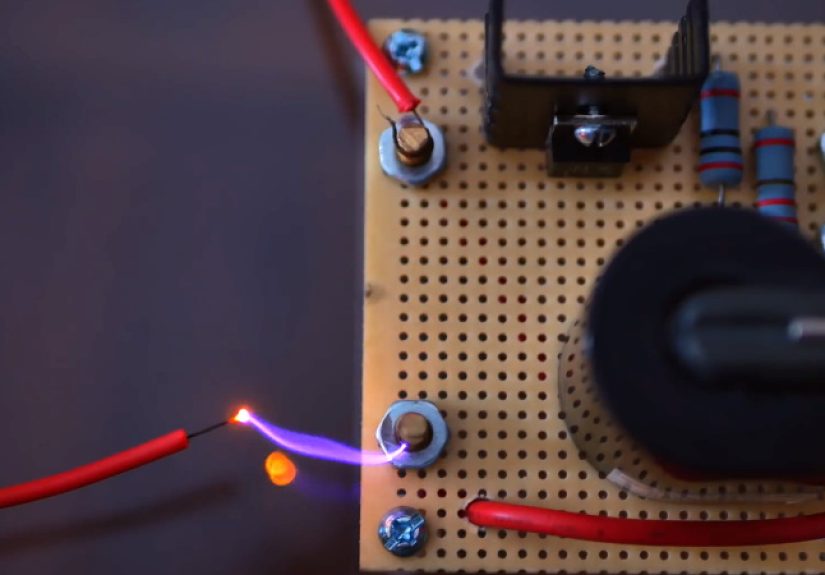
High voltage is useful for demonstrating electric fields, corona discharge, ion wind, small electrostatic motors, and attraction or repulsion effects. These experiments can be educational and visually dramatic. They also highlight why insulation, enclosure design, and current limiting matter. Air becomes less friendly when the electric field gets intense enough to ionize it.
Insulation and Leakage Testing
Small high voltage supplies can help test insulation resistance or leakage in components, cables, and assemblies. However, measurement setups need proper meters, current limiting, discharge paths, and procedures. Improvised test rigs are famous for producing misleading results and exciting noises.
What Makes a Good Mini High Voltage Power Supply?
Stable Output Voltage
Good regulation separates a real power supply from a tiny chaos machine. If the load changes, the output should remain within a reasonable range. Some applications can tolerate loose regulation, but detectors and measurement instruments usually cannot.
Low Ripple and Noise
Switching supplies generate ripple. In high voltage systems, ripple can become a serious issue because it may appear as measurement noise, flicker, false counts, or instability. Filtering helps, but high voltage filtering requires properly rated capacitors and thoughtful layout.
Current Limiting
Current limiting protects the load, the supply, and the user. A miniature high voltage supply should not be treated as safe merely because it is small. Current limiting, fusing, and fault handling are important parts of responsible design.
Proper Insulation
High voltage design is not only about schematic diagrams. Physical layout matters. Creepage is the distance along an insulating surface between conductors. Clearance is the distance through air. Both become critical as voltage rises. Dust, humidity, flux residue, sharp solder points, and cramped PCB routing can all encourage arcing or tracking.
Predictable Controls
A variable high voltage supply should have controls that are smooth, labeled, and hard to bump accidentally. Nothing ruins a careful experiment faster than a twitchy trim pot that jumps from “gentle bias” to “angry lightning beetle.”
Safety: The Part That Keeps the Fun Fun
High voltage safety is not optional decoration. It is the main character. Even low-current high voltage can be dangerous under the wrong conditions, especially when capacitors store energy after power is removed. A circuit can appear dead and still hold a painful or hazardous charge.
Responsible high voltage hacking includes insulated enclosures, bleeder resistors, clear labeling, protected terminals, proper connectors, and a habit of verifying discharge before handling. Use meters and probes rated for the voltage involved. Keep one hand away from the circuit when practical, avoid jewelry, keep the bench dry, and never work when tired or distracted. High voltage is not impressed by confidence.
Another important rule: do not rely on air as your only insulation plan. Air can break down, especially near sharp points or contaminated surfaces. Rounded conductors, generous spacing, conformal coating, potting, or encapsulation may be needed depending on voltage and environment. When in doubt, design for more spacing, not less. Electrons are tiny, sneaky, and apparently committed to finding the shortest bad idea.
Choosing a Miniature High Voltage Module
When selecting a module, start with the load. What voltage does it need? How much current? How stable must the output be? Is ripple important? Does the load need positive or negative voltage? Is isolation required? Will the module run from a battery, USB supply, bench supply, or embedded system?
For a Geiger tube, choose a module designed for detector bias, not a random spark generator. For a PMT, look for low ripple, stable regulation, and documentation. For Nixie tubes, choose a supply with adequate current and appropriate output adjustment. For experiments involving arcs or corona, understand that many small modules sold online are not built for continuous abuse. They may overheat, drift, or fail dramatically.
Documentation is a good sign. A datasheet should list input voltage, output voltage range, maximum current, ripple, regulation, operating temperature, efficiency, isolation rating, and pinout. If the only documentation is a blurry marketplace photo and the phrase “super powerful high pressure module,” proceed with skepticism and maybe a fire-safe work surface.
Bench Testing Without Drama
Testing a miniature high voltage supply should be slow and deliberate. Begin with a current-limited input supply where possible. Use a rated high voltage probe or meter arrangement. Keep the output unloaded at first only if the manufacturer allows it; some supplies do not like open-circuit operation. Add an appropriate load or divider when required.
Watch for heat, smell, noise, corona glow, unstable readings, and sudden changes in input current. These are not personality quirks; they are clues. If a module makes a hissing sound, leaves carbon marks, or creates visible discharge where none should exist, stop and inspect the layout, insulation, and load conditions.
It is also wise to treat high voltage wiring as part of the circuit, not an afterthought. Use wire and connectors rated for the voltage. Avoid loose alligator clips at kilovolt levels. Keep leads short where practical, but maintain safe spacing. Secure the module so it cannot slide across the bench like a tiny electrified skateboard.
Design Lessons from Mini High Voltage Projects
The first lesson is humility. High voltage does not care that your circuit worked perfectly at 5 V. At higher voltage, the board itself becomes part of the design. Surface contamination matters. Fingerprints matter. Solder flux matters. Corners matter. A layout that looks neat at logic voltage may become a miniature thunderstorm when pushed into the kilovolt range.
The second lesson is that power and voltage are different stories. A 1,000 V supply delivering microamps behaves very differently from one delivering milliamps. Stored energy is also its own story. A capacitor charged to high voltage can deliver a sharp, dangerous pulse even if the supply feeding it is modest.
The third lesson is that measurement changes everything. High voltage probes have input resistance and capacitance. Voltage dividers load the circuit. Long wires add capacitance. The act of measuring can alter the circuit’s behavior, especially in low-current systems. This is why careful instrument builders document the test setup, not just the reading.
Experience Notes: Working With a Miniature Power Supply For High Voltage Hacking
The most useful experience with miniature high voltage supplies is learning to slow down. Low-voltage electronics encourages quick experiments: plug in a breadboard, move a jumper, try again. High voltage punishes that rhythm. The better workflow is closer to lab work: plan, inspect, energize, measure, discharge, verify, then touch. It sounds formal, but after a few sessions it becomes natural.
One practical lesson is that enclosures are not just for finished products. Even during prototyping, a temporary shield can prevent accidental contact and reduce surprises. Clear acrylic, properly spaced insulating barriers, or a purpose-built test box can make experiments easier to observe without leaving conductors exposed. The goal is not to make the bench look fancy; it is to make the dangerous parts boringly inaccessible.
Another experience worth sharing is that cheap high voltage modules vary wildly. Two modules with the same advertised rating may behave differently under load. One may regulate reasonably well while another sags, squeals, or creates corona at the output pins. Before trusting a module in a project, test it with the intended load and operating time. A supply that survives a five-second spark demo may not survive an afternoon powering a detector.
High voltage also teaches respect for cleanliness. A PCB that looks clean may still have flux residue that encourages leakage. Dust and humidity can create conductive paths. In sensitive circuits, leakage current can be large compared with the actual load current. Cleaning, spacing, and insulation often improve performance more than swapping random components.
Thermal behavior is another quiet teacher. Miniature supplies are compact, and compact things have limited room to shed heat. A module may be comfortable at low output current but become hot when asked to run near its rating. If it is enclosed, heat becomes more important. Ventilation, derating, and realistic duty cycles matter. The smallest supply is not always the best supply; sometimes the slightly larger module is the one that does not cook itself.
In detector projects, patience pays off. Geiger tubes and photomultiplier tubes often need stable bias and careful signal handling. A noisy supply can look like a sensor problem. A poor ground layout can imitate mysterious radiation. A bad cable can become an antenna. The solution is usually not dramatic; it is methodical testing. Check the supply. Check the load. Check the measurement tool. Check the shielding. Then check your assumptions, because assumptions are where many gremlins rent apartments.
For display projects such as Nixie clocks, the experience is more aesthetic but still technical. Tube brightness, resistor values, supply headroom, and switching noise all affect the final result. A clean high voltage rail makes the display look more consistent. Good layout reduces noise in nearby logic circuits. Proper insulation keeps the charming retro glow from becoming a maintenance headache.
The best overall habit is to build a high voltage checklist. Before powering up, confirm the input supply limit, output connections, load rating, meter rating, discharge path, enclosure, and emergency shutoff. After powering down, verify discharge before adjusting anything. This routine may feel excessive for a module smaller than a postage stamp, but voltage does not scale with cuteness.
Finally, the most rewarding part of high voltage hacking is that it makes invisible physics visible. Electric fields pull dust, bend tiny streams of ionized air, light gas-filled tubes, bias sensors, and reveal insulation weaknesses. A miniature high voltage power supply is not just a component; it is a ticket into a part of electronics where layout, materials, air, humidity, and measurement technique all matter. Treat it with respect, and it becomes a remarkable tool. Treat it casually, and it becomes an unusually educational mistake.
Conclusion
A miniature power supply for high voltage hacking is one of the most interesting tools an electronics enthusiast can explore. It transforms ordinary low-voltage input into the kind of output needed for detectors, displays, electrostatic experiments, and specialized sensors. The best supplies are compact, regulated, low-noise, current-limited, well-insulated, and properly documented.
But the real skill is not merely producing high voltage. It is producing it safely, measuring it correctly, and using it for a clear purpose. High voltage work rewards careful planning and punishes shortcuts. If you respect creepage, clearance, stored energy, rated probes, enclosures, and discharge procedures, a tiny high voltage supply can become a powerful learning tool rather than a tiny troublemaker with pins.
Note: This article is written for educational and publishing purposes. It avoids dangerous step-by-step construction instructions and emphasizes safe, responsible experimentation with high voltage electronics.