Table of Contents >> Show >> Hide
- The Strange Fun of Turning Celebrities Into Kids With A.I.
- How A.I. Age Regression Actually Works
- The 21-Pic Test: Who Looked Convincing?
- Why Some A.I. Celebrity Kids Look “Right”
- Why Some A.I. Celebrity Kids Look Wrong
- The Ethics: Cute Experiment or Digital Likeness Minefield?
- What This Test Teaches Us About A.I. Image Accuracy
- My Experience Testing Celebrity Age-Regression A.I.
- Conclusion
- SEO Tags
What happens when artificial intelligence tries to rewind famous faces back to childhood? Sometimes it creates a sweet little time-machine moment. Sometimes it creates a child who looks like they already have a mortgage, a publicist, and unresolved contract negotiations.
The Strange Fun of Turning Celebrities Into Kids With A.I.
Artificial intelligence has become very good at remixing faces. Give it a famous adult face, ask it to imagine that person as a child, and within seconds it can produce a tiny version of Rihanna, Ed Sheeran, Barack Obama, Lady Gaga, or Jennifer Lopez. The result is part digital art, part facial recognition puzzle, and part internet party trick. It is also a surprisingly useful way to see what A.I. understands about identity.
The idea behind this experiment is simple: take 21 well-known celebrities, run them through an A.I. age-regression process, and compare the results against what we already know from real childhood photos, public archives, and the facial traits that made those people instantly recognizable in the first place. A good result should not merely shrink the face. It should preserve the ingredients of recognition: eye shape, smile, bone structure, hairline, expression, and that mysterious celebrity “spark” that makes your brain say, “Oh, that is absolutely them,” even before the caption gives it away.
That is where things get hilarious. Some A.I. celebrity kids look impressively believable. Others look like the software panicked, grabbed a random yearbook photo from the universe, and hoped nobody would ask too many questions. The best images feel like lost family-album snapshots. The worst ones feel like casting choices for a school play titled Famous People: The Confusing Years.
How A.I. Age Regression Actually Works
A.I. image tools do not “remember” what a celebrity looked like as a child in the way a person remembers a photo. Instead, they analyze visual patterns. They learn how adult faces tend to change with age, then apply those patterns backward. Wrinkles soften, cheeks become fuller, jawlines shrink, eyes look larger, and skin texture becomes smoother. In theory, the model is rebuilding a younger version of the same person. In practice, it is making a very educated guess with a paintbrush made of math.
The challenge is that childhood faces are not just smaller adult faces. Real children have different proportions. Their personalities are less visually “branded.” A celebrity’s adult image is often shaped by styling, makeup, lighting, cosmetic choices, facial hair, fame-era fashion, and decades of public photos. Strip all that away and the A.I. has to decide what is essential. Is Ed Sheeran still Ed Sheeran without the adult beard and stage-worn expression? Is Rowan Atkinson recognizable if his comic timing is reduced to a tiny serious face? Can Lady Gaga look like Lady Gaga before the avant-garde fashion armor arrives? These are the big questions. Scholars may call them synthetic media issues. The internet calls them Tuesday.
The 21-Pic Test: Who Looked Convincing?
The original lineup included a wide mix of celebrities and public figures: Rihanna, Ed Sheeran, Rowan Atkinson, John Travolta, Mark Zuckerberg, Barack Obama, Susan Sarandon, Scarlett Johansson, Robert Downey Jr., Will Smith, Celine Dion, Antonio Banderas, Reese Witherspoon, Sylvester Stallone, Justin Bieber, Mark Wahlberg, Rita Hayworth, Luíza Brunet, Lady Gaga, Paris Hilton, and Jennifer Lopez. That variety makes the experiment more interesting because the A.I. has to handle different ages, ethnic backgrounds, eras, beauty standards, and public personas.
The Best Results: When the Face Still Feels Familiar
Rihanna is the kind of subject A.I. should handle well because her face has strong, balanced features that remain recognizable even when softened. A convincing child version should preserve the eyes, the facial symmetry, and that unmistakable calm confidence. When an A.I. gets Rihanna right, the result does not need heavy styling. The face alone does the work.
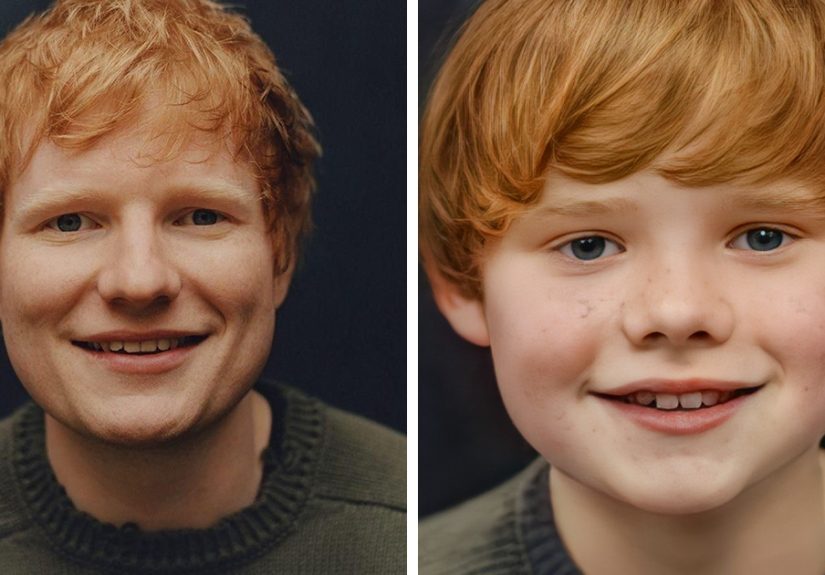
Ed Sheeran is another strong test case because his look is distinctive in a very human way. Red hair, soft features, and a friendly expression give the model plenty to hold onto. The joke, of course, is that a child version of Ed Sheeran may look only slightly younger than adult Ed Sheeran on a casual day. Some faces are already operating in permanent “nice kid from music class” mode.
Rowan Atkinson is more difficult. His recognizability depends not only on facial structure but also on expression. The eyebrows, the mouth, the slightly theatrical seriousness these are huge parts of why people recognize him. A good A.I. child version of Atkinson has to keep the comic geometry without turning the child into a tiny Mr. Bean impersonator. When it works, it is oddly charming. When it fails, it becomes a Victorian ghost child who has just seen the electricity bill.
The Mixed Results: Close, But Not Quite
John Travolta, Robert Downey Jr., Will Smith, and Mark Wahlberg reveal one of the main weaknesses of A.I. age regression: it often overgeneralizes male celebrity faces. It may smooth the skin and round the jaw, but it can lose the unique traits that make the person identifiable. Adult charisma does not always translate into childhood pixels.
For example, a young Robert Downey Jr. should retain a certain sharpness around the eyes and mouth, even as a child. If the A.I. rounds everything too much, he can start looking like “random handsome kid from a cereal commercial.” Will Smith is another difficult subject because many people have seen real images of him when he was young. The audience has a built-in fact-checker. If the A.I. version does not match the real Fresh Prince-era memory, viewers notice immediately.
Mark Zuckerberg is funny for a different reason. His public image is already filtered through years of memes about robotic calm and tech-founder awkwardness. When A.I. turns him into a kid, viewers are not only judging facial accuracy. They are judging whether the image contains the correct amount of “future platform update at 3 a.m.” energy. That is not a standard scientific metric, but perhaps it should be.
The Toughest Results: When A.I. Loses the Person
Jennifer Lopez, Paris Hilton, Lady Gaga, and Rita Hayworth are especially challenging because their famous images are deeply tied to styling, era, glamour, and performance. J.Lo’s adult face is recognizable, but her public identity also includes hair, makeup, movement, fashion, and star power. A child version that misses her facial heritage or softens her into a generic doll-like image will feel wrong fast.
Lady Gaga is almost unfair to the machine. Which Gaga should the A.I. reverse-engineer? The glam-pop star? The dramatic actor? The avant-garde fashion shapeshifter? The stripped-down singer-songwriter? A.I. loves visual averages, but Gaga has built a career out of refusing to be average. So the model may produce a cute child, but not necessarily a child who feels like Stefani Germanotta before the lightning bolt hit pop culture.
Rita Hayworth shows another limitation: historical context. Her adult Hollywood image was shaped by studio-era beauty standards, hair color changes, styling, and identity transformation. If an A.I. only sees the final movie-star version, it may project that glamour backward instead of imagining the real child behind the manufactured icon. That is where A.I. can become visually impressive but historically clumsy.
Why Some A.I. Celebrity Kids Look “Right”
When these images succeed, they usually do three things well. First, they preserve the eyes. Humans rely heavily on the eye area for recognition, and A.I. age regression that keeps the spacing, shape, and emotional tone of the eyes has a better chance of passing the “that’s them” test.
Second, the best images avoid over-smoothing. A child’s face is softer than an adult’s, but it still has structure. Too much smoothing creates a porcelain-doll effect, which may look pretty but not personal. The result becomes less “young celebrity” and more “stock photo child who is suspiciously good at networking.”
Third, the strongest results keep personality. This is hard because personality is not a pixel. It is expression, posture, styling, and memory. Yet the most convincing A.I. transformations somehow retain a little spark of the adult persona. A tiny Rihanna should still look like she knows something you do not. A tiny Sylvester Stallone should probably look like he is about to challenge the playground slide to a rematch.
Why Some A.I. Celebrity Kids Look Wrong
The failures are just as revealing. A.I. often struggles with ethnicity, historical styling, unusual facial proportions, and celebrity faces that have changed significantly over time. It may also confuse visual fame with personal identity. In other words, if the adult celebrity is famous partly because of a hairstyle, beard, makeup style, or fashion era, the model may not know what to do when those clues disappear.
Another issue is that A.I. does not understand childhood as biography. It understands childhood as a visual category. It knows “bigger eyes,” “rounder cheeks,” “smaller chin,” and “smoother skin.” It does not know that a real child grew up in a particular family, country, decade, school system, or cultural environment. That missing context matters. Without it, age-regressed celebrities can look technically polished but emotionally generic.
There is also the “uncanny yearbook” problem. Some images look plausible, but not specific. The child could be anyone. This is the danger zone for A.I. art: the picture is clean, the lighting is nice, the face is cute, and yet the recognition is gone. It is like receiving a celebrity look-alike from a parallel universe where everyone had better skin and fewer distinguishing features.
The Ethics: Cute Experiment or Digital Likeness Minefield?
At first glance, turning celebrities into kids seems harmless. It is playful, imaginative, and clearly not meant to fool anyone into thinking these are authentic baby photos. But this kind of experiment sits inside a much bigger conversation about A.I.-generated likenesses, deepfakes, consent, and digital identity.
Celebrities are public figures, but they are still people whose faces, voices, names, and personas carry value. As A.I. tools become more powerful, the line between fan art, satire, commentary, and unauthorized exploitation becomes more complicated. A fake childhood portrait is usually low-risk when it is labeled clearly and presented as creative work. But the same technology can be used to create fake endorsements, misleading political images, scam ads, or damaging impersonations.
That is why transparency matters. A.I.-generated celebrity images should be labeled as A.I. art. Viewers should not have to play detective. The more realistic the image, the more important the disclosure. A funny gallery can become misinformation very quickly when captions are removed, images are reposted, or context gets flattened by social media.
What This Test Teaches Us About A.I. Image Accuracy
The biggest lesson is that A.I. can imitate visual age, but it cannot guarantee personal truth. It can make a celebrity look younger, but “younger” is not the same as “accurate.” Accuracy requires comparison to real childhood photographs, knowledge of family resemblance, awareness of ethnic and historical context, and careful human judgment.
In that sense, this 21-pic experiment works best as entertainment and media literacy at the same time. It invites us to laugh, but it also teaches us to inspect images more carefully. Does the face preserve identity? Are the proportions believable? Does the image rely on stereotypes? Is it labeled clearly? Could someone misread it as real? These questions are becoming normal parts of looking at pictures online.
A few years ago, most people saw a realistic photo and assumed it began with a camera. Today, that assumption is shaky. Watermarking tools, content credentials, and platform detection systems are developing quickly, but viewers still need a healthy sense of skepticism. The internet has always rewarded curiosity. Now it also rewards people who zoom in, read captions, and ask, “Wait, where did this image actually come from?”
My Experience Testing Celebrity Age-Regression A.I.
Testing A.I. celebrity transformations is more addictive than it should be. You start with one face, purely for research, obviously. Then suddenly you are 40 minutes deep, comparing jawlines like a forensic art historian with too much coffee. The fun comes from the tiny moment of recognition. When the image works, your brain lights up. You feel as if you have discovered a secret school photo hidden in a drawer.
My first rule is to judge the image without reading the name. If I can recognize the person quickly, the A.I. has done something right. If I need the caption, the image may still be cute, but it is not accurate. A good age-regression image should not simply create an attractive child. It should create a believable younger version of that specific person. That difference sounds small until you look at a gallery where half the celebrities accidentally become cousins.
The second thing I look for is whether the A.I. preserved asymmetry. Real faces are not perfectly symmetrical. A slightly uneven smile, a distinctive brow, a particular eye shape, or a unique nose bridge can be the difference between “That is Scarlett Johansson” and “That is a child actor from a toothpaste commercial.” Many A.I. tools love to beautify faces into smooth, symmetrical perfection. Unfortunately, perfection is often where recognition goes to die.
The third test is cultural and historical believability. A child version of Rita Hayworth should not look like a modern influencer’s niece dressed for a retro filter. A young Antonio Banderas should not lose the warmth and regional identity that make his face recognizable. A.I. can flatten these details if the prompt is vague or if the model leans too heavily on generic beauty patterns.
The funniest part of the process is watching the A.I. overcommit. It may decide that every child needs giant sparkling eyes, pillow cheeks, and lighting that suggests they are being photographed for a luxury cereal campaign. It may turn rugged actors into angelic toddlers or glamorous pop stars into suspiciously polished pageant contestants. These mistakes are not just funny; they reveal the model’s assumptions about childhood, beauty, and fame.
After testing enough images, I came away impressed but cautious. A.I. is excellent at producing something that feels emotionally plausible. It is less reliable at producing something biographically accurate. The best use of these celebrity kid images is not to claim, “This is what they looked like.” It is to say, “Here is how A.I. imagines them, and here is where the machine gets clever, confused, or accidentally hilarious.”
That is why I like this topic. It gives readers a fun entry point into a serious technology. You can enjoy the gallery, laugh at the weird ones, admire the convincing ones, and still leave with a sharper understanding of synthetic media. The future of images will not be all fake or all real. It will be a messy mix of photography, editing, A.I. generation, disclosure labels, and human judgment. So yes, let the A.I. turn celebrities into kids. Just keep the caption honest, the skepticism awake, and the jokes ready.
Conclusion
I Test How Accurately This A.I. Turns Celebrities Into Kids (21 New Pics) is more than a funny celebrity gallery. It is a small window into how artificial intelligence understands faces, memory, age, and fame. When the results are good, they feel like a charming glitch in time. When they are bad, they remind us that A.I. is not a magic family album. It is a prediction machine with excellent lighting and occasional confidence problems.
The best way to enjoy these images is with curiosity and clear labeling. Treat them as digital art, not evidence. Compare them with real childhood photos when possible. Notice what the A.I. preserves and what it erases. And most of all, remember that behind every famous face is a real human identity, not just a prompt waiting to be remixed.
SEO Tags
Note: This article is written as original commentary and analysis for web publication. It discusses A.I.-generated celebrity age-regression images as creative digital art, not as authentic childhood photographs.