Table of Contents >> Show >> Hide
- How an interest-only mortgage works
- Interest-only mortgage vs. other “low payment” loans
- Why do people choose interest-only mortgages?
- The biggest advantages
- The biggest risks and drawbacks
- How lenders typically qualify borrowers for interest-only mortgages
- Key terms you should understand before signing anything
- Questions to ask your lender (and yourself)
- Alternatives to consider
- Bottom line: who is an interest-only mortgage really for?
- Real-world experiences with interest-only mortgages
An interest-only mortgage is exactly what it sounds like: for a set period at the beginning of the loan,
your required monthly payment covers only the interestnot the amount you borrowed (the principal).
That means your payment can look pleasantly “small” for a while… and then suddenly grow up, get a job, and start paying principal later.
Interest-only loans aren’t automatically “good” or “bad.” They’re a specific tool that can help in specific situations
(high income, predictable future cash, short holding period). But they can also backfire if you’re counting on
home prices always going up, refinancing always being available, or your future income always being higher.
How an interest-only mortgage works
Most interest-only mortgages are structured as adjustable-rate mortgages (ARMs) with an “interest-only feature.”
Here’s the usual setup:
- Interest-only period (often 3, 5, 7, or 10 years): required payments cover interest only.
- Repayment period (the remaining years): payments switch to principal + interest so the loan fully pays off by the end of the term.
During the interest-only period, your principal balance typically stays the same (unless you choose to pay extra).
When the interest-only period ends, you must start paying principaloften over a shorter remaining termwhich is why the payment can jump.
A quick example (with real math, not wishful thinking)
Suppose you borrow $500,000 at 6.50% on a 30-year loan with a 10-year interest-only period.
- Interest-only payment: $500,000 × 6.50% ÷ 12 ≈ $2,708/month (principal not included).
-
After 10 years, you still owe about $500,000 (assuming you only paid interest). Now you have 20 years left to pay it off.
The fully amortizing payment at the same rate is about $3,728/month.
That’s roughly a $1,020/month increase. And that’s before considering that many interest-only mortgages are ARMs,
meaning the rate may adjust too. Translation: the “later” payment can be higher than you expected.
Interest-only mortgage vs. other “low payment” loans
Interest-only vs. traditional fixed-rate mortgage
A traditional 30-year fixed mortgage starts paying principal from day one. Your payment is typically higher than an interest-only payment
at the same interest ratebut you build equity faster and reduce the risk of a big payment jump later.
Interest-only vs. balloon mortgage
A balloon mortgage can also have lower payments early on, but it ends with a large lump-sum payment (the “balloon”).
Interest-only loans usually don’t require a single lump sum at the endhowever, they can still feel “balloon-ish” if you planned to refinance
and then can’t. Different mechanics, similar “uh-oh” potential if your exit strategy depends on perfect conditions.
Interest-only vs. payment-option ARM (watch for negative amortization)
Some products historically allowed payments that could be less than the interest due, causing the balance to grow.
That’s called negative amortization. Not all interest-only mortgages do this, but some adjustable products can.
If your loan allows negative amortization, you’re not just treading wateryou’re swimming backward with a backpack full of bricks.
Why do people choose interest-only mortgages?
The main appeal is cash-flow flexibility. A lower required payment can free up money for other goalsespecially if you have
a clear plan and the ability to handle higher payments later.
Common situations where it can make sense
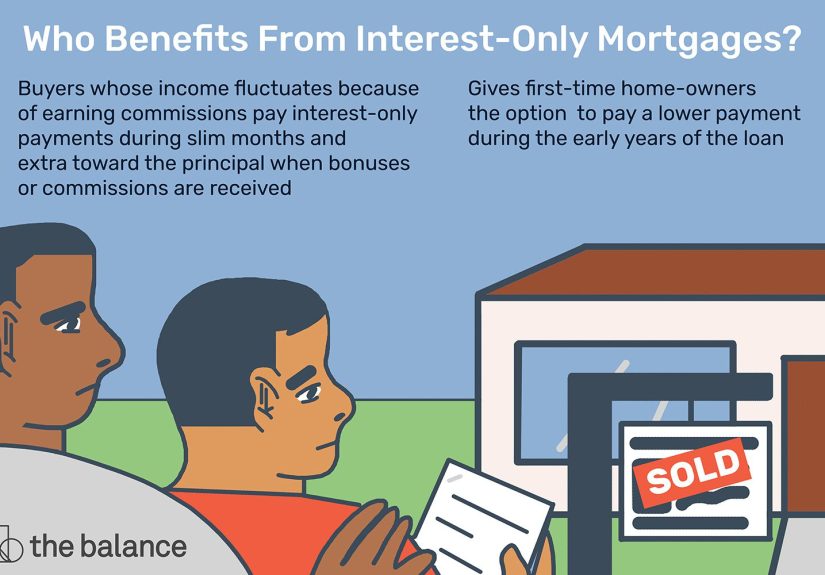
- High earners with uneven income (bonuses, commissions, business owners) who prefer flexibility and can make extra principal payments when cash is strong.
- Short-term homeowners who expect to sell before the interest-only period ends (job relocation, planned upgrade, temporary housing).
- Jumbo borrowers purchasing high-priced homes where interest-only options may be more available in the nonconforming market.
- Strategic liquidity planning (for example, keeping more cash available during a renovation or a business expansion).
Notice what these have in common: the borrower has a plan and financial resilience.
Interest-only loans are not designed for “I hope it works out” as the primary strategy.
The biggest advantages
1) Lower required monthly payments (at first)
Paying only interest reduces the required payment during the interest-only period, which can help with short-term affordability or liquidity.
2) Flexibility to pay principal when you choose
Many interest-only mortgages still allow (or even encourage) extra payments. If you make voluntary principal payments during the interest-only period,
you can reduce the later payment jump and build equity.
3) Useful for short holding periods
If you truly plan to sell within a few years, an interest-only structure may align with that timeline. (Big emphasis on “truly,” not “maybe.”)
The biggest risks and drawbacks
1) Payment shock
When the interest-only period ends, you must start repaying principal over fewer remaining years. Even if your interest rate stays the same,
the payment often increases significantly. If the rate adjusts upward, the increase can be larger.
2) You build little to no equity from payments
With interest-only payments, your loan balance usually doesn’t shrink. If home prices flatten or fall, you can end up with limited equityexactly when you might need it
to refinance or sell without bringing cash to the closing table.
3) Refinancing may not be available when you need it
Many borrowers assume they’ll refinance before the payment rises. But refinancing depends on:
your credit, your income, the home’s value, and market interest rates. If any of those move against you, refinancing can be harder or more expensiveor not possible.
4) Interest-only loans may be harder to find (and may come with stricter requirements)
After the mortgage crisis, underwriting tightened and many mainstream programs moved away from interest-only features in the conforming market.
Interest-only options are often found in jumbo or nonconforming lending, which can mean higher standards and more documentation.
5) Extra complexity
Interest-only loans often come as ARMs with caps, indexes, margins, adjustment schedules, and “recast” dates.
If those terms make your eyes glaze over, that’s your cue to slow downnot speed up.
How lenders typically qualify borrowers for interest-only mortgages
Requirements vary by lender and program, but interest-only mortgages often expect stronger borrower profiles than standard loans.
You may see:
- Higher credit score expectations (often “good to excellent”).
- Larger down payment compared with some traditional programs.
- Lower debt-to-income ratio (DTI) to show you can handle the future payment.
- Strong cash reserves (months of payments in savings/investments).
- Full income documentation (pay stubs, tax returns, asset verification).
A big underwriting question is: Can you afford the payment after it resets?
In many cases, lenders evaluate affordability using the higher, fully amortizing payment (and sometimes an adjusted rate), not just the teaser payment.
Key terms you should understand before signing anything
Interest-only period
The initial years when payments can be interest-only. Know exactly when it ends.
Fully amortizing payment
The payment amount required to pay off principal + interest by the end of the term after the interest-only period ends.
ARM index, margin, and caps
If your loan is an ARM, your rate is typically based on an index plus a margin, and capped by annual and lifetime limits.
These details determine how high (and how quickly) your payment can rise.
Recast / recalculation
Some adjustable products recalculate payments at set intervals. Understand the schedule and what triggers changes.
Negative amortization (if applicable)
If your loan allows payments that don’t cover interest, your balance can grow. If the loan has this feature, treat it like a bright red warning label.
Questions to ask your lender (and yourself)
- What will my payment be on the first month after the interest-only period ends?
- What’s the highest possible payment under the rate caps?
- Can I pay extra principal during the interest-only period, and are there any penalties?
- How does the lender underwrite affordabilityusing the initial payment or the future payment?
- What’s my plan if home values drop and refinancing is off the table?
If your plan is “I’ll just refinance,” pause. That’s not a plan; it’s a wish with paperwork.
Alternatives to consider
1) A standard fixed-rate mortgage
Boring can be beautiful. Fixed payments, steady principal payoff, simpler long-term planning.
2) A traditional ARM without interest-only payments
If you want a lower initial rate and plan to move within a set period, a standard ARM may offer a balance of lower early payments
while still building equity.
3) A larger down payment (or buying slightly less house)
Not glamorous, but it reduces your payment and your risk without adding loan complexity.
4) Paying points or shopping lenders aggressively
Depending on your time horizon, paying points might reduce your rate and monthly payment without the interest-only reset risk.
Bottom line: who is an interest-only mortgage really for?
An interest-only mortgage is best suited for borrowers who have:
strong finances, a clear timeline, a realistic exit strategy, and the discipline to plan for higher payments.
It can be a legitimate tool for short-term ownership or cash-flow management, especially in jumbo lending.
But if you need interest-only payments just to qualify for the home you want, that’s a big signal that the home (or the loan) may be too expensive
for your current budget. A mortgage should help you build a lifenot trap you in a monthly payment surprise party you didn’t RSVP to.
Real-world experiences with interest-only mortgages
The internet loves extremes: interest-only mortgages are either “a genius hack” or “the financial villain of the century.”
Real life is more nuanced. Here are a few common, realistic experiences people run intoshared as illustrative scenarios,
not promises of what will happen to you.
Experience 1: The “I’m moving in 3–5 years anyway” buyer
This borrower takes an interest-only ARM because the monthly payment is lower and they expect to relocate for work.
For the first couple years, everything feels great. They direct extra cash to their emergency fund and enjoy the flexibility.
The catch? Life happens. The job transfer gets delayed. The local housing market cools. Now the borrower is still in the home as the interest-only period
approaches its end, and the future payment looks a lot bigger than the current one. The lesson many people learn here is that
an interest-only mortgage can work well only if the timeline stays true. If your plan depends on a move, it’s wise to have a backup:
“If I don’t move, can I still afford the fully amortizing payment?”
Experience 2: The high-income, bonus-heavy professional
Think commission-based sales, physicians early in their careers, or executives with big annual bonuses.
The monthly interest-only payment can be manageable, and they plan to make lump-sum principal payments when bonuses arrive.
In a strong year, this can be very effective: they enjoy lower required payments and still reduce principal strategically.
But in a weak yearwhen bonuses shrink or disappearthe flexibility flips into pressure. They can still make the required payment,
but the planned principal paydown doesn’t happen, which means the later reset payment remains high. Borrowers who succeed in this setup
usually share one trait: they treat bonus income like “extra,” not “guaranteed.” They keep enough cash reserves so a disappointing year
doesn’t force them into a bad refinance or a rushed sale.
Experience 3: The renovation or remodel “cash-flow manager”
Some homeowners choose interest-only payments during a renovation because they’re temporarily carrying higher expenses:
contractor draws, material orders, maybe even rent elsewhere. For a short period, the lower required payment can help keep everything afloat.
The smartest versions of this story include a detailed budget, a firm timeline, and a plan to refinance into a conventional loan once the renovation
is complete (often after the home’s value and livability improve). The risky versions? When renovations run long (which they often do),
costs rise (surprise!), and the homeowner starts leaning on the interest-only structure longer than planned.
The moral: interest-only payments can be a short-term bridge, but you don’t want to turn a bridge into a permanent address.
Experience 4: The “I’ll just refinance” optimism trap
This is the most common emotional storyline: a borrower counts on refinancing before the interest-only period ends.
Then rates rise, property values stagnate, credit scores dip, or income becomes harder to document (especially for self-employed borrowers).
Suddenly, refinancing isn’t cheapor isn’t available. The borrower faces the reset payment and feels blindsided,
even though the terms were disclosed up front. That’s not about intelligence; it’s about human nature.
We’re all tempted to believe future-us will have it handled.
The practical takeaway: before choosing interest-only, run two stress tests:
(1) “Can I afford the payment after the interest-only period ends?” and
(2) “Can I afford it if the rate is higher than today?”
If either answer is “no,” the loan may be too fragile for your life.
In the best experiences, interest-only mortgages are used intentionallylike a power tool with safety goggles.
In the worst experiences, they’re used to stretch affordabilitylike a power tool… with the instruction manual still in the box.
The difference isn’t the loan. It’s the plan.