Table of Contents >> Show >> Hide
- Why framing huge prints gets pricey (and how to outsmart it)
- Step zero: decide what “inexpensive” means for your print
- Measure like a pro (so you don’t buy the wrong thing twice)
- Cheapest option first: use a standard ready-made frame
- The smartest hack for odd sizes: buy bigger + mat it down
- Thrift-store frames: the budget MVP for giant art
- DIY a huge frame from trim molding (the best “custom look” for cheap)
- Glazing choices: acrylic vs glass (and what to do on a budget)
- Mounting: keep it flat now, avoid damage later
- No-frame options that still look intentional (and cost almost nothing)
- Design tricks that make budget framing look high-end
- Hanging huge frames safely (without a drywall tragedy)
- Cost examples (realistic, budget-friendly scenarios)
- Common mistakes (and how to fix them without crying)
- Real-world experiences: what people actually learn framing huge prints cheaply (about )
- Conclusion
Huge prints are like big dogs: lovable, dramatic, and occasionally expensive to keep nicely contained. The good news? You don’t need a museum budget (or a second mortgage) to frame oversized art. With a few smart shortcutslike standard-size frames, thrift-store rescues, DIY trim builds, and lighter glazingyou can get a clean, “I totally paid a professional” look for way less.
In this guide, you’ll learn how to plan the frame size, pick budget materials that still look legit, mount your print safely, and hang it like you know what you’re doing. We’ll also walk through real-world cost examples for common large sizes like 24×36, 30×40, and 40×60.
Why framing huge prints gets pricey (and how to outsmart it)
Custom framing costs jump fast as prints get bigger for three simple reasons:
- Materials scale up: Bigger frame molding, bigger backing, bigger mat, bigger glazingbigger receipt.
- Glazing gets heavy: Large glass is expensive to ship and risky to hang; acrylic is lighter but can cost more.
- Labor isn’t linear: Large pieces take longer to square, mount, and assembleso shops charge accordingly.
Your mission is to reduce custom work (especially custom glass and custom mats), keep weight manageable, and choose techniques that look premium without requiring premium pricing.
Step zero: decide what “inexpensive” means for your print
Before you buy anything, decide which lane you’re in:
- Budget display: Posters, digital prints, décor art, temporary pieces. You want it to look great and stay flat.
- Better preservation: Limited editions, sentimental prints, anything you’d cry about if it got damaged. You want reversible mounting, stable boards, and spacing so the print doesn’t touch the glazing.
You can do both on a budgetyou just spend money where it matters (backing/mounting and spacing) and save where it doesn’t (frame sourcing and labor).
Measure like a pro (so you don’t buy the wrong thing twice)
Get these measurements straight:
- Print size: The actual paper size (example: 24×36).
- Image area: The printed artwork area (often smaller, leaving a white border).
- Frame opening: What the frame is designed to hold (often matches standard paper sizes).
Two golden rules
- Standard sizes are your wallet’s best friend. If your print can be trimmed (or ordered) to a standard size, do it.
- If the print is odd-sized, go bigger and use a mat (or a “float” look). A mat can make an “almost fits” situation look intentionallike you planned it that way all along.
Cheapest option first: use a standard ready-made frame
If your print is already a standard size (24×36, 18×24, 16×20, 30×40), start here. Ready-made frames are usually the best cost-per-square-inch deal.
Where standard frames shine
- Big-box and home stores: Lots of sizes, frequent sales, easy returns.
- Budget furniture retailers: Great for poster sizes, minimalist looks, and “I need three frames today” energy.
- Online poster frame shops: Often cheaper than custom shops for big standard sizes.
How to make a cheap frame look expensive
- Add a mat (even a simple one): Mats create breathing room and make the piece feel “finished.”
- Upgrade the backing: Swap flimsy cardboard for foam board or mat board so the print stays flat.
- Use spacers if the print might touch the glazing (especially photos): contact can cause sticking over time.
The smartest hack for odd sizes: buy bigger + mat it down
When your print is a weird size (say 27×39, 29.5×41, or “I swear the website said 30×40”), the most budget-friendly move is often:
Buy the next standard size up and use a mat with an opening cut to your image area.
Why this saves money
- You avoid custom glass/acrylic (the priciest part).
- You avoid custom frame molding labor.
- You can replace the art later without replacing the frame.
Mat tips that prevent regret
- Keep margins generous on huge prints. Skinny mats can look accidental at large scale.
- Use thicker boards for big pieces so the glazing doesn’t touch the art and the package stays stiff.
- Leave a tiny “wiggle room” fit so the mat/backing isn’t jammed into the frame like a suitcase you sat on.
Thrift-store frames: the budget MVP for giant art
If you want the lowest price with the highest “wow,” thrift stores and resale marketplaces are your best bet. People donate huge frames because they’re awkward to movenot because they’re bad frames.
How to thrift like a framing ninja
- Shop for the frame, not the art inside it. You’re adopting the frame and politely evicting the old contents.
- Check corners for cracks, separation, or warping.
- Check the back: If it’s missing hardware, no big dealyou can add D-rings and wire.
- Don’t overpay for glass. Old glass can be scratched; plan to swap to acrylic for large frames.
Fast makeover ideas (high impact, low effort)
- Spray paint the frame matte black or warm white.
- Rub-on wax for a wood look (great on “meh” brown frames).
- New backing (foam board) instantly upgrades the feel.
DIY a huge frame from trim molding (the best “custom look” for cheap)
If you can measure, cut, and glue without starting a feud with your tape measure, you can build a large frame from common trim or picture-frame molding. This is where you get that chunky gallery look without the custom shop price tag.
What you’ll need
- Frame molding or trim (enough for all four sides)
- Miter saw (or miter box + hand saw for smaller profiles)
- Wood glue + clamps (or corner clamps)
- Brad nails (optional but helpful) and wood filler
- Sandpaper, paint or stain
- Acrylic sheet (recommended for big sizes)
- Foam board or mat board backing
- D-rings + wire (or a French cleat for very large frames)
Step-by-step: build a big frame in a weekend
- Pick your target size. Start with a standard art size if possible (24×36, 30×40). Decide if you’re using a mat.
- Plan the “lip.” Frames need an inner ledge (rabbet) that holds the glazing and backing. Some molding already has it; some trim doesn’t. If your trim doesn’t have a rabbet, you can add thin strips inside the back to create a ledge.
- Cut 45° miters. Measure carefully. Cut long, sneak up on the final length, and label pieces (top, bottom, left, right).
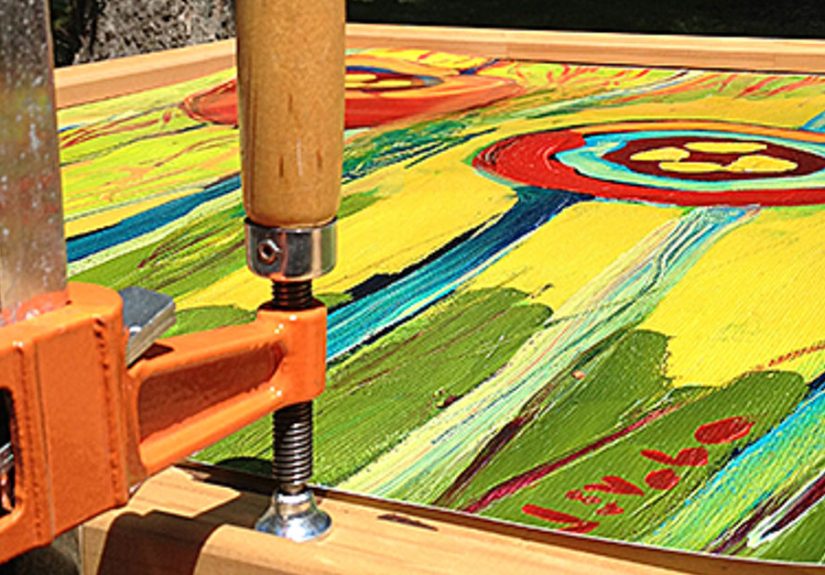
- Glue and clamp. Apply wood glue to miters, clamp corners square, and let it set. Add brads or corner braces for strength.
- Fill, sand, finish. Wood filler hides seams; sanding smooths everything out. Paint or stain, then seal.
- Add glazing + backing. Acrylic in front, your art package (mat + print + backing) behind it.
- Secure the back. Use flexible points, offset clips, or small screws with washers to hold the backing in place.
- Add hardware. D-rings on both sides, wire across. For very large frames, consider a French cleat for better weight distribution.
Humor break: The frame should be square. Your “creative interpretation of square” will show on the wall, loudly, like a karaoke singer who doesn’t know the song.
Glazing choices: acrylic vs glass (and what to do on a budget)
For huge prints, glazing is often the most annoying line item. Here’s how to choose:
Acrylic (often best for large frames)
- Pros: Lightweight, safer (less shatter risk), easier to hang big pieces.
- Cons: Scratches more easily; can build static (not ideal for very dusty environments or delicate media).
Glass (sometimes fine for smaller “large” frames)
- Pros: Scratch-resistant, crisp clarity, often cheaper in small sizes.
- Cons: Heavy, risky for oversized pieces, harder to ship and hang safely.
Budget move: Use standard acrylic sheets cut to size, or buy a ready-made frame that already includes the front. Save premium, UV-filtering museum acrylic for truly valuable prints.
Mounting: keep it flat now, avoid damage later
Mounting is where “cheap framing” can accidentally become “expensive sadness.” The goal is to keep the print flat without permanently damaging it.
Best budget-friendly mounting methods
- Hinge mounting (reversible): Use archival hinging tape to attach the print to a backing board at the top edge so it can expand/contract a bit.
- Photo corners: Great for lighter paper and anything you might swap later.
- Float mounting: If the print has a nice border, you can mount it on a backing board and show the edges for a modern look.
What to avoid (even if it’s tempting)
- Direct tape on the front: It can stain or tear paper when removed.
- Spray adhesive: Fast, but often not reversible and can cause rippling or discoloration over time.
- Letting the print touch the glazing: Over time, humidity can cause sticking or “ghosting.” A mat or spacer helps.
No-frame options that still look intentional (and cost almost nothing)
If your print is massive and you’re not ready to commit to framing, you can still display it cleanly.
Budget display ideas
- Poster rails / magnetic hangers: Minimalist and great for frequent swaps.
- Binder clips + wall hooks: Surprisingly stylish with industrial décor.
- Washi tape “gallery” corners: Works best for casual posters and kids’ rooms.
- Mount to foam board: A clean border and rigid backing can look like modern panel art.
These options aren’t “forever solutions,” but they’re perfect for renters, rotating décor, or anyone who wants to spend money on food and joy instead of exclusively on glass.
Design tricks that make budget framing look high-end
- Go bigger than you think: Large art needs visual breathing room. A wider mat or thicker frame reads “gallery,” not “dorm room.”
- Match frame finish to your room: Matte black, warm oak, and soft white are classic for a reason.
- Use consistent spacing in a grid: If you’re hanging multiple large pieces, uniform gaps look professional.
- Consider a float look: Showing the paper edge can make an inexpensive print feel more “art object.”
Hanging huge frames safely (without a drywall tragedy)
Large frames are basically sails for your wallespecially if your HVAC turns on like it’s trying to launch a spaceship.
Best practices
- Use wall anchors or hit studs for anything heavy.
- Use two hooks for wide frames to prevent tipping.
- Consider a French cleat for very large piecesit spreads weight and helps the frame sit flat.
- Add bumpers on the back corners to protect the wall and keep the frame from shifting.
Cost examples (realistic, budget-friendly scenarios)
Example 1: 24×36 print in a ready-made frame
- 24×36 poster frame (with acrylic): $25–$70
- Foam board backing upgrade: $5–$15
- Optional mat (pre-cut or simple DIY): $10–$30
Estimated total: $30–$115 depending on finishes and matting.
Example 2: Odd-size print (27×40) using a larger frame + mat
- Standard 30×40 frame: $40–$120
- Uncut mat board + cutting (or store-cut opening): $15–$60
- Mounting tape/corners: $5–$15
Estimated total: $60–$195, often far less than fully custom.
Example 3: 40×60 “statement piece” using DIY trim frame
- Trim/molding: $30–$120 (depends on profile/material)
- Acrylic sheet: $60–$200
- Backing board: $15–$40
- Hardware/fasteners/finish: $15–$50
Estimated total: $120–$410. Still potentially hundreds less than custom, and you control the look.
Common mistakes (and how to fix them without crying)
Mistake: the print waves inside the frame
Fix: Upgrade the backing (foam board), use hinge mounting, and make sure the frame package is snug (but not forced).
Mistake: the print sticks to the glazing
Fix: Add a mat or spacer so the art doesn’t touch the front.
Mistake: the frame looks “cheap” up close
Fix: Paint it matte, add a wider mat, and use a cleaner backing. Most “cheap” is really “unfinished.”
Mistake: the frame tilts like it’s judging your life choices
Fix: Use two hooks, level your wire, add bumpers, or switch to a cleat system.
Real-world experiences: what people actually learn framing huge prints cheaply (about )
When DIYers start framing huge prints on a budget, the first surprise is emotional, not technical: big art makes small mistakes look enormous. A slightly crooked mat on an 8×10 is “quirky.” On a 40×60, it’s an architectural feature you did not request. That’s why the most common “experience-based” tip is also the least exciting one: slow down on measuring and squaring. People who rush the planning step usually spend more laterbuying a second sheet of acrylic, recutting mats, or redoing corners that drifted out of square during glue-up.
The second common lesson is that cheap frames aren’t the enemyflimsy backing is. Many budget frames look totally fine from the front, but the included backing can bend, bow, and transfer that bend into your print. DIYers who swap in foam board (or a sturdier archival board) often describe it as the moment their frame went from “college apartment” to “adult who owns a cordless drill.” It’s also a morale boost because the upgrade is inexpensive and immediately visible: the print sits flatter, the corners align better, and the whole package feels more solid when you lift it.
Another big “aha” moment: mats are problem-solvers disguised as decoration. People start thinking of mats as fancy extras, then discover mats are basically framing duct tape (in a good way). A mat can hide uneven borders, rescue a print that’s slightly smaller than expected, and create separation from the glazing. When you’re working inexpensively, that flexibility is gold. DIYers who learn to cut mats (even imperfectly at first) tend to unlock a whole new level of budget framing because they can buy larger standard frames and make almost any print fit with intention.
Then there’s glazingwhere experience teaches the hard truth: big glass is not your friend. People try to reuse thrifted glass for a giant frame, carry it home like a heroic statue, and eventually realize they’re hanging a heavy, fragile sheet over their couch. The more common “experienced” move is switching to acrylic for large pieces. It’s lighter, safer, and easier to hang without feeling like you’re playing a physics-based horror game. The tradeoffscratches and staticbecomes manageable once people learn basic handling: peel the protective film last, use microfiber cloths, and avoid harsh cleaners.
Finally, many budget framers discover the joy of embracing imperfection strategically. If your print is a casual poster, a magnetic hanger or rail can look modern and intentionalplus you can swap art whenever your mood changes. If your frame corners aren’t flawless, painting them matte often hides tiny gaps better than stain. And if you’re framing something truly important, people commonly report a hybrid approach works best: save money by sourcing the frame cheaply, but spend a bit more on stable boards, reversible mounting, and spacing so the artwork stays protected. In other words, the “real experience” of cheap framing is learning where to be frugaland where to be just a little bit fancy.
Conclusion
Framing huge prints inexpensively is all about choosing your battles. Use standard frames whenever possible, size up and mat down when you can’t, thrift frames for instant savings, and DIY molding when you want a custom look. Spend your “serious” money on what protects the printsturdy backing, smarter mounting, and spacing from the glazingand save everywhere else. Your walls get the drama. Your bank account gets to keep its dignity.