Table of Contents >> Show >> Hide
- Why Halloween Is Arriving Earlier (and Why Home Depot Is Leaning In)
- What “Now in Stores” Actually Means (and When You’ll See the Full Selection)
- The Headliners: Skelly, Ultra Skelly, and the “Oh No, He Has Pets” Expansion Pack
- Two Core Styles: Grave & Bones vs. Gruesome Grounds
- Licensed Characters and Movie Monsters: When Your Yard Becomes a Horror Fan Convention
- How to Shop Home Depot’s In-Store Halloween Drop Without Regrets
- How to Build a Display That Looks Intentional (Not Accidental)
- Budget and Safety: The Unsexy Stuff That Saves Your Season
- of “In-Store” Experience Energy (So You Know What You’re Walking Into)
- Conclusion: The Aisle Is Open, the Season Is Early, and the Best Stuff Won’t Wait
There are two types of people in the world: the ones who think Halloween decorations should appear sometime around, oh, October,
and the ones who see a 12-foot skeleton in late August and whisper, “Yes. This is the correct timeline.”
If you’ve wandered into The Home Depot lately and noticed an aisle that suddenly feels like a movie set for a very polite horror film,
you’re not imagining things. Home Depot’s Halloween décor is officially showing up in storesbigger, louder, and somehow more emotionally supportive than ever.
But “now in stores” doesn’t mean the same thing it used to. The modern Halloween season is a two-phase event:
the online drop happens first (often in July or early August), and then the in-store takeover arrives latertypically late August into early fall
when the seasonal aisles flip like a haunted switch.
This guide breaks down what’s hitting shelves, why it shows up so early, which pieces tend to sell out fast,
and how to build a display that looks intentional (instead of “I panic-bought four animatronics and now I live with the consequences”).
Why Halloween Is Arriving Earlier (and Why Home Depot Is Leaning In)
Halloween shopping used to be a sprint. Now it’s a marathon with fog machines. Retailers have learned that the most enthusiastic decorators
don’t wait until Octoberthey plan, collect, upgrade, and “accidentally” expand their front-yard graveyard year after year.
Putting decorations out earlier helps stores capture that demand, especially during the slower retail stretch of midsummer.
Home Depot has openly embraced the early kickoff: it has promoted Halloween season starting in summer, with online launches appearing well before fall,
and in-store arrivals following later. The result is a predictable pattern: the internet gets first dibs, and then stores become the stage
for the “wait, is that a 15-foot scarecrow?” moment.
What “Now in Stores” Actually Means (and When You’ll See the Full Selection)
Home Depot’s Halloween timeline often works like this:
online previews and early access first, then in-store shelves stocked later.
For example, some collections have launched online in mid-July, while in-store inventory has been noted as arriving toward the end of August.
In 2024, Home Depot’s Halloween décor was reported as hitting store shelves starting August 29.
In 2025, Home Depot emphasized that online shopping would begin in early August and that items would reach stores in the fall.
Practically speaking, the in-store rollout often starts with a curated selectionbig-ticket yard icons, popular inflatables,
lighting, and a handful of “wow” piecesthen expands as shipments land. That means if your goal is a specific headline animatronic,
you’ll want to shop early; if your goal is to browse and build a theme, the aisle tends to get better (and more dangerous to your budget)
as the season gets closer.
The Headliners: Skelly, Ultra Skelly, and the “Oh No, He Has Pets” Expansion Pack
If Home Depot Halloween décor had a cinematic universe, the Skelly franchise would be the main seriescomplete with spinoffs, upgrades,
and supporting characters that are somehow both adorable and unsettling.
Skelly: The 12-Foot Celebrity Who Keeps Selling Out
Home Depot’s iconic 12-foot skeleton (affectionately nicknamed “Skelly”) became a viral sensation after its debut
and has remained one of the most recognizable outdoor Halloween props in the U.S.
It’s known for its towering size, poseable arms, and animated eye features that let you choose different looks depending on the model year.
The price point frequently referenced for Skelly has been around $299a number that has become weirdly comforting to fans,
like a seasonal tradition that says, “Yes, you are about to store a giant skeleton in your garage again.”
Ultra Skelly: Big Skelly Energy, More Tech, Less Ceiling Clearance
Not everyone has the space (or the HOA tolerance) for a 12-foot front-yard guardian. Enter Ultra Skelly:
a smaller, high-tech version with more advanced movement and interactive features.
Coverage of Ultra Skelly highlights app-controlled options, expanded eye animations, and features designed to react to guestsbasically,
the kind of décor that makes trick-or-treaters feel like they’re being judged by a skeleton who owns a smartphone.
The Skelly Pet Collection: Because Apparently We’re Doing Family Portraits Now
Alongside Skelly, Home Depot has expanded the lineup with skeletal companionsdogs and cats that match the vibe of your graveyard scene
while also making you question why you feel emotionally attached to a plastic bone animal with glowing eyes.
These companions have been widely covered as popular add-ons for building a coordinated yard display.
Two Core Styles: Grave & Bones vs. Gruesome Grounds
Home Depot’s Halloween assortment tends to fall into theme “families,” which is helpful if you want your yard to look like a deliberate set
rather than a spooky yard sale. Two big buckets get a lot of attention:
Grave & Bones and Gruesome Grounds.
Grave & Bones: Classic Cemetery Drama
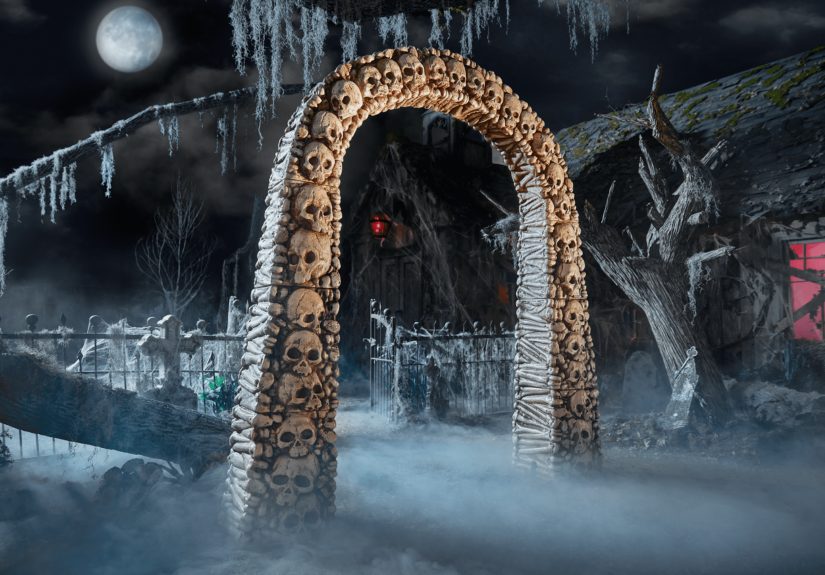
Think skeletons, archways, tombstone vibes, and the kind of Halloween aesthetic that pairs nicely with fog, lantern-style lights,
and a soundtrack of distant cackling. This is where Skelly typically lives, along with other graveyard-ready pieces that build a cohesive scene.
If you like traditional Halloweenbones, crypts, and “welcome to my yard, please scream quietly”this is your lane.
Gruesome Grounds: Fantasy Creatures, Big Scale, Maximum “Wow”
Gruesome Grounds leans into haunted-forest energy: towering scarecrows, trolls, dragons, oversized spiders, and characters that feel like they
escaped from a spooky storybook and immediately applied for a job as your front-lawn security system.
Some of the most talked-about additions include very tall animated scarecrows (up to around 15 feet in coverage),
mythical creatures like a wyvern-style dragon, and other giant props designed to become neighborhood landmarks.
Licensed Characters and Movie Monsters: When Your Yard Becomes a Horror Fan Convention
Home Depot’s Halloween lineup has also leaned into licensed characters and recognizable horror icons,
including Universal-adjacent favorites and classic monster energy. Coverage has highlighted animated figures tied to famous films,
plus returning monster staples like Frankenstein’s monster and a Bride of Frankenstein-style character in certain lineups.
Translation: you can build a yard display that feels less “random spooky stuff” and more “curated horror museum,”
especially if you mix one licensed centerpiece with supporting décor that matches the theme (graveyard fencing, spotlights, and sound).
How to Shop Home Depot’s In-Store Halloween Drop Without Regrets
1) Start with a Plan (Even a Small One)
Before you grab the biggest box you can lift, decide your goal:
one statement piece, a themed scene, or a full-yard takeover. A simple plan prevents you from accidentally creating
“Skeleton Court,” a legal drama where every character is 7 feet tall and somehow needs batteries.
2) Assume Bestsellers Will Disappear
The most in-demand itemsespecially giant animatronics and viral favoritesoften sell quickly.
If you care about a specific prop, shopping earlier (or checking availability frequently) helps.
In-store stock can vary by region, and shelves don’t always restock on a satisfying schedule.
3) Check the Box Like You’re Buying a Tiny Refrigerator
Big décor pieces come with big parts: frames, stakes, power adapters, and sometimes delicate electronics.
Inspect packaging for damage, verify what’s included, and keep receipts. If the box looks like it wrestled a forklift and lost,
pick a cleaner oneyour future self will thank you.
4) Think About Storage Before You Buy the Giant Thing
If you’re investing in large décor, storage is not optionalit’s the secret to keeping the props functional year after year.
Coverage around Home Depot’s lineup has even pointed shoppers to large storage totes and décor storage solutions designed for bulky pieces.
The best Halloween display is the one you can safely pack away without turning your garage into a bone-themed obstacle course.
How to Build a Display That Looks Intentional (Not Accidental)
Pick One “Hero” Item
A great yard setup usually has one centerpiece: Skelly, a towering scarecrow, a dragon, or a giant spider.
Everything else supports that hero item. When you choose the hero first, you can shop supporting décor with purpose
(lighting, ground props, archways, smaller figures).
Use Lighting to Make Cheap Stuff Look Expensive
The difference between “pile of decorations” and “Halloween scene” is often lighting.
Add spotlights pointed up at your hero prop, mix warm and cool tones intentionally, and use shadows to create depth.
Even simple décor looks elevated when it’s lit like a stage.
Layer Height Like a Designer
Tall in back, medium in the middle, small up front. If everything is the same height, your display reads flat.
If you mix sizes, it reads like a scene. Use archways or tall props as the skyline, medium figures as the cast,
and ground props (tombstones, skull stacks, pumpkins) as texture.
Don’t Forget Sound (But Keep It Neighbor-Friendly)
Sound effects are fun until your neighbors start planning a counter-display called “Noise Complaint.”
If you use audio, keep it timed, moderate in volume, and focused near the front door for trick-or-treaters,
not blasting across the block at 10:30 p.m.
Budget and Safety: The Unsexy Stuff That Saves Your Season
- Power: Use outdoor-rated extension cords and weather-resistant connections.
- Stability: Stake and secure tall props. Wind does not respect your creative vision.
- Placement: Keep pathways clear for visitors. A spooky vibe is great; a twisted ankle is not.
- Weather: Consider rain exposure and whether props need covered placement.
- Maintenance: Store props clean and dry, and label parts so setup next year isn’t a puzzle.
of “In-Store” Experience Energy (So You Know What You’re Walking Into)
The in-store Halloween moment at Home Depot has a very specific feel, and if you’ve never experienced it, it’s worth preparing yourself.
You walk in thinking you’re there for something responsiblelight bulbs, a rake, maybe a storage toteand then you spot it:
a seasonal aisle that looks like it’s hosting a reunion for every skeleton who has ever haunted a suburban lawn.
The lighting shifts. The boxes get taller. Your shopping cart starts to feel emotionally available for poor decisions.
Many shoppers describe the first in-store wave as a blend of excitement and strategy. People slow down, scan the shelves,
and do that little “Is this the one?” head tilt at giant boxes. If a marquee animatronic is present, it becomes an instant landmark.
You’ll see customers circling like they’re evaluating real estate: “Could this fit by the porch?”
“If I angle it diagonally, could I still open the garage?”
“If I buy this today, will my family still speak to me by Thanksgiving?”
The best part of shopping in-store is the reality check: scale is hard to grasp online.
In person, you realize that “7 feet tall” is not a casual purchaseit’s a commitment.
You start measuring with your eyes. You look at the ceiling. You imagine the storage situation.
You also notice how décor pieces “read” from a distance: some props look incredible up close but disappear at the curb,
while others have bold silhouettes that feel made for front-yard theater.
The aisle itself tends to encourage scene-building. You’ll find yourself picking up smaller supporting pieces you didn’t plan on:
a set of lights to create shadows, ground décor to add texture, maybe an archway because suddenly you believe your front walkway deserves
an “entrance moment.” This is also where you overhear the unofficial Halloween economy at workpeople comparing notes on what sold out online,
which store got the best shipment, and whether it’s “too early” (spoiler: someone always says it’s too early, while holding three skull-themed items).
The most experienced Halloween shoppers move with purpose: they check the big-ticket items first, then circle back for accessories,
and they don’t assume something will be there next week. They also inspect boxes carefully, because the last thing anyone wants is to get home,
open a giant prop, and realize a key piece is missingnothing kills spooky season faster than customer service hold music.
And then there’s the emotional partthe reason people keep coming back. Seeing Halloween décor in-store feels like a little permission slip
to have fun in public. It’s campy, dramatic, and oddly wholesome. You might not buy the 12-foot skeleton, but you’ll probably smile at it.
You might not need the dragon, but you’ll definitely imagine it in your yard for a second. That’s the in-store magic:
it turns errands into inspiration, and inspiration into… well, a very large box in your trunk.
Conclusion: The Aisle Is Open, the Season Is Early, and the Best Stuff Won’t Wait
If Home Depot’s Halloween décor is now in stores near you, treat it like the start of the real seasoneven if the weather still says summer.
The hottest pieces tend to move fast, and the in-store experience helps you plan a display that fits your space, your budget,
and your tolerance for storing giant props later.
Pick a hero item, build a theme, light it like a stage, and remember: the only thing scarier than a 12-foot skeleton is realizing
you waited too long and now you’re decorating with whatever’s left.