Table of Contents >> Show >> Hide
- Why Real Conversations on Omegle Were So Difficult
- Step 1: Start With a Better Opening Line
- Step 2: Use Interests to Find Better Matches
- Step 3: Ask Questions That Invite Stories
- Step 4: Share Enough About Yourself to Build Trust
- Step 5: Listen Actively, Even in Text Chat
- Step 6: Keep the Conversation Balanced
- Step 7: Protect Your Privacy and Watch for Red Flags
- Step 8: End the Chat Politely When It Runs Out of Energy
- Examples of Real Conversation Flow
- How to Be Interesting Without Trying Too Hard
- Common Mistakes That Kill Omegle Conversations
- What Omegle Taught Us About Online Conversation
- 500-Word Experience Section: What It Was Like Trying to Have a Real Conversation on Omegle
- Conclusion
Note: The original Omegle website shut down in November 2023 after years of safety concerns and abuse reports. This guide is written for historical, educational, and online communication purposes. The conversation principles below also apply to moderated Omegle-style chat platforms, online communities, and other random chat environments. If you are under 18, avoid unmoderated stranger-chat sites and talk with a trusted adult about safer ways to meet people online.
Omegle was once the internet’s equivalent of opening a mystery door and hoping the person on the other side was interesting, polite, and wearing pants. Sometimes, you met someone funny from another country. Sometimes, you met a bored student procrastinating homework. And sometimes, well, you hit “next” faster than your Wi-Fi could blink.
But beneath the chaos, Omegle revealed something surprisingly human: people want to connect. The problem is that random chat platforms are not exactly designed for deep conversation. They are fast, anonymous, awkward, and full of people who treat the “next” button like a sport. Having an actual conversation on Omegle required more than typing “hi” and praying for magic. It required timing, curiosity, boundaries, and a little social courage.
This guide breaks down how to have an actual conversation on Omegle in eight practical steps. It includes safety-first advice, examples of better opening lines, ways to keep a chat alive, and tips for leaving politely when the vibe turns weird. Whether you are writing about Omegle, studying online communication, or trying to understand how random chats work, the goal is simple: turn a disposable interaction into a real exchange without sacrificing privacy, comfort, or common sense.
Why Real Conversations on Omegle Were So Difficult
Omegle’s original appeal was also its biggest weakness: total randomness. You did not choose the person, the mood, the age range, the intention, or the topic. One click could connect you with a thoughtful traveler, a prankster, a spam bot, or someone who clearly needed a hobby and maybe a sandwich.
Because users were anonymous, many chats stayed shallow. People often opened with “M or F?” or “ASL?” instead of asking anything meaningful. Others skipped instantly if the first three seconds were not entertaining. That created a strange environment where people wanted connection but behaved as if everyone was disposable.
To have a better conversation, you had to break the pattern. Instead of copying the boring script, you needed to be clear, respectful, interesting, and quick enough to catch attention before the other person disappeared into the digital fog.
Step 1: Start With a Better Opening Line
The first message matters because random chat moves fast. “Hi” is not wrong, but it is weak. It gives the other person nothing to respond to except another “hi,” which is how many conversations go to the tiny graveyard of internet small talk.
A better opener gives the stranger an easy path into the conversation. It should be friendly, low-pressure, and specific enough to spark a response.
Good Omegle Conversation Starters
Instead of writing only “Hey,” try something like:
- “Quick question: what is the most interesting thing you learned this week?”
- “I’m trying to prove the internet still has normal conversations. Want to help?”
- “What country are you from, and what is one thing people misunderstand about it?”
- “Give me a random topic and I’ll try to make it interesting.”
- “What’s a movie, song, or game you think more people should know about?”
These openers work because they are easy to answer. They also signal that you are not there to spam, flirt aggressively, or interrogate someone like a broken airport security robot.
Step 2: Use Interests to Find Better Matches
Omegle allowed users to enter interests before starting a chat. This feature was often underrated. Without interests, you were thrown into the full ocean of randomness. With interests, you at least had a small paddle.
Choosing specific interests helped create better conversations. Broad interests like “music” or “movies” could work, but they were not always enough. More specific terms gave people something real to discuss.
Examples of Strong Interest Tags
- Instead of “music,” try “indie music,” “Taylor Swift,” “jazz,” “K-pop,” or “guitar.”
- Instead of “games,” try “Minecraft,” “Valorant,” “Nintendo,” “RPGs,” or “chess.”
- Instead of “books,” try “fantasy novels,” “Stephen King,” “manga,” or “classic literature.”
- Instead of “travel,” try “Japan travel,” “New York City,” “backpacking,” or “food travel.”
Specific interests create instant context. If both people choose “photography,” the chat can begin with cameras, editing apps, favorite subjects, or terrible attempts at sunset photos. That is already more promising than “hey,” “hi,” “wyd,” and silence.
Step 3: Ask Questions That Invite Stories
Good conversations are not built from yes-or-no questions. They are built from questions that give people room to answer in their own way. Instead of asking, “Do you like music?” ask, “What song have you played way too many times lately?” The second question invites a story, a recommendation, maybe even a tiny confession about guilty pleasure pop music.
Conversation research has consistently shown that asking thoughtful follow-up questions helps people feel heard. On a random chat platform, that matters even more because users are used to being skipped. A good question can make someone pause and think, “Wait, this person is actually listening.” Congratulations, you have just become rare.
Better Questions to Ask
- “What is something people in your country do that outsiders would find funny?”
- “What hobby would you start if time and money were not an issue?”
- “What is a small thing that instantly improves your day?”
- “What is a popular opinion you secretly disagree with?”
- “What is the best advice someone ever gave you?”
The trick is to ask questions that are interesting but not invasive. You are looking for personality, not someone’s home address, school name, phone number, or entire family history. Keep it curious, not creepy.
Step 4: Share Enough About Yourself to Build Trust
A conversation is not an interview. If you only ask questions, the other person may feel like they accidentally joined a survey. Share your own thoughts too. A simple pattern works well: ask, answer, and invite.
For example, instead of asking “What music do you like?” and then waiting silently, try this:
“What music are you into lately? I’ve been listening to a lot of indie rock because apparently my personality now comes with a guitar pedal.”
This gives the other person something to react to. It also shows personality without oversharing. You do not need to reveal private details to be interesting. Talk about hobbies, opinions, favorite media, funny observations, school or work in general terms, or harmless daily experiences.
Safe Things to Share
- Your favorite movie, game, book, or show
- A funny opinion about food, music, or trends
- A general region rather than a specific address
- A hobby or skill you are learning
- A travel dream or bucket-list activity
Good online conversation requires warmth and caution at the same time. Think of it like making soup: you need flavor, but you probably should not throw in your Social Security number.
Step 5: Listen Actively, Even in Text Chat
Active listening is not only for face-to-face conversations. It works in text too. On Omegle, active listening meant noticing what the other person said and responding to it directly instead of launching a brand-new topic every five seconds.
For example, if someone says, “I’m from Texas and I’m studying biology,” a lazy response is “cool.” A better response is, “Nice. Biology is huge. Are you more into animals, medicine, genetics, or the tiny terrifying world of microbes?”
That response proves you read the message. It also opens several doors. The person can talk about school, career goals, animals, science, or their hatred of lab reports. You have created momentum.
Active Listening Phrases That Work Online
- “That’s interestingwhat got you into that?”
- “I never thought about it that way. Can you explain?”
- “So you mean…”
- “That sounds fun. What is the hardest part?”
- “I relate to that, especially the part about…”
People remember how you make them feel. If you make someone feel heard, the chat becomes less random and more human.
Step 6: Keep the Conversation Balanced
A real conversation has rhythm. One person talks, the other responds, then the energy moves back and forth. Problems happen when one person dominates or gives one-word replies that make the other person carry the entire chat like a backpack full of bricks.
If someone gives short answers, do not panic immediately. Some people need a minute to warm up. Try one or two better questions. If they still respond with “idk,” “lol,” or “yeah,” the conversation may simply be out of fuel. That is okay. Not every chat is destined to become a documentary.
The 50/50 Rule
A helpful rule is to aim for balance. If you ask two questions in a row, share something of your own. If you talk for a long time, pause and invite the other person in. If they share a story, respond to the story before switching topics.
For example:
“That reminds me of when I tried learning Spanish and accidentally told someone I was a potato. Have you ever had a language mistake like that?”
This keeps the conversation playful and open. Humor helps, but it should not be mean, insulting, or aimed at embarrassing the other person. The best online humor says, “We are having fun,” not “I am trying to win.”
Step 7: Protect Your Privacy and Watch for Red Flags
No guide about Omegle is complete without a serious safety section. Random chat platforms can expose users to scams, harassment, explicit content, manipulation, and people who are not honest about who they are. The original Omegle shut down after major safety concerns, especially involving minors. That reality should not be ignored or softened.
If a conversation becomes uncomfortable, leave immediately. You do not owe a stranger your time, your attention, your photo, your social media account, or an explanation. The “next” button existed for a reason.
Never Share These Details
- Your full name
- Your home address or exact location
- Your school, workplace, or daily routine
- Your phone number, email address, or private social media
- Personal photos, documents, or financial information
- Passwords, verification codes, or account details
Red Flags That Mean You Should Leave
- The person pressures you to move to another app immediately
- They ask for personal information too quickly
- They make sexual comments, especially after you ask them to stop
- They threaten, guilt-trip, or manipulate you
- They offer money, gifts, or favors in exchange for private content
- They refuse to respect boundaries
For younger users, the safest choice is to avoid unmoderated random chat platforms altogether. If something upsetting happens online, tell a trusted adult. That is not “being dramatic.” That is using your brain, which is the original antivirus software.
Step 8: End the Chat Politely When It Runs Out of Energy
One underrated skill on Omegle was knowing how to leave. Many people simply disconnected, and sometimes that was necessary. But if the conversation was friendly and simply finished, a polite ending made the interaction feel more complete.
You can say:
- “Nice talking with you. I’m going to head outhope your day goes well.”
- “This was actually a fun chat. Take care!”
- “I need to go, but thanks for the conversation.”
- “Good luck with your exam/project/trip. Bye!”
A good ending matters because it respects the other person as a person, not just a screen. It also helps you practice real social skills. Random chats are temporary, but the way you communicate can become a habit.
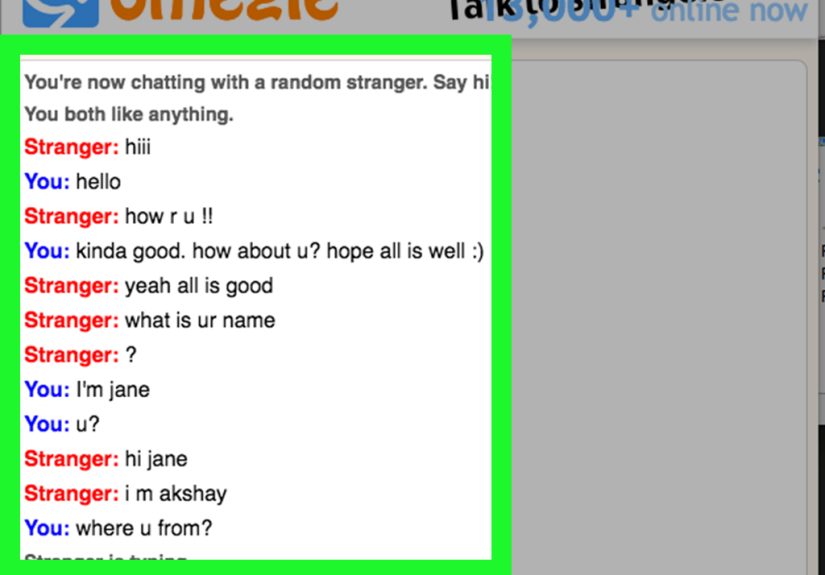
Examples of Real Conversation Flow
Weak Conversation
You: hi
Stranger: hi
You: asl
Stranger: no
Stranger has disconnected.
This conversation did not fail because the universe is cruel. It failed because nobody gave it anything interesting to work with.
Better Conversation
You: Random question: what is one thing from your country or city that outsiders should try?
Stranger: I’m from Chicago, so deep-dish pizza probably.
You: Nice. Is deep-dish actually everyday food there, or is it mostly something tourists treat like a religious experience?
Stranger: Haha mostly tourists, but it’s good once in a while.
You: That makes sense. My city has foods like that toofamous, delicious, and impossible to eat without needing a nap.
This works because it is specific, playful, and responsive. It gives the other person room to explain, joke, and ask something back.
How to Be Interesting Without Trying Too Hard
Trying too hard can make a chat feel like a performance. You do not need to be the funniest, smartest, or most mysterious person online. You just need to be present.
Use simple details. Mention a strange food combination you like. Ask about local slang. Talk about a hobby you are bad at but still enjoy. Share a small opinion, such as “movie trailers are too long now” or “breakfast food should be legal at all hours.” These small hooks are easy for people to grab.
Also, do not pretend to be someone else. Online anonymity makes it tempting to invent a cooler version of yourself. But real conversations usually become better when people are relaxed and honest in a safe way. You can be private without being fake.
Common Mistakes That Kill Omegle Conversations
Opening With Personal Questions
Asking for age, gender, location, photos, or social media right away can feel intrusive. Start with interests instead.
Turning Every Chat Into a Debate
Debates can be fun, but not everyone wants to defend their entire worldview to a stranger at 1:00 a.m. Begin with curiosity before disagreement.
Using Copy-Paste Lines
People can sense when a message is generic. A little originality goes a long way.
Ignoring Boundaries
If someone says they do not want to discuss something, move on. Respect is not optional; it is the price of admission.
Staying After the Chat Feels Wrong
You are allowed to leave. A conversation is not a contract signed in invisible internet ink.
What Omegle Taught Us About Online Conversation
Omegle was messy, unpredictable, and often unsafe. Yet it also showed that people are curious about strangers. A person in California could talk to someone in Italy. A student in Florida could compare school life with someone in Canada. A bored night could turn into a surprisingly thoughtful conversation about music, culture, loneliness, language, or dreams.
The best Omegle conversations usually had three things in common: respect, curiosity, and timing. Respect kept the chat safe. Curiosity kept it interesting. Timing kept it alive long enough to become something more than a random hello.
Those lessons still matter beyond Omegle. Whether you are chatting in a moderated community, joining a study group, playing online games, or meeting people through social platforms, the same rules apply. Ask better questions. Listen to the answer. Share safely. Leave when needed. Treat the person on the other side like a human being, not a loading screen.
500-Word Experience Section: What It Was Like Trying to Have a Real Conversation on Omegle
Trying to have an actual conversation on Omegle felt a little like fishing in a thunderstorm. You knew something might happen, but you also knew there was a decent chance the whole situation would become weird very quickly. The first challenge was patience. Many chats ended before they began. You could type a thoughtful opener, press enter, and watch the stranger disconnect like your sentence had personally offended their ancestors.
But every now and then, someone stayed. That was the strange magic of the platform. A simple question like “What is your favorite thing about where you live?” could become a ten-minute conversation about local food, school systems, weather, family traditions, or why one city’s public transportation was apparently designed by a confused raccoon. The randomness made ordinary topics feel fresh because the other person brought a completely different background.
One useful experience was learning that humor worked best when it was gentle. Self-deprecating jokes, playful observations, and silly “would you rather” questions often performed better than edgy humor. Since strangers had no context for your personality, sarcasm could easily come across as rude. A line like “I’m conducting very serious research into whether pineapple belongs on pizza” was safer and more inviting than starting with a controversial rant.
Another lesson was that people opened up when they felt unjudged. Some users wanted to talk about school stress, boredom, music, cultural differences, or feeling lonely. You did not need to become their therapist. In fact, you should not try to carry heavy emotional situations alone. But you could listen kindly, respond with empathy, and suggest talking to someone trusted if the topic became serious. Even brief conversations can feel meaningful when someone is respectful.
The best chats often happened when both people accepted the temporary nature of the interaction. There was no pressure to become lifelong friends. That made honesty easier in some ways. People shared favorite songs, unpopular opinions, travel dreams, or funny mistakes because the chat felt like a small window rather than a permanent stage. Still, privacy mattered. The smartest users kept personal details vague and never treated a friendly stranger as automatically trustworthy.
There were also many reminders that leaving is a skill. Some conversations turned inappropriate, repetitive, or uncomfortable. The healthiest response was not to argue, fix, or investigate. It was to leave. Online safety often depends on quick exits. A person who respects you will respect a boundary. A person who does not respect a boundary does not deserve more access to you.
In the end, the real experience of Omegle was not just about random chatting. It was a crash course in digital communication. You learned how fast first impressions form, how powerful a good question can be, how awkward silence feels in text, and how important boundaries are when anonymity removes normal social guardrails. Omegle is gone, but the skill remains useful: talk to people with curiosity, protect your privacy, and remember that even a short conversation can be human when both sides choose to make it that way.
Conclusion
Having an actual conversation on Omegle was never about finding the perfect stranger. It was about becoming a better conversationalist in an imperfect environment. A strong opener, specific interests, thoughtful questions, active listening, balanced sharing, privacy awareness, and polite exits could turn a random chat into something surprisingly real.
The original Omegle is no longer active, and its shutdown is an important reminder that online connection must be paired with safety. Random chat can feel exciting, but it also comes with real risks, especially for younger users. The best approach is to prioritize privacy, avoid unmoderated spaces if you are under 18, and never ignore discomfort just to keep a conversation going.
If there is one lesson worth keeping, it is this: real conversation begins when you stop treating the other person as random. Ask something better. Listen a little longer. Share carefully. Leave when necessary. That is how a chat becomes more than noise.