Table of Contents >> Show >> Hide
- What Is the “Nancy Meyers Home Look,” Really?
- Start With the Bones: Light, Architecture, and “Good Editing”
- Nail the Palette: Creamy Neutrals, Warm Woods, and “Quiet” Color
- Furniture: Comfort First, Always
- Texture Is the Secret Sauce: Linen, Wool, Wicker, Wood
- Lighting: Turn Off the “Big Light” and Let Lamps Do Their Job
- The Kitchen: The Unofficial Main Character
- Styling: Curated Abundance (Not Minimalism, Not Chaos)
- Don’t Forget the “Lifestyle Layer”
- A Practical Roadmap: How Designers Would Do This in 30 Days
- Common Mistakes That Kill the Vibe (Gently, Like a Bad Third Date)
- Final Takeaway: It’s About Warmth, Not Perfection
- Real-Life Experiences: What It’s Like to Actually Try the Nancy Meyers Look (500-ish Words)
You know the moment: someone pads into a sun-drenched kitchen, pours coffee like they have nowhere to be,
and somehow the counter is both perfect and casually lived-in. There are flowers in a vase,
a bowl of lemons (not one sad lemon, all of them thriving), and a chair that looks so comfortable it should come
with a warning label: “May cause spontaneous life reflection.”
That’s the Nancy Meyers home lookan interior vibe so cozy and aspirational it makes people want to fold linen napkins
for fun. The good news: you don’t need a movie budget (or a Hamptons zip code) to get the feel. You just need the right
mix of timeless basics, warm light, and the kind of “effortless” styling thatplot twisttakes a little intention.
What Is the “Nancy Meyers Home Look,” Really?
Designers often describe the Nancy Meyers aesthetic as lived-in luxury: traditional and familiar, but never stuffy.
Think soft neutrals, warm wood, layered textures, and rooms that prioritize comfort
without looking like you gave up. It’s a style that feels collected over timelike you’ve been an interesting adult for years,
even if you bought your first “real” table last Tuesday.
It’s also a feeling as much as a look: welcoming, sunny, and calm. These homes are built for conversation, cooking,
reading, and gatheringless “museum tour,” more “come in, I’m making something that smells amazing.”
Start With the Bones: Light, Architecture, and “Good Editing”
Prioritize natural light (or fake it like a professional)
Nancy Meyers sets are bright for a reason: light makes everything feel cleaner, bigger, and more expensive.
If you’re blessed with big windows, lean inkeep treatments airy (think linen panels, woven shades, or simple romans).
If your windows are… emotionally small, add mirrors opposite them and choose lighter wall colors to bounce what you have.
Add subtle architectural detail
The look loves classic structure: trim, crown molding, paneled doors, built-ins, and cabinets that feel permanent.
If you can’t renovate, you can still “cheat” with picture-frame molding, upgraded baseboards, or even a well-placed bookcase
that reads as built-in once you paint it to match the wall.
One designer trick: repeat details across roomssame paint finish, similar hardware tones, consistent trim color.
It creates that continuous, film-set cohesiveness without screaming, “I made a mood board and now I’m unstoppable.”
Nail the Palette: Creamy Neutrals, Warm Woods, and “Quiet” Color
The signature base is rarely stark white. Instead, it’s warm whites, soft ivories,
sand, taupe, and gentle grays that feel friendly under lamplight. Then come the wood tones:
medium oak, walnut, or antique finishes that add depth so the room doesn’t float away like a marshmallow.
Where the color goes
Color shows up like a supporting actor who steals every scene: blue-and-white ceramics, faded vintage rugs, muted greens,
dusty blues, soft stripes, and florals that feel sun-washed rather than shouty. A pop of blue is practically part of the
casting call.
If you’re nervous, stick to one “hero color” (say, soft blue) and repeat it 5–7 times in small wayspillow, art,
a bowl, a book spine, a throw, a vase. That repetition reads intentional, not accidental.
Furniture: Comfort First, Always
The sofa test (aka: would Diane Keaton nap here?)
Nancy Meyers seating is generously scaled. Deep sofas, plush cushions, chairs you can curl up in, and ottomans that say,
“Yes, put your feet up. This is a safe space.” The silhouette tends to be classicroll arms, skirted bases, and slipcovers
but the comfort is the point.
Mix “polished” with “relaxed”
A key designer move is pairing tailored pieces with casual textures. Example:
a traditional sofa + a chunky knit throw; a structured dining table + woven chairs; a refined sideboard + a basket underneath.
This contrast keeps the room from feeling too formalor too “I only shop in the aisle labeled BEIGE.”
Buy fewer, better anchorsand go high/low everywhere else
Spend where you touch: sofa, mattress, dining chairs, rugs. Save on accent tables, baskets, throws, and decorative objects.
The Nancy Meyers look reads expensive because the foundations look quality, even when the accessories are thrifted,
swapped, or slowly collected.
Texture Is the Secret Sauce: Linen, Wool, Wicker, Wood
If the palette is quiet, texture does the talking. Think linen drapes, cotton slipcovers, wool rugs, woven baskets,
natural stone, and warm woods. The goal is “touchable”a home you can live in, not just photograph.
Designers love a few signature textures for this look:
- Linen (napkins, shades, slipcovers, beddingwrinkles allowed)
- Woven elements (rattan, rush, wicker, seagrassespecially in coastal-adjacent rooms)
- Natural stone (marble, soapstone, quartziteused thoughtfully)
- Warm metals (aged brass, unlacquered finishes, a little copper in the kitchen)
Lighting: Turn Off the “Big Light” and Let Lamps Do Their Job
Want the fastest Nancy Meyers upgrade? Stop relying on overhead lighting. This style is built on a warm glow:
table lamps, floor lamps, sconces, and pendants used like jewelrynot interrogation.
Aim for at least three light sources per room (more in large spaces). Use warm bulbs,
add dimmers if you can, and choose shades that soften the light (linen shades are especially on-theme).
This is how rooms feel cozy at 7 p.m. instead of looking like a waiting room at 7 a.m.
The Kitchen: The Unofficial Main Character
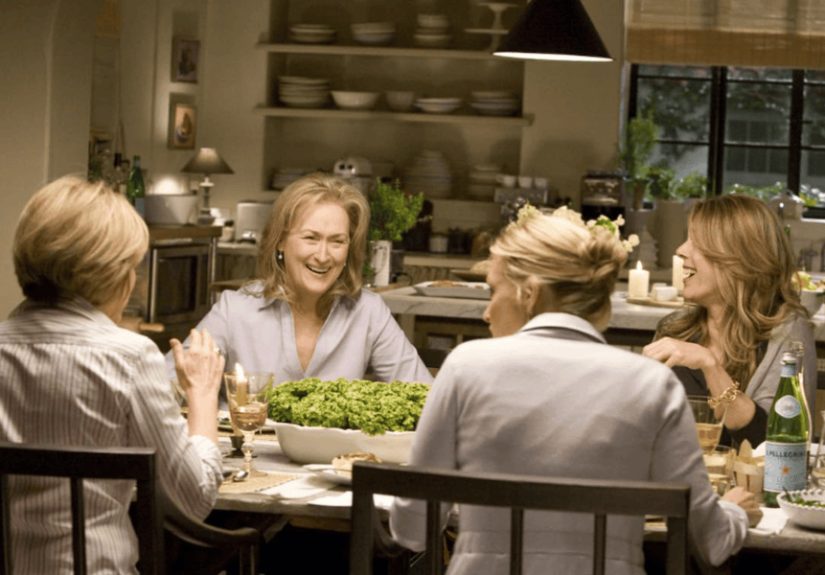
If Nancy Meyers homes had IMDb pages, the kitchen would have top billing. The “Nancy Meyers kitchen” tends to be:
bright, spacious, functional, and filled with lifeopen shelves, herbs, bowls, cookbooks, and a layout that encourages
people to linger.
Classic elements that show up again and again
- A generous island (room for prep, chatting, and dramatic leaning)
- Pendant lights that feel substantial but not trendy
- A farmhouse or apron-front sink (or at least a deep, practical sink)
- Open shelving mixed with closed storage (so the “pretty” stuff gets airtime)
- Something green (herbs, plants, flowersalive, not plastic-perfect)
Make it look lived-in (without making it a mess)
The magic is “real life, but edited.” Keep a wooden cutting board out. Lean a cookbook. Put fruit in a bowl.
Hang a few copper or stainless tools you actually use. The trick is to avoid clutter that looks accidental:
corral small items on trays, use baskets for paper goods, and let surfaces breathe.
A pro move borrowed from film-set logic: create little vignettescoffee station, baking corner,
herb zone by the window. It makes the kitchen feel like it’s always mid-story.
Styling: Curated Abundance (Not Minimalism, Not Chaos)
Nancy Meyers rooms aren’t empty. They’re layered with books, art, ceramics, throws, and personal objects.
But they’re also not chaotic. Think “collected,” not “clearance aisle explosion.”
Books everywhere (like you read, even if you mostly inhale subtitles)
Coffee-table books, cookbooks on open shelves, novels by the bedbooks add color, texture, and that lived-in intelligence.
Stack them, stand them, mix vertical and horizontal. Add one object on top (a small bowl, a candle, a mini lamp) and stop there.
Fresh flowers are basically a design requirement
If you do nothing else, add flowers. Hydrangeas, tulips, grocery-store roseswhatever’s in season.
The point is that “someone lives here and cares.” If real flowers aren’t realistic, a high-quality faux arrangement
can still deliver the vibe.
Rugs that soften everything
A classic move is anchoring rooms with natural-fiber rugs (like sisal) or vintage-style rugs with gentle pattern.
The rug is often the quiet workhorse that makes wood floors feel warmer and furniture feel grounded.
Don’t Forget the “Lifestyle Layer”
The Nancy Meyers home look isn’t just decorit’s the sense that life is happening beautifully inside the space.
That means a few small rituals:
- A candle that smells like “clean, but expensive.”
- A throw within reach of every seat (yes, every seat).
- A bowl for keys that prevents the daily scavenger hunt.
- Background music that says “I host brunch,” not “I rage at 2 a.m.”
In other words: your home should look ready for company, but also ready for you to flop onto the sofa with a snack and zero guilt.
A Practical Roadmap: How Designers Would Do This in 30 Days
Week 1: Base layer
- Paint one key space a warm neutral (or refresh trim for crispness).
- Swap harsh bulbs for warm ones; add at least one lamp.
- Declutter surfaces, then add back only what you love and use.
Week 2: Comfort upgrades
- Add a plush throw and two textured pillows to your main seating.
- Upgrade bedding: cotton percale or linen-feel sheets, a quilt, and one “hotel” pillow situation.
- Introduce a rug (or layer one) to soften the room.
Week 3: The “collected” factor
- Thrift one vintage piece (mirror, side table, pottery, framed art).
- Add books in at least two rooms (stack or shelf them intentionally).
- Choose one signature material to repeat (rattan, brass, linen, or wood).
Week 4: Kitchen + finishing touches
- Create one styled-but-useful countertop vignette (tray + grinder + oil + herb).
- Add fresh flowers, a fruit bowl, and a linen towel that looks like it belongs in a movie.
- Hang art or add a mirror where the room feels “blank.”
Common Mistakes That Kill the Vibe (Gently, Like a Bad Third Date)
- Going too trendy: The look is timeless; avoid ultra-specific fad pieces as your “anchors.”
- Too much beige with no texture: Neutrals need contrastwood, pattern, weave, and age.
- Over-styling: Leave space for real life. One perfect vignette beats five cluttered ones.
- Cold lighting: If your room looks like a dentist’s office, it’s not Nancy Meyers. Add warmth.
- Matchy-matchy sets: Mix old + new. Slight imperfection is the charm.
Final Takeaway: It’s About Warmth, Not Perfection
The most “Nancy Meyers” thing you can do is create a home that feels like an exhale. Prioritize comfort.
Choose classic shapes. Layer texture. Add light. Keep a few beautiful, useful things out where life happens
and edit the rest.
Because the real goal isn’t to recreate a movie set. It’s to make your own space feel like the place everyone
wants to land: cozy, inviting, and quietly (but clearly) well-loved.
Real-Life Experiences: What It’s Like to Actually Try the Nancy Meyers Look (500-ish Words)
Here’s what designers don’t always say out loud: the Nancy Meyers home look is less about buying “the right stuff”
and more about changing how you live in your space. The first time you try it, the biggest surprise is that
you’ll start making decisions based on feel instead of “does this photograph well?”
For example, people often begin with a sofa. They’ll sit on a few and realize the Nancy Meyers version is never the stiff,
showroom-perfect one. It’s the sofa you sink intodeep enough to tuck your feet under, supportive enough to read for an hour,
and forgiving enough that a throw blanket can cover yesterday’s snack choices. Once you pick comfort as the priority, the rest
of the room starts aligning around that decision. Your coffee table needs to be within reach. Your lighting needs to be softer.
Your rug needs to feel good under bare feet. Suddenly your room becomes a place you want to spend time, not just pass through.
Another real-life shift: you learn the difference between “clutter” and “life.” Nancy Meyers interiors often include objects on
surfacesbooks, a bowl, a tray, a vase. When people try to copy that, they sometimes add everything at once and the room starts
feeling busy. The experience that works best is slower. You put one tray down by the door and realize it solves a daily problem
(keys stop migrating like they’re on a gap year). You add a basket near the sofa and suddenly the living room doesn’t look messy
it looks ready. Over time you build a little system: the pretty things are also the practical things.
The kitchen is where the “movie magic” becomes most real. When you keep a fruit bowl out, you snack differently. When you have
a small herb plant by the window, you’re more likely to toss basil into pasta. When you swap harsh overhead lighting for a lamp
on the counter, the kitchen stops feeling like a workstation and starts feeling like a place where people linger. Even if your
kitchen is small, that cozy glow changes the whole moodlike your home is giving you a tiny standing ovation for making toast.
The funniest part? Once you get the look even halfway right, people respond to it. Guests tend to sit longer. Conversations
stretch out. Someone will eventually say, “Your house feels so cozy,” and you’ll act casual while internally accepting your
imaginary set-design award. That’s the real Nancy Meyers effect: not perfection, not luxury, but a space that makes everyday
life feel a little more romantic-comedy adjacent.