Table of Contents >> Show >> Hide
- Meet Ilan Ben Yehuda: The Eye Behind the Lens
- Why Street Life in Israel Is So Visually Captivating
- Inside the 42 Captivating Images
- What Ilan’s Photos Reveal About Everyday Life in Israel
- How to Experience Street Life in Israel Yourself
- Street Photography Tips Inspired by Ilan Ben Yehuda
- Final Thoughts: Why These 42 Images Stick With You
- Personal Reflections: Walking Through Ilan’s Israel
Some cities whisper. Israel’s streets do the opposite—they talk with their hands, shout in three languages at once, and absolutely insist you stay for one more coffee. Street photographer Ilan Ben Yehuda has spent years wandering those streets with a camera, turning everyday chaos into 42 striking images that landed on Bored Panda and grabbed the internet’s attention. His photos don’t feel like postcards; they feel like you accidentally stepped right into the frame with him.
From Tel Aviv’s sun-drenched boulevards to Jerusalem’s crowded markets, these shots capture a mix of humor, intensity, color, and tiny, human moments that most of us would miss while fumbling with our phones. In this article, we’ll dive into who Ilan is, what makes Israeli street life so visually electric, what themes run through his 42 images, and how you can experience this energy yourself—with or without a camera.
Meet Ilan Ben Yehuda: The Eye Behind the Lens
Ilan Ben Yehuda is a street photographer from Ramat Gan, just outside Tel Aviv. By day, he works in graphic design for the fashion industry; by passion, he’s the person loitering on the corner with a camera, waiting for something interesting to collide with something unexpected. He studied black-and-white film photography decades ago at Camera Obscura in Tel Aviv and later transitioned to digital, but his images still feel very cinematic—like single frames cut from a movie you’d actually want to watch.
His style leans toward bold contrasts and strong visual geometry. People are often placed in unusual compositions—half out of frame, dwarfed by a wall, or caught mid-motion. He’s especially drawn to scenes that mix tradition with modern life: ultra-Orthodox Jewish communities framed against billboards, markets where ancient rituals meet supermarket packaging, and seafront promenades where classic holiday vibes clash with urban grit.
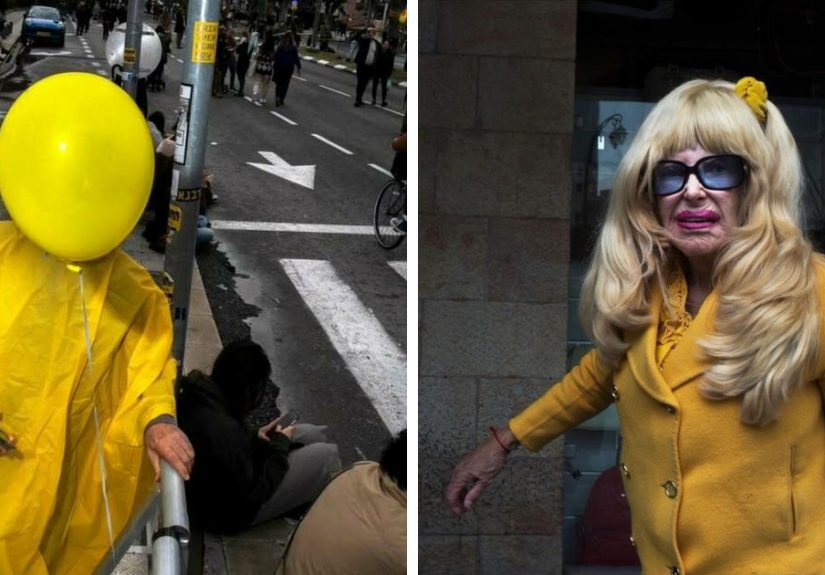
What keeps his work from feeling heavy or staged is his sense of humor. A yellow balloon hovering exactly over a person’s head, a surprising reflection in a car window, or a stranger mid-bite into a stuffed pita—these moments show that Ilan isn’t just documenting; he’s quietly winking at you through the viewfinder.
Why Street Life in Israel Is So Visually Captivating
To understand why these 42 images hit so hard, you need to understand the playground Ilan works in. Israel’s streets are dense with contrasts: old and new, secular and religious, beachwear and black coats, Hebrew signs and English menus. For a street photographer, it’s like having several different cities stacked on top of each other.
Markets That Never Quite Calm Down
Markets like Tel Aviv’s Carmel Market and Jerusalem’s Mahane Yehuda might technically have opening hours, but in practice, they feel like living organisms that inhale and exhale people all day long. Stands overflow with tomatoes, spices, candies, and pastries. Vendors shout prices over the noise. Visitors weave through with coffee in one hand and a bag of produce in the other.
Ilan’s photos often grab one slice of this chaos: a vendor leaning just-so beneath a burst of citrus color, or a customer frozen in pure joy mid-bite of street food. Instead of pulling back for a wide scene, he pushes in close enough that you can almost smell the falafel.
Beaches, Boulevards, and Late-Night Cafes
Tel Aviv is famous for its beaches and its nightlife, and those two things blur together on its seaside promenades. In one direction, you have joggers and cyclists on the boardwalk; in the other, people in evening wear heading to bars and clubs. Cafes along streets like Rothschild Boulevard spill onto the sidewalks, turning the city into one long open-air living room.
This is prime Ilan territory: silhouettes against the setting Mediterranean sun, a couple sharing an ice cream while traffic streaks behind them, friends laughing around a tiny café table with chairs that look like they were borrowed from someone’s kitchen. The scenes are warm but not sentimental—it’s not the “perfect” Instagram sunset; it’s someone’s actual Tuesday evening.
Between Ancient Alleys and Modern Glass
Then there’s the contrast between places like Old Jaffa and modern Tel Aviv. In Jaffa, narrow lanes and stone archways create dramatic light and shadow, while flea markets spill out with antiques, fabrics, and oddities. Just a short walk away, towers of steel and glass rise over high-end shops and tech offices.
Ilan’s images reflect that collision of eras. You might see a person in traditional dress walking past a minimalist storefront or a neon sign glowing above centuries-old stone. It’s visually jarring in the best way—and that tension is what gives the images so much depth.
Inside the 42 Captivating Images
Bored Panda’s feature brings together 42 of Ilan’s photographs into a single narrative about everyday life in Israel. You don’t have to read Hebrew or know the geography of each neighborhood to feel what’s going on; the photos operate on a universal level: people trying to get somewhere, buy something, talk to someone, or just exist in peace.
Bold Color and Strong Shadows
One of the first things you notice in Ilan’s work is the color: neon greens and yellows from posters and safety vests, deep blues of the Mediterranean sky, warm oranges of late-afternoon light. He often lets a single, strong color dominate the frame, using shadows to carve out shapes and create graphic tension.
These colors aren’t just decorative; they guide your eye to the tiny human detail that matters—a hand gripping a railing, a bag of groceries swinging mid-step, a face caught between laughter and concentration. The result is a visual style that feels both chaotic and carefully composed.
Humor Hidden in Plain Sight
Many of Ilan’s images feel like visual jokes that you “get” a second after you see them. A balloon lines up perfectly with someone’s head. A person’s pose accidentally mirrors a nearby ad. A stranger’s expression seems to respond to text on a wall behind them. This isn’t mean-spirited humor; it’s the gentle comedy of everyday life when you happen to look up at exactly the right moment.
That sense of playfulness is very Bored Panda-friendly: it makes the images instantly shareable while still being artistically rich. You’re not just scrolling past pretty scenery; you’re being invited into a small, unscripted story.
Quiet Moments in a Loud Environment
Despite all the noise and color, some of the most powerful photographs are surprisingly quiet. A man eating his sandwich alone in a dark corner of the market. A child staring curiously at something just out of frame. A figure leaning on a wall, lost in thought, while the city rushes by around them.
These images remind you that every “busy” street scene is made of individual people, each carrying their own stories, worries, and joys. The camera pauses those stories just long enough for us to notice them.
What Ilan’s Photos Reveal About Everyday Life in Israel
Taken together, the 42 images function like a visual essay about contemporary life in Israel. They’re not a tourism brochure or a political statement; they’re a layered portrait of a place where many cultures, histories, and lifestyles cross paths every single day.
- Diversity is visible everywhere. You see different styles of dress, different ages, different communities, all sharing the same sidewalks and buses.
- Public space really matters. Cafes, parks, promenades, and markets aren’t just background decorations; they’re where life actually happens.
- Tradition and modernity coexist. You might spot ancient religious customs happening across the street from a trendy brunch spot or street art mural.
The emotional tone across the series is surprisingly grounded. Yes, the streets are intense and crowded, but there’s also warmth, familiarity, and routine. People joke with friends, browse produce, wait for the bus, sip espresso, scroll their phones, and occasionally notice the guy with the camera—and then keep walking anyway.
How to Experience Street Life in Israel Yourself
You don’t have to be a professional photographer to appreciate what Ilan captures. If you ever find yourself in Israel, you can step into similar scenes simply by choosing to walk instead of ride and to look instead of scroll.
- Wander the markets. Visit Carmel Market in Tel Aviv or Mahane Yehuda in Jerusalem. Go at different times of day—morning deliveries, afternoon shoppers, evening bars—to feel how the mood changes.
- Walk the promenades. Stroll the Tel Aviv beachfront near sunset, when joggers, dog walkers, skateboarders, and families all share the same strip of pavement.
- Get lost in older neighborhoods. Explore the alleys of Old Jaffa or Jerusalem’s older quarters, where textures, shadows, and small architectural details can be as interesting as people.
- Take your time at a café. Sit outside, order coffee or fresh juice, and just watch. Think of it as a live-action version of Bored Panda—only you’re the one curating the feed.
The key is to slow down enough to notice tiny interactions: a hand on someone’s shoulder, a kid chasing pigeons, a vendor arranging produce for the third time “because this way it looks better.”
Street Photography Tips Inspired by Ilan Ben Yehuda
If Ilan’s images make you want to pick up a camera (or just use your phone more intentionally), here are a few takeaways from his approach:
- Chase light, not gear. His work proves that timing and light matter more than owning the most expensive camera. Early morning and late afternoon give you dramatic shadows and rich color.
- Work the scene. If you find an interesting corner, sign, or background, stick around. People will walk through and eventually something unexpected will happen.
- Look for visual echoes. Similar shapes, colors, or gestures that repeat across the frame create strong compositions—like a row of hats or a line of windows mirroring people’s poses.
- Stay respectful. Ilan’s images feel observational rather than intrusive. He records life as it happens, without mocking or exploiting his subjects.
- Embrace imperfection. A slightly blurred limb, a cropped head, or a shadow cutting across the scene can add energy and mystery.
Final Thoughts: Why These 42 Images Stick With You
There’s a reason a series like Street Life In Israel: 42 Captivating Images Taken By Ilan Ben Yehuda resonates so strongly with online audiences. Yes, the colors are beautiful and the compositions are clever, but at the heart of it, the photos feel honest. They don’t try to smooth out the rough edges of urban life; they celebrate them.
When you scroll through the series, you don’t just think, “I want to go there.” You think, “I’ve felt that. I know what it’s like to be lost in a crowd, or to savor a snack, or to pause in the middle of a busy day.” The details are local, but the emotions are universal—which is exactly why street photography, and Ilan’s work in particular, feels so powerful.
Personal Reflections: Walking Through Ilan’s Israel
Imagine spending a day in Israel with Ilan as your unofficial tour guide, camera in hand. You don’t start with a checklist of “top attractions.” You start with a question: “What’s happening on the street right now?” From there, the city writes the itinerary for you.
Morning begins in a quiet residential neighborhood where balconies drip with laundry and potted plants. Someone waters a row of geraniums in a plastic robe and slippers. A cat naps in a spot of sunlight on a car hood. It’s nothing dramatic, but it’s already a photograph waiting to happen. Ilan might frame the shot so that the cat is sharp and the background soft, inviting you to notice how even the calm corners of the city hum with small rituals.
By mid-morning, you’ve reached the market. The air changes first—suddenly it’s full of spices, coffee, and fresh bread. A vendor slaps dough onto a hot surface while another slices halva into crumbly blocks. People jostle, apologize, negotiate, and sample. You watch Ilan hover by a beam of light streaming between awnings, raising his camera only when a figure steps into that glow with just the right expression. It feels like magic, but it’s really patience and practice.
In the afternoon, you move toward the seafront. The sun is harsher now, casting crisp shadows. Cyclists zip past toddlers on scooters. Friends sprawl on benches scrolling their phones. A lone fisherman leans over the railing, half in silhouette. Ilan might crouch low, lining up the horizon so the fisherman’s figure cuts across the frame like a question mark. You realize how much of street photography is about being comfortable with waiting and noticing, rather than chasing.
Evening arrives in a different neighborhood altogether—maybe Jaffa, with its older stone alleys and glowing windows. Here, the city feels slower but denser, as if every doorway hides a story that’s decades long. A couple walks past speaking softly, their conversation lost in the sound of clinking dishes from a nearby restaurant. A shopkeeper adjusts a display of vintage lamps that throw out warm pools of light. If Ilan lifts his camera now, the resulting image would be less about drama and more about atmosphere, a quiet exhale at the end of a vibrant day.
By the time you scroll back through those imagined photos on your screen, you understand something important about Ilan’s 42 images: they aren’t “lucky shots.” They’re the product of curiosity, respect, and countless hours spent paying attention to the world in front of him. Street life in Israel, as he shows it, is loud and colorful, yes—but it’s also delicate, layered, and deeply human.
And that might be the biggest lesson his work offers all of us, whether we’re photographers or just people speed-walking through our own cities: slow down, look up, and treat each intersection like a stage where something meaningful might happen. Because very often, it already is.